Precision Cabling Underpins Performance in Modern Digital Infrastructure
In the race to build faster, smarter, and more resilient infrastructure, attention often gravitates towards high-profile technologies such as cloud computing, artificial intelligence, and edge processing. Yet beneath these layers of innovation lies a far more fundamental component that quietly determines whether systems perform as intended: structured cabling. In server rooms, commercial offices, transport hubs, and industrial facilities, the physical integrity and precision of network cabling continue to dictate performance outcomes.
Cable length measurement is not merely a technical detail but a decisive factor in infrastructure reliability. Accurate length determination influences signal integrity, ensures compliance with international standards, and directly affects project cost control. As infrastructure projects scale in size and complexity, even small inaccuracies in cable planning can cascade into operational inefficiencies, network instability, and avoidable financial waste.
From hyperscale data centres to regional transport control systems, the margin for error is shrinking. Digital infrastructure is now expected to support real-time analytics, automation, and mission-critical communications. That expectation places renewed emphasis on the physical layer of networks, where precision is no longer optional but essential.
Briefing
- Accurate cable length measurement is essential to maintaining signal integrity and network reliability
- Industry standards such as ISO/IEC 11801 impose strict limits on structured cabling distances
- Overestimating or underestimating cable lengths can significantly increase project costs and reduce performance
- Time Domain Reflectometry is widely used as a reliable method for measuring cable lengths and identifying faults
- Tools such as the PCE-CLT 10 support compliance, efficiency, and accurate installation planning
The Hidden Constraints of Signal Transmission
Digital infrastructure depends on the consistent transmission of signals across physical media, most commonly copper or fibre cabling. While advances in networking hardware have dramatically increased data throughput, the fundamental physics of signal transmission remain unchanged. Electrical signals degrade over distance, encountering resistance, attenuation, and interference that can compromise performance if not carefully managed.
Standards such as ISO/IEC 11801 define strict parameters to mitigate these risks. For example, in structured copper cabling systems such as Category 6a or Category 7, the maximum length of a permanent link is typically limited to 90 metres, excluding patch cords. Exceeding this threshold increases insertion loss and crosstalk, raising the likelihood of data errors and reduced network speeds.
In practical terms, this means that every metre counts. Cable routes are rarely straight, often navigating ceilings, conduits, and containment systems. Without accurate measurement, installations can easily exceed allowable distances, leading to non-compliant systems that require costly rework. In large-scale deployments involving hundreds or thousands of connections, these errors can multiply rapidly.
Cost Efficiency Begins with Measurement Accuracy
Beyond technical performance, cable length measurement has a direct financial impact. Copper cabling remains a significant cost component in infrastructure projects, particularly in large office developments, data centres, and transport facilities. Even marginal overestimation of cable lengths can lead to substantial material waste when multiplied across an entire project.
Conversely, underestimation carries its own risks. Running short of cable during installation can delay projects, increase labour costs, and disrupt carefully planned schedules. In high-pressure environments such as data centre commissioning, where timelines are tightly controlled, such delays can have knock-on effects across multiple project phases.
Accurate measurement provides a foundation for efficient procurement and installation planning. It enables engineers to specify precisely what is required, reducing surplus materials while ensuring sufficient capacity for installation. This balance is essential for maintaining both budget discipline and project momentum.
Industry experience consistently shows that early-stage planning errors are among the most expensive to correct. By integrating precise measurement into the planning process, project teams can mitigate these risks before they materialise.
Time Domain Reflectometry as an Industry Standard
To achieve the level of accuracy required in modern infrastructure projects, measurement techniques must go beyond manual estimation. Time Domain Reflectometry, commonly referred to as TDR, has emerged as a widely adopted method for determining cable length and identifying faults within a network.
TDR operates by transmitting an electrical pulse along a cable and analysing the reflected signal. When the pulse encounters a change in impedance, such as the end of a cable or a fault, part of the signal is reflected back. By measuring the time taken for this reflection to return, the system can calculate the distance to the reflection point based on the known propagation speed of the signal within the cable.
This approach offers several advantages. It allows technicians to measure cables that are already installed, eliminating the need for physical access to both ends. It also provides diagnostic capabilities, enabling the detection of faults such as breaks, short circuits, or impedance mismatches.
The accuracy of TDR measurements depends on factors such as the Nominal Velocity of Propagation, which varies between cable types and manufacturers. As a result, modern measurement devices incorporate calibration features and cable databases to ensure reliable results across different materials.
Practical Tools Supporting Installation Precision
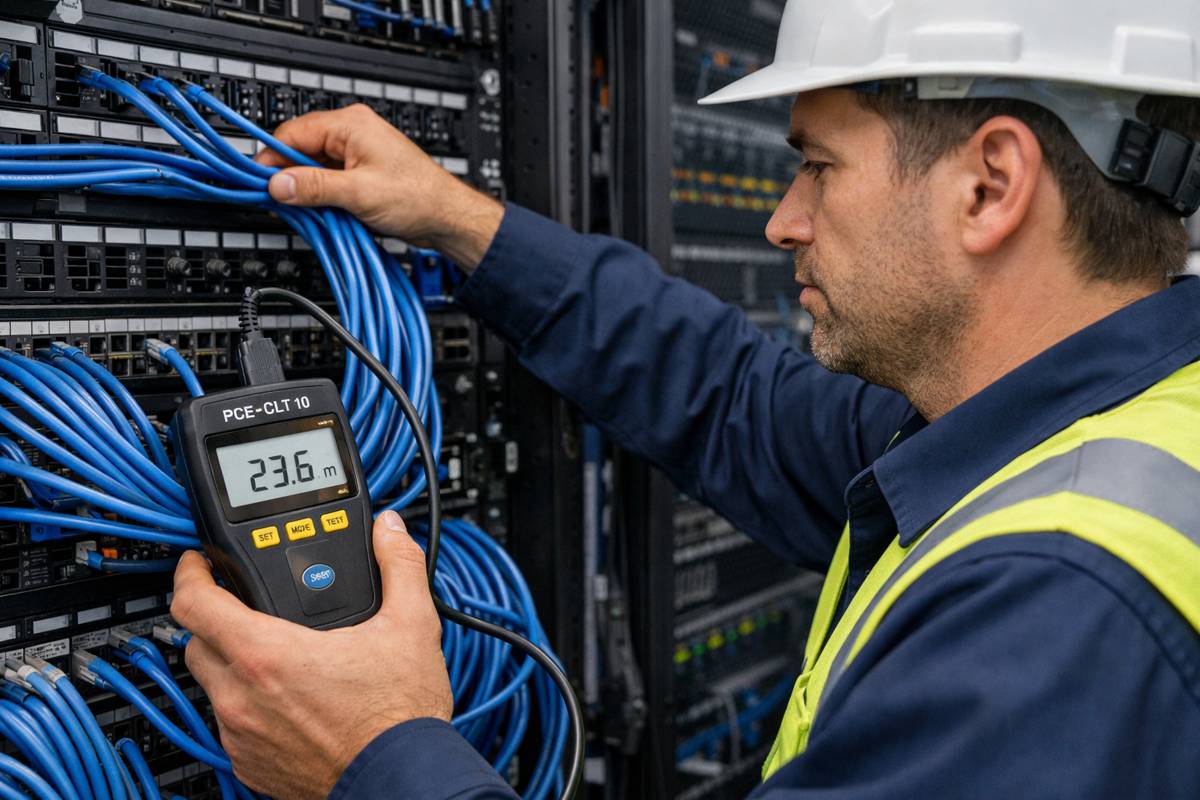
In practical applications, handheld measurement devices have become essential tools for technicians working in the field. The PCE-CLT 10 is one such device designed to support accurate cable length measurement across a variety of cable types, including network, coaxial, and power cables.
Devices of this type integrate TDR technology with user-friendly interfaces, allowing technicians to perform measurements quickly and efficiently. Preconfigured cable profiles and adjustable parameters help account for variations in cable construction, reducing the risk of measurement errors. This is particularly valuable in complex installations where multiple cable types are used.
The ability to measure cables both on the reel and after installation adds further flexibility. Before installation, technicians can verify cable lengths to ensure accurate cutting and preparation. After installation, the same device can be used to validate compliance with design specifications and identify any issues that may have arisen during routing.
In high-density environments such as server rooms, where cable management is critical, these tools contribute to orderly installations and reliable documentation. Clear records of cable lengths and routing paths support ongoing maintenance and future upgrades, reducing the likelihood of disruption.
Supporting Compliance in a Standards-Driven Industry
Compliance with international standards is a central requirement in modern infrastructure projects, particularly in sectors such as data centres, transport systems, and public infrastructure. Standards bodies such as ISO and the International Electrotechnical Commission provide frameworks that ensure interoperability, safety, and performance consistency across installations.
Accurate cable length measurement plays a key role in meeting these requirements. By ensuring that installations remain within specified limits, project teams can avoid compliance failures that may lead to certification issues or operational risks. In regulated environments, non-compliance can result in delays, additional costs, or even project rejection.
Moreover, as digital infrastructure becomes increasingly integrated with critical services such as transport management, energy distribution, and emergency response systems, the consequences of failure become more significant. Reliable cabling is not simply a matter of performance but of operational resilience.
Infrastructure at Scale Requires Discipline at Detail Level
The scale of modern infrastructure projects continues to grow, driven by urbanisation, digital transformation, and the expansion of connected technologies. Large office developments, smart cities, and industrial facilities all rely on extensive network cabling to support their operations.
At this scale, small inefficiencies can have substantial cumulative effects. A minor measurement error repeated across hundreds of cable runs can lead to significant cost overruns or performance issues. Conversely, consistent accuracy across all installations contributes to smoother project delivery and long-term reliability.
This principle extends beyond individual projects to the broader infrastructure ecosystem. As governments and private investors allocate substantial resources to digital infrastructure, the expectation is that these investments will deliver dependable performance over extended lifecycles. Achieving that outcome requires attention to detail at every stage of the project.
Building Reliable Networks from the Ground Up
While the technology landscape continues to evolve, the importance of foundational elements such as cabling remains constant. Accurate cable length measurement, supported by proven techniques such as Time Domain Reflectometry and reliable tools, provides a basis for building networks that perform as intended.
For construction professionals, engineers, and policymakers, the message is clear. Infrastructure performance begins at the physical layer, where precision and discipline determine outcomes long before software or hardware comes into play. Investing in accurate measurement and compliance processes is not an optional enhancement but a necessary step in delivering resilient, efficient, and future-ready infrastructure.