Worksport Clears Certification as Portable Energy Systems Move Into the Mainstream
The push towards decentralised energy is no longer confined to grid-scale renewables or utility-led initiatives. Increasingly, the conversation is shifting to mobile, modular systems capable of delivering reliable power wherever it is needed, from construction sites and transport corridors to remote infrastructure projects.
Now Worksport Ltd. has confirmed that its COR portable energy system has completed full certification for the North American market, marking a transition from development to commercial deployment.
While certification announcements rarely grab headlines, this milestone carries weight. In practical terms, it signals that the system has cleared a dense web of safety, transport, and compliance requirements that often delay or derail product rollouts in the energy storage sector. For contractors, fleet operators, and infrastructure developers, it also means another viable option is entering the market at a time when demand for flexible power solutions is accelerating.
The timing is far from coincidental. Grid instability, rising electrification across transport and equipment, and the increasing frequency of extreme weather events have exposed the limits of centralised energy systems. Portable and hybrid solutions are stepping in to fill the gaps, offering resilience and operational continuity without the need for permanent infrastructure.
Briefing
- Worksport has completed full North American certification for its COR portable energy system
- Certification includes UL, CSA, transport, and environmental compliance standards
- The system is designed for mobile power, emergency backup, and worksite applications
- Modular battery architecture allows scalability and flexible deployment
- Integration with solar generation supports off-grid and hybrid energy use cases
Certification as a Commercial Gatekeeper
For energy storage products, certification is not a formality. It is a prerequisite for market entry, particularly in North America, where regulatory frameworks are both rigorous and fragmented. Worksport’s COR system has now passed a suite of recognised standards, including UL 2743, UL 1741, UL 1977, UL 1778, UL 2054, and CSA 62133-2. These certifications cover everything from electrical safety and battery performance to system integration and operational reliability.
Each of these standards addresses a different layer of risk. UL 2054, for instance, focuses on household and commercial battery systems, while UL 1741 relates to inverters and distributed energy resources. CSA 62133-2 aligns with international safety requirements for portable sealed secondary cells, ensuring that the system meets both North American and global benchmarks.
Beyond product safety, the certification package also includes transport and compliance approvals such as UN38.3 for lithium battery shipping, alongside regulatory declarations covering emissions, materials, and electronic compatibility. Taken together, these approvals remove a significant barrier to distribution through major retail and commercial channels.
“Completing COR’s certification process is an important execution milestone for Worksport,” said Steven Rossi, Chief Executive Officer of Worksport. “Achieving key safety certifications, including UL and CSA standards, helps remove a critical barrier to broader market access and supports our ability to scale across retail and commercial channels. With COR and SOLIS now shipping, we believe Worksport is better positioned to advance its clean-energy growth strategy with a product platform built for practical, everyday use.”
Modular Energy for a Mobile Workforce
At its core, the COR system is built around a modular architecture centred on the COR HUB, supported by swappable battery units. This design reflects a broader shift in the energy storage sector towards flexibility and scalability, allowing users to adapt capacity based on operational needs rather than committing to fixed installations.
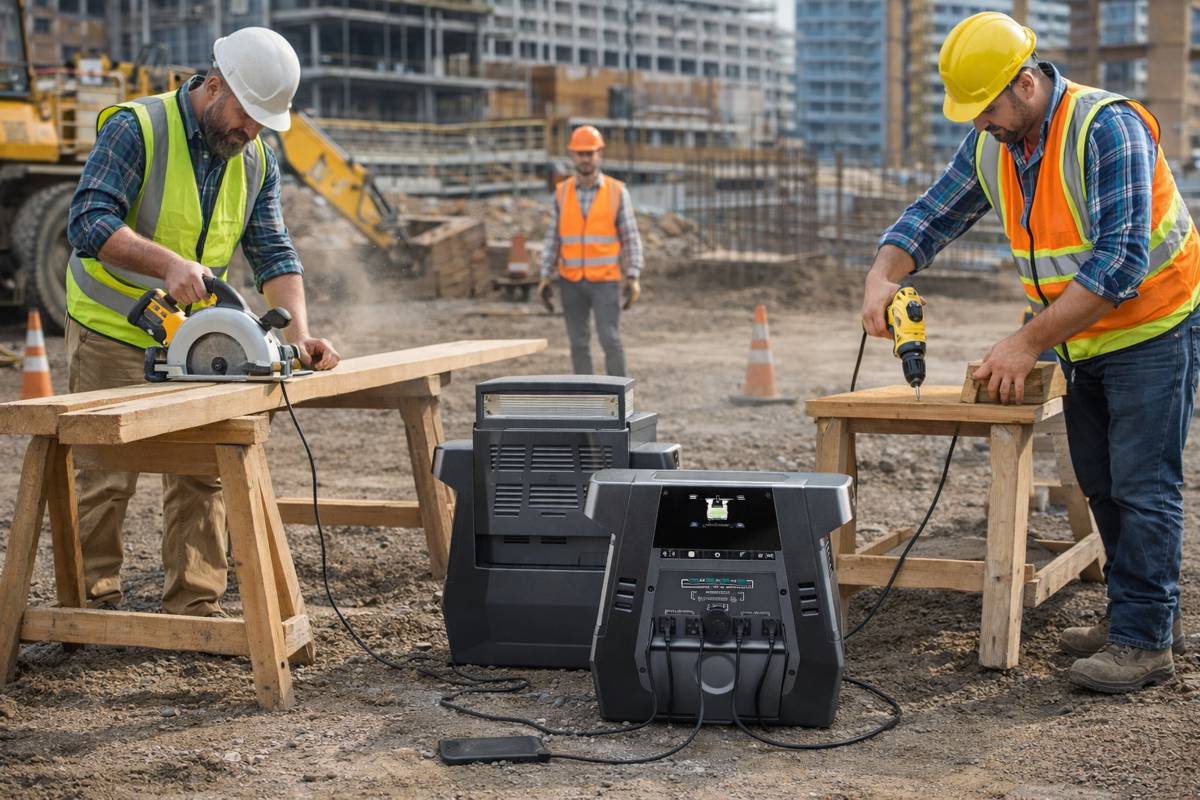
For construction and infrastructure projects, this approach has clear advantages. Temporary worksites often require reliable power for tools, lighting, communications, and increasingly, electric machinery. Traditional solutions such as diesel generators remain common, but they bring logistical challenges, emissions concerns, and rising fuel costs.
Portable battery systems offer an alternative. They can be deployed quickly, operate silently, and integrate with renewable inputs such as solar panels. In urban environments, where noise restrictions and emissions regulations are tightening, these systems are becoming particularly relevant.
The ability to swap batteries also addresses one of the key limitations of portable power, namely downtime. Instead of waiting for a unit to recharge, operators can replace depleted modules and continue working. This model mirrors developments in electric vehicle battery swapping and aligns with broader trends towards service-based energy delivery.
Integration with Solar and Hybrid Systems
A notable aspect of Worksport’s approach is the integration of its COR system with the SOLIS solar tonneau cover. Designed primarily for pickup trucks, the SOLIS system enables on-vehicle solar generation, feeding energy directly into the portable storage unit.
This combination effectively creates a mobile microgrid. Users can generate, store, and use electricity without relying on fixed infrastructure, a capability that has implications beyond recreational or consumer use. For field engineers, maintenance crews, and emergency response teams, the ability to operate independently of the grid can be critical.
The concept aligns with a growing interest in hybrid energy systems that combine storage with distributed generation. According to the International Energy Agency, decentralised and off-grid solutions are expected to play a significant role in meeting global energy demand, particularly in regions with limited grid access or ageing infrastructure.
In developed markets, the focus is shifting towards resilience. Portable systems can provide backup power during outages, support peak load management, and reduce reliance on fossil fuel generators. As electrification expands across transport and construction equipment, these use cases are likely to multiply.
Market Dynamics and Competitive Landscape
The portable energy storage market has seen rapid growth in recent years, driven by advances in lithium-ion technology, falling battery costs, and increasing consumer awareness. Companies such as EcoFlow and Bluetti have established strong positions in the consumer segment, offering compact systems for home backup and outdoor use.
However, the commercial and industrial segments remain less saturated. This is where systems like COR could find traction, particularly if they can bridge the gap between consumer-grade portability and industrial-grade reliability. Certification plays a crucial role here, as commercial buyers typically require compliance with recognised safety and performance standards before adopting new technologies.
There is also a broader shift underway in procurement strategies. Contractors and fleet operators are increasingly evaluating total cost of ownership rather than upfront costs alone. Battery systems, while often more expensive initially, can offer savings over time through reduced fuel consumption, lower maintenance requirements, and compliance with environmental regulations.
Governments are also influencing the market through policy measures. Incentives for clean energy adoption, emissions targets, and restrictions on diesel use in urban areas are all contributing to the uptake of alternative power solutions. In this context, certified, ready-to-deploy systems are well positioned to benefit.
Practical Applications Across Infrastructure Sectors
The potential applications for portable energy systems extend across multiple sectors. In road construction, they can power traffic management systems, lighting, and small machinery. On rail projects, they can support signalling equipment and temporary installations. In utilities, they provide backup for critical infrastructure and enable maintenance work in remote locations.
Emergency response is another key area. Natural disasters often disrupt grid infrastructure, leaving communities without power. Portable systems can be deployed rapidly to support relief operations, providing electricity for medical equipment, communications, and basic services.
Even within urban environments, there is a growing need for flexible power. Pop-up construction sites, temporary events, and maintenance works all require energy without the time or cost associated with grid connections. Portable systems offer a practical solution, particularly when combined with renewable generation.
From Certification to Market Reality
Clearing certification is one thing; achieving market adoption is another. The success of systems like COR will depend on a range of factors, including pricing, distribution, and real-world performance. Reliability, in particular, will be closely scrutinised, as infrastructure projects demand consistent operation under challenging conditions.
Worksport’s ability to scale production and establish distribution channels will also be critical. Certification opens the door to major retailers and commercial partners, but sustained growth requires more than regulatory approval. It demands a clear value proposition and the ability to meet customer expectations over time.
That said, the broader trajectory of the market suggests that demand for portable energy solutions is unlikely to slow. As electrification continues and the need for resilient, decentralised power grows, systems that combine mobility, scalability, and compliance will play an increasingly important role.
A Step Towards Practical Energy Independence
The completion of COR’s certification process marks a turning point for Worksport, but it also reflects a wider shift in how energy is generated, stored, and used. Portable systems are moving from niche applications into mainstream infrastructure and industrial use, driven by practical needs rather than technological novelty.
For construction professionals, investors, and policymakers, the implications are clear. Energy is no longer just a fixed asset tied to the grid. It is becoming a flexible resource that can be deployed wherever it is needed, supporting productivity, resilience, and sustainability in equal measure.
As more certified systems enter the market, the focus will shift from possibility to performance. The question will not be whether portable energy can support infrastructure projects, but how effectively it can do so at scale.