Derq to Test AI-Powered Crash Prevention at US Intersections
The US Department of Transportation (USDOT) has selected intelligent transportation technology company Derq to develop and test an AI-powered intersection safety system capable of predicting dangerous traffic conflicts and initiating preventative interventions. The company is one of three teams participating in a federal programme examining whether roadside intelligence can help prevent collisions before they occur.
The award forms part of the Intersection Safety Systems (ISS) initiative, which brings together artificial intelligence, roadside sensors, connected vehicle communications and traffic signal control. Derq will work with transport authorities, research institutions and technology partners in Texas and Virginia, initially testing its system at controlled facilities before the programme progresses towards potential public-road evaluation.
The approach extends beyond conventional traffic monitoring. Rather than identifying hazardous behaviour after it occurs, the proposed system processes live information about vehicles, pedestrians and traffic signals to anticipate conflicts. Depending on the circumstances and the available infrastructure, it could generate warnings, activate roadside signs or request changes to signal operations.
For highway authorities, the programme offers an opportunity to establish whether predictive safety technology can operate reliably within existing intersection control systems, particularly where connected and unconnected vehicles, pedestrians and cyclists share the same road space.
Briefing
- Derq is one of three teams selected for the USDOT Intersection Safety Systems initiative, alongside teams led by the University of California, Los Angeles and the University of Michigan.
- The system combines AI-based video analysis, sensor fusion, traffic signal information and vehicle-to-everything communications.
- Testing is planned at Virginia Tech Transportation Institute’s Virginia Smart Roads and Texas A&M Transportation Institute’s RELLIS Proving Grounds.
- Partners include transport authorities in Texas and Virginia, WSP USA, ITS America and AT&T.
- The federal programme provides for prototype development and testing, with a subsequent phase intended to assess systems at operational intersections.
From Detecting Hazards to Preventing Collisions
Intersections are among the most demanding environments for road safety systems. Vehicles approach from different directions, turning movements cross pedestrian routes, and the behaviour of one road user can change the risk facing several others within seconds.
Conventional traffic management equipment is generally designed to control movements through predetermined signal sequences, respond to detected traffic demand or provide information to operators. Cameras and traffic detectors can establish what is happening at a junction, but turning that information into an immediate safety intervention requires additional processing and decision-making capabilities.
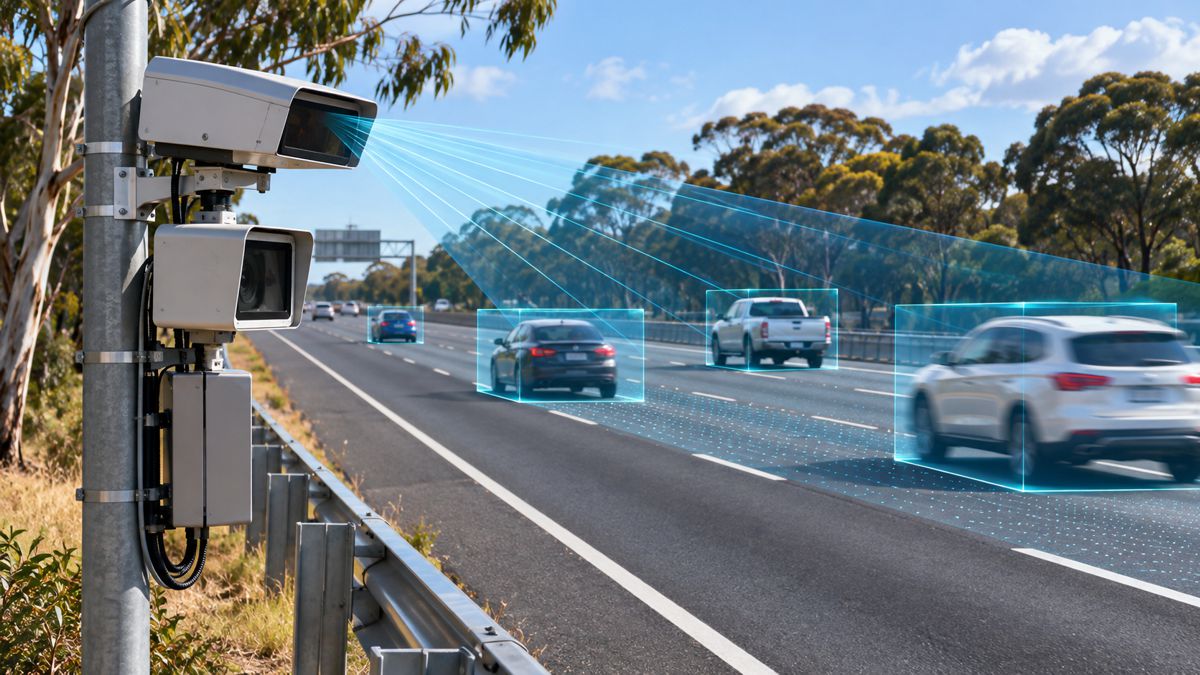
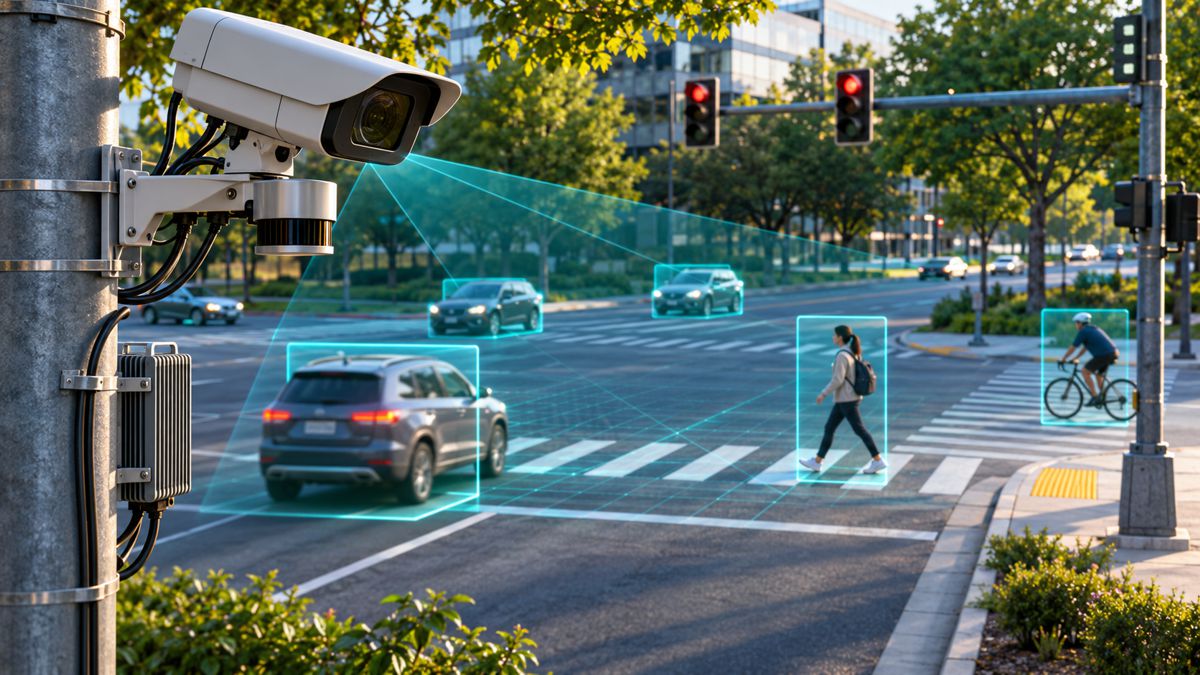
Derq’s proposed system combines real-time camera footage with other roadside sensor inputs, traffic signal status and vehicle-to-everything (V2X) messages. Its AI models analyse the movements of road users and attempt to predict situations in which their paths could conflict.
A vehicle approaching a red light without slowing sufficiently is one potential scenario. Another involves a pedestrian preparing to enter a crossing while an approaching vehicle is unlikely to stop in time. Rather than waiting for a violation or collision, the system is intended to identify the developing risk and initiate an appropriate response.
That response could involve a warning transmitted to a connected vehicle, an illuminated roadside sign or a change to traffic signal operations. The specific interventions available during testing will depend on the equipment, operating rules and control arrangements at each location.
Processing information at the roadside reduces dependence on sending every sensor feed to a remote computing platform. Local processing can support faster responses, although the effectiveness of an intervention still depends on sensor performance, prediction accuracy, communications delays and the physical time available for a driver or vehicle to react.
According to the USDOT’s technical overview, Derq’s prototype will combine video cameras with LiDAR or radar data, signal controller events and V2X messages. Its intent-classification methods are designed to anticipate red-light violations and pedestrian crossing movements, with conflict mitigation logic selecting an appropriate response.
Derq says its technology draws on a portfolio of 23 patents covering sensor fusion, road-user intent prediction, V2X warnings and real-time conflict mitigation. Founded in 2016 as a Massachusetts Institute of Technology spin-off, the company reports deployments in the United States, Canada and the Gulf Cooperation Council region.
Testing at Virginia Smart Roads and RELLIS
The initial programme will use two established transportation research facilities with different capabilities for evaluating intelligent vehicle and infrastructure technologies.
The Virginia Tech Transportation Institute operates Virginia Smart Roads, a research environment designed for controlled transportation experiments. Its facilities allow researchers to investigate vehicle behaviour, infrastructure systems and emerging mobility technologies under repeatable conditions.
In Texas, the Texas A&M Transportation Institute operates the RELLIS Proving Grounds, where researchers and technology developers can test connected and automated transportation systems away from unrestricted public traffic.
These environments provide opportunities to examine how an intersection safety system responds to deliberately created conflicts, including situations that would be unsafe or impractical to reproduce on public roads.
The USDOT has identified several questions for the research teams. They include how far in advance a conflict can be predicted, the conditions under which predictions remain reliable, and whether warnings or changes to intersection control can meaningfully reduce risk.
The federal research programme also identifies specific interventions for investigation, including delaying a pedestrian WALK indication until approaching vehicles have cleared the crossing, or restricting permissive turning movements where vehicles could conflict with pedestrians.
Such interventions require careful assessment. A warning issued too late may provide little practical benefit, while an unnecessary warning could distract a driver. An inappropriate signal intervention could disrupt other traffic movements or conflict with established signal safety requirements.
Controlled testing will allow researchers to measure these behaviours before considering wider operational deployment.
Working with State and Local Transport Authorities
Derq’s public-sector partners include the Texas Department of Transportation, the City of Houston, the Virginia Department of Transportation, and the Virginia cities of Alexandria and Falls Church.
Industry and research partners include WSP USA, the Intelligent Transportation Society of America and AT&T.
The involvement of operating road authorities gives the programme access to practical experience with intersection management, traffic signal infrastructure and the constraints associated with maintaining public highway networks.
Existing intersections vary considerably in their equipment and communications capabilities. Some already have extensive detection systems and modern traffic controllers, while others operate with relatively limited roadside technology. Introducing predictive safety functions may require additional cameras, processing equipment, communications infrastructure or modifications to traffic signal interfaces.
Integration becomes particularly demanding where an AI platform is expected to influence signal operations rather than simply provide information to traffic management personnel.
Signal controllers operate within established safety requirements, including minimum clearance intervals and safeguards against conflicting movements. Any automated intervention must work within those constraints, and the system needs a defined response when sensors, communications or processing equipment fail.
The participation of telecommunications, engineering and transport organisations should help examine how the technology can be incorporated into operational infrastructure. The programme announcement does not establish which interventions will be enabled at individual public-road sites or how responsibility for automated decisions will be allocated.
Building on the Intersection Safety Challenge
The new initiative follows the USDOT’s earlier Intersection Safety Challenge, conducted between 2023 and 2025 to encourage the development and assessment of technologies capable of improving safety at intersections.
Derq was recognised as a Tier 1 winner in Stage 1B of that programme, which evaluated concepts involving real-time sensing, sensor fusion and artificial intelligence. The USDOT announcement of the Stage 1B results provides background on the earlier evaluation.
The latest programme advances the work towards integrated prototype systems and practical testing. Phase 1 is intended to support development and assessment, while a proposed second phase would refine the prototypes and examine their performance at operational intersections.
The federal solicitation identified an estimated $5.5 million budget across up to three teams for Phase 1, with a further $11.5 million anticipated for Phase 2. The programme’s estimated total value was $17 million across both phases.
Separate federal award records identify Derq USA’s contract, awarded on 30 September 2026, at approximately $5.66 million. Contracts of similar listed values were awarded to the University of California, Los Angeles and the University of Michigan. These contract values should not be confused with the programme’s estimated initial-phase expenditure, and the available notices do not establish how much funding will be expended during each phase.
The staged approach allows technical performance to be examined before broader operational conclusions are drawn. A system that performs successfully in a controlled environment must still demonstrate that it can handle the variability of ordinary traffic, changing weather, obstructed sensor views and the behaviour of road users who do not carry connected vehicle equipment.
The Road Safety Case for Predictive Infrastructure
The United States recorded an estimated 36,640 traffic fatalities in 2025, according to preliminary figures from the National Highway Traffic Safety Administration. Although national fatality totals encompass many different crash types and road environments, intersections remain a particular concern because they concentrate crossing and turning movements involving vehicles and vulnerable road users.
According to figures cited in the federal programme documentation, approximately 18% of pedestrian traffic fatalities in 2024 occurred at intersections. The initiative is intended to examine whether infrastructure-based prediction and intervention can address some of these risks before a collision becomes unavoidable.
One attraction of roadside intelligence is that it does not necessarily require every vehicle to carry advanced driver assistance equipment or V2X communications. Cameras and other infrastructure sensors can observe road users independently of their onboard technology, although the range of available interventions will depend on the equipment present.
A connected vehicle may be able to receive a direct warning, while a conventional vehicle might only be reached through roadside signs or changes in traffic signal operation. Pedestrians and cyclists introduce further variations in detection, prediction and response.
The effectiveness of these approaches will need to be assessed against appropriate safety outcomes. Correctly detecting a potential conflict is a useful technical result, but it is not equivalent to demonstrating that crashes have been prevented.
Researchers can examine surrogate safety measures such as time-to-collision, post-encroachment time and changes in vehicle behaviour. Longer-term operational evidence may be needed to establish effects on actual collision rates.
From Research Prototypes to Operational Traffic Systems
Derq’s selection provides another opportunity to test whether artificial intelligence can become part of the active safety infrastructure at road intersections.
“Most systems today tell you what happened. Ours also predicts what’s about to happen and acts on it,” said Dr Georges Aoude, co-founder and CEO of Derq.
The company believes its existing deployments and experience with predictive road safety technology provide a foundation for developing systems capable of intervening directly in traffic operations. Its participation in the federal programme will subject those capabilities to further structured testing.
The research brings together technologies already familiar individually to transport engineers: traffic detection, machine vision, communications networks, signal controllers and roadside computing. Combining them into a dependable system capable of making safety-related decisions within the short intervals available at a busy junction is a more demanding engineering task.
Commercial deployment would also require highway authorities to consider maintenance, cybersecurity, equipment compatibility, system performance monitoring and the long-term costs of operating additional roadside technology.
The next stage will establish how well those predictions translate into interventions under controlled conditions, before the technology faces the less predictable environment of public intersections. Detecting a developing conflict is one engineering problem. Intervening safely, consistently and quickly enough to prevent a collision is another.
Key Industry Questions
- What is the USDOT Intersection Safety Systems initiative? It is a federal programme intended to develop and evaluate technologies that detect, predict and mitigate dangerous interactions between road users at intersections.
- How does Derq’s intersection safety technology work? The system combines cameras, LiDAR or radar, traffic signal information and V2X messages. AI models process the information to predict potential conflicts and support warnings or infrastructure-based interventions.
- Can the system work with vehicles that do not have V2X equipment? Yes. Roadside sensors can observe vehicles without V2X equipment. However, direct vehicle warnings require compatible communications capabilities, and other interventions depend on the installed roadside infrastructure.
- Where will the technology be tested? Initial testing is planned at Virginia Smart Roads and the Texas A&M Transportation Institute’s RELLIS Proving Grounds.
- Can artificial intelligence change traffic signals automatically? AI systems can potentially request changes through compatible traffic control equipment, but interventions must comply with signal safety requirements and the operating rules established by the responsible road authority.
- Has Derq demonstrated that its technology reduces actual crashes? The company reports existing deployments and previous technical recognition, but the supplied programme announcement does not provide independently verified crash-reduction results from the new USDOT initiative.
- What are the main technical challenges? Reliable road-user detection, accurate movement prediction, low response latency, avoidance of false warnings and safe integration with existing traffic signal controllers are among the principal challenges.
- How much funding is available? The federal solicitation estimated $5.5 million across the three teams for Phase 1 and $11.5 million for a proposed second phase. Derq’s separately recorded contract value is approximately $5.66 million, which should not be interpreted as its Phase 1 expenditure.
- What happens after the initial testing phase? The proposed second phase would refine the prototype systems and assess their performance at operational intersections, subject to the programme’s progression and funding arrangements.
Strategic Takeaways
- Roadside AI could extend active collision prevention to road users who do not have advanced connected vehicle technology.
- The effectiveness of predictive systems will depend on the time available between recognising a developing conflict and completing an intervention.
- Integration with existing traffic signal controllers may be as demanding as the underlying AI prediction technology.
- Controlled testing can establish technical performance, but evidence of real-world safety benefits requires operational evaluation.
- Maintenance requirements, cybersecurity, equipment compatibility and false-warning performance will influence whether transport authorities can justify widespread deployment.