Renesas Brings 600 MHz Processing and MRAM to Industrial Automation
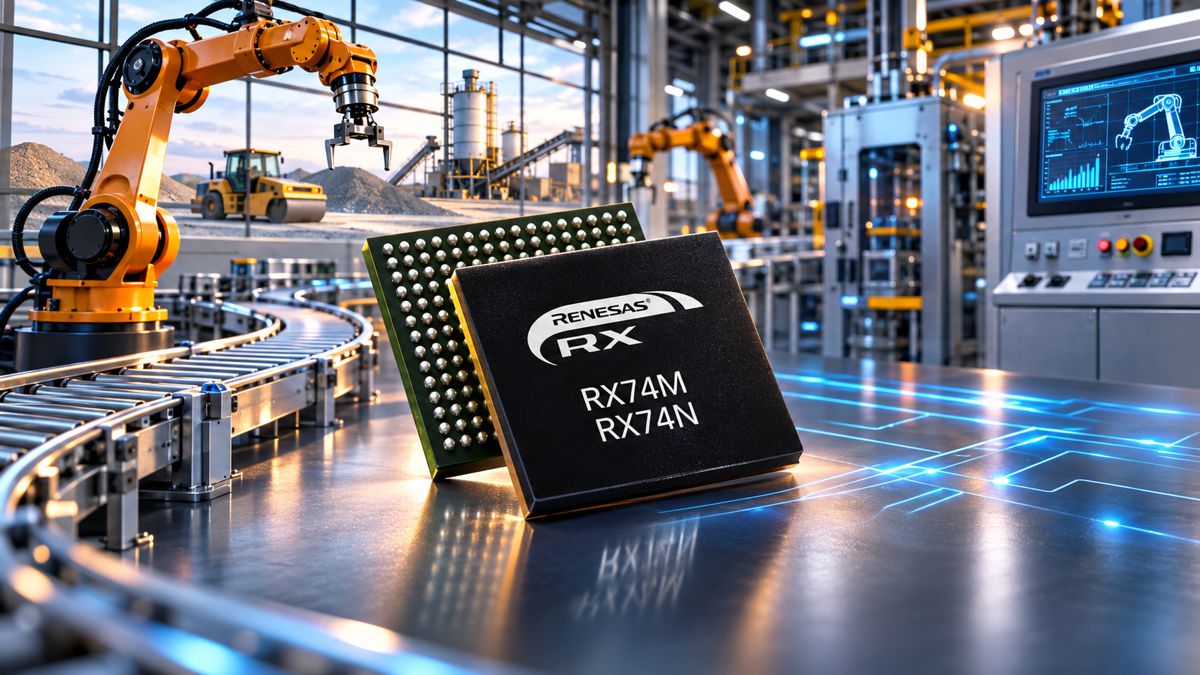
Renesas Electronics has introduced two industrial microcontrollers operating at up to 600 MHz, combining high-speed real-time processing with embedded magnetoresistive memory and enhanced hardware security. The RX74M and RX74N are the first devices in the company’s RX family manufactured using a 22 nm process, extending the capabilities available to designers of industrial control equipment.
The development is particularly relevant to industrial automation, where controllers must coordinate motors, sensors and network communications within tightly controlled timing requirements. Renesas is targeting applications ranging from industrial robots and programmable logic controllers to smart meters, power conversion equipment and building automation.
The two devices share a processing architecture but address different equipment requirements. The RX74M concentrates on factory automation and industrial networking, while the RX74N is intended for a broader range of industrial control applications.
Briefing
- Renesas has launched the RX74M and RX74N, offering processing speeds of up to 600 MHz using a 22 nm manufacturing process.
- Both families feature up to 1 MB of dual-bank code MRAM, 48 KB of data MRAM and 1.5 MB of SRAM.
- The RX74M integrates EtherCAT, TSN-capable Gigabit Ethernet switching and CAN FD communications.
- Hardware security includes ProtectZone isolation and cryptographic capabilities intended to support emerging cybersecurity requirements.
- The devices are commercially available in configurations operating at 300, 480 and 600 MHz.
Real-Time Processing and Embedded MRAM
The RX74M and RX74N are built around Renesas’ RXv3e processor core, supported by 256 KB of tightly coupled memory, up to 1 MB of dual-bank code MRAM, 48 KB of data MRAM and 1.5 MB of SRAM with error correction.
The combination addresses different requirements in industrial control. Time-critical instructions need predictable execution, particularly when handling frequent interrupts or coordinating multiple control functions. Configuration data, operating parameters and event records must also be stored reliably without unnecessarily interrupting equipment operation.
Tightly coupled memory provides rapid access for selected instructions and data, while SRAM supports working memory requirements. MRAM introduces a different approach to non-volatile storage. Unlike conventional embedded flash memory, MRAM does not require an erase operation before writing new information.
The dual-bank code memory arrangement can also support firmware update strategies in which a replacement program image is prepared while an existing version remains available. Actual update procedures and any reduction in downtime depend on the equipment’s software architecture.
The move from the previous generation’s 240 MHz operating frequency to 600 MHz increases the processing capacity available for control algorithms, communications and supervisory functions. Renesas reports more than twice the performance of the earlier RX72M and RX72N devices, although the announcement does not provide an application-level benchmark for that comparison.
The RXv3e architecture also incorporates a double-precision floating-point unit and register bank save functionality intended to accelerate interrupt handling. These features are relevant to control applications that combine numerical calculations with frequent real-time events.
Industrial Networking Within a Single Controller
Industrial Ethernet connectivity is a central feature of the RX74M.
The device integrates an EtherCAT slave controller, a TSN-capable Gigabit Ethernet switch and CAN FD communications. Renesas states that the architecture supports industrial networks including EtherCAT, PROFINET and EtherNet/IP, together with network redundancy arrangements such as EtherNet/IP Device Level Ring.
These technologies serve different requirements within automated production systems. EtherCAT is widely used for deterministic communication between controllers and distributed devices, particularly in motion control. PROFINET and EtherNet/IP provide established communications frameworks for industrial automation, while Time-Sensitive Networking introduces mechanisms for managing time-critical traffic over Ethernet infrastructure.
Integrating the communications hardware can reduce dependence on separate networking components, although implementation and interoperability still depend on appropriate protocol software, configuration and any applicable certification requirements. The available interfaces also vary between product configurations.
For manufacturers developing equipment for international markets, support for several established industrial networking technologies can be valuable. A machine builder supplying different customers may encounter different factory communications standards even when the underlying mechanical equipment is substantially similar.
The RX74M provides a common hardware foundation for developing equipment variants, potentially reducing the number of controller designs required across a product range.
Cybersecurity and Equipment Lifecycle Requirements
The RX74M and RX74N incorporate additional hardware security functions, reflecting the increasing cybersecurity obligations placed on manufacturers of connected industrial equipment.
Renesas has introduced ProtectZone technology within the RX processor architecture, allowing secure and non-secure execution regions to be separated. The devices also incorporate the company’s next-generation Renesas Secure IP cryptographic technology, which expands support for public-key cryptography, authenticated encryption and hashing algorithms.
The company positions these capabilities as preparation for security requirements associated with legislation such as the European Union’s Cyber Resilience Act and the longer-term adoption of post-quantum cryptography.
The Cyber Resilience Act introduces cybersecurity obligations for products with digital elements, including requirements relating to vulnerability handling, security maintenance and product lifecycle management. Hardware security can support these responsibilities, but compliance also depends on software development, documentation, update procedures and organisational processes.
Similarly, the ability to support advanced cryptographic implementations should not be confused with demonstrated post-quantum security. Renesas describes forward-looking capabilities, but the announcement does not establish the performance or certification status of specific post-quantum algorithms running on the devices.
The hardware nevertheless provides equipment developers with additional options for protecting firmware, separating trusted operations and securing communications throughout a product’s operating life.
Applications Across Industrial Equipment
The RX74M is primarily aimed at equipment requiring sophisticated real-time control and industrial networking. Renesas identifies AC drives, industrial robots and programmable logic controllers among its principal applications.
Motor drives provide a particularly demanding operating environment. A controller may need to process feedback from current and position sensors, execute control algorithms and exchange data with supervisory equipment within precise timing windows. Industrial robots introduce further coordination requirements, particularly where multiple axes and distributed control devices must operate together.
Similar control requirements arise in construction and infrastructure operations, including automated materials handling, asphalt and concrete production plants, pumping installations and industrial processing equipment. These represent potential applications for the technology rather than confirmed deployments of the new Renesas devices.
The RX74N extends the same processing platform into applications such as smart metering, power conditioners and heating, ventilation and air-conditioning systems. These devices may require substantial processing capacity and secure connectivity without the same industrial networking configuration found in factory automation equipment.
Renesas offers 300, 480 and 600 MHz variants, allowing equipment designers to select processing capacity according to application requirements. The company reports that its 300 MHz products consume more than 20% less power than the higher-performance versions, although actual system consumption will depend on operating conditions and peripheral usage.
The devices support supply voltages from approximately 1.62 V to 3.63 V and junction temperatures from −40°C to +125°C. Package options include LFBGA and LFQFP configurations with different pin counts.
Software Development and Integration
Renesas is supporting the RX74M and RX74N through its Flexible Software Package, a development framework shared across the company’s RX, RA and RZ product families.
The company has also identified software, development-tool and real-time operating system partners, including Codewerk, RT-Labs, IAR, MIKROE, eForce and the Zephyr RTOS ecosystem.
This support is relevant to equipment manufacturers managing long development cycles. Industrial controllers often remain in production for many years, and changing processor architecture can involve substantial software validation, communications testing and certification work.
The RX74M and RX74N also support execute-in-place operation from external Octa Flash, with on-the-fly decryption available for applications requiring protected external code storage.
Renesas has published example system designs covering applications such as magnetic-levitation conveyor systems and smart HVAC control, illustrating how the microcontrollers can be combined with other devices from its semiconductor portfolio.
Expanding the RX Industrial Control Platform
Renesas announced commercial availability of the RX74M and RX74N on 22 October 2026, with technical documentation, product configurations and evaluation hardware detailed on its official product pages.
The new devices bring faster processing, embedded MRAM and additional hardware security into the RX family while retaining an architecture directed towards deterministic industrial control.
Industrial equipment manufacturers will judge the devices on application-level performance, communications interoperability, software compatibility, power consumption and long-term component availability. The RX74M’s integrated networking capabilities are particularly relevant to machine builders developing equipment for factories operating under different industrial communications standards.
Key Industry Questions
- What are the Renesas RX74M and RX74N? They are 32-bit industrial microcontrollers based on the RXv3e processor architecture, offering operating frequencies up to 600 MHz, embedded MRAM and hardware security features.
- What is the difference between the RX74M and RX74N? The RX74M is aimed primarily at factory automation, motion control and industrial networking, including EtherCAT applications. The RX74N targets broader industrial equipment, energy management and building automation applications.
- What advantage does embedded MRAM provide? MRAM retains information without power and allows data to be rewritten without the erase operations required by conventional flash memory. This can improve programming efficiency and support frequent parameter updates.
- What is dual-bank MRAM? Dual-bank memory allows code storage to be divided into separate banks, potentially supporting firmware updates while retaining an existing program image. Implementation depends on the device configuration and update software.
- Which industrial communication protocols does the RX74M support? Renesas specifies hardware supporting EtherCAT, PROFINET, EtherNet/IP, TSN-capable Gigabit Ethernet and CAN FD. Protocol availability and interoperability depend on the relevant software and device configuration.
- How do these microcontrollers support industrial cybersecurity? They incorporate hardware isolation and cryptographic capabilities that can help developers protect firmware, communications and sensitive operations. These features support secure system design but do not independently establish regulatory compliance.
- Are the RX74M and RX74N suitable for construction equipment? Potential applications include industrial drives, auxiliary control systems, power conversion and connected machinery. Suitability for mobile construction equipment would require assessment of environmental, electrical and applicable qualification requirements.
- Are lower-power versions available? Yes. Renesas offers 300 MHz variants that it reports consume more than 20% less power than the higher-performance products.
- Are the devices commercially available? Renesas announced availability on 22 October 2026. Product variants, evaluation boards and technical documentation are listed on its website.
Strategic Takeaways
- Integrating real-time processing and industrial networking hardware can reduce reliance on separate communications components in automation controllers.
- Dual-bank MRAM and dedicated data memory offer additional options for firmware management and frequent non-volatile data updates.
- Support for established industrial communications technologies can help machine builders develop equipment for different factory automation environments.
- Hardware cybersecurity capabilities provide a foundation for secure equipment design, but regulatory compliance remains a system-level responsibility.
- Adoption will depend on application-level performance, software compatibility, component availability and the overall cost of integration.