China’s Smart Brain TBM’s Create a New Era for Underground Infrastructure
Tunnel construction has always been one of the most complex and risk-laden activities in global infrastructure delivery. Whether driving road tunnels beneath dense cities, rail links through mountain ranges, or utility corridors below ageing urban networks, the underground environment remains stubbornly unpredictable. Variable geology, groundwater pressure, fault zones, and sudden rock instability have historically placed tunnel boring machine operators in a constant race between experience and uncertainty.
Over the past decade, however, the scale and ambition of tunnelling projects has increased dramatically. Mega-cities are expanding metro systems at pace, cross-border rail corridors are pushing through challenging terrain, and highway authorities are under pressure to deliver safer, faster underground routes with minimal surface disruption. Incremental improvements in mechanical design alone are no longer enough, so the industry has been searching for a step-change using intelligence.
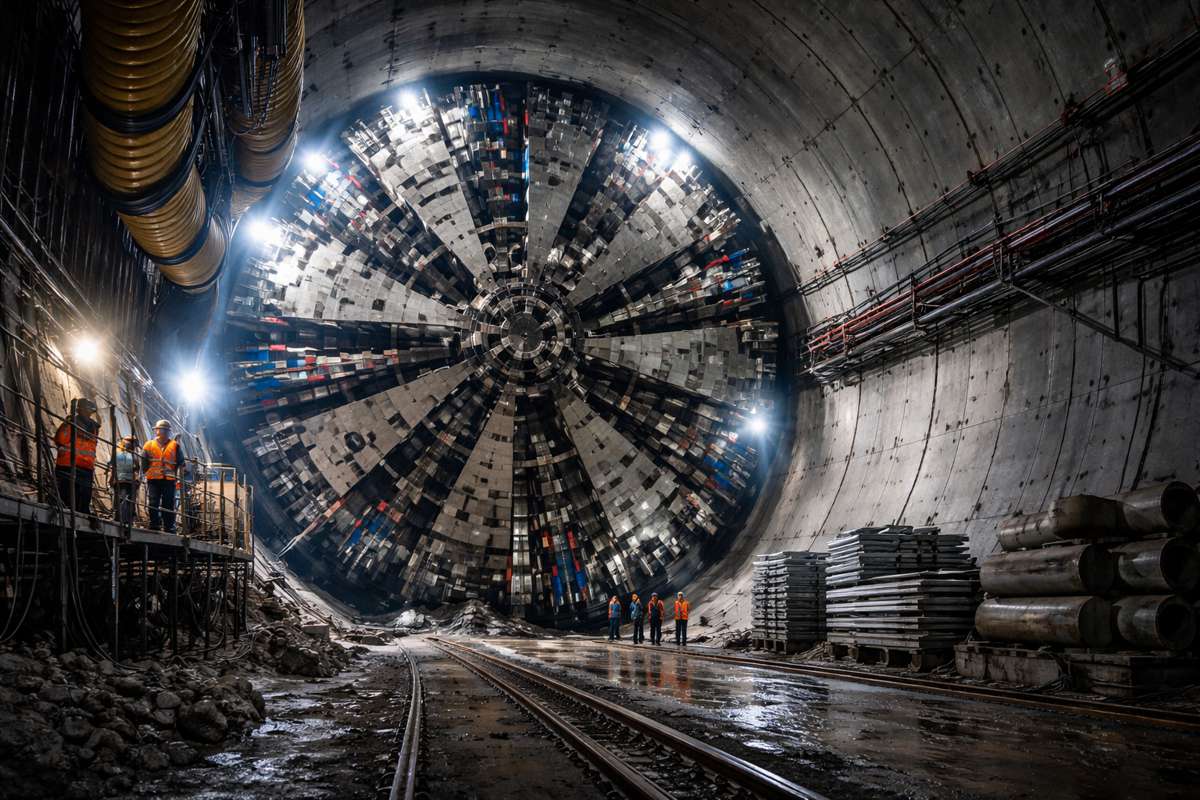
That context makes China’s latest development in tunnel automation particularly significant. Researchers from Hunan University, working with industry partners, have unveiled an AI-enabled operating system for tunnel boring machines described as a “smart brain”. Rather than acting as a passive control layer, the system is designed to sense geological conditions in real time, predict hazards before they escalate, and dynamically adjust excavation parameters as conditions evolve.
The implications reach well beyond a single technology demonstration. If deployed at scale, intelligent TBM systems of this kind could fundamentally reshape how highway, rail, and utility tunnels are designed, built, and managed worldwide.
From Operator Experience to Machine Intelligence Underground
Traditional TBM operation relies heavily on human judgement. Operators interpret sensor data, monitor cutterhead behaviour, assess spoil characteristics, and respond to anomalies using experience built up over years underground. While modern machines are packed with instrumentation, translating raw data into timely decisions remains labour-intensive and, at times, reactive.
The newly developed TBM “smart brain” shifts that balance. According to reporting by Xinhua News Agency, the system integrates artificial intelligence with multi-sensor fusion, allowing the machine to continuously interpret geological feedback as excavation progresses. Rather than simply flagging abnormal readings, the operating system analyses patterns across datasets, building a live understanding of the ground ahead.
This is a crucial distinction. Predictive capability, rather than post-event response, is where automation delivers its greatest value in tunnelling. Sudden encounters with soft ground, fractured rock, or high-pressure water inflows can halt progress, damage equipment, or place crews at serious risk. An intelligent system that anticipates such transitions even minutes earlier can enable controlled adjustments that prevent incidents altogether.
By embedding this intelligence directly into the TBM’s operating logic, the system effectively augments or, in certain scenarios, substitutes human decision-making during critical moments.
Real-Time Geological Sensing as a Safety Multiplier
At the core of the smart brain concept is enhanced geological perception. TBMs already collect large volumes of data, including cutterhead torque, thrust force, penetration rate, vibration, temperature, and slurry or spoil characteristics. Historically, much of this information has been underutilised, analysed retrospectively rather than in real time.
The new operating system uses AI models trained to correlate these parameters with known geological conditions. As excavation progresses, the system continuously compares live data against learned patterns, refining its predictions as more information becomes available. This allows the TBM to infer changes in rock hardness, detect potential fault zones, and identify conditions associated with instability or water ingress.
For tunnel safety, this represents a substantial advance. Hazard prediction has long been a weak point in underground construction, particularly in mixed or highly variable geology. While geotechnical investigations provide a baseline, conditions often diverge from expectations once excavation begins. Intelligent sensing closes that gap, turning the TBM itself into a moving geological probe.
In practical terms, earlier detection means smoother transitions, fewer emergency stops, and a reduced likelihood of catastrophic events that can set projects back by months.
Adaptive Excavation and the End of Static Parameters
Conventional TBM operation typically involves predefined parameter ranges based on expected ground conditions. Operators adjust thrust, cutterhead speed, and face pressure manually as conditions change. This process, while effective in experienced hands, is inherently reactive.
The smart brain approach replaces static parameter sets with continuous optimisation. As geological conditions evolve, the operating system recalibrates excavation settings in real time, maintaining stability while maximising efficiency. If the ground becomes harder, the system adapts cutting force and rotation. If softer strata emerge, it moderates pressure to reduce the risk of face collapse or excessive settlement.
This adaptability is particularly relevant for urban tunnelling, where even small deviations can translate into surface movement, structural damage, or public disruption. Intelligent control offers a pathway to tighter tolerances and more predictable outcomes, a priority for transport authorities and city planners alike.
Over time, adaptive operation could also extend tool life, reduce energy consumption, and lower wear on critical components, delivering long-term cost benefits alongside safety improvements.
For Highway and Rail Megaprojects
The global pipeline of tunnel projects is expanding rapidly. High-speed rail corridors, underground expressways, cross-harbour links, and mountain highway tunnels are becoming defining features of national infrastructure strategies. Many of these schemes involve unprecedented lengths, diameters, or geological complexity.
In such environments, even marginal improvements in reliability can translate into major programme savings. A single TBM breakdown or geological incident can cascade into contractual disputes, cost overruns, and political fallout. For investors and policymakers, risk predictability is often as important as raw construction speed.
AI-enabled TBMs directly address that concern. By reducing uncertainty underground, intelligent systems make project timelines more resilient and outcomes more forecastable. This, in turn, improves the bankability of large tunnelling schemes, particularly those delivered through public-private partnerships or long-term concessions.
For highway authorities, the implications are equally significant. As surface corridors become congested and environmentally constrained, underground road solutions are increasingly attractive. Intelligent tunnelling lowers the barrier to entry, making complex subsurface alignments more feasible in challenging terrain.
China’s Broader Strategy in Construction Automation
The development of a TBM smart brain should be viewed within the wider context of China’s push towards intelligent construction. Over recent years, the country has invested heavily in digital design, automated equipment, and AI-driven project management across infrastructure sectors.
From smart precast factories to autonomous earthmoving fleets, the objective has been clear: reduce reliance on manual labour, improve safety outcomes, and enhance productivity across massive construction programmes. Underground works, long considered resistant to automation, represent one of the final frontiers.
By targeting TBMs, China is addressing a technology with global relevance. Tunnel boring machines are used worldwide, and advances in their intelligence have export potential far beyond domestic projects. This positions Chinese research institutions and manufacturers to influence future standards in underground construction technology.
Importantly, the involvement of academic researchers alongside industry partners reflects a maturing innovation ecosystem, where applied research feeds directly into operational equipment rather than remaining confined to laboratories.
Data, Learning and the Long View of Intelligent Tunnelling
One of the most powerful aspects of AI-enabled machinery lies in its ability to learn over time. Each tunnel driven becomes a data source, refining algorithms and improving future performance. In the context of TBMs, this creates the prospect of cumulative intelligence across projects, geologies, and regions.
As datasets grow, predictive accuracy improves. Patterns associated with specific rock types, fault structures, or groundwater behaviours become clearer, enabling earlier and more precise interventions. Over time, this could lead to shared knowledge platforms where insights from one project inform the next, regardless of geography.
For global contractors operating fleets of TBMs, the value proposition is compelling. Consistency across projects reduces dependence on scarce specialist operators and mitigates the risks associated with workforce turnover. It also opens the door to more standardised training and operational procedures.
That said, questions around data ownership, interoperability, and cybersecurity will need careful management as intelligent TBMs move from pilot deployments into mainstream use.
Implications for Workforce Skills and Site Management
Automation in tunnelling does not remove the need for skilled professionals, but it does change the nature of their work. As TBMs become more autonomous, operators transition from hands-on control to supervisory roles, focusing on system oversight, anomaly investigation, and strategic decision-making.
This shift places greater emphasis on digital literacy, data interpretation, and systems engineering. Training programmes will need to evolve accordingly, blending traditional tunnelling expertise with AI awareness and operational analytics.
For site management, intelligent TBMs offer improved visibility. Real-time insights into machine performance and ground conditions enable more proactive planning, better coordination with downstream activities, and clearer communication with stakeholders. In large projects involving multiple machines, this level of transparency becomes a critical management tool rather than a technical luxury.
Global Relevance Beyond China’s Borders
While the smart brain system has been developed in China, its relevance is unmistakably global. Countries across Europe, Asia, the Middle East, and the Americas are grappling with the same underground challenges, often under even tighter regulatory and environmental constraints.
Urban tunnelling beneath historic city centres, alpine rail corridors through geologically complex mountains, and subsea road links all demand higher levels of predictability and safety. AI-driven TBMs align closely with these priorities.
As international contractors and equipment suppliers assess the technology, questions will naturally arise around certification, standards compliance, and integration with existing machine platforms. However, the underlying direction of travel is clear. Intelligent tunnelling is moving from aspiration to operational reality.
For policymakers, the emergence of smart TBMs reinforces the importance of supporting innovation in construction technology. Infrastructure delivery is no longer solely a matter of funding and planning approvals. It increasingly depends on the intelligent systems that underpin execution on the ground, or in this case, underground.
A New Benchmark for Underground Construction Intelligence
The development of an AI-enabled operating system capable of sensing, predicting, and adapting in real time marks a meaningful milestone in tunnelling technology. Rather than automating isolated functions, the smart brain concept integrates intelligence across the entire excavation process.
For the global construction and infrastructure sector, this signals a shift in expectations. TBMs are no longer just powerful mechanical tools guided by human judgement. They are evolving into adaptive systems that learn, anticipate, and respond with increasing autonomy.
As tunnel networks expand to support the next generation of highways, railways, and utility systems, technologies like this will play a decisive role in shaping outcomes. Safer projects, more reliable schedules, and reduced underground risk are not abstract benefits. They are commercial, social, and political imperatives.
In that sense, China’s intelligent TBM development is less about a single innovation and more about redefining what modern tunnelling looks like in an era where data, AI, and infrastructure are inseparable.