John Deere Pushes Wheel Loader Efficiency Forward with Electrified X-Tier
The race to improve productivity in quarrying, mining, bulk materials handling and heavy construction has increasingly shifted from simply adding horsepower to extracting more performance from every litre of fuel burned. Equipment manufacturers are under growing pressure to help contractors and material producers lower operating costs while simultaneously increasing output, particularly as fuel prices, labour costs and sustainability expectations continue to rise.
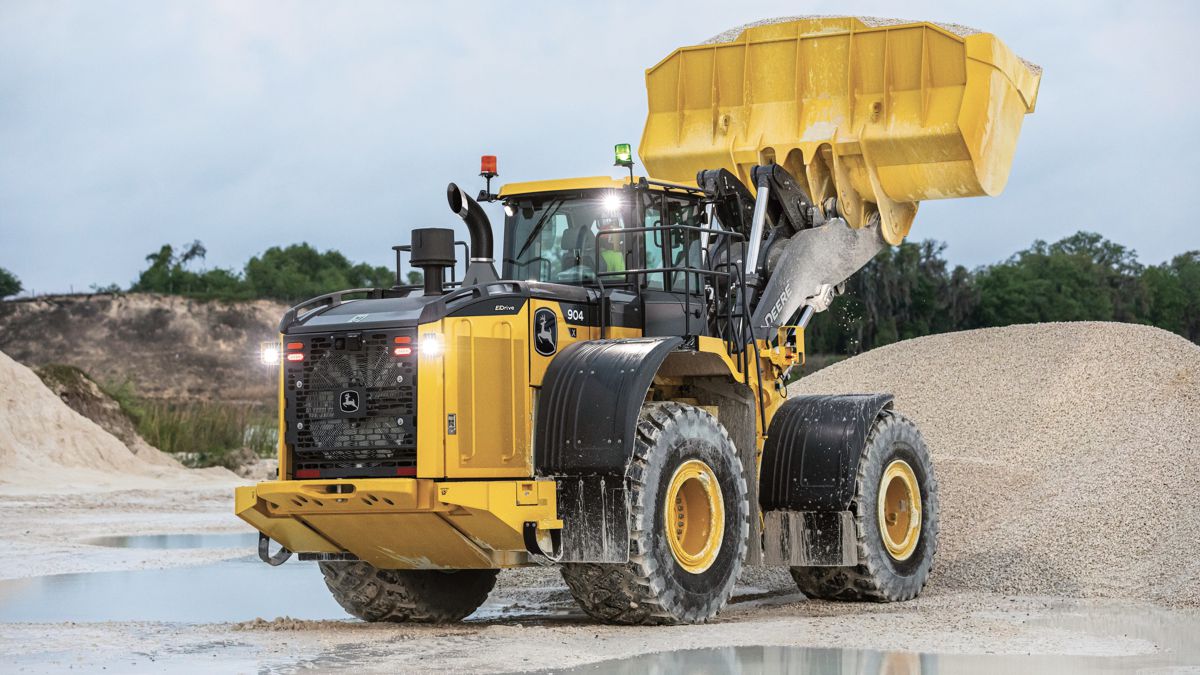
John Deere has just introduced two new production-class wheel loaders, the 844 X-Tier and 904 X-Tier, expanding its electrified X-Tier portfolio into larger material handling applications. The machines combine electric-drive technology, enhanced traction management, digital operator assistance systems and connected fleet support tools designed to improve cycle efficiency in demanding loading environments.
The introduction of electric-drive wheel loaders reflects a broader industry trend in which manufacturers are increasingly deploying electrification not solely for emissions reduction, but as a pathway to improved machine performance, controllability and operating efficiency.
Briefing
- John Deere has launched the new 844 X-Tier and 904 X-Tier production-class wheel loaders.
- Both models utilise an Electric Variable Transmission (EVT) drivetrain architecture.
- Fuel consumption can be reduced by up to 15% in Standard Mode, while Performance Mode can increase productivity by up to 5%.
- New traction and bucket-loading technologies are designed to improve material movement efficiency and reduce tyre wear.
- Advanced visibility and object detection systems aim to enhance operator awareness in busy loading environments.
Electrification Continues to Transform Heavy Equipment
Electrification is no longer confined to compact machinery or experimental prototypes. Across the global construction and mining sectors, manufacturers are increasingly adopting electric-drive architectures in large production equipment where energy efficiency gains can deliver substantial financial returns.
Wheel loaders represent a particularly attractive application for electric-drive systems because of their repetitive duty cycles. Machines spend much of their operational life accelerating, loading material, reversing, travelling short distances and repeating the process hundreds of times per shift. Traditional mechanical drivetrains often struggle to maintain optimal efficiency throughout these constantly changing load conditions.
Electric-drive systems can respond far more rapidly to fluctuating demands. By electronically managing torque delivery and power distribution, operators benefit from smoother acceleration, improved traction and more precise machine control. These advantages can translate directly into faster loading cycles and lower fuel consumption.
The construction equipment industry has seen increasing adoption of electric-drive technology over the past decade, particularly in mining haul trucks, large loaders and specialised industrial machinery. The latest generation of systems is now becoming more refined, integrating sophisticated software controls that optimise performance automatically while reducing operator workload.
The Role of Electric Variable Transmission
At the heart of the new X-Tier wheel loaders is John Deere’s Electric Variable Transmission, or EVT. Unlike conventional drivetrain arrangements that rely heavily on mechanical transmission components, EVT uses electronically managed power delivery to optimise machine response and efficiency.
According to John Deere, the system enables smoother operation, faster response times and improved efficiency when compared with equivalent P-Tier models. The design also allows hydraulic performance to operate independently of engine speed, helping maintain consistent hydraulic capability while reducing unnecessary engine loading.
One notable operational benefit is the introduction of single-pedal control functionality. Simplifying machine operation can reduce operator fatigue during long shifts while making precise loading manoeuvres easier to perform. In industries where experienced operators remain in short supply, technologies that shorten learning curves and support productivity are becoming increasingly valuable.
The ability to decouple hydraulic performance from engine speed also reflects a broader movement towards software-managed machine optimisation. Rather than relying solely on operator judgement, advanced control systems increasingly assist in balancing performance and efficiency throughout the working day.
Productivity Gains in High Volume Material Handling
Large wheel loaders typically operate in environments where productivity is measured in tonnes moved per hour. Any increase in bucket fill factor, traction performance or cycle consistency can generate significant operational savings over the life of a machine.
The new X-Tier models incorporate larger high-strength steel buckets designed to move more material per pass than previous P-Tier machines. Combined with enhanced traction management systems, operators can potentially achieve greater material movement without increasing cycle frequency.
A key addition is Pile Slip Assist, a feature intended to improve traction and bucket penetration when working in stockpiles. Material loading efficiency is often influenced by wheel slip, particularly in loose aggregate, sand, coal or crushed rock applications. Reducing wheel slip can improve bucket fill performance while also decreasing tyre wear.
Tyres remain one of the largest operating expenses for production-class wheel loaders. Premature wear caused by excessive wheel spin can significantly increase ownership costs over a machine’s operating life. Technologies that improve traction while protecting tyres therefore offer benefits extending beyond immediate productivity improvements.
Balancing Fuel Efficiency and Performance
Equipment buyers increasingly evaluate machinery based on total cost of ownership rather than purchase price alone. Fuel consumption remains one of the most significant components of lifetime operating costs, especially for machines operating continuously across multiple shifts.
John Deere states that the X-Tier machines provide two selectable operating modes designed to balance efficiency and productivity according to job requirements. Standard Mode can reduce fuel consumption by up to 15%, while Performance Mode can increase productivity by up to 5% in demanding applications. Together, these improvements contribute to an estimated 4% reduction in total ownership costs compared with previous models.
Although percentages may appear modest individually, the cumulative impact can be substantial across large fleets. In high-volume aggregate operations or major infrastructure projects where machines operate thousands of hours annually, even small efficiency improvements can translate into significant financial savings.
This growing emphasis on flexible machine operating modes mirrors developments seen across the wider equipment industry. Contractors increasingly seek equipment capable of adapting to changing production targets, fuel prices and environmental requirements without compromising operational capability.
Digital Vision Systems Improve Jobsite Awareness
Visibility remains a critical safety consideration for large wheel loaders operating in busy worksites. Aggregate facilities, ports, recycling centres and construction projects often involve multiple machines, ground personnel and haul vehicles working within confined operational areas.
The optional Advanced Vision System expands operator visibility through the use of digital camera technology mounted on side mirrors. These cameras provide enhanced side and rear visibility beyond what conventional mirror systems can offer.
Dynamic reverse path projection technology further assists operators by displaying predicted machine movement based on articulation angle. This capability can help operators better understand vehicle positioning during reversing manoeuvres, particularly when visibility is restricted by material stockpiles or site congestion.
The system integrates camera feeds into a dedicated in-cab display, creating a centralised view of surrounding operating conditions. Additional Advanced Object Detection functionality can further support situational awareness, helping operators identify potential hazards within the machine’s working envelope.
As construction and industrial sectors continue to pursue Vision Zero safety strategies, digital visibility technologies are becoming increasingly common across heavy equipment fleets. Enhanced awareness tools may never replace operator vigilance, but they can provide valuable supplementary information in complex operating environments.
Connected Equipment Becomes Standard Practice
Connectivity has rapidly evolved from a premium feature to an operational necessity within modern fleet management. Equipment owners increasingly rely on machine-generated data to optimise maintenance schedules, monitor utilisation and reduce unplanned downtime.
The new X-Tier wheel loaders integrate with John Deere Operations Center and remote diagnostic systems, allowing fleet managers and service teams to access operational information remotely. These tools support predictive maintenance strategies and can assist in identifying emerging issues before they result in costly failures.
Remote diagnostics have become particularly important as equipment fleets grow more technologically sophisticated. Electrified drivetrains, advanced software controls and integrated sensor systems generate extensive operational data that can improve maintenance planning and machine availability.
John Deere is also providing a five-year or 15,000-hour coverage package for qualifying electric-drive components. Long-term support provisions are becoming increasingly important as customers evaluate the reliability and lifecycle costs associated with newer drivetrain technologies.
A Glimpse of the Next Generation of Production Equipment
The launch of the 844 and 904 X-Tier wheel loaders reflects a wider evolution occurring across the heavy equipment sector. Electrification is increasingly being adopted not merely as an environmental initiative, but as a means of improving machine performance, controllability and economic efficiency.
Production-class loaders remain fundamental assets within aggregate extraction, materials processing, mining support and infrastructure construction operations. As projects become larger and margins tighter, contractors and operators are looking for technologies that can deliver measurable improvements without disrupting established workflows.
By combining electric-drive architecture, advanced traction management, digital visibility systems and connected fleet support, the latest X-Tier models demonstrate how future heavy equipment is likely to evolve. The industry’s next chapter appears less focused on raw mechanical power alone and increasingly centred on intelligent systems that help operators move more material, consume less fuel and maintain higher levels of operational consistency throughout every working shift.