The Living Infrastructure Cooling Nearly 9,000 Cities Worldwide
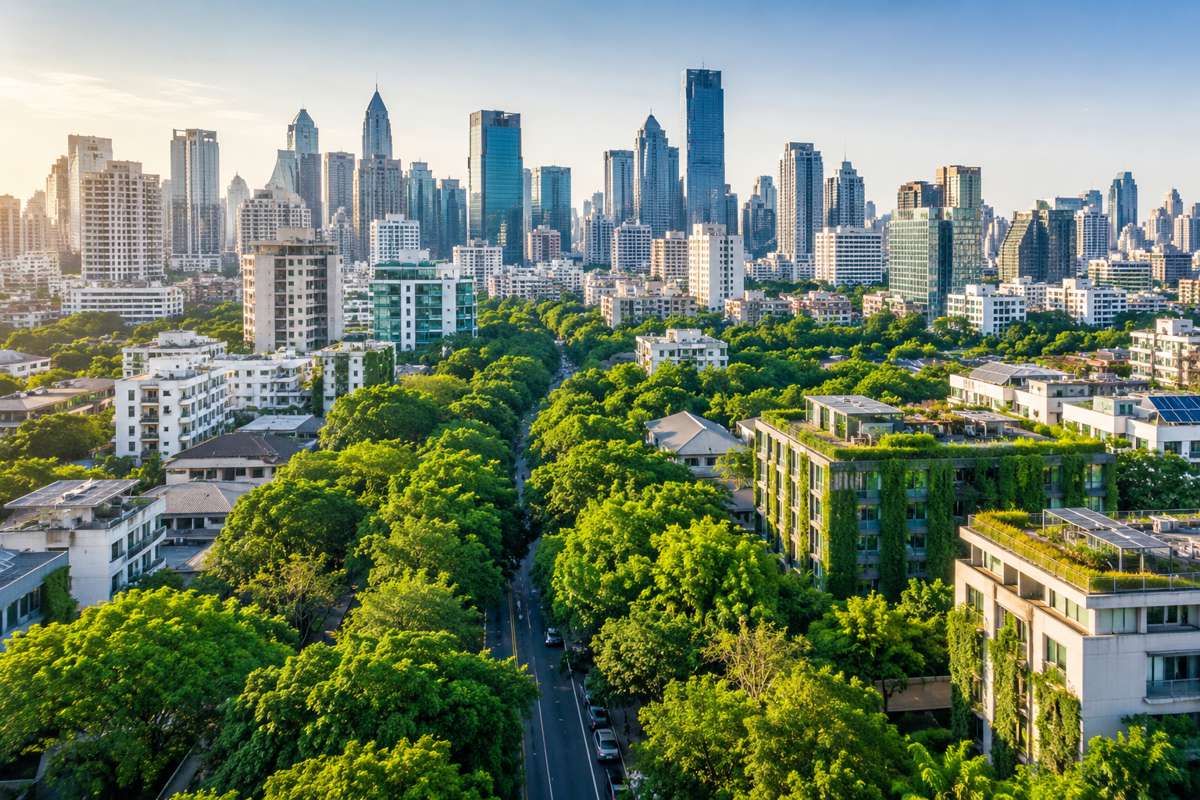
City trees are pulling double duty as infrastructure, and a sweeping new global study has finally put a number on how much heavy lifting they do. Research led by The Nature Conservancy (TNC) and published in Nature Communications finds that without tree cover, the world’s urban heat islands would run roughly twice as hot.
Pooling data from nearly 9,000 large cities that are collectively home to around 3.6 billion people, the team calculated that existing canopy already offsets close to half, about 48.6%, of the heat that builds up when roads, roofs, car parks and other hard surfaces soak up the sun and radiate it back into the streets below.
For anyone who plans, finances or builds the urban fabric, that’s a finding with teeth. It reframes the humble street tree as a working asset that sits alongside the asphalt, the drainage and the power network, rather than a decorative afterthought bolted on once the engineering’s been signed off.
Briefing
- Tree cover offsets roughly 48.6% of the urban heat island effect across nearly 9,000 cities, effectively halving how hot built-up areas would otherwise become.
- More than 200 million city residents already enjoy ambient temperatures over 0.5°C cooler thanks to nearby canopy, a margin that scales into real public-health and energy savings.
- The benefit is lopsided, concentrated in wealthier, humid and suburban areas while the hottest, poorest neighbourhoods, where it’s needed most, go without.
- Trees alone can only blunt 9 to 10% of the warming expected by 2050, rising to around 20% under maximum planting, so canopy must work as one layer of a broader strategy.
- Protecting mature trees during construction matters as much as planting new ones, since replacements take decades to reach full cooling capacity.
Why a Living Asset Belongs on the Infrastructure Ledger
The mechanism is straightforward enough that it’s easy to underrate. Trees cool cities two ways at once: they throw shade over hot surfaces, and they release water vapour that pulls heat out of the surrounding air. The study’s authors stress that this second effect, evaporative cooling, often outperforms shade alone, which has practical consequences for how canopy gets managed through dry spells. Dr Theodore Endreny, study co-author from the SUNY College of Environmental Science and Forestry (ESF), put it plainly: “Evaporative cooling from trees and soil does even more to lower air temperatures than shade alone, so during summer droughts trees may need irrigation to activate that effect. Just as important is protecting existing trees from damage or removal during construction, since a newly planted tree can take decades to reach its full size and cooling potential.”
That last point lands squarely on the desks of contractors and project managers. A mature tree felled to widen a junction isn’t replaced by a sapling in any meaningful timeframe, and the cooling deficit lingers for a generation. There’s a hard irony here too, given that the very projects reshaping cities can deepen the problem they’re meant to serve. Separate research out of Northeastern University found that highway expansion intensifies the urban heat island effect, and the scale of activity is enormous: as of early 2026 there were nearly 115,000 highway projects underway in the United States alone, backed by some $257 billion in federal funds, according to the American Road and Transportation Builders Association. Folding canopy retention into that pipeline isn’t a soft environmental nicety, it’s a way of stopping new grey infrastructure from quietly cooking the neighbourhoods it passes through.
Where the Cooling Falls Short
Here’s the catch that should temper any rush to treat trees as a silver bullet. The study projects that current and likely future canopy will mitigate only 9 to 10% of the temperature rise that climate change is expected to bring by 2050. Push planting to its absolute maximum and that figure climbs to roughly 20%, useful, but nowhere near enough on its own.
Rob McDonald, TNC’s lead global scientist for nature-based solutions and its European regional team, was candid about the limits: “While expanding tree cover – particularly in urban areas that don’t have enough right now – is an essential part of adapting to rising temperatures, our study suggests that trees by themselves won’t be enough. Humanity will need to use multiple strategies to adapt to a hotter world, and we desperately need to reduce greenhouse gas pollution to avoid committing ourselves to catastrophically high temperatures.”
For the built environment, that’s an argument for layering rather than betting on a single fix. Cool and reflective pavements, high-albedo roofing, permeable surfaces and shade structures all earn their keep when stacked alongside canopy, and several come with attractive cost-benefit ratios. Cool-roof coatings, for instance, run at broadly comparable installation costs to green roofs while cutting cooling loads inside the building below. Cities including Tokyo, Barcelona, Montreal and Paris have leaned on pavement watering and reflective surfaces during heatwaves precisely because no one intervention does the whole job. The takeaway for planners and investors is that heat resilience is a portfolio, not a product.
The Equity Gap Investors and Policymakers Can’t Ignore
If the headline finding is encouraging, the distribution of the benefit is anything but. The cooling effect of trees, the study finds, is currently concentrated in exactly the places where it’s least urgent: high-income countries, humid climates and leafier suburban neighbourhoods. The hotter, drier, lower-income districts that face the sharpest heat risk tend to have the thinnest canopy, a pattern that mirrors decades of uneven investment in green space. It’s a familiar story to anyone who has watched infrastructure spending track wealth rather than need.
Johnny Quispe, Director of Cities Programs at TNC, framed the stakes in terms any city leader will recognise: “It’s increasingly common to see stark temperature differences between neighbourhoods in the same city, driven by unequal amounts of tree canopy. The impacts of extreme heat often affect the most vulnerable communities. Investing in urban forestry yields cooler streets, cleaner air and more resilient communities for everyone.”
The study’s authors argue that governments should prioritise canopy expansion in their most densely settled and lowest-income urban areas, and do it soon, because trees planted today need decades to grow into their full cooling role. Leave it too late and the window for that slow-maturing benefit closes.
Measuring What Was Always Assumed but Never Counted
What sets this work apart isn’t just the conclusion, it’s the precision behind it. Earlier global studies leaned heavily on satellite readings of land surface temperature, which tend to flatter the cooling power of trees. This team went finer-grained, knitting together air-temperature data at a 1km scale with high-resolution land-cover maps and breaking cities into segments of roughly 150 blocks each, so that the greenery of a large central park wasn’t wrongly credited with cooling built-up districts miles away.
McDonald described the breakthrough as a long-overdue piece of accounting: “By combining datasets showing air temperatures at 1km scale with high-resolution land cover maps, we’ve succeeded for the first time in producing tangible estimates for a natural cooling effect that’s long been accepted but never comprehensively measured until now.”
The analysis also reached for a metric that better reflects what a body actually feels. ESF’s i-Tree Cool Air model, an open environmental tool built by ESF researchers to quantify how canopy shading and soil moisture lower temperatures, fed the neighbourhood-scale work, while remote-sensing analysis led by TC Chakraborty, Earth Scientist at Pacific Northwest National Laboratory (PNNL), tested human heat stress directly.
“Most global studies rely on satellite land surface temperature, which significantly overstates the cooling benefits of trees. But air temperature alone doesn’t tell the whole story. By modeling Wet Bulb Globe Temperature – a metric that also factors in humidity, wind, and solar radiation – at the local scale for a small subset of cities, we found that trees reduce actual human heat stress by an average of three times more than air temperature suggests. This gives us a much more accurate, physiologically relevant estimate of how trees can protect urban residents during hot, sunny, summer days,” Chakraborty said.
Endreny added a regional note that doubles as a maintenance brief for every parks department: “Strategic tree planting and management where people live can dramatically reduce the intensity, duration, and frequency of extreme heat. Trees in cities across New York State are working hard as natural air conditioners, but they need care to deliver their full cooling benefits.”
What Comes Next for the Built Environment
The honest reading of this study is that it hands the construction and infrastructure world both a credit and a warning. The credit is real and quantified: canopy is already saving cities from roughly double the heat-island burden they’d otherwise carry, and the savings show up in lower energy demand, fewer heat-stress hospital admissions and more liveable streets. Treating those trees as protected infrastructure, budgeting for their irrigation, their root space and their survival through construction, turns a vague green commitment into a measurable line item with a payback.
The warning is just as clear. Canopy can’t outrun unchecked warming, and planting more of it in the wrong places does little for the people sweltering hardest. The work points towards a joined-up approach, where tree retention sits beside cool pavements, reflective roofs and, underpinning all of it, deep cuts to emissions. For policymakers weighing where to direct adaptation funding, and for developers deciding what stays and what goes on a cleared site, the message from nearly 9,000 cities is that the cheapest cooling technology available is often the one already growing on the verge, provided it’s looked after rather than bulldozed.