CNH’s Norcar Alliance Signals a New Strategy for Compact Construction Equipment
The industrial cooperation agreement CNH Construction signed with Finland’s Oy Norcar Ab on 24 July 2026 looks, on the surface, like a modest distribution deal: a small manufacturer of sub-two-tonne miniloaders gains a route to market through the CASE and New Holland Construction dealer networks. Read against CNH’s wider position, it is something more deliberate.
The company’s construction arm has been loss-making through early 2026, its leadership has spent the year openly hunting for partners, and the segment Norcar occupies, the under-four-tonne compact and sub-compact loader, is one of the fastest-consolidating and most fiercely contested corners of the equipment market. The Norcar agreement is best understood not as a product announcement but as a statement of method. Faced with a real gap at the smallest end of its range, CNH has chosen the capital-light route of industrial cooperation over the expense of acquisition or the slow grind of in-house development.
The timing sharpens the point. Only months earlier, Doosan Bobcat’s multi-billion-euro attempt to acquire Germany’s Wacker Neuson, a deal explicitly designed to turn Europe into the group’s second growth pillar, had collapsed. That failure underlined how costly and uncertain the acquisition path into European compact equipment has become. CNH, by contrast, is assembling coverage of the same segment for the price of a badging and distribution arrangement, and doing it region by region.
A 2023 agreement with the Netherlands’ Tobroco-Giant handed CASE and New Holland a compact and sub-compact wheel loader line for North America. The Norcar deal now plugs the equivalent gap in Europe. For an industry watching CNH weigh the future shape of its entire construction business, the mechanics of this small Finnish agreement matter far more than its size suggests.
Briefing
- CNH Construction has signed an industrial cooperation agreement with Oy Norcar Ab of Nykarleby, Finland, to distribute Norcar’s compact and sub-compact wheel loaders under the CASE and New Holland Construction brands, with new models due to be unveiled later in 2026 and to reach European dealers in the first quarter of 2027.
- The deal targets the under-four-tonne operating weight segment, where CNH’s existing range is thin, and follows the same capital-light playbook the group used with the Netherlands’ Tobroco-Giant in North America in 2023.
- CNH’s construction segment posted a roughly three per cent decline in net sales in 2025 to just under three billion US dollars and an adjusted operating loss of around 28 million US dollars in the first quarter of 2026, with management running an open search for construction partnerships.
- The move lands months after Doosan Bobcat’s attempted acquisition of Germany’s Wacker Neuson collapsed in January 2026, throwing the contrast between costly consolidation and lighter-touch cooperation into sharp relief.
- Independent market estimates value Europe’s compact wheel loader market at well over one billion US dollars in 2025 and project sustained mid-single-digit growth, driven by urban construction, tight-site work and tightening EU emissions rules.
The Gap at the Small End Is Real, and Commercially Attractive
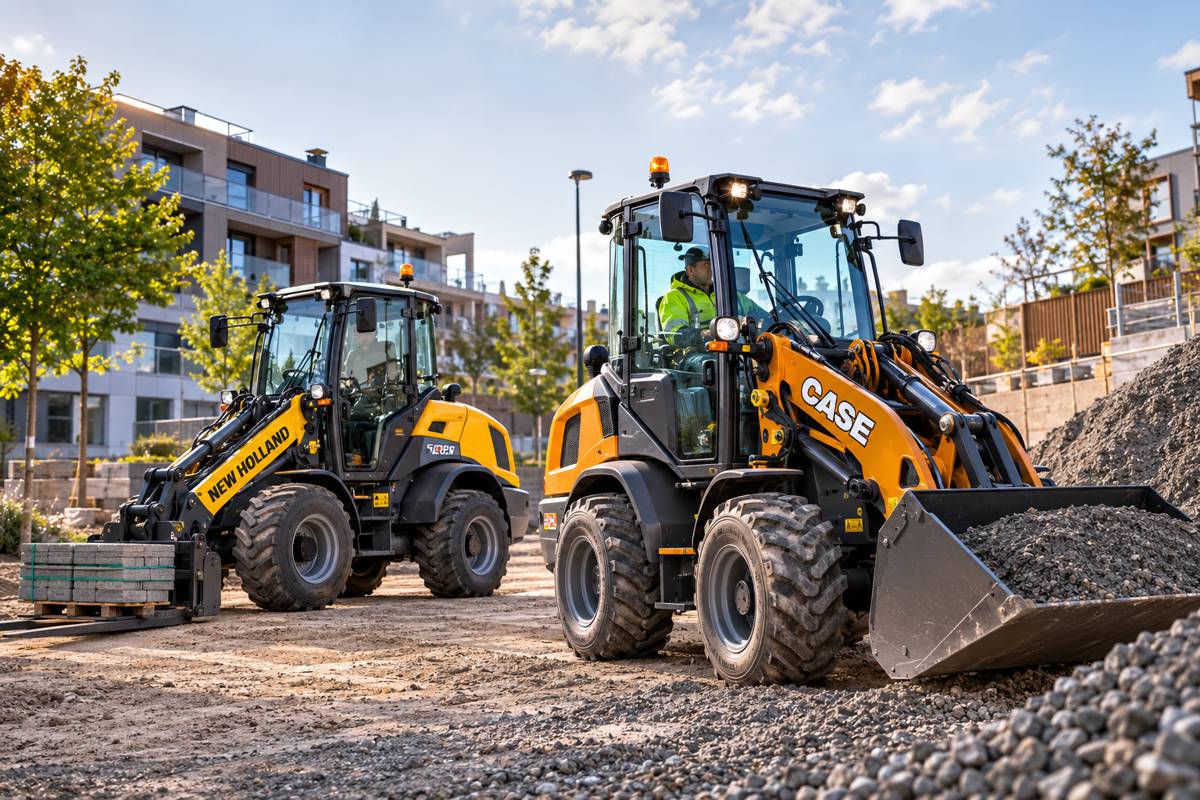
CNH’s construction portfolio is strongest in the categories that built the CASE and New Holland reputations: backhoe loaders, excavators, motor graders, larger wheel loaders, dozers, skid steers and compact track loaders. What it has lacked is a credible presence at the very bottom of the weight range, the articulated miniloaders and sub-compact wheel loaders that weigh under four tonnes and, in Norcar’s case, under two.
That gap is not trivial. This is the equipment class that thrives precisely where the machines CNH sells well begin to struggle, on constrained urban sites, inside buildings, across finished surfaces and around landscaping, municipal and property-maintenance work where a skid steer’s footprint or a larger loader’s ground pressure becomes a liability. The commercial logic of the Norcar machines rests on that distinction, offering agility, easy transportability and minimal ground disturbance compared with skid steers or heavier compact wheel loaders.
The attraction of the niche is that it is both defensible and growing. Compact wheel loaders command strong residual values, lend themselves to attachment-driven versatility that keeps a single machine earning across multiple tasks, and increasingly suit rental fleets looking for machines that transport on a light trailer and switch jobs quickly. CNH’s own North American sales data illustrates where the volume already sits: models such as the CASE 321F compact wheel loader and the SV208B skid steer rank among the group’s most-financed machines.
Extending that appeal downward into the sub-compact class lets CNH serve customers it currently cannot, without cannibalising the mid-size loaders that remain core to its business. In a construction segment under earnings pressure, a niche that adds incremental margin and dealer footfall rather than competing head-on with Caterpillar, Komatsu, Volvo and Deere in the heavy categories is a sensible place to concentrate effort.
A Partnership Playbook, Not a One-Off Deal
The most revealing feature of the Norcar agreement is how closely it tracks a route CNH has walked before. In February 2023 the group signed an industrial cooperation agreement with Tobroco-Giant, a Dutch specialist in compact equipment, to distribute compact and sub-compact wheel loaders spanning roughly one to five tonnes under CASE and New Holland Construction in North America.
That deal even delivered CNH’s first electric sub-compact wheel loader. The Norcar arrangement applies the same structure to the other side of the Atlantic, filling the European end of the same portfolio gap. The regional logic is clean: where the group could badge Giant machines for North America, it needed a separate European partner for a market where Giant sells strongly under its own name, and Norcar, with roughly ninety per cent of its output already exported across the Nordics and northern Europe, fits that requirement.
CNH’s leadership has been candid about the strategy behind these moves. Through its 2025 results and into 2026, chief executive Gerrit Marx confirmed the group had restarted discussions with several players about partnering options for its construction business, framing the aim as strengthening the equipment lineup and the machines sold through New Holland’s agricultural dealers.
The Norcar deal is a concrete instance of that approach in action, and CNH Construction President Humayun Chishti positioned it in exactly those terms: “Norcar’s products integrate seamlessly into our brand portfolio, allowing us to meet customer needs in the smaller compact and sub-compact segments that our current lineup does not fully cover. Norcar was selected as the ideal partner thanks to its complimentary product range, quality, and strong potential for production capacity expansion. This partnership further strengthens the positioning of the CASE and New Holland Construction brands within an attractive market niche,” he said. The reference to production capacity expansion is worth noting, since it signals that CNH sees Norcar not merely as a badge to apply but as a supplier it intends to scale.
The Consolidation Backdrop Makes Cooperation Look Astute
The strategic value of the Norcar route becomes clearer when set against how the rest of the sector has been trying to buy position in the same space. In December 2025 Doosan Bobcat, whose sales remain heavily weighted towards North America, confirmed advanced talks to acquire around 63 per cent of Wacker Neuson, the Munich-based owner of the Wacker Neuson, Kramer and Weidemann brands and a business generating roughly two billion euros a year.
The rationale was explicit: Wacker Neuson’s entrenched dealer network across Germany, Austria and northern Europe offered Bobcat a fast track into a region where it is comparatively weak. By late January 2026, those talks had collapsed, and the German group’s shares fell sharply on the news. The episode is a reminder that acquisition-led entry into European compact equipment is expensive, slow to clear and far from guaranteed.
Against that backdrop, CNH’s decision to secure European sub-compact coverage through cooperation rather than takeover reads as a considered hedge rather than a compromise. The group gains a market-ready product line, a manufacturer with a proven design and a route into Q1 2027 deliveries, all without deploying acquisition capital or absorbing integration risk at a moment when its construction earnings can least afford it.
There is also a telling geographic pattern in where this expertise resides. Norcar sits in Ostrobothnia on Finland’s west coast, the same country that produces Avant Tecno, another respected sub-compact articulated loader specialist, while Norcar’s flagship a7750 runs a Kubota Stage V engine, placing a major Japanese compact-equipment name inside the supply chain. Finland has quietly become a centre of gravity for small articulated loaders, and CNH’s choice of partner reflects where genuine capability in the class is concentrated.
The Market Maths Behind the Move
The niche CNH is reinforcing is small in machine size but not in commercial weight. Independent market research places Europe’s compact wheel loader market at well over one billion US dollars in 2025, with credible projections pointing towards a figure approaching or exceeding two billion by the early 2030s, and global estimates for the broader compact wheel loader category cluster around mid-single-digit compound annual growth through the coming decade.
Articulated compact wheel loaders dominate European demand, valued for the manoeuvrability and load handling their pivot-point steering delivers on uneven and confined ground. That is precisely the configuration Norcar builds, and it aligns CNH’s offer with the machine type European buyers already prefer.
Two structural forces underpin the growth story, and both favour a well-timed entry. The first is the persistent tension between compact wheel loaders and the skid steers and backhoe loaders that remain entrenched among contractors, particularly in North America but also across parts of Europe. As urban and tight-site work expands, the compact wheel loader’s stability, visibility and lower ground disturbance steadily erode that incumbency, opening room for the sub-compact class to take share.
The second is regulation. Tightening EU emissions policy is accelerating demand for cleaner compact machines and, in time, for electric and hybrid variants in exactly the indoor and urban settings where sub-compact loaders excel. CNH has already shown, through the electric sub-compact it launched with Tobroco-Giant, that it reads this shift, and a European partner positions it to respond as the regulatory pressure intensifies.
What It Means for Norcar, and for the Dealer Network
For Norcar, the agreement is a step-change in reach that stops short of surrendering independence. A manufacturer whose machines have largely travelled through single-dealer arrangements across the Nordics and northern Europe suddenly gains access to one of the industry’s established global dealer and aftermarket infrastructures, while retaining its own brand and identity. Norcar’s engineering credibility gives that access substance rather than novelty: the a7750 topped an independent four-country European comparison of fifteen compact loaders in the 2.5 to 2.7 tonne class, taking the top overall ranking alongside a strong technical score.
Chief executive Lotta Linden-Svarvar framed the deal as validation and opportunity in equal measure, saying it “elevates Norcar’s global visibility, confirms the quality of our products, and opens the door to international recognition, all while preserving and strengthening the distinct identity of the Norcar brand.” The preservation of that identity matters commercially, because it lets CNH add a credentialed product without the cost and time of developing brand trust from scratch.
For CASE and New Holland dealers, the practical gains are immediate and the risks manageable. Dealers acquire a tested product in a growing class, backed by CNH’s warranty, financing and parts operations, which lowers the total-cost-of-ownership case for buyers weighing a sub-compact against a skid steer. The main considerations are the ones inherent to any cooperation model rather than acquisition.
Supply depends on a partner’s capacity, which is why Chishti’s emphasis on production expansion is significant, and margins and roadmap control are shared rather than owned. Those are real constraints, but they are modest set against the alternative of building a competitive sub-compact line from a standing start or paying acquisition premiums in a segment where the largest recent bid failed to close.
The Bigger Question Sitting Behind a Small Deal
The Norcar agreement is a small transaction that doubles as a live test of how CNH intends to compete in construction at all. The group has spent 2026 signalling that its construction future will be shaped by partnerships, and it has floated, in reporting on its strategic options, the possibility of a more fundamental separation of the business.
Each cooperation deal that plugs a portfolio gap without heavy capital outlay makes the construction arm more coherent and more saleable, whether the endgame is renewed investment, a deeper alliance or an eventual standalone future. The pattern established with Tobroco-Giant and now Norcar suggests a template CNH can repeat wherever its range is thin, using distribution agreements to buy market presence quickly and cheaply while it settles the larger strategic question.
For the wider industry, the read-across is the more interesting takeaway. If a group the scale of CNH can assemble competitive coverage of a contested, growing segment through cooperation rather than ownership, and can do so precisely when the sector’s biggest attempted acquisition in the space has just fallen apart, then the industrial cooperation model deserves closer attention from every full-line manufacturer carrying gaps in its portfolio.
Consolidation through acquisition will continue where the strategic prize justifies the cost and the risk. But the Norcar deal is a reminder that in the compact and sub-compact classes, where specialist engineering is concentrated in a handful of capable independents, the smarter move may often be to partner with the expertise rather than to buy it outright. That is a lesson CNH’s competitors, and its potential future owners, will be weighing carefully.
Key Industry Questions
- Why does CNH need a partner for compact loaders when it already builds wheel loaders? CNH’s construction range is strong in mid-size and larger wheel loaders, but thin at the very bottom of the weight scale. The articulated sub-compact and compact loaders that weigh under four tonnes, and in Norcar’s case under two, are a distinct machine class requiring dedicated design for tight-site agility, transportability and low ground disturbance. Developing a competitive line in-house would take years and capital that CNH’s loss-making construction segment can ill afford in the current cycle. Partnering with an established specialist gives CNH a market-ready product, a proven design and a fast route to European deliveries in Q1 2027, without diverting engineering resource from its core categories or absorbing the risk of building brand trust in an unfamiliar segment from scratch.
- How does the Norcar deal differ from the earlier Tobroco-Giant agreement? Both follow the same industrial cooperation model, distributing a partner’s compact and sub-compact loaders under CASE and New Holland Construction, but they cover different regions. The 2023 Tobroco-Giant agreement supplied CASE and New Holland dealers in North America and included CNH’s first electric sub-compact wheel loader, spanning roughly one to five tonnes. The Norcar deal fills the equivalent gap in Europe, where Giant already sells strongly under its own name and CNH therefore needed a separate partner. Read together, the two agreements show CNH assembling compact-loader coverage region by region through cooperation rather than acquisition or in-house development, establishing a repeatable template it can apply wherever its portfolio is thin.
- What condition is CNH’s construction business actually in? It is under real pressure. CNH’s construction segment recorded a decline of around three per cent in net sales in 2025 to just under three billion US dollars, and posted an adjusted operating loss of roughly 28 million US dollars in the first quarter of 2026, hit by weaker North American volumes, higher tariffs and cost inflation. Management has forecast broadly flat construction demand for 2026. In response, chief executive Gerrit Marx has run an open search for construction partnerships and, in wider reporting, the group has been linked to a possible separation of the business. The Norcar deal sits squarely within that context, adding portfolio strength cheaply while CNH settles its longer-term construction strategy.
- Why did the Doosan Bobcat and Wacker Neuson deal matter here? It set the strategic contrast. Doosan Bobcat, whose sales lean heavily on North America, pursued Wacker Neuson to gain a strong European foothold through the German group’s dealer network and manufacturing base, in what would have been a multi-billion-euro acquisition. Those talks collapsed in January 2026. The failure highlighted how expensive, slow and uncertain acquisition-led entry into European compact equipment has become. CNH’s decision to secure European sub-compact coverage through a distribution agreement instead looks well judged by comparison, delivering a market-ready product line and a route to 2027 deliveries without acquisition capital or integration risk at a difficult point in its earnings cycle.
- How large is the compact wheel loader market, and is it growing? It is a substantial and expanding niche. Independent estimates value Europe’s compact wheel loader market at well over one billion US dollars in 2025, with projections pointing towards a figure approaching or exceeding two billion by the early 2030s, while global forecasts for the broader category cluster around mid-single-digit annual growth over the coming decade. Growth is driven by urban and tight-site construction, rental demand for easily transported machines, and tightening EU emissions rules that favour cleaner and increasingly electric compact equipment. Articulated compact loaders, the configuration Norcar builds, dominate European demand, which aligns CNH’s new offer with the machine type buyers in the region already prefer.
- What does the partnership give Norcar, and what does it risk? Norcar gains a major uplift in reach, moving from largely single-dealer arrangements across the Nordics and northern Europe to one of the industry’s established global dealer and aftermarket networks, while keeping its own brand and identity. Its engineering credibility, evidenced by the a7750 topping an independent four-country European comparison of fifteen compact loaders, gives that reach substance. The principal challenge is capacity: supplying CNH’s networks at volume will require Norcar to expand production, which is why CNH stressed its partner’s potential for capacity growth. Norcar also cedes some control over pricing and roadmap within the badged arrangement, though it retains independence over its own brand, a balance that limits the strategic downside.
- Should dealers and buyers treat a badged Norcar machine as a CASE or New Holland product? In practical terms, yes. Machines distributed under CASE and New Holland Construction come with CNH’s warranty, financing and parts and service support, which is the infrastructure most buyers actually rely on across a machine’s working life. That backing strengthens the total-cost-of-ownership case for a sub-compact loader against a comparably priced skid steer, particularly for rental fleets and contractors already tied into CNH’s dealer relationships. The underlying engineering remains Norcar’s, which is a strength given the design’s independent test performance. Buyers should assess these machines on their specification and support package in the usual way, while recognising that the aftermarket standing behind them is CNH’s rather than a small independent’s.
Strategic Takeaways
- Industrial cooperation is emerging as a faster, cheaper alternative to acquisition for filling portfolio gaps in compact equipment, and CNH’s Norcar deal, following its Tobroco-Giant agreement, shows how a full-line manufacturer can assemble segment coverage region by region without deploying acquisition capital.
- The under-four-tonne compact and sub-compact loader class is one of the most contested and structurally growing parts of the equipment market, and manufacturers without a credible presence there are increasingly exposed as urban and tight-site work expands.
- The collapse of Doosan Bobcat’s Wacker Neuson bid signals that acquisition-led entry into European compact equipment carries high cost and real execution risk, making lighter-touch partnerships a more attractive route for gaining position.
- Tightening EU emissions regulation will steadily reward compact and sub-compact machines, and electric variants in particular, so a European sub-compact foothold positions CNH to respond as demand for cleaner tight-site equipment accelerates.
- Each capital-light deal that strengthens CNH’s construction range makes the business more coherent and more optionable, and industry observers should read the Norcar agreement as much for what it says about CNH’s broader construction strategy as for the machines it adds.