Balanced Mix Design Meets Its Missing Standard – Inside ASTM WK99720
For most of the past two decades, an asphalt mixture has been specified largely by what goes into it. Binder grade, aggregate gradation and air voids define the recipe, and a mix that hits its volumetric targets is deemed fit for the road. That logic is quietly being replaced.
Value in the sector is moving from the ingredients of a mixture towards what the finished material can be proven to do under load, and cracking resistance has emerged as the property that decides how far the industry can push cheaper, greener and more heavily recycled mixes without shortening pavement life. A proposed guide now in development at ASTM International sits precisely at that pressure point.
ASTM’s road and paving materials committee, known as D04, is drafting a work item designated WK99720 that will set out how engineers should design methods for evaluating the cracking resistance of asphalt mixtures. The important word is design. This is not another cracking test competing for laboratory space, but a standard guide intended to structure how existing and future assessment protocols are selected and applied during mix design.
In a field that has quietly accumulated half a dozen competing cracking tests without a shared framework, the interpretive layer has become as commercially significant as the tests themselves, because it determines which numbers procurement teams, contractors and pavement owners will actually trust.
Briefing
- ASTM committee D04 is developing WK99720, a proposed standard guide for designing methods to evaluate the cracking resistance of asphalt mixtures, intended to complement rather than replace the mix design process.
- The guide addresses a crowded testing landscape that already includes ASTM D8225 (indirect tensile cracking), D8044 (semi-circular bend), D7313 (fracture energy), D8303 (thermal cracking) and the recently approved D8458 (fatigue cracking).
- The work aligns with the wider shift to balanced mix design, an approach adopted or piloted by states including Texas, Louisiana, New Jersey and California that judges mixtures on measured rutting and cracking performance rather than volumetrics alone.
- Cracking resistance is the technical gate on recycled content, and in 2024 the United States reused more than 101 million tons of reclaimed asphalt pavement, saving road owners an estimated 4.7 billion dollars in material costs, according to NAPA and the Federal Highway Administration.
- The committee plans a round-robin programme and an interlaboratory study to establish precision and reproducibility, and is seeking laboratories worldwide to take part, with the effort linked to United Nations Sustainable Development Goals 9 and 11.
The Interpretive Layer Now Matters As Much As The Test
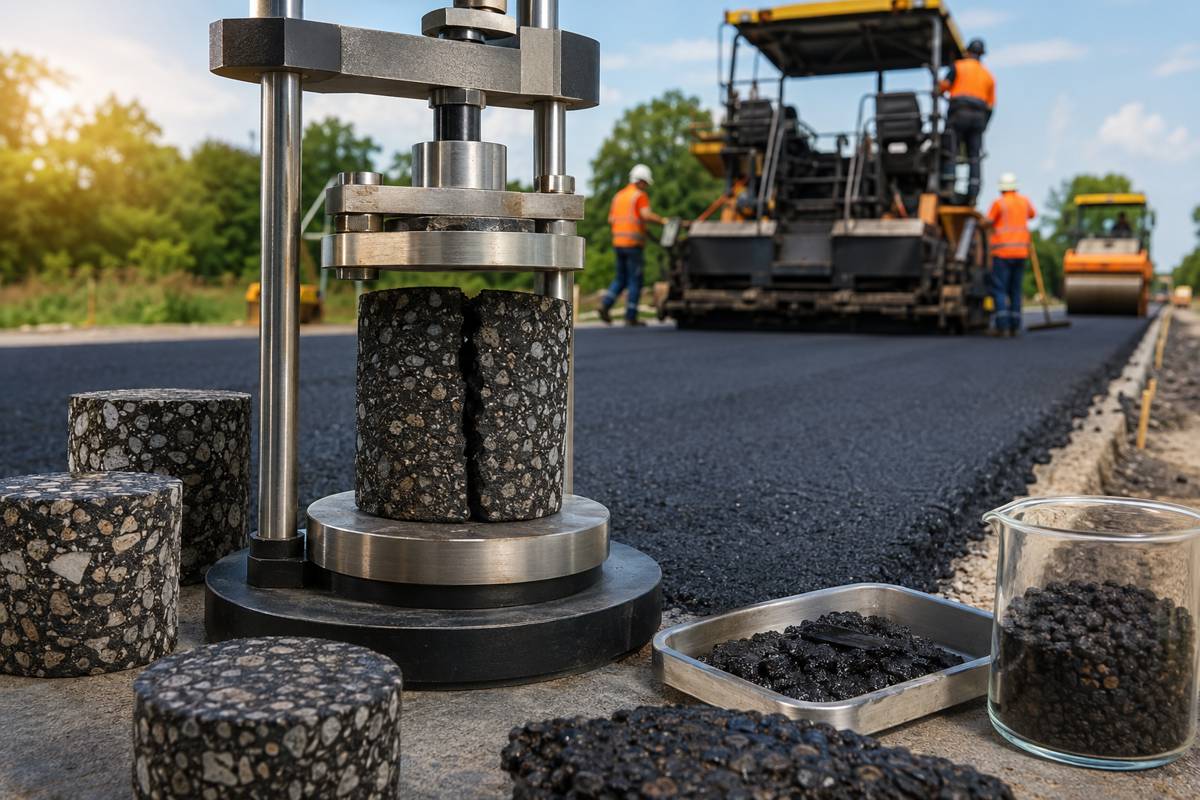
Cracking has long been the distress that undermines the economic case for durable asphalt, and the response has been a proliferation of laboratory tests rather than a single agreed method. The industry can already reach for the indirect tensile cracking test that produces the Cracking Tolerance Index under ASTM D8225, the semi-circular bend method under D8044, the disk-shaped compact tension fracture-energy test under D7313, a thermal cracking method under D8303, and a newly approved fatigue standard, D8458, developed to assess how mixtures withstand repeated heavy-truck loading.
Each measures something real, yet the sheer choice creates confusion over which result should govern a purchasing decision, and mixes can pass one test while failing the philosophy of another.
That is the gap WK99720 is designed to close. By codifying how a cracking-evaluation method should be chosen and deployed within mix design, the guide turns a scattered toolkit into a defensible process, which matters far more to a highway agency writing a specification than any individual test procedure.
Mofreh Saleh, professor of civil engineering at the University of Canterbury and an ASTM member, frames the intent around durability and lifespan. “The purpose of the standard is to help engineers design asphalt mixtures with balanced properties that are more resistant to cracking and have a longer service life,” he says. “It can be incorporated into the asphalt mix design process to optimize performance or used as part of quality control and quality assurance programs.” His reference to balanced properties is not incidental, because it points directly at the market movement giving this work its commercial weight.
Balanced Mix Design Is Rewiring How Pavement Is Bought
The concept Saleh alludes to is balanced mix design, and it represents the most consequential change in asphalt specification since Superpave. Where the volumetric method sets an aggregate blend and binder content and then checks the numbers, balanced mix design tests the finished mixture against the distresses that actually destroy pavements, pairing a rutting test such as the Hamburg Wheel Track with a cracking test to confirm that improving one property has not sacrificed the other.
Originating in Texas and now advanced in Louisiana, New Jersey and California, the approach relaxes rigid volumetric constraints in favour of demonstrated field performance, which changes the terms of trade between owner and contractor.
The commercial consequence is a migration of purchasing power towards measured outcomes. Under a balanced framework, a producer is no longer rewarded simply for meeting a recipe, but for delivering a mixture that provably resists cracking and rutting in a given climate and traffic regime, which rewards technical capability and penalises box-ticking.
Adoption remains uneven, and research summarised in Virginia’s balanced mix design roadmap found that while roughly two dozen state agencies required a rutting test in mix design, only a handful mandated a cracking test, exposing precisely the weakness a standardised cracking framework is meant to correct. That imbalance has held the concept back, because a design philosophy built on balancing rutting against cracking cannot function reliably if the cracking half of the equation lacks a common standard.
Cracking Resistance Is The Gate On Recycled Value
The financial stakes sit in recycled content, and this is where a cracking guide stops being a laboratory nicety and becomes an economic lever. Reclaimed asphalt pavement is the most recycled material in the United States, and 2024 industry data compiled by the National Asphalt Pavement Association with the Federal Highway Administration recorded more than 101 million tons returned to use, conserving roughly 5.1 million tons of binder and 96 million tons of virgin aggregate while saving road owners an estimated 4.7 billion dollars against virgin materials.
Warm-mix asphalt, which lowers production temperatures and energy use, accounted for around 40 per cent of output in the same year. The industry body is now pressing federal legislators to reward mixtures that exceed a quarter recycled content, which would push recycled binder ratios higher still.
The catch is metallurgical, or rather rheological. Recycled binder is aged and stiff, and every additional percentage point of reclaimed material raises the risk of premature cracking, which is exactly the distress a growing number of agencies have reported in newer pavements built with recycled binders. Cracking resistance is therefore the technical constraint that decides how much cheaper, lower-carbon material a producer can safely specify, and a robust, standardised way to measure it is what allows rejuvenators, warm-mix additives and high recycled-content mixes to be pushed to their economic limit rather than held back by caution.
Saleh ties the durability argument straight to lifecycle cost. “Longer-lasting pavements require fewer repairs, reducing maintenance costs, traffic disruptions, material consumption, and greenhouse gas emissions over the pavement’s life cycle,” he says. In a market where materials suppliers such as rejuvenator and additive specialists position their products explicitly around balanced mix design, the test that governs cracking effectively governs who wins the specification.
Precision Is The Barrier Nobody Advertises
For all the momentum behind performance testing, the quiet obstacle has always been reproducibility. A cracking test is only useful for procurement if two laboratories testing the same mixture arrive at comparable results, and index tests have historically shown enough variability to make agencies wary of writing them into pass-or-fail specifications. Without agreed precision, a producer can dispute a failing result, an owner cannot enforce a threshold with confidence, and the whole balanced-design edifice wobbles. This is the unglamorous engineering problem that determines whether performance specifications hold up in a commercial dispute.
The committee is confronting that directly through the validation programme attached to the guide. “As the standard progresses, we plan to undertake a round-robin test program and an interlaboratory study (ILS) to establish the precision and reproducibility of the test method,” Saleh says. “We would welcome the participation of laboratories from around the world to support this important stage of the standard’s development.” An interlaboratory study is the mechanism that converts a promising test into an enforceable specification, because it produces the repeatability and reproducibility statistics that let an agency defend a rejection or a bonus payment. For contractors, materials producers and testing houses, taking part is not merely civic-minded participation but a chance to shape the precision limits they will later be measured against.
The Standard Is Written For A Global Pavement Market
Although balanced mix design has advanced fastest in the United States, the significance of a standardised cracking framework is international, and the composition of the effort reflects that. Saleh works at the University of Canterbury in Christchurch, a centre of pavement research operating within the Australasian AUSTROADS design tradition, and his call for laboratories worldwide to join the interlaboratory study is a deliberate move towards harmonisation rather than a purely North American exercise.
The wider relevance is straightforward, because cracking is a universal pavement distress and every road authority weighing higher recycled content against durability faces the same evidentiary problem. A common method travels across borders in a way that a patchwork of national practices cannot.
That harmonisation carries commercial and strategic weight for anyone operating across jurisdictions. Materials suppliers, testing laboratories and international contractors benefit when a single, defensible cracking protocol underpins specifications in multiple markets, because it lowers the cost of qualifying products and reduces the risk of a mix accepted in one country being rejected in another.
ASTM frames the work against United Nations Sustainable Development Goals 9 and 11, on resilient infrastructure and sustainable communities, and with more than 12,000 of its standards in use globally the body has the reach to make a cracking-evaluation guide a genuine reference point. For a global pavement market absorbing ever more recycled material, an agreed measure of durability is the connective tissue that lets sustainability ambitions and procurement discipline advance together.
Where Industry Leaders Should Concentrate
The practical message for the sector is that the centre of gravity in asphalt specification is shifting from composition to demonstrated performance, and cracking resistance is the property around which that shift now turns. Highway agencies and infrastructure owners revising their quality assurance regimes have a clear reason to track WK99720 as it develops, because a standardised cracking framework will influence how balanced mix design is written into contracts and how recycled-content limits are justified.
Testing laboratories and materials producers have an even more direct incentive to engage with the interlaboratory study, since the precision statistics it generates will set the tolerances against which their mixes and their equipment are ultimately judged.
The investment logic follows the same line. As performance testing hardens into enforceable specification, commercial advantage accrues to the additive suppliers, rejuvenator manufacturers and test-equipment makers whose products help mixtures pass demanding cracking thresholds while carrying more recycled binder.
The suppliers positioning their portfolios around balanced mix design today are anticipating a market in which durability is measured rather than assumed, and a credible, internationally recognised cracking guide accelerates exactly that transition. The organisations that treat cracking resistance as a strategic variable rather than a compliance afterthought are the ones most likely to capture the value now consolidating around proven, long-life, lower-carbon asphalt.
Key Industry Questions
- What is ASTM WK99720 and how does it differ from existing cracking tests? WK99720 is a proposed standard guide under development by ASTM committee D04, intended to define how engineers should design methods for evaluating the cracking resistance of asphalt mixtures. Unlike ASTM D8225, D8044, D7313 or D8303, it is not a single laboratory test but a framework for selecting and applying such tests within mix design and quality control. Its purpose is to bring structure to a fragmented testing landscape, so that agencies and producers can choose a cracking-evaluation approach on a defensible, consistent basis. Because it is still a work item rather than an approved standard, its final scope may evolve, but the intent is to complement the mix design process rather than add another competing procedure to it.
- Why does cracking resistance matter more now than it did a decade ago? Cracking resistance has become central because the industry is using far more recycled binder and lower-temperature warm-mix asphalt to cut cost and carbon. Aged binder from reclaimed asphalt pavement is stiffer and more prone to cracking, so the more recycled material a mixture contains, the more its cracking performance must be proven rather than assumed. Some agencies have reported premature cracking in newer pavements built with recycled binders, which sharpened the focus on measuring the distress directly. A reliable cracking test is therefore the safeguard that lets producers push recycled content and sustainability gains without shortening pavement life, making it a commercial lever rather than a purely technical concern.
- What is balanced mix design and why is it significant? Balanced mix design is a method that judges an asphalt mixture on measured performance against real pavement distresses, typically pairing a rutting test with a cracking test, rather than relying solely on volumetric targets such as air voids and binder content. It originated in Texas and has been advanced in states including Louisiana, New Jersey and California. Its significance is commercial as much as technical, because it rewards producers for delivering demonstrably durable mixtures and gives owners a performance-based basis for acceptance. The approach also relaxes rigid volumetric constraints, allowing greater use of recycled materials and warm-mix technologies, provided the finished mixture proves it can resist both rutting and cracking in service.
- How large is the economic value tied to recycled asphalt? Reclaimed asphalt pavement is the most recycled material in the United States, and 2024 data from the National Asphalt Pavement Association and the Federal Highway Administration recorded more than 101 million tons returned to use. That reuse conserved roughly 5.1 million tons of asphalt binder and 96 million tons of virgin aggregate, saving road owners an estimated 4.7 billion dollars against the cost of virgin materials in a single year. Warm-mix asphalt accounted for around 40 per cent of production. These figures explain why cracking resistance carries such weight, because the ability to safely raise recycled content directly determines how much of this material and cost saving the industry can capture without compromising durability.
- Why is an interlaboratory study so important to this standard? An interlaboratory study, supported by a round-robin testing programme, establishes how repeatable and reproducible a test method is across different laboratories and operators. This matters because a cracking test is only useful for procurement if two laboratories testing the same mixture reach comparable results. Without agreed precision, an owner cannot confidently enforce a specification threshold and a producer can contest a failing result, which undermines the whole basis of performance-based acceptance. The study produces the statistical limits that turn a promising test into an enforceable standard, and laboratories that take part help shape the precision requirements they will later be measured against, giving early participation genuine strategic value.
- How should highway agencies and pavement owners respond? Owners revising quality assurance and acceptance regimes should monitor WK99720 as it progresses, because a standardised cracking framework will influence how balanced mix design is written into contracts and how recycled-content limits are justified. Agencies weighing higher recycled content against durability gain a defensible basis for setting cracking thresholds once a common method exists. In the interim, owners can review which cracking tests their specifications reference and whether precision data supports enforcement. Engaging early, including by encouraging their testing laboratories to join the interlaboratory study, positions an agency to adopt performance-based specification with confidence rather than reacting once a finished standard is imposed on their procurement process.
- What does this mean for materials suppliers and testing laboratories? For additive and rejuvenator suppliers, a robust cracking standard defines the performance their products must help mixtures achieve, and firms already positioning around balanced mix design are anticipating a market where durability is measured rather than assumed. For testing laboratories and equipment makers, the shift creates demand for cracking-test capability and for the calibration and competence that reproducible results require. Participation in the interlaboratory study offers direct commercial insight into where precision limits will settle. Across the supply chain, the common thread is that value is concentrating around the ability to prove cracking resistance, so the suppliers and laboratories that build credibility in this area stand to benefit as performance specification spreads internationally.
Strategic Takeaways
- Asphalt specification is shifting from ingredient-based recipes to demonstrated performance, and cracking resistance is becoming the property that decides how far recycled content and lower-carbon mixes can be pushed.
- WK99720 standardises the interpretive layer rather than adding another test, which is what turns a fragmented toolkit of cracking methods into an enforceable, procurement-ready framework.
- The commercial value sits in recycled material, where proven cracking resistance is the gate that allows higher reclaimed-binder ratios, warm mix and rejuvenators to be specified without sacrificing pavement life.
- Precision and reproducibility, not the tests themselves, are the real barrier to balanced mix design, so the planned interlaboratory study will determine whether performance specifications hold up commercially.
- A cracking guide backed by international participation supports cross-border harmonisation, lowering the cost of qualifying materials in multiple markets and rewarding suppliers that treat durability as a measured, strategic variable.