ONERugged Targets Bus Fleet Integration with New Rugged Vehicle Computers
A bus operator introducing digital ticketing, live vehicle tracking and driver monitoring faces a familiar equipment problem. Each system needs a reliable connection to the vehicle, a display or control interface, and a way of communicating with the depot. Installing separate hardware for every function adds wiring, maintenance requirements and potential points of failure.
ONERugged is addressing that problem with its VPC Series of vehicle-mounted rugged computers, a six-model range intended for public transport, coach operations and commercial fleet management. The devices provide a common hardware platform through which operators and systems integrators can connect ticketing equipment, fleet management software, cameras and vehicle diagnostic systems.
The range comprises the V80J, V80T, V10J, V10T, V12R and V82T, with Android, Windows and Linux configurations available across the family. The emphasis is on vehicle integration, including industrial connectors, multiple communications interfaces and equipment designed to withstand the electrical and mechanical conditions encountered in daily transport operations.
Briefing
- ONERugged has introduced six VPC Series vehicle-mounted computers for bus and commercial fleet applications.
- The range supports integration with ticketing peripherals, vehicle diagnostics, dispatch systems and camera equipment.
- Connectivity options across the family include CAN bus, serial connections, Ethernet, USB and analogue video interfaces, depending on the model.
- The manufacturer specifies IP65 protection and references relevant vehicle environmental testing standards.
- A reported V12R deployment in South America provides an operational reference, although independently verified performance figures have not been disclosed.
Bringing Vehicle Systems onto One Platform
A modern bus can carry several independent electronic systems. Fare collection equipment communicates with payment processors, tracking devices report vehicle positions, cameras monitor road conditions, and dispatch applications transmit information between drivers and control centres.
These functions do not necessarily use the same communications protocols. A ticket printer may require a serial connection, while diagnostic information can be available through CAN bus and camera feeds may use dedicated video inputs. Bringing them together requires suitable interfaces and software capable of handling information from different sources.
The VPC Series provides a selection of physical connections, including RS232, RS485, RJ45 Ethernet, USB, CAN bus, AHD video and general-purpose input/output interfaces across the family. Industrial connectors, including Deutsch-type connections on certain models, are intended to improve reliability in installations exposed to vibration and repeated vehicle movement.
The six devices offer different configurations, allowing integrators to select hardware according to the available vehicle interfaces, peripheral equipment and applications. Compatibility with existing ticketing platforms, proprietary vehicle networks and fleet management software still requires appropriate development and integration work.
For fleet operators replacing ageing equipment, that flexibility may be particularly useful. Many buses already contain a mixture of electronic systems installed at different stages of their working lives, often supplied by separate manufacturers. Introducing a common computing platform offers a way to connect those systems without necessarily replacing every peripheral device.
Ticketing and Passenger Operations
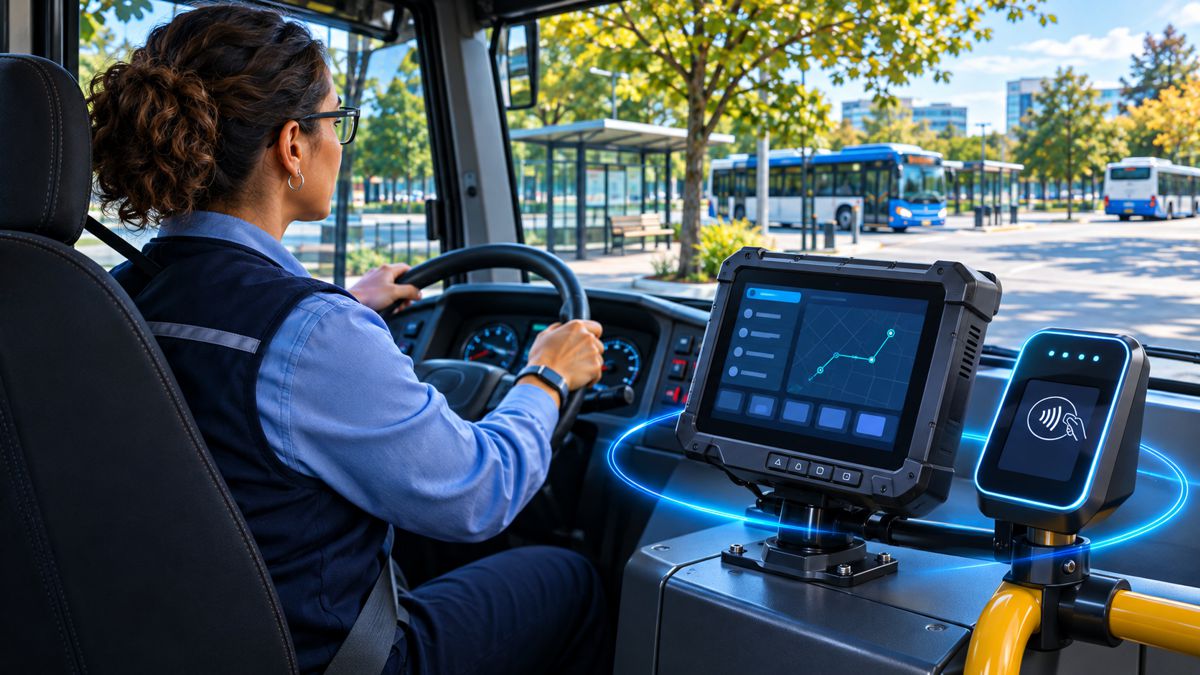
Cashless fare collection is one of the applications ONERugged is promoting for the range. Its proposed configuration connects a vehicle-mounted computer to equipment such as NFC payment readers, barcode scanners and ticket printers, allowing passenger transactions to be managed through a common terminal.
Transaction records can be transmitted to a central system through mobile communications, providing information for revenue reporting and passenger activity analysis. Depending on the ticketing software, operators may also use these records alongside scheduling and vehicle location information.
Existing fare collection arrangements will influence how such installations are configured. Payment processing requires compatible applications, approved payment equipment and appropriate security controls, while transport authorities may have established ticketing contracts and back-office systems that must remain operational.
The PCI Security Standards Council provides the relevant security framework for payment card data, with requirements determined by the equipment and processing architecture used. A vehicle computer forming part of a payment system must therefore be considered within the wider security arrangements rather than assessed in isolation.
Fleet Dispatch, Tracking and Vehicle Diagnostics
The same hardware can support location reporting, driver communications and vehicle monitoring, bringing operational information into a common interface.
ONERugged specifies 4G communications and multi-constellation GNSS positioning within the product range, allowing suitable applications to transmit vehicle locations and operational information to fleet management servers. Dispatchers can monitor service movements, identify delays and send updated instructions to drivers.
In the cab, a terminal can display route assignments, scheduled stops, expected arrival times and operational messages. Drivers can acknowledge instructions or report incidents through the interface, replacing some of the paperwork and routine radio exchanges traditionally associated with fleet operations.
Vehicle diagnostic connections extend the available information. Where appropriate CAN bus data is accessible, a terminal can receive details of operating conditions, fault indications and other parameters made available through the vehicle’s electronic systems. The information varies according to the vehicle manufacturer, electronic architecture and permitted data access.
The VPC Series also supports connections to outward-facing advanced driver assistance cameras and inward-facing driver status monitoring equipment. With suitable cameras and analytical software, these arrangements can provide lane departure warnings, forward collision alerts and indications of driver fatigue or distraction.
Combining these functions allows a control centre to receive information about the vehicle, its location and its operating condition through connected applications. Operators can also use the driver’s terminal to display relevant alerts and instructions, although safety-critical functions require careful consideration of system independence and reliability.
Mobile coverage remains a practical constraint, particularly on rural routes and in areas with limited network reception. Applications intended for continuous fleet operations need to accommodate interrupted connections and restore communications when coverage becomes available.
Driver monitoring introduces additional requirements concerning personal information. Camera recordings, behavioural alerts and associated records must be handled in accordance with the applicable privacy and employment regulations, including the European Union’s General Data Protection Regulation where relevant.
Hardware Designed for Vehicle Conditions
Electronic equipment installed in a bus must accommodate vibration, temperature changes, electrical supply fluctuations and repeated power cycles. Fixed installations also require secure mounting and cable connections that can tolerate sustained movement.
ONERugged specifies IP65 ingress protection across the VPC Series and references MIL-STD-810H and ISO 16750 environmental testing. The ISO 16750 series addresses environmental conditions affecting electrical and electronic equipment in road vehicles, including electrical, mechanical and climatic stresses.
The distinction between these specifications is worth retaining during procurement. IP65 concerns protection against dust and water ingress, while environmental testing addresses different operating stresses. The precise test conditions and results need to be checked against the documentation supplied for the selected model.
Power supply design is another practical consideration. The range includes wide-voltage input and ignition-triggered startup functions, allowing terminals to accommodate vehicle electrical systems and manage their operating state when the ignition is switched on or off.
Mounting options based on VESA or RAM-compatible arrangements provide flexibility in different cab layouts. Installation still needs to account for driver visibility, reach and access to existing controls, particularly in vehicles where dashboard space is limited.
For operators maintaining vehicles over long service periods, the physical installation is as important as the electronics. Connectors, brackets and cable routing must remain accessible for servicing while being sufficiently secure to withstand years of daily operation.
Different Hardware for Different Installations
Although ONERugged presents the VPC Series as a common product family, the devices offer different hardware configurations.
The V12R, for example, uses a 10.1-inch display and a Rockchip RK3568 processor, with Android and Linux configurations described in the manufacturer’s technical documentation. Its specification includes a display rated at up to 700 nits and a 6–36V DC input, providing a larger interface for vehicle applications requiring multiple peripheral connections.
The V82T provides a more compact 8-inch option using a MediaTek MT6789 processor and Android 14. Its specification includes an anti-glare display rated at 700 nits, 4G LTE connectivity, multi-constellation satellite positioning and a selection of communications interfaces.
The V82T also lists 8GB RAM, 128GB storage and a 6–36V DC power input. The smaller display may suit installations where cab space is restricted, while larger terminals provide more room for applications requiring detailed operational information.
Operating system choice will depend on the software being deployed. An application developed for Windows will not automatically run on an Android terminal, and the availability of updates, device management support and replacement hardware can influence purchasing decisions over the life of a fleet.
A South American Fleet Reference
ONERugged reports that a passenger coach operator in South America has deployed the V12R as part of a digital fleet management installation.
According to the manufacturer, the deployment covers vehicle monitoring, dispatch communications and remote maintenance. It reports improved operational coordination and fewer hardware failures than were experienced with the consumer-grade tablets previously used.
An unnamed fleet operations manager is quoted in the announcement: “The ONERugged V12R vehicle tablet effectively solved the delays and errors we experienced with paper-based dispatch. Real-time instruction delivery and vehicle status visualization have greatly improved our operational coordination. The industrial-grade protection design handles our rough roads without issue—running stable with a significantly lower failure rate. This is a reliable, intelligent bus vehicle tablet solution.”
The manufacturer has not identified the customer or supplied deployment numbers, measured failure rates or independently verified maintenance data. Nevertheless, the installation provides an example of the intended application, with permanently mounted equipment replacing general-purpose tablets in regular passenger transport operations.
Fleet Economics and System Integration
Vehicle computers are typically one component of a larger technology procurement. Installation work, communications subscriptions, software licences, peripheral equipment and maintenance arrangements can account for a substantial part of the cost of a connected fleet system.
A common hardware platform may reduce the number of separate devices requiring support, particularly where ticketing, dispatch and vehicle monitoring are being renewed together. The financial outcome will depend on the existing equipment, integration requirements and ongoing software support.
Consolidation also creates dependencies. If several applications rely on one terminal, its failure or removal for maintenance can affect multiple functions. Operators therefore need to consider fault isolation, replacement procedures and whether essential systems require independent operation.
ONERugged includes support for mobile device management and over-the-air software updates, allowing administrators to distribute configuration changes and manage supported terminals remotely. Across a large fleet, these functions can reduce routine visits to individual vehicles, provided the management platform and network arrangements are maintained.
The potential applications extend beyond passenger transport. Delivery fleets, service vehicles and industrial equipment often require similar combinations of secure mounting, diagnostic access and reliable communications. The same considerations apply when integrating a new terminal into an existing vehicle rather than specifying equipment for a new fleet.
For ONERugged, the VPC Series provides a configurable hardware platform for transport operators and the systems integrators responsible for their applications. Its practical value will be established through installation quality, software compatibility and the reliability of the complete system over years of service.
Inside a working bus, the objective is straightforward: fewer independent devices competing for dashboard space, dependable connections to the vehicle and equipment that continues operating through thousands of hours of vibration, temperature changes and daily use.
Key Industry Questions
- What is the ONERugged VPC Series? It is a family of six rugged vehicle-mounted computers designed for transport and fleet applications, including ticketing, dispatch, vehicle monitoring and communications.
- Which models are included? The range comprises V80J, V80T, V10J, V10T, V12R and V82T, with specifications and operating systems varying between models.
- Can the terminals connect to a bus CAN bus network? Selected models support CAN bus connectivity. The diagnostic information available depends on the vehicle, interface configuration and software access.
- Can one terminal manage ticketing and fleet tracking? Yes, where the selected hardware has suitable connections and compatible applications. Integrated ticketing also requires appropriate payment processing and security arrangements.
- Do the computers include built-in driver fatigue detection? The range supports integration with driver monitoring equipment. Detection capabilities depend on the connected cameras and analytical software.
- What does IP65 protection provide? IP65 indicates dust-tight protection and resistance to water jets under specified test conditions. It does not establish protection against every environmental condition.
- What is ISO 16750? ISO 16750 is a series of standards addressing environmental conditions and testing for electrical and electronic equipment installed in road vehicles.
- Can fleet operators manage the devices remotely? ONERugged describes support for mobile device management and over-the-air updates, subject to compatible software, network connectivity and device configuration.
- Has the VPC Series been deployed commercially? ONERugged reports a V12R installation with a South American passenger coach operator, although it has not disclosed independently verifiable fleet size or performance measurements.
Strategic Takeaways
- Integration determines value: A vehicle computer must accommodate the actual equipment, protocols and software installed across a fleet.
- Consolidation has limits: Combining several applications on one device can simplify cab installations but creates shared hardware dependencies.
- Ruggedness needs specification: Environmental ratings should be supported by model-specific testing documentation and appropriate installation methods.
- Software support shapes lifecycle costs: Operating system compatibility, remote management and update availability can be as relevant as initial hardware pricing.
- Operational evidence remains limited: The reported South American deployment offers a reference application, but quantified reliability and maintenance comparisons have not been disclosed.