John Deere Targets the Transport Sweet Spot with New 40 P-Tier Excavator
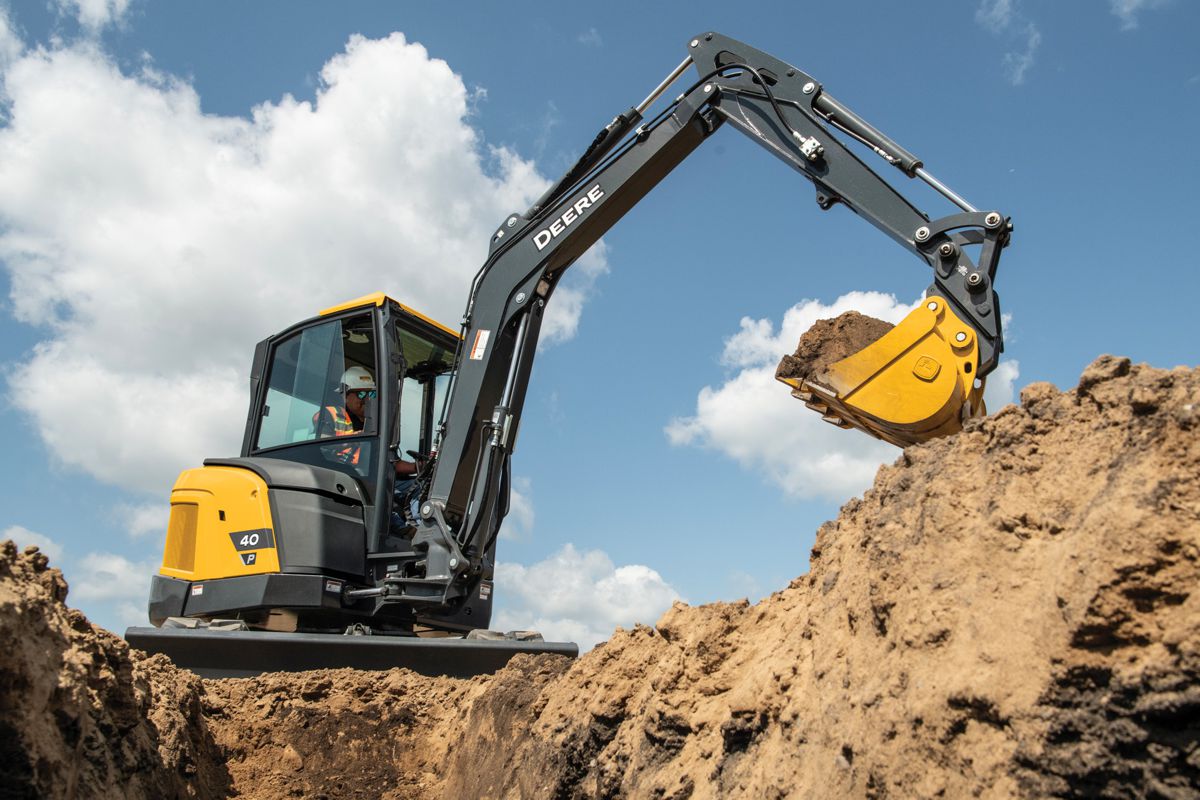
John Deere is adding a new machine between its 35 P-Tier and 50 P-Tier compact excavators, targeting a particularly useful part of the market where digging performance, attachment capability and transport weight have to coexist.
The new 40 P-Tier Compact Excavator is scheduled to make its public debut at Equip Exposition in Louisville, Kentucky, from 20 to 23 October 2026. Its defining characteristic is an operating weight below 10,000 lb, while Deere is positioning its digging and lifting capability closer to machines in the larger size class.
That places the 40 P-Tier in an interesting part of Deere’s existing range. The 35 P-Tier has an operating weight of 8,135 lb in cab configuration, while the 50 P-Tier reaches 10,847 lb. The new machine occupies the space between them, giving contractors and rental fleets another option where moving equipment frequently can matter almost as much as what it can do once it arrives.
Deere describes the machine as suitable for landscaping, utility work, rental fleets and general construction, applications where compact excavators may move repeatedly between relatively short-duration jobs.
Briefing
- John Deere will unveil the 40 P-Tier Compact Excavator at Equip Exposition from 20 to 23 October 2026.
- The machine sits between Deere’s existing 35 P-Tier and 50 P-Tier compact excavators.
- Deere has kept operating weight below 10,000 lb, with transportability central to the design.
- Factory options include a hydraulic pin-grabber coupler, thumb, angle blade, auxiliary hydraulic packages and rear-view camera.
- A new ME28 Mulching Head extends the machine into vegetation management and land-clearing applications.
Between the 35 and 50 P-Tier
John Deere’s 35 P-Tier produces 23.3 hp net, weighs up to 8,135 lb and offers a maximum digging depth of 10 ft. The 50 P-Tier produces 35.9 hp net, weighs 10,847 lb and digs to 11 ft 7 in. Deere’s published fleet specifications therefore leave a substantial weight and performance interval between the two machines.
Specifications reported around the launch put the 40 P-Tier at 9,190 lb in long-arm, cab and extra-counterweight configuration. It uses a 42 gross hp turbocharged Yanmar diesel engine and offers an 11 ft digging depth with the standard arm, extending to 11 ft 10 in with the long arm. Maximum reach is listed at 18 ft 1 in with the standard configuration and 18 ft 10 in with the long arm.
In the US market, Deere says the sub-10,000 lb operating weight can make transportation possible in many circumstances without relying on a commercial driver’s licence. Actual vehicle, trailer, axle, combined-weight and licensing requirements still depend on the transport configuration and applicable regulations, so the excavator’s weight alone does not determine whether a CDL is required.
For landscaping, utility and rental fleets, lighter transport arrangements can be particularly useful where machines regularly move between smaller projects rather than remaining on one site for weeks or months.
Hydraulics and Attachments
Available equipment for the 40 P-Tier includes a hydraulic pin-grabber coupler, factory-installed thumb, angle blade and auxiliary hydraulic packages, along with an optional rear-view camera. Different configurations allow the machine to be set up around the attachments and work patterns expected on individual fleets.
Attachment Manager technology is fitted as standard, allowing operators to store and recall preset hydraulic settings for compatible attachments rather than establishing the required configuration each time a tool is changed. For machines moving between buckets, breakers, grapples, mulchers and other hydraulic tools, repeatable settings can simplify changeovers and reduce the opportunity for incorrect setup. The feature also suits rental fleets, where the same excavator may return to the yard and leave again with a completely different attachment package.
“Operators require equipment that helps them move confidently from task to task, including projects of varying sizes and the new 40 P-Tier Compact Excavator is designed to do just that,” said Emily Pagura, product marketing manager at John Deere.
“With exceptional hydraulic performance, expansive attachment options and an intuitive John Deere technology experience, the 40 P-Tier gives operators the control, versatility and efficiency they need to get more done throughout the day.”
The ME28 Mulching Head
The launch also introduces the ME28 Mulching Head, designed for use with the 40 P-Tier and aimed at vegetation management applications including rights-of-way, fence lines and confined land-clearing operations. It uses a variable-speed motor, durable rotor design and reversible Cubit knife-style teeth.
The combination takes the excavator beyond conventional digging and grading work. Rights-of-way are a natural application, with utilities, highways, railways, pipelines and other linear infrastructure requiring repeated vegetation clearance, sometimes in locations where access is restricted and larger machines are difficult to position.
A compact excavator can also use its boom and upper structure to place a mulching head where conventional ground-based vegetation equipment may struggle to reach, while retaining the ability to switch back to excavation or other attachment work.
Cab and Fleet Technology
The 40 P-Tier carries several features familiar from Deere’s larger excavators, including the CommandARM, an 8-inch touchscreen display and an integrated electronic control-pattern changer. Buyers can also specify a premium Bluetooth radio, rear-view camera, heating and air conditioning, upgraded seating and additional storage.
JDLink connectivity is standard, feeding machine location and health information into John Deere Operations Center. For an owner-operator, that provides remote access to basic machine information and servicing data. Across larger contracting and rental fleets, location, utilisation and condition information becomes more useful as the number of machines and jobsites increases.
Daily service points are also designed for easy access, particularly relevant for machines working short cycles across multiple operators and jobsites.
The 40 P-Tier in Deere’s Range
Compact excavators are increasingly configured around more than bucket capacity, digging depth and operating weight. Auxiliary hydraulics, couplers, specialist attachments, stored hydraulic settings, cameras and telematics allow the same carrier to move between substantially different types of work.
Deere’s existing range helps explain where the 40 P-Tier fits. The 35 P-Tier provides a lighter machine with zero-tail-swing packaging, while the 50 P-Tier moves into a heavier class with greater digging capability. At 9,190 lb in one of its heavier reported configurations, the 40 P-Tier remains below the published 10,847 lb operating weight of the 50 P-Tier while offering digging dimensions that approach it.
For contractors, utilities and rental companies, the choice is ultimately determined by the work. There are jobs where the smallest possible excavator is desirable and others where maximum digging capacity determines the machine. Between them lies a large volume of work where the useful machine is the one that can arrive easily, run the required attachment and still have enough capability once the bucket reaches the ground.
Key Industry Questions
- Where does the John Deere 40 P-Tier fit in the company’s excavator range? It sits between the 35 P-Tier and 50 P-Tier compact excavators. Deere’s published figures put the 35 P-Tier at up to 8,135 lb and the 50 P-Tier at 10,847 lb, while specifications reported around the launch put the 40 P-Tier at 9,190 lb in long-arm cab configuration with extra counterweight.
- How deep can the John Deere 40 P-Tier dig? Published launch specifications give a digging depth of 11 ft with the standard arm and 11 ft 10 in with the long arm.
- What applications is the 40 P-Tier designed for? John Deere identifies landscaping, rental, utility and general construction as primary applications. Its attachment capability also extends the machine into vegetation management and land clearing.
- What is Attachment Manager? Attachment Manager allows operators to recall stored hydraulic settings for compatible attachments, simplifying setup when changing between different hydraulic tools.
- What is the ME28 Mulching Head? The ME28 is a mulching attachment introduced alongside the 40 P-Tier. It is intended for work including rights-of-way maintenance, fence-line clearance and vegetation management in confined areas.
- Does the 40 P-Tier require a commercial driver’s licence to transport? Deere promotes the machine’s sub-10,000 lb operating weight as allowing transportation without a CDL in many circumstances. Whether a CDL is actually required depends on the towing vehicle, trailer, combined weight and applicable regulations.
- Does the 40 P-Tier include telematics? Yes. JDLink connectivity is standard and provides location and machine-health information through John Deere Operations Center.
- When will the 40 P-Tier make its public debut? John Deere plans to display the machine at Equip Exposition in Louisville, Kentucky, from 20 to 23 October 2026.
Strategic Takeaways
- The 40 P-Tier closes a sizeable operating-weight gap between Deere’s 35 P-Tier and 50 P-Tier excavators.
- Keeping the machine below 10,000 lb creates a transport-oriented option for mobile contracting and rental fleets.
- Standard Attachment Manager and multiple auxiliary hydraulic options support frequent changes between different tools.
- The ME28 Mulching Head adds vegetation management and infrastructure rights-of-way to the machine’s potential workload.
- Standard JDLink provides fleet visibility for a machine likely to move frequently between relatively short-duration jobs.