Asplundh Connects Tens of Thousands of Vehicles and Equipment with Samsara
Managing a fleet becomes a very different exercise when the assets being tracked extend from road vehicles and aerial lifts to wood chippers, trailers, electrical testing equipment and smaller tools scattered across thousands of jobs.
Asplundh is bringing much of that operational picture together through a major deployment of Samsara technology across its North American businesses. The programme covers tens of thousands of vehicles and pieces of specialist equipment, combining vehicle telematics, AI-enabled cameras, powered equipment gateways and asset tags.
Asplundh employs approximately 36,000 people and operates across vegetation management, utility construction, electrical testing, pole maintenance, roadway lighting and other infrastructure services. Its work can also require large numbers of crews and machines to be mobilised rapidly when storms damage electricity networks.
Samsara will provide a common digital layer across much of that physical operation, giving Asplundh a consolidated view of vehicles, drivers and equipment while creating standardised safety and operational metrics across its businesses.
Briefing
- Samsara technology is being deployed across tens of thousands of Asplundh vehicles and pieces of specialist equipment in North America.
- The deployment includes AI Dash Cams, Vehicle Gateways, Powered Asset Gateways and Asset Tags.
- Asplundh employs approximately 36,000 people across vegetation management and infrastructure services.
- Equipment covered can range from vehicles and trailers to chippers, aerial lifts, electrical testing equipment and smaller tools.
- FirstNet-compatible vehicle gateways will support priority connectivity for eligible operations involved in utility and emergency response.
One View Across a Large Physical Operation
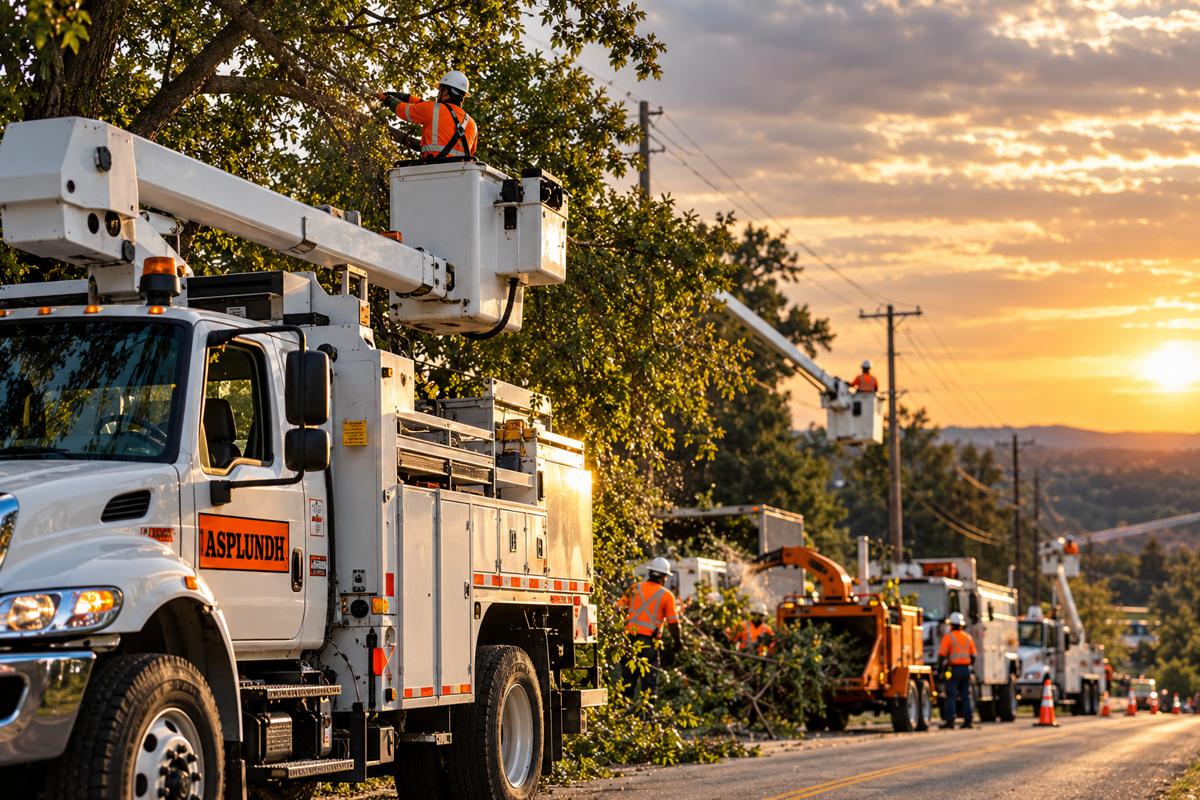
Asplundh’s fleet reflects the breadth of its work. The company describes an equipment base that includes lifts, chippers, tracked equipment, loaders and trucks, alongside machinery used for highway vegetation management and utility infrastructure work.
That variety creates a practical problem for large field-service organisations. A road vehicle can be connected through an onboard telematics gateway. A trailer, chipper or aerial lift requires a different approach, while smaller portable equipment may only justify a compact asset tag.
Samsara’s Powered Asset Gateways and Asset Tags extend that visibility beyond the road fleet. Asplundh plans to use them across equipment including trailers, chippers, aerial lifts and high-value electrical testing equipment, as well as smaller tools.
For an operation of this size, utilisation becomes particularly important. Managers need to know whether equipment is working regularly, sitting unused, approaching maintenance or located hundreds of miles from the next job that needs it.
Farrukh Rafiq, Vice President of Fleet Operations at Asplundh, said the ability to consolidate that information had already changed the company’s view of its operation.
“Working with Samsara has enabled a step change in how we operate and mitigate risk across our fleet,” said Farrukh Rafiq, Vice President of Fleet Operations at Asplundh. “What stands out is how simple the platform makes managing an operation of this size. Seeing our vehicles, crews, and equipment in a single view means our teams are all working from the same picture. Samsara is already helping us improve, and we’re excited to keep investing in technology and co-building what comes next.”
Safety Data from the Cab
The deployment puts driver safety alongside asset management rather than treating the two as separate systems.
Samsara’s AI Dash Cams can identify selected driving hazards and provide in-cab alerts, while recorded operational data allows supervisors to examine patterns across a fleet. Asplundh intends to use the system both to identify areas requiring improvement and to recognise safer driving behaviour.
David Fleischner, Co-President, Vegetation at Asplundh, linked the investment directly with the company’s safety programme.
“Our ongoing commitment to safety contributes to reduced incidents, improved productivity, enhanced morale, and a positive reputation with our partners and customers,” said David Fleischner, Co-President, Vegetation at Asplundh. “Our top priority remains keeping people safe, both on the job and off, and investing in technology is how we do that. Samsara’s AI solutions help us see and manage risk and efficiency in ways we haven’t been able to before.”
Cameras, alerts and telematics can identify events and patterns, but the resulting data still has to be incorporated into training, supervision and operational decisions. At Asplundh’s scale, consistent data can also make it easier to compare performance between operating companies with different fleets, working environments and management structures.
Connectivity During Utility Response
The deployment takes on another dimension when Asplundh moves from routine work into emergency response.
Vegetation management is closely tied to electricity network resilience. Trees and branches can damage overhead lines during severe weather, while restoration can require vegetation crews, utility construction teams and specialist equipment to move into affected areas quickly.
During the response to Hurricane Helene, Asplundh reported that more than 8,000 employees were involved in restoration work across Florida, Georgia, the Carolinas and Virginia, including more than 2,800 additional personnel mobilised from over 40 operating regions.
Such deployments put unusual demands on fleet visibility, with crews and equipment moving between states while local communications networks may themselves be under pressure.
Part of the Samsara deployment therefore includes its VG55-FN Vehicle Gateway. The device is FirstNet Trusted and supports Band 14 as well as commercial LTE bands. FirstNet provides priority communications for public safety organisations and eligible organisations supporting emergency response.
The gateway can transmit near-real-time vehicle and driver information while supporting GPS tracking and remote vehicle diagnostics. For Asplundh, that connects routine fleet management with the more demanding operational requirements of storm restoration and utility support.
Asset Utilisation Across the Business
Large contractors can own substantial numbers of assets distributed between depots, projects and operating companies. Some may be difficult to locate without calling individual supervisors or searching yards. Across large contracting groups, equipment can also be duplicated simply because one operation has limited visibility of what another has available.
Reliable utilisation data can expose those patterns. It can also influence maintenance. Location and usage information can help determine when equipment needs attention and where it should be serviced, rather than treating maintenance records as a separate administrative system.
Asplundh’s decision to combine powered equipment gateways and smaller asset tags reflects the different value and information requirements of its equipment. A hand-held tool does not justify the same hardware used on a truck, while a chipper or aerial lift may require considerably more operational visibility.
The approach allows different classes of asset to remain visible without requiring identical levels of instrumentation.
Standardising a Diverse Business
Asplundh has spent almost a century expanding beyond its original tree-care operations. Established in 1928, the family-owned company now works for electric utilities, municipalities, pipelines and railways, with operations spanning vegetation services and a broad infrastructure division.
Its infrastructure businesses cover activities including power-line construction and engineering, electrical testing and commissioning, utility pole maintenance, roadway lighting, traffic signals and intelligent transportation systems.
That diversity helps explain the emphasis on standardised reporting. The company’s One Asplundh strategy is intended to bring its different operating businesses together more closely, while a common operational platform gives management comparable measures across companies performing very different types of work.
Samsara says its platform can connect with more than 400 partner integrations, allowing information to flow between the connected-operations system and other business software rather than requiring every existing system to be replaced.
The Asplundh deployment fits that architecture particularly well. Its physical estate extends far beyond conventional fleet vehicles, encompassing specialist machines, trailers, tools and equipment moving between depots, projects and emergency deployments.
Vehicles Arriving Connected
Asplundh is also addressing the installation process before new vehicles enter its fleet.
Under Samsara’s Pre-Delivery Installation programme, new vehicles can arrive with the required technology already fitted. For a large fleet, this removes a small but repetitive piece of operational friction: receiving a vehicle and then taking it out of the deployment pipeline while telematics equipment is installed.
Standardising installation at the point of delivery can also reduce variations between vehicles and establish the data connection from the beginning of an asset’s working life.
Asplundh additionally expects its safety data to play a role in insurance arrangements. Samsara says its insurance partnerships can help customers reduce collateral obligations where improved visibility provides evidence of safety performance. The eventual financial benefit will depend on Asplundh’s insurance structure and demonstrated results rather than the technology alone.
Connecting the Physical Business
Digital fleet systems have become commonplace, but large contractors and infrastructure service companies can still operate with information divided between vehicle telematics, equipment registers, maintenance systems, spreadsheets and the practical knowledge held by individual depots and supervisors.
Connecting tens of thousands of assets does not automatically solve those organisational problems. It does create a common operational dataset from which utilisation, maintenance, dispatch and safety decisions can be made.
David Gal, Vice President of Connected Equipment at Samsara, described the challenge in physical terms.
“Asplundh crews work every day to protect the infrastructure that communities run on,” said David Gal, Vice President of Connected Equipment at Samsara. “An operation this size means keeping track of thousands of vehicles, tools, and equipment at once. The more precisely they can do that, the faster they can show up when a community needs them, and that’s exactly what we build for.”
For Asplundh, the test will come in everyday operations rather than the number of connected devices. A chipper found without a phone call, a truck dispatched from the right depot, an aerial lift maintained before it becomes unavailable or a storm crew directed towards the equipment it needs would each be a small result. Across tens of thousands of assets, those small decisions are where the economics of connected operations begin to accumulate.
Key Industry Questions
- What technology is Asplundh deploying from Samsara? The programme includes AI Dash Cams, Vehicle Gateways, Powered Asset Gateways and Asset Tags across the company’s North American operations.
- How large is the deployment? The companies describe it as covering tens of thousands of vehicles and pieces of specialist equipment across the Asplundh family of companies.
- Why connect equipment as well as vehicles? Equipment connectivity allows operators to monitor location, utilisation and maintenance across assets such as trailers, chippers and aerial lifts rather than limiting fleet intelligence to road vehicles.
- What is a Powered Asset Gateway? It provides connectivity and operational visibility for powered equipment and other non-road assets that would not normally use a conventional vehicle telematics gateway.
- What is the role of asset tags? Asset tags provide a lighter form of tracking suitable for smaller equipment and tools where fitting a full telematics gateway would be unnecessary.
- How does FirstNet fit into the system? Samsara’s VG55-FN Vehicle Gateway is FirstNet Trusted and supports FirstNet’s Band 14 and priority connectivity capabilities for eligible organisations, which can be useful during emergency and utility restoration operations.
- Will AI Dash Cams make the fleet safer automatically? No. They can identify selected risks, issue alerts and provide safety data, but improvements still depend on training, supervision, operating policies and how effectively the information is used.
- Why is standardised reporting useful across a large contractor? It allows managers to compare operations using common measures even when individual businesses operate different vehicles, equipment and services.
Strategic Takeaways
- Extending telematics beyond trucks and vans gives large contractors a more complete picture of the equipment supporting field operations.
- Different connectivity technologies allow high-value machines, powered equipment and smaller tools to be incorporated without using the same hardware on every asset.
- Asset utilisation data can influence fleet purchasing by identifying equipment that is scarce, heavily used or persistently idle.
- Priority communications become particularly relevant when utility contractors move from routine operations into large-scale storm and emergency response.
- A common operational dataset can support consolidation across businesses without requiring every operating company to use identical equipment or working practices.