Turning Industrial Exhaust Into Feedstock with Direct Reactive Capture
For most of the past decade, the debate over carbon capture in cement, steel and heavy chemicals has fixated on the wrong number. Attention has settled on how much CO₂ a plant can capture, when the harder commercial question has always been what happens next. Capturing carbon dioxide from a kiln or a smelter is now well understood engineering.
Turning that captured gas into something worth selling is where the economics fall apart, because almost every conversion route first demands that the CO₂ be separated from everything else in the exhaust and purified to a high standard before a single molecule of product can be made. That clean-up stage carries much of the cost and much of the energy penalty, and it is the reason so many capture projects default to burying the gas rather than using it.
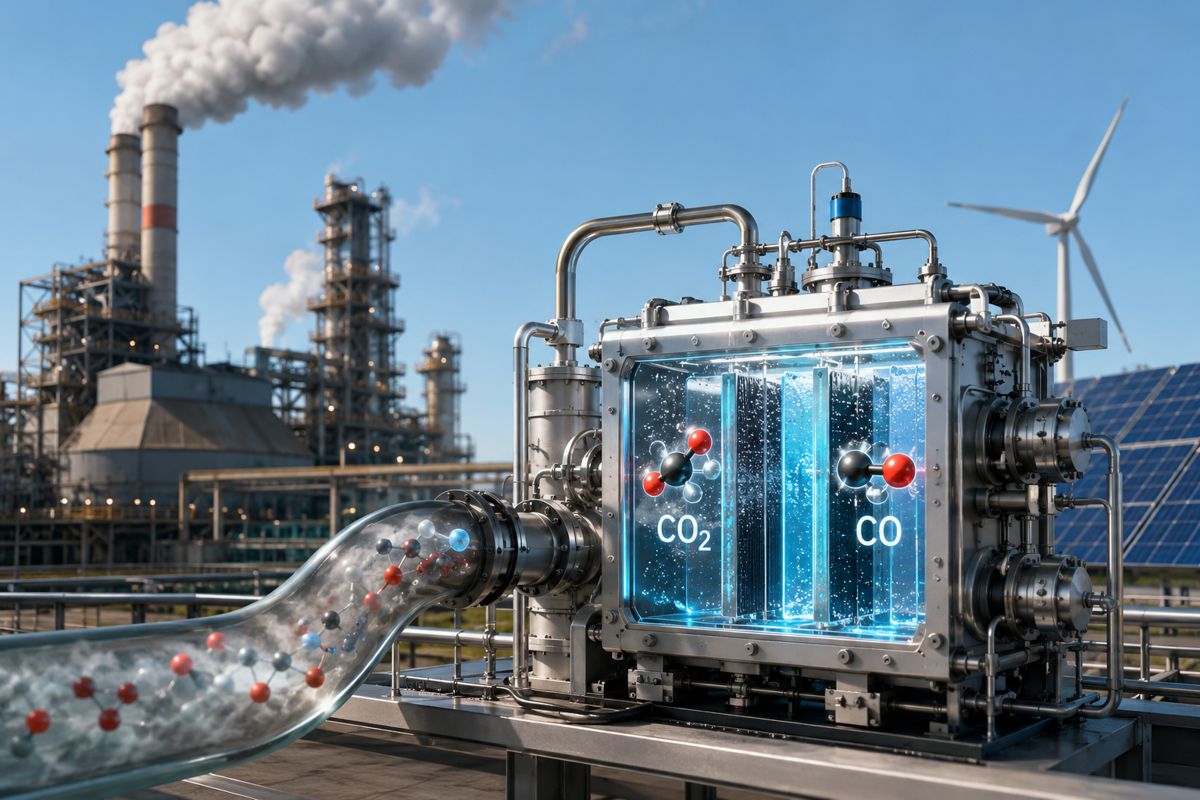
A research team led by the Université de Montpellier and Adelaide University has now demonstrated a way to skip that stage entirely, converting CO₂ straight from raw, unpurified industrial flue gas into carbon monoxide, a foundational feedstock for fuels and chemicals. Published in Nature Communications, the work is a laboratory result rather than a plant-ready process, and it should be read as such. Its significance for construction materials producers, infrastructure asset owners and industrial investors lies in where it points.
If direct conversion from dirty flue gas can be made cheap and durable at scale, the commercial logic of carbon capture shifts from a cost that has to be subsidised or regulated into existence toward a process that produces a saleable product. That shift is arriving at precisely the moment European fuel regulation is manufacturing guaranteed demand for exactly the molecules this chemistry produces.
Briefing
- A team led by the Université de Montpellier and Adelaide University, with partners at Shaanxi University of Science & Technology and Southwest Jiaotong University, has converted CO₂ directly from unpurified flue gas into carbon monoxide, published in Nature Communications under the title Hydrogen Bond Network Disruption Enables Efficient Direct Reactive Capture of CO₂ from Flue Gas.
- The advance targets the most expensive part of carbon utilisation, the separation and purification of CO₂ from a dilute, oxygen-rich exhaust stream, which conventional conversion routes require before any product can be made.
- Using simulated flue gas at 15 per cent CO₂ and 8 per cent oxygen, the system achieved close to 100 per cent selectivity to carbon monoxide, consumed 30.7 gigajoules per tonne of CO, and ran continuously for more than 100 hours, with the underlying paper reporting selective conversion down to 1 per cent CO₂ in the presence of oxygen.
- Paired with a high-efficiency solar cell, the integrated system reached a solar-to-fuel efficiency of roughly 5.5 per cent, comparable to systems that depend on cleaned and purified CO₂.
- The wider market is moving in the same direction, with the carbon capture, utilisation and storage sector valued at around USD 5.3 billion in 2025 and forecast to reach at least USD 30 billion by 2035, while European aviation fuel rules are locking in demand for synthetic fuels built from captured carbon.
Why Separation Is the Expensive Step
Industrial flue gas is an awkward feedstock. A cement kiln or a steel plant produces an exhaust that is mostly nitrogen and oxygen, with carbon dioxide typically present at somewhere between a few per cent and a fifth of the stream. Conventional carbon utilisation cannot work with that mixture directly, because the oxygen and the low CO₂ concentration trigger competing reactions that swamp the intended chemistry and collapse efficiency.
The established answer has been to bolt a separation and purification train onto the plant, stripping the CO₂ out and concentrating it before sending a clean stream to a converter. That train is expensive to build, expensive to run and thermally hungry, and it is the single largest reason carbon utilisation has struggled to compete with simply venting or storing the gas.
The Montpellier and Adelaide work attacks the problem at the level of the reaction environment rather than the plant layout. The team engineered an organic solvent electrolyte with a low hydrogen-bond-donation ability, which disrupts the hydrogen-bond network that normally allows parasitic hydrogen evolution and oxygen reduction to dominate under dilute, impurity-rich conditions.
Adelaide University Chemical Engineering Dean, Professor Yan Jiao, framed the outcome in commercial terms, noting that the team had developed a mixture that weakens hydrogen bonding, suppressing unwanted side reactions while favouring conversion. “Our work shows it is possible to use CO₂ directly from industrial exhaust streams without extensive purification, making carbon utilisation much more practical and potentially more economical,”
Professor Jiao said. The interesting engineering claim buried in the underlying paper is that the approach holds selectivity down to CO₂ concentrations as low as 1 per cent while oxygen is present, which is the regime real exhaust gases actually occupy. Removing the purification requirement does not just cut a line item from the capital budget, it changes which emitters can plausibly host conversion at all.
The Hard-to-Abate Case, and Why Cement Cares Most
No sector has more at stake in this than cement. Cement and concrete production accounts for roughly 8 per cent of global carbon dioxide emissions, and the structure of those emissions is what makes the industry so difficult to decarbonise. About two-thirds of a cement plant’s direct emissions come from calcination, the chemical release of CO₂ when limestone is broken down to make clinker, and no amount of fuel switching, clinker substitution or energy efficiency removes that process fraction.
Carbon capture is not one option among several for deep cuts in cement, it is effectively the only route to the last and largest tranche of abatement, capable of cutting plant emissions by up to around 98 per cent where it is deployed. The Global Cement and Concrete Association reports that the sector has already lowered the carbon intensity of its products by about a quarter since 1990, but the remaining reductions are the expensive ones.
The cost of that capture is the whole game. Techno-economic studies of the United States cement sector put the median cost of capture at somewhere between 144 and 215 US dollars per tonne of CO₂ depending on how much of the sector is abated, and European analyses reach broadly similar territory once emissions allowance prices are factored in. Almost all of that spending currently produces a stream of gas that then has to be transported and stored, a pure cost with no revenue on the other side unless a utilisation market exists nearby.
A process that converts flue gas to a saleable feedstock on site, without the separation train, reframes the investment case for a cement or lime producer. It offers the prospect of turning the calcination emissions that cannot be engineered away into a product line, which is a very different proposition from paying indefinitely to inject them underground. For infrastructure owners procuring low-carbon cement and concrete, the same shift matters downstream, because the cost of capture ultimately lands in the price of the material.
From Cost Centre to Feedstock: The Carbon Monoxide Value Chain
Carbon monoxide is an unglamorous molecule with an outsized commercial role. It is a primary building block for synthesis gas, and through Fischer-Tropsch and related routes it feeds the manufacture of synthetic fuels, methanol and a long list of chemicals. Producing CO from captured carbon rather than from fossil feedstocks is the foundation of the power-to-liquids pathway, the electrified route to synthetic kerosene, diesel and chemical intermediates that industry shorthand calls e-fuels. The value of the Montpellier and Adelaide result is that it produces this specific feedstock, cleanly and selectively, from the dirtiest and most abundant source of CO₂ available, namely industrial exhaust.
Dr Damien Voiry from the Université de Montpellier described the mechanism as the heart of the finding. “We found that controlling hydrogen-bond interactions is the key to suppressing unwanted reactions and enabling highly selective carbon dioxide conversion,” he said, adding that the approach “opens a new direction for carbon utilisation technologies and could help accelerate the transition towards sustainable fuel and chemical production powered by renewable energy.”
The demand side of that value chain is no longer speculative, because European regulation has legislated it into being. Under the ReFuelEU Aviation regulation, fuel suppliers must blend a rising minimum share of sustainable aviation fuel into jet fuel at European airports, climbing from 2 per cent in 2025 to 6 per cent in 2030 and eventually to 70 per cent by 2050.
Crucially, the rules carve out a separate binding sub-mandate for synthetic e-fuels made from renewable hydrogen and captured CO₂, which ramps up through the 2030s toward 35 per cent by 2050 and which must be met each year rather than averaged away. That is a guaranteed, penalty-backed demand floor for fuels built on captured carbon, and carbon monoxide sits directly upstream of the synthetic kerosene those mandates require. When a supply-side chemistry breakthrough and a legislated demand curve point at the same molecule, the commercial signal is worth taking seriously.
Where the Money and the Intellectual Property Are Moving
The academic result lands in a market that is already attracting serious capital and consolidating around a handful of competing conversion routes. The broader carbon capture, utilisation and storage sector was worth in the region of USD 5.3 billion in 2025, with mainstream forecasts putting it at USD 30 billion or more by the mid-2030s and some analysts modelling considerably higher figures depending on policy assumptions. Solvent and sorbent based capture still dominates that market, holding around two-thirds of technology share, but electrochemical conversion is the fastest-moving segment and the one where the Montpellier and Adelaide chemistry competes.
The direction of investment tells its own story. The US company Twelve has raised close to a billion dollars to run electrochemical reactors that turn CO₂ into carbon monoxide as the first step toward synthetic jet fuel and specialty chemicals, while LanzaTech has built the most commercially advanced position in biological conversion of carbon-rich industrial off-gases, and firms such as Carbon Clean and CarbonCure occupy the capture and mineralisation flanks of the same field.
Academic competition is intensifying in parallel, which is the clearest sign that direct, integrated capture-and-convert has become the field’s central problem rather than a niche curiosity. A separate 2026 study in Nature Energy demonstrated reactive capture in non-aqueous media by tuning amine speciation, and other groups have pursued amino-acid capture solutions and light-driven metal-organic frameworks that capture and convert CO₂ in a single step. Each approach is chasing the same commercial prize, which is selective conversion from realistic, oxygen-rich, CO₂-lean streams without the energy cost of separation.
For industrial buyers and investors, the practical read is that the technology risk is spread across several credible routes, and that the winners will be decided less by peak laboratory selectivity than by durability, energy cost and the ability to run on genuinely dirty gas. That is the terrain on which a cement or steel producer will eventually write a purchase order.
What Still Stands Between the Bench and the Kiln
Confidence about direction should not be mistaken for confidence about timing. The reported energy figure of 30.7 gigajoules per tonne of carbon monoxide places the process among the more competitive direct capture-and-conversion results published to date, and more than 100 hours of continuous operation is a meaningful durability signal for a laboratory system, but neither number is yet a commercial specification.
The solar-to-fuel efficiency of roughly 5.5 per cent is respectable and, importantly, matches what comparable systems achieve on purified CO₂, which is the whole point of the exercise. Scaling from a bench cell to a reactor that handles the volume, temperature, particulates and trace contaminants of a real cement or steel stack is a substantial engineering programme, and the organic electrolytes at the core of the approach will need to prove they are stable, recoverable and affordable at industrial throughput.
The infrastructure question is equally live. Direct on-site conversion is attractive precisely because it avoids building CO₂ pipelines and separation trains, but it substitutes a different set of requirements, including large volumes of low-cost renewable electricity, downstream synthesis capacity to turn carbon monoxide into finished fuel or chemical, and offtake arrangements to sell the product.
Those are exactly the assets that the UK’s multibillion-pound commitment to industrial CCUS clusters and similar hub strategies across Europe and North America are designed to co-locate. A plausible near-term pathway is not a standalone cement plant making its own jet fuel, but a capture-and-convert unit embedded within an industrial cluster where hydrogen, renewable power and synthesis capacity already sit alongside the emitter. The chemistry reduces one barrier decisively. The commercial architecture around it still has to be built.
Reading the Signal for Industrial Strategy
The honest framing of this result is that it is an early marker of where competitive value in carbon management is heading, not a product a plant manager can order this year. For construction materials producers, the strategic implication is nonetheless concrete. The assumption baked into most decarbonisation roadmaps, that captured cement and lime emissions are a cost to be stored, is beginning to look conservative. As direct conversion matures, those same emissions become a potential feedstock, and the plants that sit inside industrial clusters with access to cheap renewable power and synthesis capacity will be best placed to capture that value.
Professor Jiao pointed explicitly at this readership, noting that the approach “could help heavy industries such as steel, alumina refining, cement, chemicals, and energy production move toward cleaner and more circular production.”
For investors and infrastructure owners, the sharper lesson is about where to look for advantage. The competitive frontier in carbon capture is moving from the capture step, which is increasingly commoditised, toward the conversion step, where separation cost and feedstock quality decide the economics. Technologies that tolerate dirty, dilute, oxygen-rich gas and turn it into a marketable molecule without an expensive purification stage will command the value in that chain.
Cement, steel and alumina producers evaluating long-term capture strategy have reason to track integrated capture-and-convert developments as closely as they track storage infrastructure, and to design flexibility into any near-term capture investment so that a stored-carbon plant can become a converted-carbon plant when the chemistry and the market are ready. The molecules coming out of the world’s kilns and smelters have spent a century being treated as waste. The commercial question now is which producers will be positioned to treat them as inventory.
Key Industry Questions
- What is direct reactive capture, and how does it differ from conventional carbon capture? Conventional carbon capture separates CO₂ from a flue gas stream and purifies it, then sends that clean stream to a separate process for storage or conversion. Direct reactive capture combines the capture and conversion steps and works on the raw exhaust without an intermediate purification stage. The Montpellier and Adelaide system does this electrochemically, using an engineered organic electrolyte to suppress the competing reactions that oxygen and low CO₂ concentrations normally trigger. The commercial appeal is the elimination of the separation and purification train, which carries much of the capital cost and energy penalty in traditional utilisation projects. It changes carbon capture from a process that produces a gas to be managed into one that can produce a saleable feedstock.
- Why is CO₂ purification so expensive in carbon utilisation? Industrial flue gas is mostly nitrogen and oxygen, with CO₂ often present at only a few per cent up to around a fifth of the stream. Converting that CO₂ directly is difficult because oxygen and dilution drive parasitic reactions that ruin efficiency, so conventional routes first strip out and concentrate the CO₂. That separation stage requires dedicated equipment, consumes significant thermal energy for solvent regeneration, and adds both capital and operating cost. Because the purified gas usually ends up stored rather than sold, the entire expense sits on the cost side of the ledger with no offsetting revenue. Removing the purification requirement is therefore one of the highest-value targets in the whole carbon management chain.
- What can carbon monoxide made from flue gas actually be used to make? Carbon monoxide is a core industrial building block, most importantly as a component of synthesis gas. Through Fischer-Tropsch and related processes it can be converted into synthetic fuels including kerosene and diesel, into methanol, and into a wide range of chemical intermediates. Producing it from captured CO₂ rather than fossil sources is the basis of the power-to-liquids pathway for making e-fuels. That positions CO directly upstream of the synthetic aviation fuels that European regulation increasingly requires. For an emitter, the ability to make CO on site turns a waste stream into the first link of a chemicals or fuels value chain.
- How relevant is this to cement and construction materials producers? It is arguably most relevant to them. Cement accounts for roughly 8 per cent of global CO₂ emissions, and about two-thirds of a plant’s direct emissions come from calcination, a chemical release that cannot be removed by fuel switching or efficiency measures. Carbon capture is effectively the only route to deep cuts in that process fraction. Today most captured cement emissions are destined for storage, a permanent cost. A conversion route that turns those emissions into a feedstock without an expensive purification stage could reframe capture as a revenue opportunity rather than a compliance burden, which is a materially different investment case for lime and cement producers.
- Is 30.7 gigajoules per tonne of carbon monoxide competitive? The researchers describe it as among the more competitive direct capture-and-conversion figures reported to date, and on a like-for-like laboratory basis that appears fair. The result also matters because the system reaches that performance on unpurified flue gas rather than on a cleaned CO₂ stream, and its solar-to-fuel efficiency of around 5.5 per cent matches comparable systems working on purified feedstock. Those are strong signals at laboratory scale. They are not yet a commercial specification, because industrial deployment introduces losses, contaminants and throughput demands that bench experiments do not capture. The number should be read as an encouraging benchmark for the approach rather than a guaranteed plant performance.
- How far is this technology from commercial deployment? Some distance, and that should be stated plainly. The work is a laboratory demonstration, and scaling to a reactor that handles the volume, temperature and impurity load of a real cement or steel stack is a significant engineering task. The organic electrolytes at its core must prove stable, recoverable and affordable at industrial throughput, and the process needs downstream synthesis capacity and renewable power alongside it to make a finished product. A realistic early route is deployment inside industrial clusters where hydrogen, clean electricity and synthesis capacity already exist. Commercial timelines will depend on that surrounding infrastructure as much as on the chemistry itself.
- What does ReFuelEU Aviation mean for demand for CO-derived fuels? ReFuelEU Aviation obliges fuel suppliers to blend a rising share of sustainable aviation fuel into jet fuel at European airports, moving from 2 per cent in 2025 to 6 per cent in 2030 and up to 70 per cent by 2050. Within that, a separate binding sub-mandate covers synthetic e-fuels made from renewable hydrogen and captured CO₂, rising through the 2030s toward 35 per cent by 2050 and required to be met each year. Because carbon monoxide sits upstream of synthetic kerosene, that sub-mandate creates a legislated, penalty-backed demand floor for fuels built on captured carbon. It provides the kind of long-term market certainty that conversion investments need.
- Which companies are commercialising electrochemical CO₂ conversion? The most prominent is Twelve in the United States, which has raised close to a billion dollars to run electrochemical reactors that convert CO₂ into carbon monoxide as a first step toward synthetic jet fuel and chemicals. LanzaTech holds the leading commercial position in biological conversion of carbon-rich industrial off-gases into fuels and chemicals, and companies including Carbon Clean and CarbonCure occupy the capture and mineralisation parts of the field. Academic competition is intensifying alongside them, with recent work on non-aqueous reactive capture, amino-acid capture solutions and light-driven metal-organic frameworks. The breadth of credible approaches spreads technology risk and suggests the field’s winners will be decided by durability and cost on real gas rather than by headline selectivity alone.
Strategic Takeaways
- The competitive frontier in carbon capture is shifting from the capture step, which is becoming commoditised, toward the conversion step, where the cost of separation and the quality of feedstock now decide the economics.
- Cement and lime producers have the most to gain from direct conversion, because their largest emissions come from calcination and cannot be abated any other way, making a route that turns those emissions into a feedstock a potential change in the investment case rather than a marginal saving.
- Legislated demand for synthetic fuels under ReFuelEU Aviation gives captured carbon a guaranteed downstream market, aligning a supply-side chemistry advance with a policy-driven demand curve pointed at the same molecule.
- Near-term commercial deployment is most plausible inside industrial clusters that already co-locate renewable power, hydrogen and synthesis capacity, so the value will accrue to emitters positioned within that infrastructure rather than to standalone plants.
- Producers making capture investments now should design in flexibility, so that a plant built to store carbon can pivot to converting it once the chemistry matures and the offtake market is in place.