Drilling a Mile Down to Build Underground Nuclear Reactors
Deep Fission has successfully lowered a full-size prototype reactor canister into a 34-inch borehole and recovered it using equipment already available to the commercial drilling industry, an early field test of a nuclear concept that ultimately intends to place reactors approximately one mile underground.
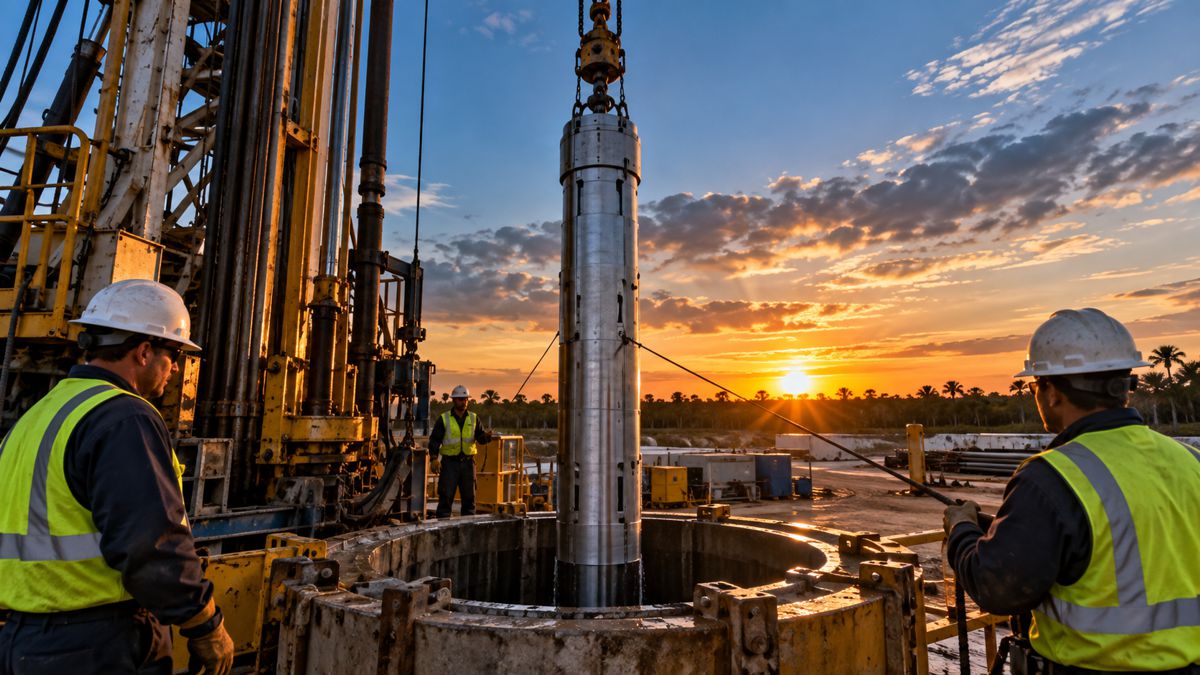
The September demonstration in Fort Myers, Florida, was deliberately much shallower. A 30-inch prototype canister was lowered to approximately 100 feet, aligned and subsequently retrieved. The canister itself was around 20 feet long and contained no nuclear material.
It was nevertheless a useful mechanical exercise. Deep Fission’s proposed Gravity reactor depends upon considerably more than designing a compact pressurised water reactor. The company must establish that large-diameter boreholes can be constructed reliably, that substantial reactor components can travel through them, and that the resulting underground system can be installed and recovered at depths measured in thousands rather than hundreds of feet.
That work is bringing Deep Fission into an industrial sector with little obvious connection to conventional nuclear construction: commercial deep drilling.
The company has entered a collaboration with Florida-based Youngquist Brothers to evaluate and test the large-diameter drilling and borehole-construction techniques required for the concept. Youngquist says it has been drilling large-diameter boreholes since 1971 and has completed holes exceeding 8,000 feet in depth.
Briefing
- Deep Fission lowered and retrieved a full-size 30-inch prototype reactor canister in Florida on 3 September 2026.
- The demonstration used a 34-inch borehole approximately 100 feet deep and commercially available drilling equipment.
- Deep Fission ultimately proposes installing its reactors approximately one mile underground.
- Youngquist Brothers has experience constructing large-diameter boreholes to depths exceeding 8,000 feet.
- The US Nuclear Regulatory Commission is conducting pre-application activities with Deep Fission for its proposed DFBR-1 reactor.
Moving Nuclear Construction Underground
Most nuclear power stations are major civil engineering projects before they become operating power plants. Their economics are influenced by excavation, reinforced concrete, containment structures, mechanical systems, safety systems and the enormous quantity of site work required to turn a reactor design into a functioning generating asset.
Deep Fission is approaching part of that problem vertically. Its Gravity concept places a small pressurised water reactor inside a water-filled borehole approximately one mile below the surface. The reactor uses conventional low-enriched uranium fuel and draws heavily on established pressurised water reactor principles, while moving some of the physical functions normally associated with a surface nuclear installation underground.
The US Nuclear Regulatory Commission describes Deep Fission’s proposed DFBR-1 as a reactor with a minimum diameter of approximately 30 inches operating at a depth of roughly one mile. The current concept produces 45 MW of thermal power, with steam delivered to surface equipment capable of generating up to 15 MW of electricity.
At that depth, hydrostatic pressure is approximately 160 atmospheres, according to the NRC’s description of the project. The surrounding geology, borehole and water therefore become integral parts of an unusual reactor architecture rather than merely the ground beneath a conventional power station.
That transfers a substantial engineering burden into the borehole.
The 100-Foot Test
The Fort Myers demonstration should not be confused with proof that a reactor can yet be installed at full operating depth. Deep Fission and Youngquist lowered the prototype approximately 100 feet, compared with the roughly 5,280 feet required for a one-mile installation. The companies themselves distinguish the emplacement exercise from the full-depth drilling programme now being considered under their collaboration.
What the test established was considerably narrower and more practical. The crew lowered the approximately 20-foot-long prototype into a 34-inch borehole, aligned it and recovered it, using commercially available equipment rather than machinery purpose-built specifically for the exercise.
That fits the engineering strategy Deep Fission is pursuing. Rather than attempting to invent an entirely new drilling system alongside a new reactor deployment model, it is examining whether existing large-bore drilling equipment, contractors and operating knowledge can be adapted to nuclear construction.
“Youngquist brings decades of hands-on drilling experience that maps directly onto what our deployment model requires,” said Liz Muller, CEO and Co-Founder of Deep Fission. “Working with an established commercial driller lets us advance the drilling side of our approach using equipment and expertise that already exist in the field, rather than starting from scratch.”
There remains a considerable distance between demonstrating that sequence at 100 feet and repeatedly performing it in a completed borehole a mile deep. A 30-inch canister travelling through a borehole only a few inches larger leaves limited tolerance over more than 5,000 feet. Borehole geometry, straightness, stability, casing, geological transitions, groundwater conditions and the ability to retrieve equipment all become part of the installation problem.
The collaboration with Youngquist is intended to start addressing the drilling side of that equation.
Large-Diameter Drilling at Nuclear Depth
A mile-deep hole is not particularly remarkable by the standards of the global drilling industry. Oil, gas, geothermal and water-well contractors routinely work at substantial depths. Diameter changes the equation.
Deep Fission requires sufficient space to accommodate a reactor canister approximately 30 inches across, together with the borehole architecture necessary for installation and operation. Maintaining a large, accurately constructed hole through changing geological formations is a different proposition from drilling a comparatively narrow exploration or production well.
Youngquist’s experience extends beyond depth alone. The contractor specialises in large-diameter boreholes and says its work has reached more than 8,000 feet.
“Large-diameter drilling to these depths is a method we’ve refined since 1971,” said Harvey Youngquist, CEO of Youngquist Brothers. “What Deep Fission requires for its nuclear application is the same discipline we’ve always applied. We’re glad to bring that experience to a project of this scale and in this unique application.”
Pressurised water reactors have decades of operating history, while deep borehole construction has an equally substantial industrial lineage. Deep Fission is attempting to combine those disciplines in a configuration neither industry routinely builds.
From Reactor Engineering to Construction Method
The construction method could eventually become central to the economics of the system. A conventional nuclear development requires extensive surface works and nuclear-grade civil structures. Deep Fission’s proposition is that placing the reactor underground can simplify part of that construction while using geology, depth and water as elements of the reactor’s containment and cooling strategy.
Whether those advantages survive the transition from design concept to repeatable construction will depend partly on what happens on the drilling rig. A borehole that takes substantially longer or costs substantially more than expected changes the project economics. So do difficulties maintaining diameter, installing casing or other borehole components, managing geological variation or repeatedly lowering equipment through thousands of feet of confined space.
This creates an unusual procurement landscape. Companies accustomed to drilling water, geothermal or industrial wells could eventually find themselves working alongside nuclear manufacturers, utilities and specialist engineering contractors if underground reactor concepts progress into deployment.
Deep Fission’s approach is particularly dependent upon that crossover because its proposed reactor is comparatively small. At up to 15 MWe per unit under the configuration described by the NRC, commercial scale would depend upon repeatability rather than the enormous individual generating capacity associated with traditional nuclear plants. Drilling consequently has to become a production process rather than a heroic civil engineering exercise.
Regulation Alongside Engineering
The engineering programme is advancing while the regulatory route is still being developed. The NRC has been conducting pre-application activities with Deep Fission since May 2024 in connection with a future combined licence application for DFBR-1. Its public record shows that a conceptual design review has been completed, while review of a conceptual design description remains in progress.
Pre-application engagement is not a reactor licence. It allows the developer and regulator to address the design, licensing approach and technical questions before a formal application proceeds through the full regulatory process.
Deep Fission has also been selected for the US Department of Energy’s Reactor Pilot Program. The DOE programme was established to accelerate testing of advanced reactor designs at sites outside the national laboratories using the Department’s authorisation process.
Deep Fission is developing its first reactor project in Parsons, Kansas, and has said it is targeting commercial deployment as early as 2027. That timetable remains a company target rather than an established commercial commissioning date.
The distinction is particularly relevant for a reactor architecture in which the underground installation is itself part of the safety concept. Regulators will ultimately need evidence extending well beyond whether a canister can physically travel down a hole.
From Demonstration to Deployment
The Fort Myers exercise was small compared with the scale of the intended installation, but it brought together a drilling contractor, commercially available equipment, a large borehole and a full-size canister to perform an operation Deep Fission eventually wants to repeat thousands of feet below ground.
The next stages become progressively harder. Full-depth borehole construction must be demonstrated, geological conditions understood, installation and retrieval procedures developed and the complete reactor architecture taken through the necessary regulatory processes.
If the concept progresses, part of the nuclear industry’s future supply chain could look surprisingly familiar to contractors from drilling, geothermal and heavy civil engineering. Deep Fission is developing not only a reactor, but a construction method for putting one where nuclear engineers have rarely attempted to build before.
Key Industry Questions
- How deep does Deep Fission intend to install its reactor? Approximately one mile, or around 1.6 kilometres, below the surface.
- How large is the proposed reactor? The NRC describes DFBR-1 as having a minimum diameter of approximately 30 inches.
- How much electricity would one reactor produce? The NRC currently describes a 45 MW thermal reactor producing steam for surface generation of up to 15 MWe.
- What was demonstrated in Florida? A full-size non-nuclear prototype canister was lowered into a 34-inch borehole to approximately 100 feet, aligned and retrieved using commercially available drilling equipment.
- Did the demonstration prove the reactor can be installed one mile underground? No. It demonstrated the installation and retrieval sequence at shallow depth. Full-depth drilling and emplacement remain separate engineering challenges.
- Why is Youngquist Brothers involved? The company specialises in large-diameter borehole construction and has experience drilling holes deeper than 8,000 feet.
- Is Deep Fission’s reactor licensed by the NRC? Not for commercial operation. The NRC is currently conducting pre-application activities with Deep Fission relating to a future combined licence application.
- Where is Deep Fission developing its first project? The company’s first reactor project is being advanced in Parsons, Kansas.
Strategic Takeaways
- Deep Fission’s reactor architecture makes borehole construction a core element of the nuclear engineering system rather than preliminary site work.
- Existing commercial drilling equipment and expertise could reduce the amount of specialised machinery that must be developed specifically for underground reactor deployment.
- Large diameter, installation tolerances and repeatability are likely to be more consequential than depth alone when developing a commercial drilling process.
- A 15 MWe unit places considerable emphasis on repeatable construction if the technology is to be deployed at meaningful generating scale.
- Underground nuclear concepts could create a new crossover market between nuclear engineering, geothermal-style drilling, specialist borehole contractors and heavy civil construction.