When the Structure Becomes the Circuit Board
Electronic circuits normally arrive as components. They are manufactured separately, mounted on boards, packaged, connected and eventually installed inside the machine or structure they are intended to serve.
Researchers at Iowa State University are working on a different proposition: print the electronics directly onto the object.
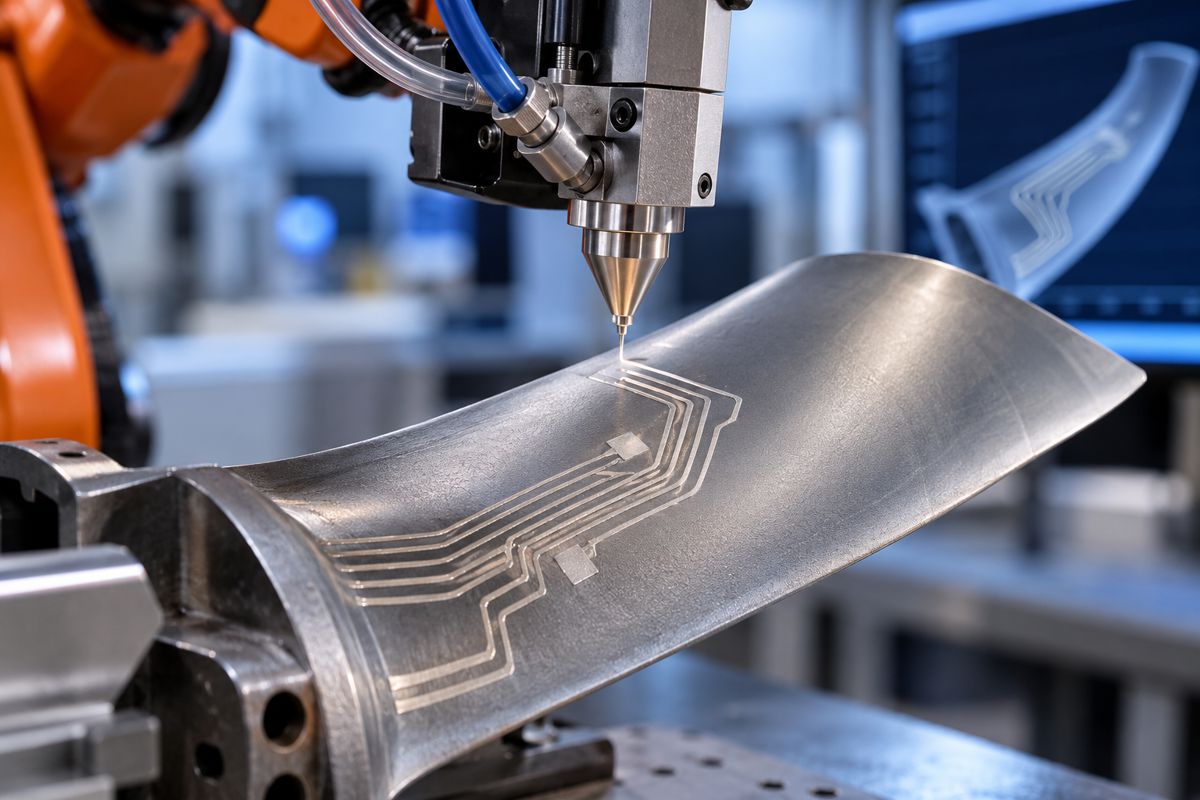
The work led by Ethan Secor, associate professor of mechanical engineering at Iowa State, uses aerosol jet printing to deposit precise electronic patterns onto curved and three-dimensional surfaces. Instead of requiring a flat circuit board, the printing head can follow the geometry of a component, opening the possibility of integrating sensors, conductors and other electronic functions directly into structures.
The process operates at a scale of roughly 10 to 100 micrometres. Ink is atomised into microscopic droplets, carried in a gas stream and focused through a nozzle before being deposited according to a digitally defined pattern. Aerosol jet printing is non-contact and compatible with a broad range of functional materials, allowing circuitry to be placed where conventional printing and manufacturing processes struggle to reach.
Moving from a flat substrate to a turbine blade, aircraft component, machine part or other complex surface introduces a substantial manufacturing problem. The printer must understand the geometry, maintain the correct relationship between nozzle and surface, position the electronic pattern accurately and reproduce it consistently.
Secor’s research group has therefore moved beyond experimenting with conductive inks. It is developing the materials, sensing systems, software, robotic motion planning and customised printing hardware needed to turn conformal electronics into a controllable manufacturing process. Some of that work is now moving towards commercialisation through Contour Circuits, the company founded by Secor and former graduate student Jeremy Rurup.
Briefing
- Iowa State researchers are developing aerosol jet systems capable of printing electronic circuits directly onto curved and complex 3D surfaces.
- Functional patterns can be deposited at resolutions of approximately 10 to 100 micrometres using atomised inks carried through a focused gas stream.
- The team has demonstrated conformal printing using conventional three-axis equipment as well as articulated robotic systems for more complex geometries.
- Contour Circuits and Iowa State have received a NASA STTR award worth $149,999 to develop structural and additive electronics capable of sustained operation at 500°C to 800°C.
- Current research extends from real-time print monitoring and automated correction to multi-material deposition that could vary material composition during a single print.
Printing Around the Geometry
Aerosol jet printing already offers useful characteristics for electronics manufacturing. It can deposit conductive and other functional materials without physical contact between the nozzle and substrate, while digitally controlling the pattern.
Flat surfaces are comparatively straightforward. Once the substrate curves in several directions, toolpath generation becomes considerably more complicated. The printer must maintain an appropriate stand-off distance and orientation while the nozzle moves across changing geometry. Errors that might be relatively unimportant in conventional additive manufacturing can become significant when the deposited feature is an electronic conductor or sensor measured in tens of micrometres.
Secor’s group has been working with Iowa State mechanical engineering professor Adarsh Krishnamurthy to address that problem through geometric modelling and robotic motion control. One approach developed by the researchers uses non-uniform rational B-splines, or NURBS, to represent the underlying curved surface.
Rather than converting the geometry into a mesh of small flat triangles before generating the printing path, the system can work directly from the continuous mathematical representation commonly used in computer-aided design. The researchers demonstrated the method by printing a strain-gauge pattern onto a curved model of a wind turbine blade, using the surface definition to generate the machine code required by a three-axis aerosol jet printer.
Tessellated models inevitably approximate curves, while a conformal electronic pattern may need to remain precisely registered against the component beneath it. Working from continuous CAD geometry provides a route from the digital representation of the component to the physical circuit deposited on its surface.
More recent work has extended the approach towards robotic systems. An articulated arm gives the print head additional freedom to approach surfaces from different orientations and reach areas that would be difficult to address using a conventional Cartesian printer, while adding further demands for accurate motion planning and alignment.
“In our work together, we have had to bring together expertise in materials, hardware, robotics, geometric modeling and computational methods to make aerosol jet printing work reliably on complex 3D curved surfaces,” Krishnamurthy said. “Ethan is very good at envisioning how all of those pieces fit together.”
Reliability Before Scale
Printing a circuit once in a laboratory is very different from manufacturing it repeatedly. Secor sees reliability as having two sides: the deposition process itself must remain consistent, while the electronic device produced by that process must survive the conditions in which it is expected to operate.
“Researchers have developed many creative and impressive demonstrations of printed hybrid electronics,” he said. “But to move those beyond a laboratory environment, reliability is key.”
His group has spent several years developing sensing and control technologies that monitor aerosol jet deposition while printing takes place. Light-scattering measurements can provide information about the material passing through the system, allowing software to identify changes in deposition and adjust process parameters.
Ink formulation, atomisation, gas flow, droplet behaviour, nozzle conditions, evaporation and substrate interaction can all influence the line eventually deposited. Research presented by Secor in 2025 reported closed-loop control validated on commercial printing equipment during runs exceeding eight hours, with the system automatically adjusting operating parameters to counter process drift.
Other work has examined droplet evaporation and overspray, where small quantities of material are deposited outside the intended pattern. At electronic scales, the edge quality of a printed line is not merely cosmetic. Unwanted material can limit the precision available for high-value electronic applications.
The group has also experimented with heating the aerosol during printing. Research published in 2024 showed that controlling evaporation within the print head could permit higher deposition rates while limiting the associated growth in printed line width.
These are incremental manufacturing problems rather than spectacular demonstrations, but they sit directly between laboratory capability and industrial adoption. Secor’s group has installed monitoring systems at industrial, government and academic locations across the United States, moving the work towards understanding how aerosol jet printing can be made repeatable rather than simply proving that it works.
Electronics Built Into the Object
Instead of attaching a separate sensor and then providing wiring, connectors and packaging around it, some electronic functions could potentially become part of the surface of the component itself.
Structural health monitoring is one application. The Iowa State team’s wind-turbine demonstration used a strain-gauge pattern, and the researchers have identified aerospace and civil infrastructure monitoring among the potential applications for conformal printing. Electronic patterns could also follow machine components, aerospace structures and other geometrically complex objects where conventional flat substrates are inconvenient or impossible.
Antennas, temperature sensors, strain measurement, heaters and electrical interconnects are among the functions being explored in conformal electronics more broadly. For infrastructure, manufacturing sensors directly onto components could eventually give designers greater freedom over their location, particularly where measurement is required close to the physical behaviour being monitored.
Conformal printing would not eliminate conventional electronics. Silicon chips and other discrete components remain essential to modern systems, while interfaces, packaging and connections remain significant engineering challenges.
Those problems become much harder when difficult means several hundred degrees Celsius.
Printing for Extreme Environments
NASA has provided one of the clearest indications of where conformal electronics could find an application beyond the laboratory.
In 2025, Contour Circuits received a $149,999 Phase I Small Business Technology Transfer award, working with Iowa State University on materials and manufacturing processes for electronics integrated onto three-dimensional structures in extreme environments. The programme is targeting sustained operating temperatures between 500°C and 800°C.
NASA identifies potential applications including missions to Venus, solar probes and propulsion systems. The proposed approach uses platinum nanoparticle inks with inorganic binders deposited through aerosol jet printing. Platinum was selected for characteristics including its melting temperature, electrical conductivity and compatibility with structural materials such as alumina and titanium.
High-temperature electronics already exist, including silicon-carbide devices capable of operating far beyond the limits of conventional silicon electronics. Packaging, interconnects and interfaces remain part of the engineering challenge.
The Contour Circuits programme is concerned with that surrounding manufacturing architecture: how electronic functionality can be deposited onto structural objects and remain attached and operational when conventional materials and packaging approaches become problematic.
Changing the substrate from a laboratory coupon to a curved ceramic or metallic component does not necessarily require an entirely new physical manufacturing tool. Much of the adaptation can instead move into materials, software and motion control, areas already being developed within Secor’s wider research programme.
From One Ink to Many
Another strand of Secor’s research is investigating whether aerosol jet systems can mix materials during deposition, varying their composition as the printer moves. He describes the concept as moving from black and white towards greyscale.
A five-year National Science Foundation CAREER project, awarded in 2024 with intended funding of just over $621,000, is examining multi-material aerosol jet printing with in-line mixing. The research is looking at the interaction between material chemistry, ink formulation, aerosol behaviour and printing parameters to understand how reliably different materials can be blended.
If controlled successfully, the composition of a printed feature could change across the feature itself. The machine would control not only where material is deposited and the geometry it creates, but potentially its material properties from one location to another.
Such graded structures could be useful where electrical, thermal or mechanical properties need to change across an electronic device or its interface with the underlying structure. Mixing materials also introduces additional variables into a manufacturing technique already sensitive to ink behaviour, atomisation, evaporation, deposition and geometry, leaving process control at the centre of the research.
Building the Printer
Secor began working with printed electronics while studying at Northwestern University, initially developing graphene inks before moving into flexible electronics, liquid-metal electronics, microsupercapacitors and lithium-ion batteries. Later, as a postdoctoral researcher at Sandia National Laboratories, he learned to build printing equipment rather than treating the machine as a fixed commercial platform.
That approach has continued at Iowa State. The group builds and modifies hardware alongside the materials and process research, including systems that place an aerosol jet print head on an articulated robotic arm and machines incorporating monitoring equipment or modified print heads.
“I learned how to build a printer and that opened up a lot of research directions,” Secor said. “Now we build and customize our own hardware. So, while other research groups are playing with a black box, we can open it up, understand how it works and improve on it.”
Materials science determines what can be printed. Fluid and aerosol physics influence how it reaches the surface. Mechanical engineering determines how the machine moves, computational geometry tells the robot where the surface is, and control software attempts to keep deposition stable.
“There are a lot of different perspectives needed,” Secor said. “And that has kept me engaged and learning.”
Contour Circuits provides a commercial route alongside that research. The NASA STTR programme puts the company into a familiar technology-transfer model, with university research, specialised hardware and materials development being pushed towards a defined engineering application rather than remaining solely as laboratory demonstrations.
Manufacturing Electronics Where They Are Needed
Printed electronics have produced striking laboratory demonstrations for years. The harder problem has been moving from something that can be printed to something that can be manufactured repeatedly, installed confidently and expected to survive.
The Iowa State programme is increasingly concentrated on that manufacturing problem. Accurate toolpaths address geometry, robotic systems address access and orientation, real-time sensing addresses process drift, materials research addresses durability, and multi-material deposition could broaden the functions that can be produced.
Substantial qualification work remains before structural electronics become commonplace on infrastructure, industrial machinery or aerospace systems. The research is nevertheless beginning to loosen one of the traditional constraints of electronics manufacturing: the need for a controlled, predominantly flat substrate separate from the object it ultimately serves.
A turbine blade can become the substrate for its strain sensor. A structural component can carry circuitry along its own contours, while an extreme-environment component can potentially acquire electrical functionality without relying entirely on conventional boards, wiring and packaging.
The electronics have not disappeared. The object underneath them has become part of the manufacturing process.
Key Industry Questions
- What is aerosol jet printing? Aerosol jet printing is a non-contact additive manufacturing process that atomises a functional ink into microscopic droplets, transports them in a gas stream and focuses them through a nozzle to deposit digitally controlled patterns.
- How fine can aerosol jet printing produce electronic features? The Iowa State work describes printing at resolutions of approximately 10 to 100 micrometres. Achievable feature size depends on the material, equipment, process settings and required device performance.
- Why is printing electronics onto curved surfaces difficult? The nozzle must maintain the correct position and relationship to a surface whose height and orientation continuously change. Accurate registration, stand-off distance, robot motion and deposition consistency all become more difficult as geometry becomes more complex.
- What are conformal electronics? Conformal electronics are circuits, sensors or other electronic features designed to follow the shape of the surface on which they are installed rather than being restricted to conventional flat circuit boards.
- Could the technology be used for infrastructure monitoring? Structural health monitoring is among the applications identified by the Iowa State researchers. The team has demonstrated a printed strain-gauge pattern on a curved wind-turbine-blade model, while its published research also identifies civil infrastructure applications.
- Why is NASA interested in the technology? NASA’s STTR programme with Contour Circuits and Iowa State is investigating electronics integrated onto 3D structural objects that could operate continuously at temperatures between 500°C and 800°C. Potential applications identified by NASA include Venus missions, solar probes and propulsion systems.
- What does multi-material aerosol jet printing add? It could allow the composition of deposited material to change during printing. Instead of controlling only the geometry of an electronic feature, the printer could potentially vary its material properties across the deposited structure.
- Is conformal aerosol jet printing ready for mass manufacturing? The research demonstrates increasingly sophisticated manufacturing capabilities, but reliability, process control, materials performance, throughput and application-specific qualification remain important development areas. Much of Secor’s work is specifically aimed at those manufacturing-readiness problems.
Strategic Takeaways
- Conformal electronics move some electronic functionality from separately manufactured packages onto the surfaces of components themselves.
- Robotic motion planning and accurate digital geometry are becoming as important as ink chemistry in making 3D printed electronics practical.
- Closed-loop monitoring addresses process drift, one of the barriers between laboratory demonstrations and repeatable production.
- Extreme environments offer a demanding application where conventional electronic packaging becomes increasingly difficult.
- Multi-material deposition could eventually allow printers to control both the geometry and local composition of electronic features.