Caterpillar is Investing in the Workforce Behind the Autonomous Machine
Caterpillar is putting $25 million behind a five-year search for new ways to train the people who will build, maintain and support increasingly digital and autonomous industrial machinery.
The Building the Future Workforce Challenge forms part of a wider $100 million commitment announced by Caterpillar in 2025. Its first year will make up to five awards of $1 million available to organisations proposing new approaches to attracting, retaining and developing manufacturing and technician talent.
Heavy machinery is acquiring software, sensors, connectivity, artificial intelligence and increasingly sophisticated automation, while the people responsible for manufacturing and supporting those machines need a correspondingly different mixture of mechanical, electrical and digital skills. Caterpillar is investing on both sides of that transition.
Briefing
- Caterpillar has committed $25 million over five years to its Building the Future Workforce Challenge.
- The programme sits within a broader $100 million, five-year workforce initiative announced in 2025.
- Up to five $1 million awards are planned for the first year of the global challenge.
- Winning concepts are intended to be piloted in selected Caterpillar communities rather than remaining theoretical proposals.
- Caterpillar is separately investing in AI, autonomy, connected machinery and digital technology, increasing the importance of technicians able to work across mechanical and digital systems.
Machinery is Changing Faster Than the Traditional Job Description
Construction and mining equipment has always demanded considerable technical expertise. Modern machines, however, increasingly combine conventional mechanical systems with electronic controls, telematics, positioning technology, software, cameras, radar, machine guidance and automated functions.
The direction is particularly visible at Caterpillar. At CES 2026, the manufacturer presented AI and autonomy developments alongside its collaboration with NVIDIA and outlined plans to increase investment in digital and technology by 2.5 times through 2030.
The technician supporting the next generation of construction equipment may still diagnose hydraulic pressure, inspect a wiring harness or replace a physical component, but troubleshooting can increasingly involve software, machine data, electronic control systems and connected services. Manufacturing environments are undergoing a similar change as robotics, automation and digital production systems become more deeply integrated into factories.
The US labour market illustrates part of the problem. Bureau of Labor Statistics projections show relatively little overall change in US manufacturing employment between 2024 and 2034, yet nearly one million openings in production occupations are expected each year on average during the period, predominantly as existing workers retire or move into other occupations. Technological progress does not necessarily remove the requirement for skilled people; it changes where they are needed and what they need to know.
From $100 Million Pledge to Local Programmes
Caterpillar announced its wider $100 million Building the Future Workforce Initiative during its centenary in April 2025. The programme was designed around collaboration between employers, training institutions and communities, with an emphasis on making technical training more accessible and aligning it more closely with industrial requirements.
Since then, the company has started turning the pledge into individual programmes. Indiana was among the first states selected, with Caterpillar committing up to $5 million towards training and upskilling. Texas subsequently received an allocation of up to $5 million, while Illinois was allocated up to $10 million and Arkansas up to $3 million.
The programmes involve organisations ranging from technical colleges and economic development bodies to chambers of commerce and the Manufacturing Institute. This gives Caterpillar a way to test different approaches in places with different labour markets and manufacturing requirements rather than attempting to impose one training model everywhere.
The global challenge extends that approach. Operated by CARROT, it is open to nonprofit and for-profit organisations and is intended to identify ideas that can be piloted in selected communities. Caterpillar has allocated $25 million over five years to the challenge, including an initial $5 million for the first year.
Technicians and the Technology Strategy
Heavy equipment manufacturers have spent years developing autonomous haulage, remote operation, machine control, telematics and increasingly intelligent assistance systems. These technologies tend to attract attention because they are visible and comparatively easy to demonstrate. Training infrastructure is less conspicuous, but deployment ultimately depends upon it.
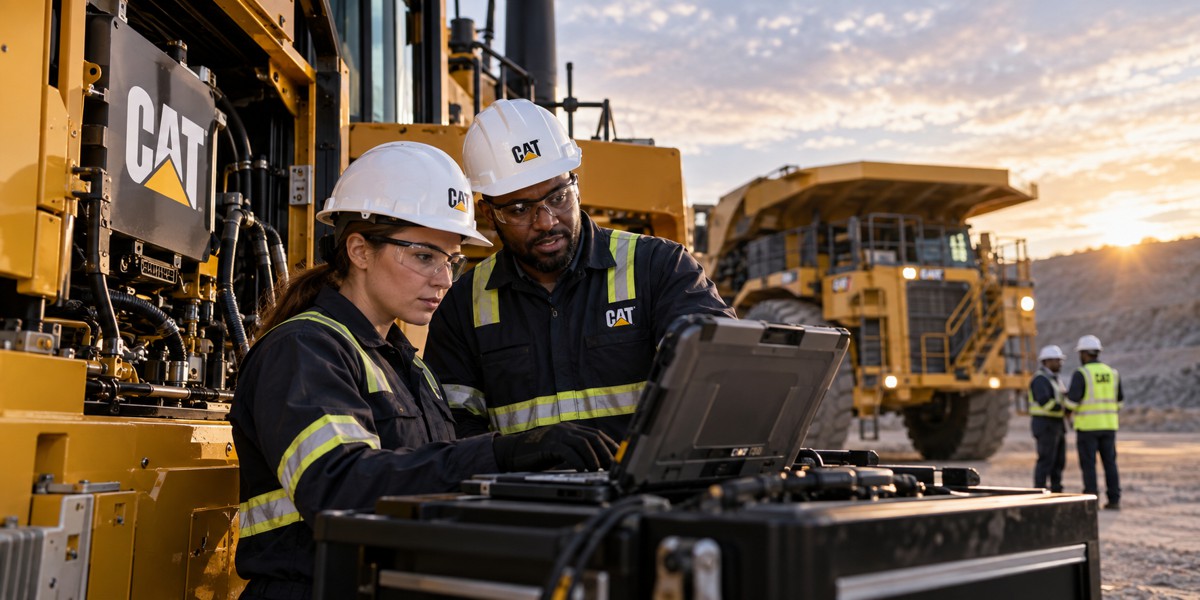
A sophisticated machine still has to be commissioned, calibrated, diagnosed, repaired and maintained. Connected systems need technicians who understand both the physical equipment and the digital architecture surrounding it. Dealers need those capabilities across distributed service networks, often far from the engineering teams that developed the technology.
Caterpillar already operates ThinkBIG, a two-year dealer technician development programme combining education with practical experience, while its Global Dealer Technician Challenge has been used to showcase the technical demands and career opportunities associated with the profession. Its latest workforce investment reaches considerably further upstream.
Rather than defining every training programme itself, Caterpillar is asking outside organisations to propose models that could be tested and, where successful, expanded. That creates room for approaches involving adaptive learning, simulation, digital tools, new financing structures and alternative routes into technical careers. Their value will ultimately depend on whether they produce people capable of doing real industrial work.
The Skills Gap Behind Industrial Automation
Automation is sometimes presented as a straightforward substitution of machines for labour. Heavy industry rarely works so neatly.
A more automated excavator, haul truck, production line or engine plant can reduce the human input required for particular tasks while increasing demand elsewhere for integration, diagnostics, electronics, software support and systems knowledge. Existing occupations evolve while new specialisms appear around them.
Industrial technology can also be deployed faster than education and training systems can redesign courses, recruit instructors, buy equipment and produce qualified workers. Caterpillar’s initiative targets some of that mismatch through stronger links between employers and training institutions, efforts to change perceptions of manufacturing careers, new training and financing models, and the sharing of approaches that prove effective.
The skills problem also extends beyond Caterpillar itself. Its machines are manufactured, sold and supported through an ecosystem of factories, suppliers, dealers, customers, educational institutions and local labour markets. A shortage of technicians somewhere in that chain can constrain technology that has already been engineered and commercialised.
Training for the Next Machine Generation
Construction and mining machines now generate data, connect to cloud platforms, receive software updates and use positioning systems to guide equipment to increasingly fine tolerances. Artificial intelligence is beginning to assist operators, technicians and managers. The training systems surrounding those machines have to develop with them.
Caterpillar’s $100 million commitment is large enough to test multiple approaches rather than fund a handful of isolated training schemes. The $25 million innovation challenge adds an external element by inviting organisations outside the company to develop ideas and placing selected proposals into operating communities where their effectiveness can be tested.
Not every experiment will scale. Workforce development is shaped by local education systems, wages, demographics, industrial demand and attitudes towards technical careers, making universal solutions unlikely. The next generation of construction and mining machinery will nevertheless contain technologies that barely appeared in a technician’s job description a decade ago, and training systems designed around yesterday’s machine will eventually become as obsolete as yesterday’s diagnostic equipment.
The engineering of the machine and the engineering of the workforce are becoming increasingly difficult to separate.
Key Industry Questions
- What is Caterpillar’s Building the Future Workforce Challenge? It is a five-year global innovation programme intended to identify, test and scale new approaches to developing manufacturing and technician skills.
- How much has Caterpillar committed to the challenge? Caterpillar has allocated $25 million over five years, within its wider $100 million Building the Future Workforce Initiative.
- How large are the first-year awards? The programme is designed to make up to five awards of $1 million each during its first year.
- Who can participate? The challenge is open to eligible nonprofit and for-profit organisations worldwide, with selected concepts intended for testing in Caterpillar communities.
- Why are equipment technician skills changing? Modern construction and mining machines increasingly combine mechanical and hydraulic systems with electronics, software, telematics, sensors, positioning technology and automation.
- Does greater automation eliminate the need for technicians? Automation can reduce labour requirements for particular activities, but increasingly sophisticated equipment still requires commissioning, diagnostics, maintenance, integration and repair. The skills mix changes alongside the machinery.
- What other workforce investments has Caterpillar made? Its wider initiative has included allocations for programmes in Indiana, Texas, Illinois and Arkansas, alongside established activities such as ThinkBIG and technician development initiatives.
- When will the challenge finalists be announced? Caterpillar has said finalists are expected to be announced in early 2027.
Strategic Takeaways
- Workforce capability is becoming increasingly closely connected to machinery technology deployment.
- Mechanical expertise remains important, but technician roles increasingly cross into electronics, software, data and connected systems.
- Caterpillar is using regional programmes to test workforce models under different educational and industrial conditions.
- The global challenge introduces outside ideas into a training problem traditionally addressed through manufacturers, dealers and colleges.
- Investment in autonomy and AI increases the requirement for people capable of diagnosing and supporting the systems surrounding the physical machine.