Multilateral Investment to Rebuild Entre Ríos Freight Roads in Argentina
The Inter-American Development Bank has cleared $280 million to overhaul provincial roads and urban access routes across Argentina’s Entre Ríos.
The country’s federal government has spent the better part of two years choking off public works to protect its hard-won fiscal surplus, so the money now keeping strategic infrastructure on the move is, more and more, arriving from multilateral lenders rather than the national treasury.
Entre Ríos isn’t a random pick, either. Wedged between the Paraná and Uruguay rivers in Argentina’s Mesopotamia region, the province is farming and agro-industry country, with cattle, soybeans, wheat, rice and citrus moving by the truckload toward river ports and processing plants. Those trucks lean hard on a road network that’s been creaking under rising freight volumes, and when a busy segment gives way, the cost ripples straight through to export margins. The loan, approved by the IDB’s Board of Executive Directors, is aimed at the arteries that carry exactly that traffic.
Briefing
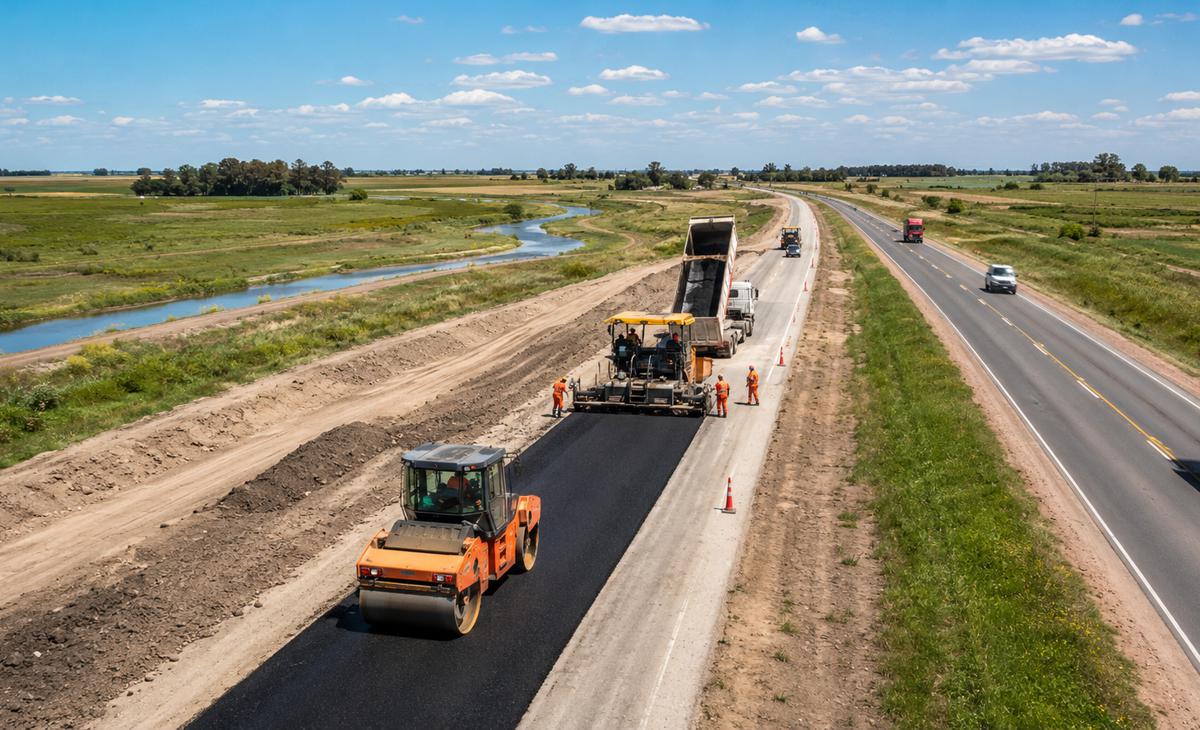
- The IDB board approved $280 million in Multiple Works Financing to rebuild and comprehensively rehabilitate strategic provincial roads and urban bypasses in Entre Ríos, with a focus on segments carrying heavy truck traffic.
- The loan runs for 21.5 years with a nine-year grace period, priced against SOFR, the dollar benchmark that’s replaced LIBOR across international lending.
- It sits inside the IDB Group’s South Connection programme, a regional initiative set in motion in September 2025 to cut trade costs and stitch South America’s corridors together.
- Beyond tarmac, the package funds hydraulic works to curb flooding and a Road Asset Management System to push the province toward data-led, long-term network planning.
- With Buenos Aires holding the line on federally funded public works, externally financed projects like this one have become the main channel for getting Argentine infrastructure built at all.
Why The Money Comes From Washington, Not Buenos Aires
To understand why a provincial road programme is making news, you have to look at what’s happened to Argentine public works since late 2023. President Javier Milei abolished the Ministry of Infrastructure within days of taking office, folding public works, transport and housing into the economy portfolio, and then took an axe to discretionary construction spending to balance the books. Federal road investment cratered, and the 2026 national budget pencils in only a modest real increase off a badly depressed 2025 base. The government’s strategy is no secret: lean on financing from the IDB, the World Bank and CAF so that strategic infrastructure can advance without blowing a hole in the fiscal surplus that underpins the whole stabilisation effort.
That’s precisely the gap this loan fills. The terms are generous by commercial standards, with that nine-year grace period giving the province room to build before repayments bite, and a 21.5-year tail spreading the cost across more than two political cycles. For investors and lenders watching Argentina edge back toward international debt markets, deals like this matter as a signal. They show that subnational governments can still tap long-tenor, dollar-denominated capital on sensible terms even while the federal purse stays shut, and they keep a pipeline of work flowing to the contractors, materials suppliers and consulting engineers who’d otherwise be staring at empty order books.
Roads That Feed The River Ports
Geography does a lot of the heavy lifting in this story. Roughly four-fifths of Argentina’s agricultural exports flow out through the Paraná river system, funnelled down to the Río de la Plata and the Atlantic beyond. Entre Ríos sits on the eastern bank of that waterway, and its provincial roads are the last overland leg before grain, oilseeds and livestock products reach the barges and the export terminals clustered around Rosario and Santa Fe. When those roads are potholed, weight-restricted or washed out, hauliers either slow down or take longer detours, and the extra cost lands on producers already squeezed by global commodity prices.
The works themselves target the segments where that pressure shows up first. The programme will reconstruct and rehabilitate strategic provincial highways and urban bypasses along corridors with heavy truck volumes, while improving access and circulation across the wider local network. Urban bypasses are worth flagging in their own right, since routing freight around town centres rather than through them tends to cut journey times, knock down accident rates and spare residents the grind of heavy lorries rumbling past their front doors. It’s unglamorous engineering, but it’s the kind that quietly lifts the productivity of an entire export economy.
A Regional Play Called South Connection
This isn’t a standalone cheque. The financing falls under South Connection, the IDB Group’s regional programme launched in September 2025 at the request of governors from across South America, including Argentina, Brazil, Chile, Paraguay and Uruguay. The programme is built around three pillars: upgrading climate-resilient physical and digital connectivity; smoothing logistics and trade facilitation at border crossings and customs; and strengthening the institutional and regulatory machinery that draws private investment in. The diagnosis behind it is blunt, with the bank pointing to high trade costs, fragmented regulation and chronic underinvestment as the structural drags holding the continent back.
Viviana Alva Hart, the IDB Group’s representative in Argentina, framed the Entre Ríos loan in that integration language. “This operation reflects our commitment to promoting more resilient and efficient infrastructure that can support the productive development of Entre Ríos and strengthen regional integration,” she said. “Improving roads not only facilitates trade and logistics, but also enhances quality of life and access to opportunities for thousands of people,” she added. The framing matters because it positions a single province’s road upgrade as one node in a much larger network, the logic being that a corridor is only as strong as its weakest stretch, and a fixed road in Entre Ríos shaves friction off freight bound for markets well beyond Argentina’s borders.
From Patch And Pray To Data Led Maintenance
Tucked inside the announcement is a component that tends to get overlooked but may outlast the asphalt. The loan funds the rollout of a Road Asset Management System and an Infrastructure Management System, plus broader work to beef up the provincial government’s road-management capabilities. In plain terms, that means moving away from the reactive, fix-it-when-it-fails approach that drains budgets, and toward planned, condition-based maintenance driven by actual data on how every stretch of road is holding up. For a province that has historically struggled to fund upkeep, knowing which kilometres to treat and when is half the battle.
There’s a hard commercial case here as well. Asset management systems let public bodies stretch every peso further by catching deterioration early, when repairs are cheap, rather than waiting for the expensive full reconstruction that follows neglect. They also create the kind of structured, transparent data that multilateral lenders and private financiers want to see before committing fresh capital. So while a database doesn’t make for a dramatic ribbon-cutting, it’s the sort of institutional plumbing that makes future investment easier to justify and easier to fund, and it nudges the whole sector toward longer-term planning.
Building For The Floods, Not Just The Trucks
Anyone who knows the region won’t be surprised that drainage gets its own line item. Entre Ríos sits in a low-lying river basin that’s taken a battering from flooding over the decades, with El Niño events repeatedly damaging roads, bridges and embankments across north-eastern Argentina. Build a brand-new road surface and skimp on the hydraulics underneath it, and you’re simply lining up the next washout. The investment plan therefore bankrolls hydraulic interventions designed to improve drainage and cut the network’s vulnerability to flooding.
That climate-resilience angle is becoming standard practice rather than a nice-to-have, and South Connection explicitly leans on the modernisation of climate-resilient roads as one of its building blocks. For the engineering firms bidding on this work, it shifts the brief from laying tarmac to designing infrastructure that can shrug off heavier rainfall and higher water tables. It’s also the difference between an asset that lasts its design life and one that’s back on the repair schedule inside a few wet seasons, which loops straight back to the asset-management thinking running through the rest of the programme.
The Road Ahead
Loan approval is the starting gun, not the finish line, and the months that follow will bring tendering, detailed design and the slow grind of getting machinery onto site. Provincial capacity, procurement speed and Argentina’s broader macroeconomic stability will all shape how quickly the money turns into resurfaced highways and finished bypasses. Contractors and suppliers eyeing the work would do well to watch the procurement calendar closely, because pipelines like this one are scarce in the current climate.
The wider significance reaches past Entre Ríos. If the South Connection model delivers, with multilateral lenders financing the climate-resilient corridors that cash-strapped national governments can’t, it offers a template for keeping South American infrastructure moving through a tight fiscal stretch. For policymakers, the lesson is that connectivity and competitiveness don’t pause for austerity, and that the institutions willing to lend long are the ones now setting the pace. A few hundred kilometres of repaved provincial road might not sound like much, but in a country where exports live or die by what flows down to the river ports, it’s the kind of groundwork the rest of the economy quietly stands on.