MetroLink Procurement Push Accelerates Dublin’s Rail Transformation
Dublin’s long-awaited MetroLink programme has entered another decisive phase as Transport Infrastructure Ireland formally launched procurement activity for the project’s major Public Private Partnership contract. The move signals growing momentum behind Ireland’s most ambitious public transport investment in decades and provides fresh evidence that large-scale rail infrastructure remains firmly on the national agenda despite mounting construction pressures across Europe.
Acting on behalf of the MetroLink programme, Transport Infrastructure Ireland, better known as TII, has invited prospective bidders to participate in the tender process for the M500 contract, a substantial availability-based Design, Build, Finance, Operate and Maintain agreement. The contract will ultimately place responsibility for critical railway systems, rolling stock operations and long-term maintenance into the hands of a single consortium for a 25-year operational period.
The procurement marks another important transition for MetroLink as the project steadily evolves from planning and enabling activities into a fully structured delivery programme. For contractors, investors and rail technology specialists, the scale and complexity of the package offers one of Europe’s most significant urban transit opportunities currently moving through procurement.
Ireland’s infrastructure sector has, for years, wrestled with increasing pressure to modernise transport capacity around Dublin. Population growth, airport expansion, worsening congestion and rising housing development across the commuter belt have all exposed the limitations of the capital’s existing transport network. MetroLink is intended to become the backbone of a future integrated public transport system connecting Dublin city centre with Dublin Airport and several major residential and commercial districts.
Briefing
- Transport Infrastructure Ireland has launched procurement for MetroLink’s M500 PPP contract
- The contract follows an availability-based DBFOM structure covering a 25-year operational period
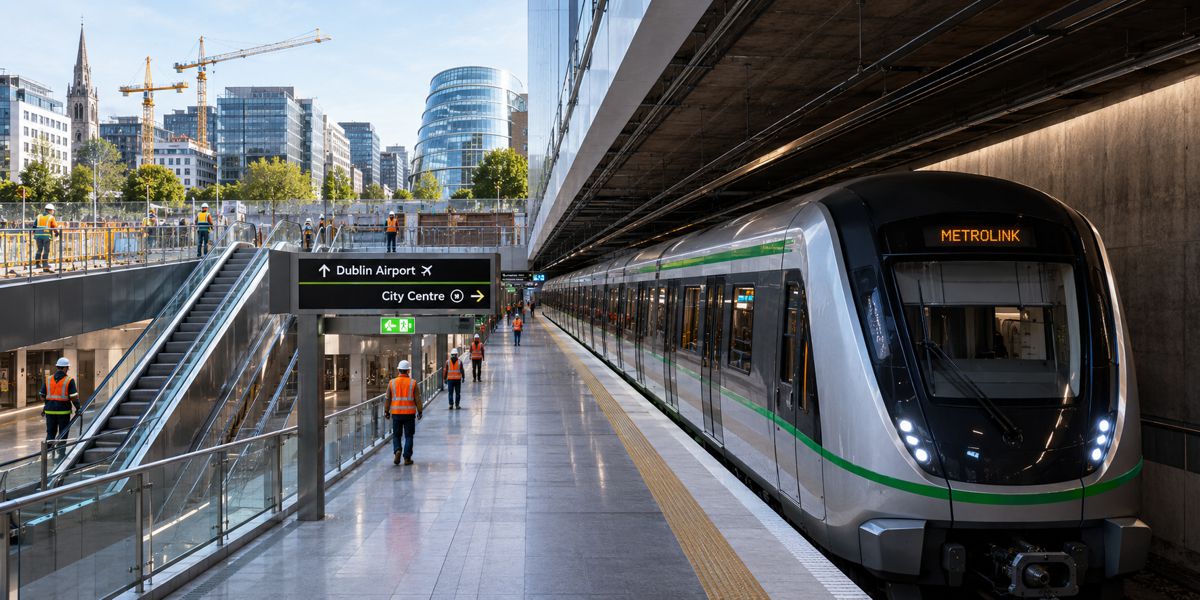
- The M500 package includes GoA4 fully automated metro systems, rolling stock and station fit-outs
- Major tunnelling and civil engineering works are being delivered separately under the M400 contracts
- The wider MetroLink programme also includes enabling works, depot construction and urban realm improvements
A Different Approach to Rail Delivery
One of the most notable aspects of MetroLink’s procurement structure is the separation of major civil engineering works from operational railway systems and passenger services. Rather than placing all responsibility under a single mega-contract, TII has divided the programme into several packages designed to attract specialist expertise while reducing overall delivery risk.
The M500 contract excludes tunnelling and large-scale enabling works, both of which are being procured separately. That distinction matters because it reflects lessons learned from major rail schemes worldwide where combining heavy civils with systems integration often created delays, interface problems and spiralling costs.
Under the MetroLink model, enabling works fall under the M100 series contracts. These include archaeological investigations, utility diversions, heritage works, surveying and advanced heavy civil activities, including the construction of the Dublin Airport station box.
Meanwhile, the M400 series comprises two large geographical design-and-build packages covering the northern and southern civil engineering sections of the route. Known as M401 and M402, these contracts focus on tunnels, stations and structural infrastructure components procured independently from the operational systems package.
This layered procurement structure has become increasingly common on complex metro projects across Europe and Asia. Cities including Copenhagen, Paris and Singapore have all demonstrated the value of aligning specialist contractors with specific technical disciplines rather than relying on a single integrated contractor to deliver every project element.
The Technological Heart of MetroLink
Although tunnelling and station construction typically attract the most public attention, the M500 contract effectively represents the technological core of the entire MetroLink system. Without signalling, communications, rolling stock and operational infrastructure, tunnels alone cannot deliver a functioning railway.
The successful consortium will oversee the design, supply, financing, construction, operation and maintenance of a sophisticated integrated metro network that includes rolling stock, power systems, communications infrastructure and fully automated signalling technology.
One of the most significant elements within the package is the adoption of Grade of Automation 4 signalling, commonly referred to as GoA4. This represents the highest level of train automation currently deployed in passenger metro operations globally.
Under GoA4, trains operate entirely without onboard staff, relying on advanced signalling, communications and centralised operational systems to manage train movements safely and efficiently. Similar systems already operate successfully in cities such as Dubai, Copenhagen, Singapore and sections of the Paris Metro network.
For Dublin, the decision to adopt GoA4 technology places MetroLink firmly within the next generation of urban transit systems. Automated operations typically offer higher service frequency, improved operational consistency and lower long-term operating costs compared with traditional manually driven railways.
Beyond Trains and Tracks
The scale of the M500 contract extends well beyond rolling stock and signalling equipment. TII’s procurement documentation outlines a broad systems package encompassing virtually every operational component required to run the metro over its lifecycle.
The selected consortium will be responsible for railway depot construction, maintenance facilities, park-and-ride infrastructure and operational control centre buildings. Route-wide infrastructure also falls within the package, including track installation, overhead contact systems, power distribution and communications networks.
Mechanical and electrical systems form another substantial portion of the contract. Underground metro systems depend heavily on ventilation, environmental control and emergency management infrastructure, particularly within tunnels and deep stations. The contract therefore includes tunnel and station ventilation systems alongside passenger movement systems within station environments.
Internal construction and fit-out works are equally significant. The M500 package includes partitioning, secondary civil elements and complete fit-out and finishing works across sixteen stations located both above and below ground. Urban realm improvements surrounding those stations also form part of the works, reflecting broader ambitions to integrate MetroLink into Dublin’s evolving urban environment.
This increasingly holistic approach mirrors wider trends in transport infrastructure where projects are expected to deliver not only mobility improvements but also wider urban regeneration benefits, improved accessibility and enhanced public spaces.
International Interest Expected
Infrastructure specialists across Europe are expected to watch the MetroLink procurement process closely. Availability-based PPP structures remain highly attractive to international infrastructure investors because they provide stable, long-term payment mechanisms linked to operational performance rather than passenger revenue alone.
Unlike concession models dependent on fare income, availability-based arrangements typically reduce exposure to fluctuations in passenger demand while maintaining strong incentives for operational reliability and asset performance. This structure has become particularly attractive to pension funds, sovereign wealth funds and infrastructure finance groups seeking stable long-term returns aligned with sustainable investment strategies.
The technical scope of MetroLink also creates opportunities for major rail systems suppliers, signalling specialists and rolling stock manufacturers looking to strengthen their position within the growing European urban transit market.
Across Europe, governments continue to prioritise rail investment as part of broader decarbonisation and sustainable mobility policies. The European Green Deal and associated transport funding programmes have accelerated investment in public transport infrastructure, especially projects capable of reducing car dependency and airport-related road congestion.
MetroLink fits squarely within that wider shift. Dublin Airport remains one of Europe’s busiest major airports without a direct rail connection, an issue that has repeatedly drawn criticism from both business groups and transport planners. The future metro line is expected to change that dynamic considerably once operational.
Early Contractor Involvement Gains Importance
An additional feature of the procurement process is TII’s plan to enter into an Early Services Agreement with the preferred bidder before the full contract is finalised.
Such agreements are becoming increasingly important on large transport programmes because they allow contractors to begin preliminary coordination, planning and technical integration activities ahead of full mobilisation. Early contractor involvement can help reduce interface risks, improve constructability and streamline programme delivery once construction accelerates.
For MetroLink, this may prove particularly valuable given the number of separate contract packages progressing simultaneously. Coordination between civil engineering contractors, systems installers and operational teams will be critical if the programme is to avoid the kinds of delays that have affected other major European rail schemes in recent years.
The approach also reflects growing recognition across the infrastructure sector that collaboration during pre-construction phases can significantly improve long-term project outcomes.
Reshaping Dublin’s Urban Future
MetroLink’s significance stretches well beyond transport engineering. The project is increasingly viewed as a central component of Dublin’s long-term urban development strategy, particularly as housing expansion pushes further beyond the traditional city core.
Improved transport connectivity has become essential to supporting economic growth while reducing pressure on already congested road networks. The metro is expected to support higher-density residential development, improve airport access and strengthen links between employment centres throughout the capital region.
For Ireland’s construction sector, the programme also represents a major source of long-term activity across engineering, rail systems, technology integration and urban development disciplines. Large-scale metro projects generate extensive supply chain opportunities extending far beyond primary contractors alone.
At the same time, MetroLink demonstrates how Ireland’s infrastructure ambitions are evolving. The country is increasingly moving toward more technically sophisticated delivery models involving automation, lifecycle asset management and integrated systems procurement rather than relying solely on conventional construction-led approaches.
The latest procurement stage may not grab headlines in the same way as tunnelling breakthroughs or station construction milestones, yet it arguably marks one of the most important phases of the programme so far. Once systems procurement begins in earnest, MetroLink shifts from concept into operational reality.
MetroLink Moves Closer to Construction Reality
With procurement activity now advancing across enabling works, civil engineering and operational systems packages, MetroLink is steadily assembling the framework required to deliver Ireland’s first fully automated metro railway.
For Dublin, the project promises more than faster journeys. It represents a long-term investment in economic resilience, sustainable urban growth and modern infrastructure capability. For the global infrastructure sector, MetroLink offers another example of how cities are rethinking procurement, automation and integrated transport delivery in an increasingly urbanised world.