Georgia’s Corridor Test: Converting Geography into Reliable, Bankable Infrastructure
Georgia has spent much of the past three years being described as a bridge, a crossroads and a gateway, and at Bituroad 2026 in Tbilisi one of the country’s top lawyers argued that none of those labels is worth much on its own.
Davit Kortava, chief executive of Kortava Khatashvili Legal Intelligence and an attorney with an LLM in European law, used his keynote to press a point that matters directly to the contractors, bitumen suppliers, equipment manufacturers and investors in the room. A country can sit on the shortest line between China and Europe and still fail to capture the freight, the financing or the trust that turn a transit location into a working corridor. The distinction is commercial as much as geopolitical, and it decides whether the money now moving into the region settles in Georgia or passes through it.
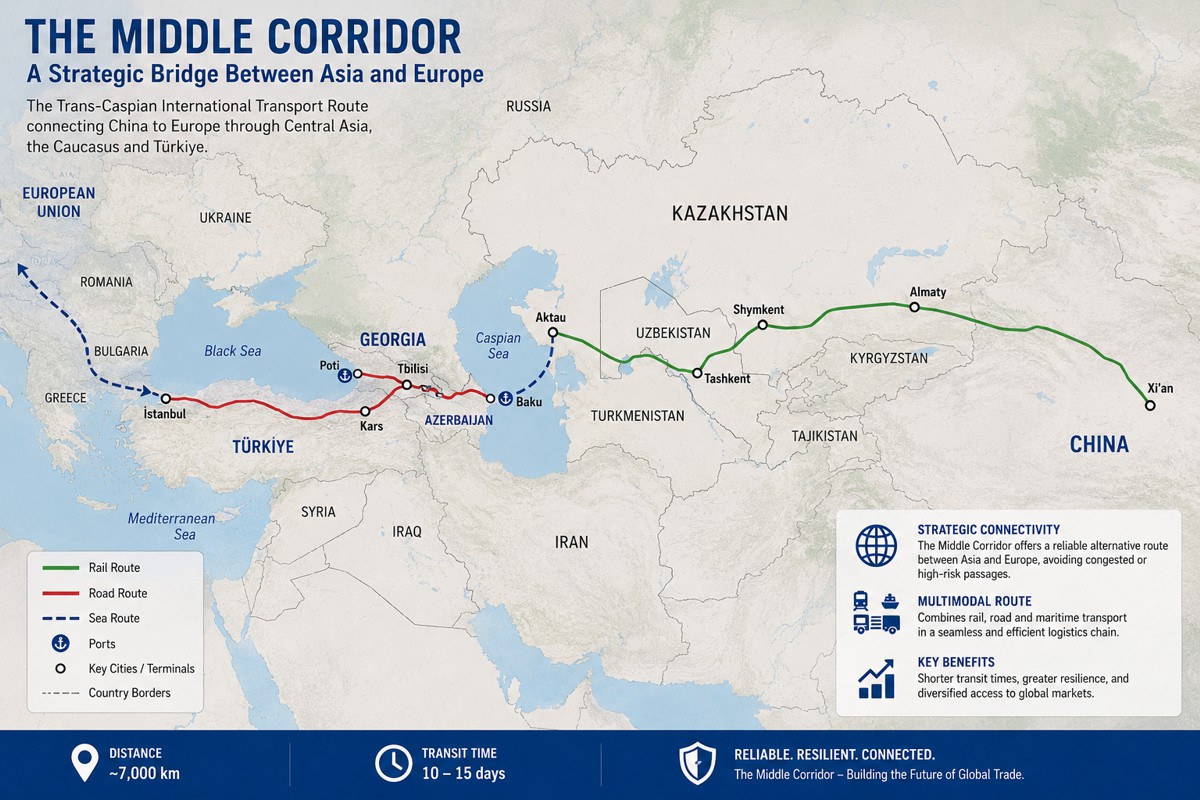
That framing lands at a moment when the wider route is drawing genuine cargo and capital rather than aspiration. The Middle Corridor, formally the Trans-Caspian International Transport Route, links western China through Kazakhstan, the Caspian, Azerbaijan, Georgia and Türkiye to European markets, and volumes have climbed sharply since operators began pulling freight off the sanctioned northern route through Russia.
For a road and materials audience, Kortava’s argument reframes that opportunity in operational terms. Asphalt quality, axle-load durability, maintenance response, customs speed, contract enforceability and legal certainty are not separate from the corridor question. They are the corridor question. As he put it: “A country becomes a corridor only when infrastructure, law, customs, logistics, financing, and institutional reliability work together.”
Briefing
- Middle Corridor cargo reached roughly 4.5 million tonnes in 2024, up more than 60 per cent year on year, with container traffic near 77,000 TEU in 2025 and a target of 300,000 TEU by 2029, though the route still carries only about six per cent of the northern corridor’s capacity.
- Georgia remains the corridor’s sole land gateway to Europe until an alternative route through Armenia becomes operational, which raises both the value and the fragility of its road and port infrastructure.
- The Rikoti Pass section of the East-West Highway, the most technically demanding stretch, was completed in December 2025 after years of delay, at a cost of around EUR 1.2 billion across four projects.
- Kortava positioned legal certainty, procurement discipline and regulatory approximation as the factors that make infrastructure bankable, arguing that *transport corridors are built by engineers, but they are trusted through law.*
- Georgia’s political path toward the European Union is frozen until at least 2028, yet the Deep and Comprehensive Free Trade Area remains in force, keeping the regulatory logic of Kortava’s argument commercially relevant.
The Corridor Is Real, And So Is The Competition
The numbers behind the Middle Corridor have moved from projection to record. Cargo across the Trans-Caspian route rose to about 4.5 million tonnes in 2024, an increase of more than sixty per cent, and container throughput reached roughly 77,000 TEU in 2025 with member states targeting 300,000 TEU by the end of the decade. End-to-end delivery times between China and Europe have been cut from around a month to roughly two weeks, according to figures released by Kazakhstan’s transport ministry, a change driven by rail modernisation, port investment and simpler border procedures.
Those gains explain why the route now attracts backing from the World Bank, the European Bank for Reconstruction and Development, the Asian Development Bank and the Asian Infrastructure Investment Bank, and why Kazakh, Azerbaijani and Georgian officials have signed successive roadmaps to remove bottlenecks.
None of that guarantees Georgia a share of the upside, which is precisely the caution Kortava built his keynote around. The corridor still moves only about six per cent of the northern route’s annual capacity, and its most exposed physical asset sits on Georgian soil. Georgia is currently the only land gateway carrying Middle Corridor freight into Europe, a position that concentrates both value and risk, and the country’s deep-sea ambitions remain unsettled.
Funding for the planned Anaklia deep-water port was cut in the 2026 budget from 150 million lari to 50 million, and the choice of contractor was still unresolved in the early part of the year. Kortava’s message to an audience of suppliers and contractors was blunt in substance if measured in tone. Cargo owners are practical, they do not choose a route because it sounds historic, and as he observed: “Shippers do not buy distance. They buy reliability.”
Where Bituroad Meets Strategy
For the delegates whose business is bitumen, machinery and maintenance, Kortava’s most useful move was to connect their technical work to corridor competitiveness rather than treat it as background. Heavier freight flows demand pavements that can absorb higher axle loads, mountainous alignments, wide temperature swings, snow, drainage pressure and slope risk, and that pushes questions of binder quality, polymer-modified bitumen, performance-based specification, preventive maintenance and asset management from the engineering department into the strategy discussion.
His argument was that a road is not simply a surface but a commitment, and that goods, contracts and investor confidence all depend on that commitment holding. “A road is an economic promise”, he told the conference, a line that reframes maintenance spending as a competitiveness decision rather than a cost centre.
Georgia has a live example of what that promise costs to keep. The East-West Highway forms the country’s spine, part of the international E60 corridor running roughly 390 kilometres from the Azerbaijan border to the Black Sea, and it carries close to sixty per cent of national foreign trade despite accounting for only a small share of the road network.
Its hardest section, the Rikoti Pass, was rebuilt as four separate projects involving dozens of bridges and tunnels at a total of around EUR 1.2 billion, and it was finally completed in December 2025 after repeated delays. That achievement carries a warning for the maintenance case Kortava was making.
In road policy, new construction usually wins the political argument over upkeep, yet for logistics it is maintenance that preserves capacity. A corridor that opens with fanfare but degrades under load does not simply generate repair bills. It generates delays, claims, reputational damage and lost cargo, and those are harder to recover than potholes.

Border Time Is Road Time
Kortava’s sharpest operational point was that physical roadworks alone cannot deliver a competitive corridor. A truck that saves two hours on a rebuilt highway and then loses twelve hours in documentation has gained nothing, which is why he reduced the argument to a phrase the audience could carry away, “border time is road time.”
Connectivity is not measured in kilometres of new asphalt but in total corridor performance, taking in customs clearance, permit handling, digital documentation, cargo dwell time, safety and axle-load checks, dispute resolution and the ability of operators to plan with confidence. The recent compression of Trans-Caspian transit times shows the point in practice, since much of that improvement came from procedural reform and data exchange rather than concrete.
The remedy Kortava proposed is measurement, and it is one the Georgian public sector could adopt without waiting for large capital programmes. He urged the corridor’s stakeholders to think in terms of performance dashboards covering average transit time, border crossing time, customs clearance, road condition, maintenance response, accident and overload data and operator satisfaction.
The logic is familiar to anyone running an asset-management regime, in that what is not measured tends not to improve, and what does not improve eventually loses freight to a competing route. For contractors and equipment suppliers, that visibility has a second-order benefit. Transparent condition data and maintenance response times make the case for preventive treatments, microsurfacing and emulsions far easier to win at procurement stage, because the cost of failure becomes legible rather than theoretical.
Where Geography Becomes Bankable
The section closest to Kortava’s own practice concerned the legal and institutional layer, and here he made a claim that infrastructure professionals sometimes undervalue – A project does not become bankable simply because it is needed. It becomes bankable when investors understand the rules, procurement is transparent, contracts are enforceable, public-private partnership structures are clear, disputes resolve predictably and regulators behave consistently.
That covers a long and unglamorous list, from transport licensing, carrier liability and insurance to concessions, axle-load enforcement, environmental obligations and public procurement, and Kortava’s point was that this softer architecture increasingly determines where capital and cargo commit. His formulation was deliberately memorable, that “transport corridors are built by engineers, but they are trusted through law.”
His argument rested heavily on alignment with European standards as an economic tool rather than a political gesture. Kortava’s case is not as fragile as the political headlines suggest. The Association Agreement and its Deep and Comprehensive Free Trade Area remain in force, the European Union is still Georgia’s largest trading partner, and Brussels has signalled interest in keeping transit and connectivity cooperation separate from the enlargement dispute, including through its Black Sea strategy.
Sector-level approximation on transport, procurement and technical standards can therefore continue to lower risk and improve reliability even while the broader accession question is frozen, which is a more precise version of the point the keynote advanced.

The Advisory Role
Kortava used the platform to set out where his firm fits, and did so in terms an infrastructure audience would recognise. Kortava Khatashvili Legal Intelligence is a Georgian legal and lobbying practice working across domestic and cross-border matters, with activity spanning regulatory compliance, contracts, dispute resolution, representation before public authorities, due diligence and government relations.
His own background sits at the intersection of European and transport law, international project work and professional training tied to the competence requirements for transport managers under European rules, and he framed the firm’s function as translating regulatory complexity into executable projects rather than offering abstract counsel.
The practical value, as he described it, splits across four groups the Bituroad audience maps onto directly. Individual transport professionals and managers face licensing, competence, employment, liability and cross-border documentation questions that carry real financial consequences. Logistics operators, contractors, suppliers and investors deal with contracts, permits, customs, corporate structuring, claims and communication with state bodies when entering or scaling in the market. Infrastructure and road-sector businesses, including bitumen suppliers and equipment providers, need clarity on procurement, payment terms, warranties and dispute mechanisms before the Georgian market becomes attractive. Governments, meanwhile, face the largest question of corridor attractiveness itself, which depends on frameworks that draw investment while protecting the public interest.
Kortava summarised the through-line without overstating it, describing the aim as helping the country become “easier to understand, easier to trust, and easier to invest in.”
The Reliability Premium
Kortava closed on a forward-looking sketch rather than a summary, imagining what a stronger Georgian corridor would look like by 2028. His list was practical: faster and more predictable border crossings, more durable roads, higher throughput, more transparent procurement, more international suppliers entering the market, more reliable maintenance systems and better integration with credible European standards where that creates real value.
The priorities that get Georgia there are equally concrete, covering continued modernisation of the East-West backbone, serious investment in lifecycle asset management, digitalised and harmonised border procedures, smart enforcement through weigh-in-motion and axle-load monitoring, and closer coordination between governments, financiers, operators, engineers and lawyers. Building roads without maintaining them, he warned, is not strategy but deferred cost.
What gives the argument weight for an investment and contracting audience is the emphasis on reputation as an asset in its own right. Once cargo owners trust a route they build operations around it, once investors trust a legal environment they commit capital, and once governments trust a partner they enter long-term cooperation, which is why Kortava argued that “Reputation is the most valuable infrastructure a corridor can have.”
For the suppliers, contractors and financiers at Bituroad, that is the commercial case in a sentence. The physical corridor through Georgia is being built and, in its hardest sections, has now largely been delivered. Whether it becomes a corridor operators plan around, rather than a route they tolerate, will be settled by the less visible layers of materials, maintenance, procedure and law that the conference exists to discuss.