Certified 3D Safety Reaches the Robot Floor with Sonair ADAR One
For most of the past decade, the safety function that keeps a mobile robot from hurting the people around it has been anchored by a technology that only ever sees a single horizontal slice of the world.
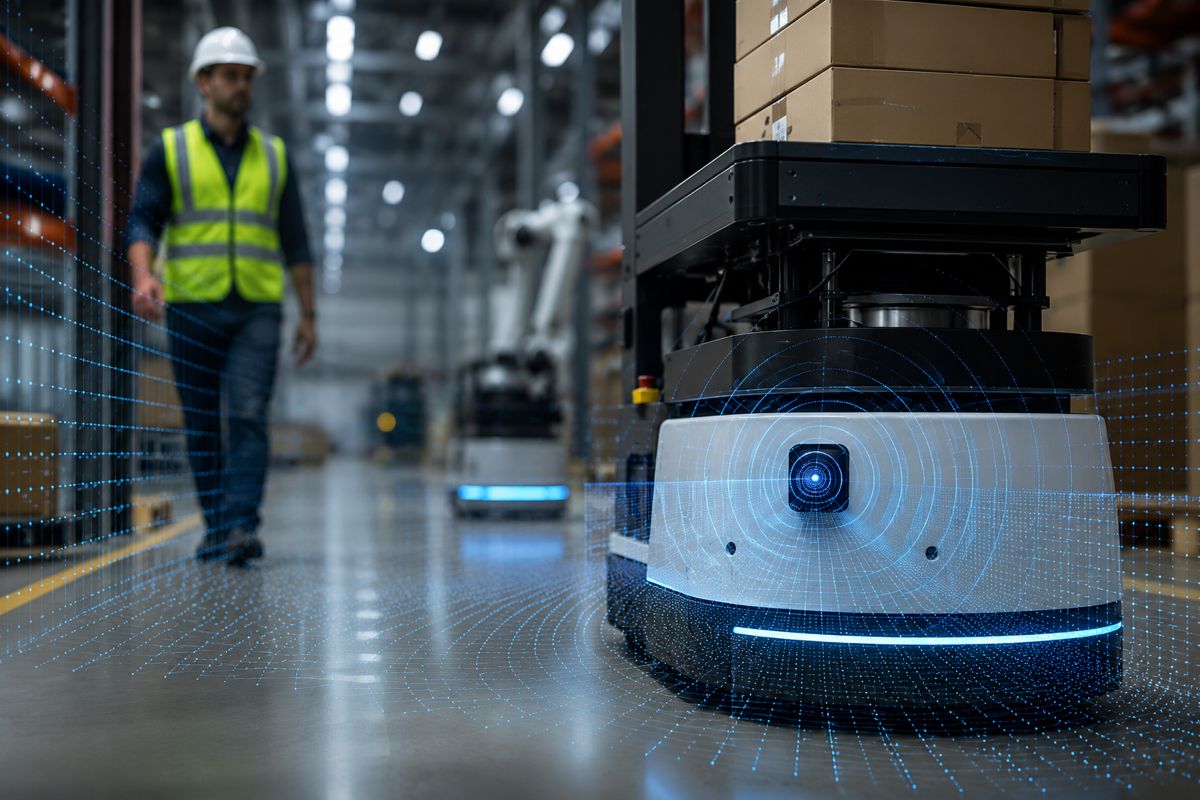
The 2D laser scanner, mounted low on the chassis of an autonomous mobile robot, defines the protective field that stops the machine when a leg crosses it. It cannot see a torso bent over a pallet, an arm reaching into a work cell, or a child’s height at all. That gap between what robots can now do and what their safety hardware can actually perceive has quietly limited how close automation can come to human workers.
Sonair, an Oslo-based deep-tech company spun out of the Norwegian research institute SINTEF, has just moved to close it.
On 30 June the company confirmed that its ADAR One sensor had become the first 3D sensor independently certified for human detection, cleared for SIL 2 and PL d applications and assessed against the demanding standards that govern electrosensitive protective equipment.
The significance is less about the device itself than about the category it creates. Certified 3D perception turns a promising laboratory capability into something an integrator can specify, an insurer can underwrite and a regulator recognises. That single shift reorders the cost and liability calculations running through the entire autonomous machine supply chain, from warehouse AMRs to the humanoid platforms now attracting enormous investment.
Briefing
- Sonair’s ADAR One is the first 3D sensor independently certified for human detection to SIL 2 and PL d, assessed under IEC 61496 alongside IEC 61508 and ISO 13849, and carrying an EC type-examination certificate from notified body exida.
- The sensor uses acoustic detection and ranging, combining airborne ultrasound with beamforming to deliver a 180° by 180° field of view at up to five metres, detecting people and obstacles at every height and eliminating the blind spots of single-plane 2D scanners.
- Sonair states that ADAR One can reduce sensor-package costs by up to 50% against incumbent LiDAR safety hardware, and the sensor is already in series production and shipping on deployed robots.
- Palletising and de-palletising specialist beRobox has agreed to deploy ADAR One, taking certified 3D safety into one of automation’s highest-throughput, closest-quarters applications.
- More than 80 robotics companies have evaluated the sensor since its beta launch a year ago, and ADAR One is also the first safety-certified embedded system built in the Rust programming language.
Why Certification Rather Than Capability Was the Real Constraint
Three-dimensional perception around robots is not, in itself, new. Cameras and depth sensors have mapped the space around machines for years, and the AI stacks now common in physical robotics are increasingly capable of interpreting what they see. The problem has always been trust of the legally accountable kind.
A camera-and-AI pipeline can be highly capable and still fail to satisfy a functional safety assessor, because its behaviour is probabilistic and difficult to bound. Safety certification exists precisely to draw a hard line, proving that a protective device will detect a person under defined conditions and move the machine to a safe state when it can no longer trust its own measurement.
Until now, no 3D sensor had cleared that bar, which is why the safety function stayed stubbornly two-dimensional even as everything else on the robot advanced.
Knut Sandven, chief executive of Sonair, frames the distinction: “The bottleneck to safe human-robot coexistence isn’t intelligence or speed,” he said. “It’s safe perception; knowing reliably under any condition, that a human is nearby. This milestone certification is the first time a 3D sensor has been independently verified to meet that bar using sound instead of light – a new sensing modality that complements cameras where they fall short.”
The framing matters for buyers as much as engineers. Industry survey data has repeatedly shown that certification, not raw capability, is the practical barrier to deployment. A 2026 benchmark study of robotics developers found that the overwhelming majority regard physical AI as central to their strategy, yet fewer than a third feel confident that such systems can make safe, predictable decisions in the real world, and roughly two-thirds report project delays caused by certification requirements. A pre-certified component speaks directly to that anxiety.
The Cost Equation Robot Builders Have Been Waiting For
The commercial logic sharpens once the certificate is understood as a piece of removable engineering burden. Building a safety case from scratch is slow, expensive and specialised work, and for most robot makers it sits well outside their core competence. Incumbent 2D LiDAR safety scanners are trusted precisely because that work has already been done around them, but they carry high unit costs and impose the design compromise of a single scan plane.
Sonair’s pitch is that ADAR One collapses that trade-off by arriving pre-certified as a drop-in layer, at a sensor-package cost the company puts at up to half that of established LiDAR arrangements. For an OEM weighing bill-of-materials against time-to-market, that combination is unusually direct in its appeal.
Sandven is explicit that the certificate is meant to function commercially rather than merely technically. “This is precisely the role ADAR One is designed to play as a drop-in, pre-certified safety layer,” he said. “What used to be an engineering burden is now transformed into a commercial differentiator for all stakeholders.”
The value cascades along the chain. Systems integrators can specify the sensor into AMR, AGV and collaborative robot architectures without negotiating special exemptions or assembling bespoke safety documentation for each site. End users gain deployments that sit inside safety architectures already recognised by insurance and liability frameworks, which has been a quiet but persistent brake on 3D sensing in regulated warehouse and logistics settings.
Given that warehouse work remains materially more hazardous than the private-sector average, with recorded injury rates among US warehouse employees running well above the norm, the liability dimension is anything but abstract.
A Palletising Partner Signals Where This Lands First
The first named deployment is instructive. Sonair has signed an agreement with beRobox, a specialist in plug-and-play palletising and de-palletising systems, to integrate ADAR One into future solutions. Palletising is among the least forgiving environments in industrial automation, combining heavy, fast-moving loads with human operators working in close proximity, and it is exactly the setting where a single-plane safety field leaves the most dangerous gaps.
Certified full-body detection in three dimensions addresses a real operational exposure rather than a theoretical one, which is why the choice of first partner reads as a statement about where the technology delivers its clearest return.
David Demers, chief executive of beRobox, positioned the agreement as part of a wider integration strategy rather than a one-off. “At beRobox, innovation is not just about developing new products. It’s about continuously integrating the best technologies available to simplify automation for our customers. Partnering with Sonair is another step in our mission to stay ahead through innovation and deliver the most advanced, user-friendly palletizing and de-palletizing solutions on the market,” he said.
The beRobox deal is not the sensor’s only traction. Cleaning-robot manufacturer Cleanfix has already built ADAR into a next-generation autonomous machine, and more than 80 companies ran the beta through Sonair’s evaluation programme over the past year. For many of those, the certificate is the trigger that converts trials into orders, and Sonair has said its priority now is moving partners from testing into volume.
What SIL 2 and PL d Actually Certify
Behind the shorthand of the ratings sits a genuinely demanding body of work. ADAR One was assessed as a human protection sensor under IEC 61496, the type standard for electrosensitive protective equipment, and against IEC 61508 and ISO 13849, the foundational standards for functional safety of electronic systems and for safety-related parts of control systems.
The resulting rating of SIL 2 and PL d, with a probability of dangerous failure below 1.5 × 10⁻⁷ per hour, is not simply a hardware metric. It requires the device to demonstrate diagnostic coverage and an architecture capable of detecting its own faults and reverting to a safe state, backed by failure-mode analysis, development-process evidence and validation testing that an assessor reviews in depth.
Sonair has described the final documentation package running to many thousands of pages, and the assessment was complicated further because IEC 61496 was written around optical devices such as light curtains and laser scanners, obliging the standards bodies to adapt their physical test methodology for a sound-based sensor.
The choice of ultrasound is central to why the certification was achievable at all. Sound in air behaves deterministically, travelling at a known speed and reflecting within a defined window, which makes performance calculable in a way that optical interpretation of a scene is not. ADAR builds its picture using arrays of piezoelectric micromachined ultrasonic transducers, digitally steering and focusing sound in the manner of medical ultrasound imaging, and it keeps working in dust, glare and darkness where cameras and LiDAR can be misled.
Sonair has also made a point of its software foundations, describing ADAR One as the first safety-certified embedded system built in Rust, a language whose memory-safety properties are designed to eliminate whole classes of software fault. Sandven casts the result not as a straight substitution but as a new stratum in the safety stack. “ADAR One does not merely replace a sensor. It introduces a new safety layer for robotics, a certified 3D perceptual foundation that sits beneath any camera, AI stack, or motion system, independently verifying that the space around a robot is safe,” he said.
Reading the Signal for Humanoids and Physical AI
The implications extend well beyond warehouse AMRs. The sensor’s compact footprint allows it to be embedded flush into a robot’s body shell, including the humanoid platforms now drawing heavy capital from investors betting on general-purpose machines. Those systems present an acute version of the safety problem, since a humanoid working alongside people needs full-body awareness of everything around it, and no camera-and-AI stack currently offers a certified perceptual backstop for that job.
A pre-certified 3D layer that can be integrated without redesigning the underlying structure gives humanoid developers a route to the kind of safety case their machines will eventually require, and it does so today rather than at some indefinite future point.
There is a strategic dimension for investors and policymakers as well. Analysts expect the installed base of warehouse AMRs alone to pass half a million machines by the end of the decade, part of a robotics market heading toward roughly 110 billion dollars by 2030, and every one of those machines that operates near people needs a defensible safety architecture.
Sonair’s backers have also flagged dual-use potential spanning civilian and defence applications, reflecting the reality that autonomous machines are proliferating across both. The company raised six million dollars in late 2025 from investors including Scale Capital, Norway’s state-backed Investinor and the Aker-linked RunwayFBU, capital explicitly aimed at scaling into that demand. Certification is the credential that lets a small Norwegian firm compete for it credibly.
Where the Regulatory Clock Now Points
Timing strengthens Sonair’s position. From 20 January 2027 the European Union’s Machinery Regulation 2023/1230 replaces the long-standing Machinery Directive, applying directly across all member states and bringing artificial intelligence, cybersecurity and digital documentation formally into the scope of machine safety for the first time.
The new framework raises the bar for anyone placing autonomous machinery on the European market, and it makes pre-certified, well-documented safety components more valuable rather than less, because they reduce the compliance load that manufacturers will soon be obliged to carry. A drop-in layer that already holds an EC type-examination certificate is precisely the sort of building block that eases that transition.
The larger story is the migration of robot safety from two dimensions to three at the exact moment robots are moving closer to people rather than being fenced away from them. For years the industry accepted a single-plane view as the practical limit of what could be certified, and designed its deployments around that constraint.
Sonair’s certificate removes the excuse, and the commercial pressure created by a lower-cost, pre-approved alternative will make it progressively harder for robot builders to justify shipping machines that can only see a slice of the people working beside them. Whether ADAR One becomes the default or simply forces the incumbents to answer it, the direction of travel for human-robot coexistence has shifted, and it now points firmly upward as well as outward.