Renesas Edge AI Ambitions Grow with Irida Labs Acquisition in Greece
Edge AI is rapidly shifting from experimental technology to operational necessity across the construction, infrastructure, transport and industrial sectors. Cameras are no longer passive recording devices bolted onto machinery, highways or buildings. Increasingly, they’re becoming intelligent decision-making systems capable of analysing hazards, monitoring assets, guiding autonomous equipment and improving operational efficiency in real time. That shift is placing fresh pressure on semiconductor companies to deliver complete solutions rather than isolated chips.
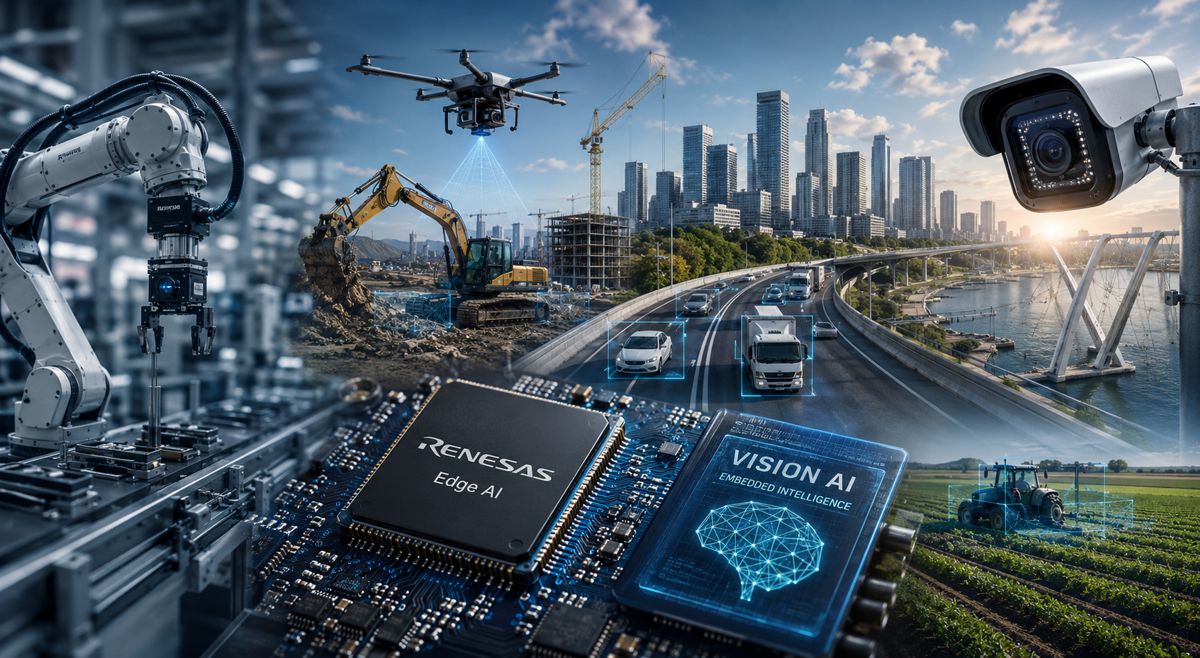
Renesas Electronics Corporation has just completed the acquisition of Irida Labs, a Greece-based developer specialising in embedded Vision AI software. The move strengthens Renesas’ position in edge AI processing while adding software capabilities that are becoming increasingly critical in industrial automation, robotics, smart infrastructure and intelligent transportation systems.
The acquisition reflects a broader trend unfolding across the semiconductor industry. Hardware vendors are steadily moving up the stack, integrating software, AI development environments and cloud-based lifecycle management into unified ecosystems. The goal is straightforward enough. Customers want faster deployment, lower complexity and fewer integration headaches when building intelligent systems at the edge.
For infrastructure operators and industrial firms, the implications are substantial. Vision AI systems are now being used to inspect roads, monitor rail assets, detect safety risks on construction sites, guide autonomous machinery and manage traffic networks. Processing that visual data locally at the edge, rather than pushing everything to the cloud, reduces latency, lowers bandwidth requirements and improves operational resilience in environments where connectivity may be inconsistent or security-sensitive.
Briefing
- Renesas has acquired Greece-based Vision AI software company Irida Labs
- The deal strengthens Renesas’ edge AI and embedded processing capabilities
- Irida Labs’ PerCV.ai platform will integrate into the Renesas 365 development ecosystem
- The combined offering targets industrial automation, robotics, infrastructure monitoring, IoT and smart city applications
- The acquisition reflects growing industry demand for integrated hardware and software AI solutions at the edge
Edge AI Moves into the Infrastructure Mainstream
The edge AI market has expanded rapidly over the past few years as industries look for ways to process data closer to where it is generated. Analysts at MarketsandMarkets estimate the global edge AI market could exceed US$60 billion before the end of the decade, driven by demand for real-time analytics, autonomous systems and industrial automation.
Construction and infrastructure sectors are increasingly part of that growth story. Smart highways equipped with intelligent traffic monitoring systems, automated construction equipment, predictive maintenance platforms and AI-enabled safety systems all rely heavily on machine vision. The challenge is that deploying these systems has often required specialist AI expertise alongside significant computing resources and complex integration work.
That’s precisely the gap Renesas appears intent on addressing through the acquisition. By bringing Irida Labs’ lightweight Vision AI software and development tools into its embedded processing portfolio, the company is aiming to reduce the complexity surrounding edge AI deployment.
Renesas already has a strong footprint in embedded systems through its RA microcontrollers and RZ microprocessors, both widely used across industrial and IoT applications. Adding integrated Vision AI software creates a more complete system-level offering capable of handling visual perception workloads without relying on large external compute platforms.
Vision AI Becomes Essential for Industrial Automation
Machine vision has quietly become one of the most important enabling technologies in industrial automation. Cameras combined with AI algorithms can now identify defects in manufacturing lines, monitor worker safety, track asset movement and support autonomous navigation systems.
In transport infrastructure, Vision AI systems are increasingly used for traffic analytics, incident detection and intelligent transportation management. Cities deploying smart infrastructure are also leaning heavily on computer vision for pedestrian monitoring, parking optimisation and public safety applications.
Meanwhile, in agriculture and mining, edge-based visual perception systems are supporting autonomous equipment guidance, crop monitoring and hazard detection in remote operating environments where cloud connectivity is limited or impractical.
These applications require a delicate balancing act between performance and efficiency. Systems need enough computing power to run AI inference models locally while operating within strict power and thermal limits. That requirement has driven demand for highly optimised embedded AI software capable of running on smaller processors without sacrificing reliability.
Irida Labs built its reputation around precisely that challenge. Its PerCV.ai software platform focuses on lightweight Vision AI deployment for embedded devices, enabling AI workloads to run efficiently on constrained hardware.
Renesas Pushes Beyond Silicon
For semiconductor manufacturers, selling processors alone is no longer enough. Customers increasingly expect complete development environments, AI toolchains and ready-to-deploy reference solutions that shorten time-to-market.
Renesas’ broader digitalisation strategy reflects that shift. Earlier this year, the company introduced Renesas 365, a cloud-based development platform designed to unify electronics system development, deployment and lifecycle management. Initially focused on RA microcontrollers and associated toolchains, the platform is intended to evolve into a wider ecosystem for embedded system design.
Integrating Irida Labs’ software into Renesas 365 significantly expands the platform’s capabilities into Vision AI and deep-learning applications.
“This acquisition accelerates our efforts to simplify how intelligence is designed and deployed at the edge,” said Gaurang Shah, Vice President and General Manager, Embedded Processing Product Group. “With Irida Labs’ Vision AI tools, software and highly competent AI engineers now part of Renesas, our solution brings together AI perception, embedded processing, development tools and system integration to significantly reduce the learning curve for developers. As a result, they can rapidly develop, train and deploy edge AI systems without deep AI knowledge.”
That emphasis on lowering technical barriers is increasingly important as labour shortages and skills gaps continue affecting industrial technology adoption globally. Many infrastructure operators and OEMs want AI capabilities but lack large in-house AI engineering teams.
Greece Emerges as a Quiet AI Innovation Hub
The acquisition also shines a spotlight on Greece’s growing technology ecosystem. While not traditionally associated with semiconductor innovation, Greece has steadily developed a reputation for advanced software engineering and AI research over the past decade.
Irida Labs, headquartered in Patras, has been part of that evolution. The company focused on embedded computer vision well before edge AI became one of the semiconductor sector’s hottest investment areas. Its collaboration with Renesas prior to the acquisition helped establish technical alignment between the two businesses.
“The joining of Irida Labs into Renesas marks an important milestone in our edge vision AI journey,” said Vassilis Tsagaris, CEO & Co-Founder of Irida Labs. “By combining Irida Labs’ edge Vision AI expertise and our PerCV.ai software with Renesas hardware and global ecosystem, we open up exciting new opportunities to deliver meaningful impact on edge AI worldwide. I am proud of what the team has built, and genuinely excited to take it forward together with Renesas, turning our shared vision into reality.”
For Greece, the deal represents another example of local deep-tech talent attracting global industrial investment. The country has seen growing interest in AI startups, software engineering firms and research-driven technology companies as international businesses look beyond traditional European tech hubs.
Industrial Robotics and Smart Infrastructure Stand to Benefit
The combined capabilities of Renesas and Irida Labs are particularly relevant for industrial robotics and infrastructure monitoring systems, both of which are expected to see major investment growth through the remainder of the decade.
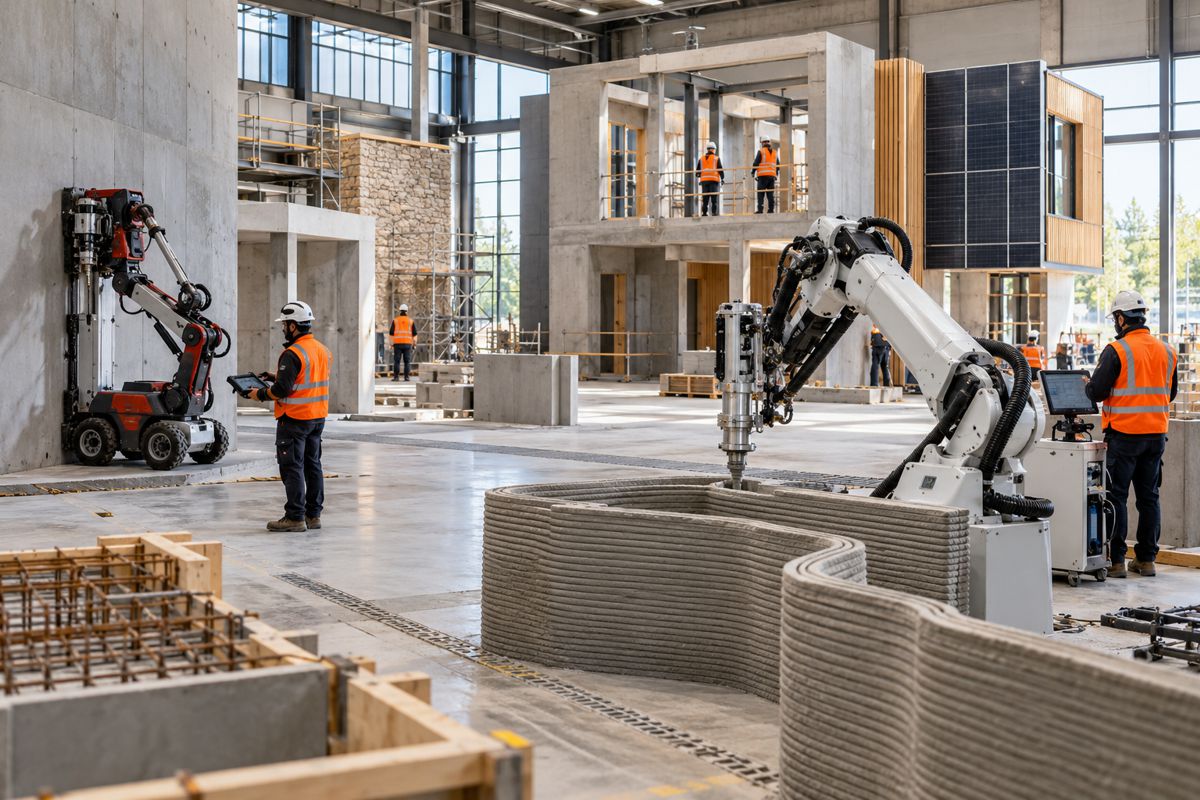
In construction environments, machine vision systems are already being used for:
- Autonomous equipment navigation
- Worker safety monitoring
- Progress tracking and digital twin updates
- Site security and access control
- Material handling automation
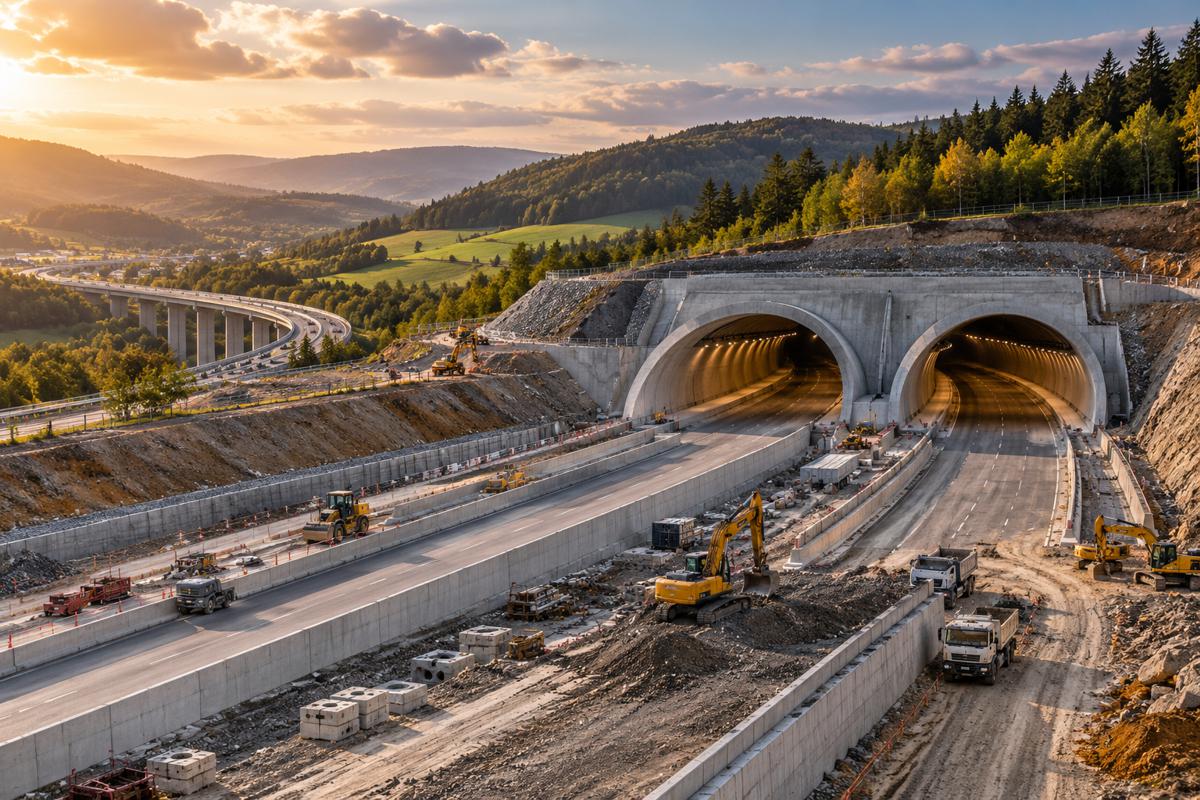
Infrastructure operators are similarly deploying Vision AI for bridge inspection, road condition monitoring, rail corridor surveillance and traffic management.
The push toward smarter infrastructure is also being reinforced by wider urban digitalisation programmes. Governments worldwide are investing heavily in connected transportation systems, intelligent mobility networks and automated infrastructure maintenance technologies as part of broader smart city initiatives.
Edge AI processing plays a central role in making these systems commercially viable. Sending continuous high-resolution video streams to cloud servers is expensive, bandwidth-intensive and often impractical for real-time decision-making. Local processing dramatically improves response times while reducing operating costs.
Competition Intensifies Across the Semiconductor Sector
Renesas is far from alone in pursuing integrated edge AI solutions. Semiconductor rivals including NVIDIA Corporation, Qualcomm Technologies, Intel Corporation and Texas Instruments are all investing heavily in AI-enabled embedded processing and machine vision ecosystems.
What differentiates vendors increasingly comes down to integration, developer accessibility and deployment efficiency rather than raw silicon performance alone.
That’s especially true in industrial markets where long product lifecycles, reliability requirements and operational simplicity often outweigh cutting-edge benchmark performance.
Renesas appears to be positioning itself as a provider of practical, power-efficient AI systems designed for industrial deployment rather than purely high-performance AI computing.
The acquisition of Irida Labs strengthens that positioning by adding software expertise directly into the organisation rather than relying solely on external partnerships.
Building the Next Layer of Intelligent Infrastructure
AI-powered visual perception is steadily becoming embedded into the physical infrastructure that underpins modern economies. Roads, factories, warehouses, ports, railways and utilities are all evolving into data-generating environments where intelligent systems continuously analyse conditions and optimise operations.
That transformation is creating enormous commercial opportunities across semiconductors, embedded systems, industrial software and infrastructure technology.
Renesas’ acquisition of Irida Labs may not generate the same headlines as multi-billion-dollar AI data centre investments, yet it speaks directly to where a significant portion of industrial AI growth is heading. The real long-term opportunity may lie less in giant cloud models and more in millions of distributed intelligent edge devices quietly operating across infrastructure networks worldwide.
For the construction and infrastructure industries, the implications are already becoming visible. Safer worksites, smarter transport systems, predictive maintenance platforms and autonomous machinery increasingly depend on embedded AI operating reliably at the edge.
The race now is no longer simply about building smarter chips. It’s about creating complete ecosystems capable of turning AI from a specialist technology into a deployable industrial tool.