AI UPS Technology to Redefine Grid Stability for Hyperscale Data Centres
The explosive growth of artificial intelligence infrastructure is creating a power challenge unlike anything modern grids have encountered before. Hyperscale AI data centres now consume electricity at levels traditionally associated with industrial manufacturing plants, yet their power demand behaves very differently. Massive GPU clusters can swing energy consumption dramatically within seconds, creating instability risks for already strained electricity networks.
Grid operators across the United States are now moving quickly to address the issue. Regulators and reliability agencies increasingly view large electronic loads as a new category of infrastructure requiring stricter operational standards before interconnection approval is granted. That shift is already beginning to reshape how AI facilities are designed, financed and connected to the grid.
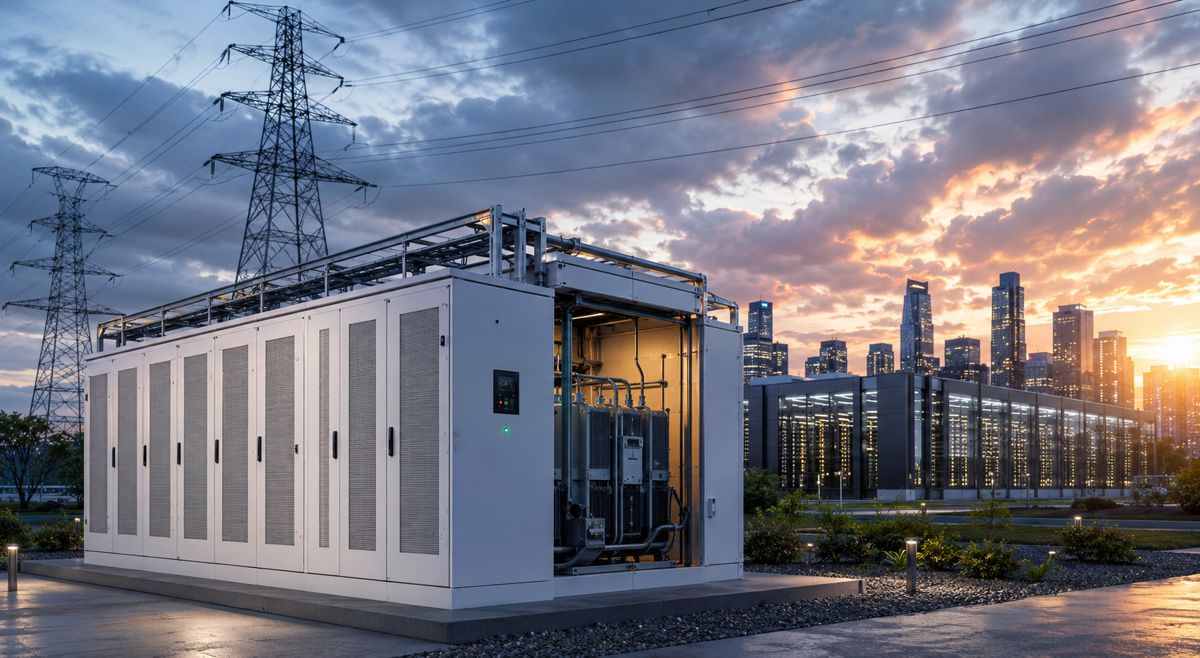
Eenergy infrastructure specialist ON.energy has released independent validation results for its AI UPS™ system following deployment at the U.S. Department of Energy’s National Laboratory of the Rockies. The testing focused on how large AI workloads behave during severe grid disturbances and whether advanced medium-voltage infrastructure can prevent those disturbances from cascading back into the wider electricity network.
The timing is significant. North American grid operators are under mounting pressure as AI development accelerates faster than transmission upgrades, generation additions and interconnection reform processes. The result is a growing collision between digital infrastructure growth and electrical system reliability.
Briefing
- ON.energy released independent validation results for its AI UPS™ system tested at 13.2 kV under real-world conditions
- Testing benchmarked performance against ERCOT’s proposed large electronic load ride-through requirements under NOGRR 282
- The system reportedly maintained stable operation during complete zero-voltage events while managing AI workload swings of ±70%
- Grid operators are tightening interconnection standards for hyperscale AI data centres amid rising reliability concerns
- Energy resilience technologies are increasingly becoming commercial assets rather than purely compliance-driven infrastructure
AI Infrastructure is Becoming a Grid Engineering Problem
The AI boom has transformed electricity demand forecasting almost overnight. According to the International Energy Agency, global electricity demand from data centres is expected to rise sharply over the next decade as generative AI systems scale. In the United States alone, utilities are already reporting unprecedented interconnection requests from hyperscale operators seeking hundreds of megawatts of new capacity.
Unlike traditional industrial facilities, however, AI compute environments create highly dynamic load profiles. GPU-intensive training models can trigger rapid fluctuations in demand as workloads scale up or down. Those transient swings can place significant stress on transmission systems, voltage stability and local distribution infrastructure.
That issue has become particularly acute in Electric Reliability Council of Texas territory, where data centre expansion is accelerating rapidly. ERCOT’s proposed NOGRR 282 revisions seek to establish formal voltage and frequency ride-through obligations for large electronic loads connecting to the network. The measure received approval from ERCOT’s Reliability and Operations Subcommittee in April 2026 and could soon become part of formal interconnection requirements.
At the same time, the North American Electric Reliability Corporation has issued a Level 3 alert concerning the reliability implications of rapidly growing large electronic loads. The message from regulators is becoming increasingly clear. AI infrastructure can no longer behave as passive consumers of electricity. They must actively support grid resilience.
Testing Under Real World Conditions
The ON.energy validation programme was conducted at the National Laboratory of the Rockies using a 13.2 kV testing environment with programmable grid and load simulators operating at 7 MW and 20 MW respectively. GPS-synchronised data acquisition systems monitored system performance during multiple ride-through scenarios designed to replicate real operational conditions.
Rather than relying on simplified laboratory simulations, the testing attempted to mirror the type of electrical disturbances large AI facilities could encounter during actual interconnection events or grid instability periods.
The results demonstrated that the AI UPS system maintained operation during complete zero-voltage ride-through events while continuing to stabilise internal load voltage. According to the validation data, the system exceeded ERCOT’s proposed requirement to remain connected during a 150 millisecond zero-voltage event.
Overvoltage conditions were also examined. ERCOT’s proposed framework requires systems to withstand 120 percent voltage conditions for one second. ON.energy reported its system sustained operation for 12 seconds during testing.
Perhaps more important for AI operators, however, was the handling of GPU workload volatility. The tests simulated workload transients involving swings of plus or minus 70 percent while remaining within proposed grid ramp-rate compliance thresholds.
That matters because unstable ramp rates are emerging as one of the biggest operational concerns surrounding hyperscale AI deployment.
The Hidden Cost of AI Electricity Demand
The broader infrastructure implications extend well beyond data centres themselves. Utilities and transmission operators increasingly face difficult questions about who should bear the cost of reinforcing grids to accommodate AI expansion.
Some utilities are now demanding that hyperscale operators fund dedicated substations, battery storage systems or transmission upgrades before projects proceed. In several North American markets, interconnection queues are becoming increasingly congested as AI developers compete for limited grid capacity.
This creates a commercial incentive for technologies capable of smoothing load volatility internally before disturbances reach the wider electricity system.
Systems such as AI UPS are therefore positioned not simply as backup power infrastructure, but as active grid conditioning platforms capable of supporting both compliance and operational optimisation.
The distinction is important. Traditional uninterruptible power systems were primarily designed to bridge short-term outages and protect sensitive equipment. AI-scale infrastructure increasingly requires far more sophisticated power architecture capable of managing grid interactions continuously rather than only during emergencies.
Energy Storage is Becoming Operational Infrastructure
One of the more interesting aspects of ON.energy’s positioning is the commercial layer attached to compliance infrastructure. The company argues that grid-safe medium-voltage systems can support services including peak shaving, demand response, ancillary services participation and energy arbitrage.
That reflects a wider transformation happening across the energy sector. Battery systems and advanced power electronics are no longer viewed purely as insurance policies against outages. Increasingly, they are being treated as revenue-generating operational assets.
For hyperscale operators facing soaring electricity costs, that evolution could become financially significant. Large AI campuses may eventually behave more like industrial energy hubs, dynamically interacting with electricity markets while balancing compute demand against grid conditions.
Several major cloud providers are already investing heavily in onsite generation, battery storage and advanced energy management systems as part of broader resilience strategies.
The shift also intersects with wider concerns surrounding decarbonisation. AI expansion is driving renewed fossil generation demand in some regions, while simultaneously accelerating investment in renewables, storage and flexible infrastructure elsewhere. Grid-safe load management technologies could therefore play an important role in helping networks absorb additional renewable generation without compromising reliability.
Medium Voltage Infrastructure is Moving Into the Spotlight
Historically, medium-voltage electrical infrastructure rarely attracted mainstream attention outside specialist engineering circles. That is beginning to change.
As AI campuses scale toward gigawatt-level demand profiles, medium-voltage architectures are becoming central to project viability. Designers are increasingly focused on power quality, harmonics, transient response and system resilience at unprecedented scales.
This is particularly relevant for facilities operating high-density GPU clusters where even brief voltage instability can disrupt workloads, damage equipment or reduce operational efficiency.
The ON.energy deployment highlights how medium-voltage technologies are evolving from conventional utility support infrastructure into strategic digital infrastructure components.
The company’s fully inline architecture also reflects growing interest in systems that avoid introducing additional switching complexity or operational bottlenecks into high-capacity environments. Simplicity, resilience and rapid responsiveness are becoming increasingly valuable as facilities scale.
Reliability is Becoming a Competitive Advantage
The rapid rise of AI infrastructure is forcing a convergence between digital engineering and power engineering that many industries were not fully prepared for.
Until recently, data centre expansion was largely constrained by land availability, fibre connectivity and cooling capacity. Today, electrical resilience and interconnection approval are increasingly determining whether projects move forward at all. That changes the economics of infrastructure investment.
Facilities capable of demonstrating stable ride-through performance, controllable ramp rates and grid-safe operation may gain advantages in interconnection negotiations, financing and permitting. Conversely, operators unable to satisfy evolving grid requirements could face significant delays or additional upgrade costs.
“NOGRR 282 is achievable. We deployed at NLR specifically to run these tests under real-world conditions that match what AI data centers face at interconnection,” said Ricardo de Azevedo, Co-Founder & CTO, ON.energy. “The validated results are definitive: AI UPS rides through a complete zero-voltage event while keeping load voltage stable, and handles ±70% GPU transients without registering on the grid.”
Building the Electrical Foundations of the AI Economy
The AI sector’s energy demands are reshaping infrastructure planning far beyond the technology industry itself. Utilities, regulators, transmission operators, construction firms and energy developers are all now being pulled into a rapidly evolving ecosystem where digital growth depends directly on electrical resilience. That transformation is likely to accelerate.
Hyperscale facilities are becoming some of the largest and most complex industrial loads ever connected to modern electricity networks. As interconnection standards tighten and reliability scrutiny intensifies, advanced power conditioning and grid-safe infrastructure could become standard components of AI campus development rather than optional enhancements.
The ON.energy validation results offer an early glimpse into how the industry may respond. The real significance lies less in one individual technology and more in what it represents. AI infrastructure can no longer operate independently of grid stability concerns.
Electricity networks are becoming active participants in the future of artificial intelligence, and the infrastructure connecting the two is quickly becoming one of the most strategically important sectors in the global economy.