Silent Sensors and Smart Spaces Powered by Battery Free Ultrasonic Tags
Modern buildings are filling up with sensors. Offices monitor occupancy, warehouses track assets, homes automate lighting, and healthcare facilities increasingly rely on data to support independent living. Yet there’s a snag many operators know all too well. Most connected devices still need batteries, wiring, charging schedules, or regular maintenance. Across large estates, that seemingly minor burden can become a costly operational headache.
Researchers at Georgia Institute of Technology believe they may have found a simpler route. Their newly developed metal sensing tags operate without batteries, generate no audible noise, protect privacy by design, and could be manufactured for only a few cents each. Small enough to sit discreetly on a doorframe or cabinet, the technology points toward a future where buildings can gather useful operational data without adding yet another layer of power-hungry electronics.
That prospect carries real weight. Smart infrastructure ambitions often stumble not because sensing is impossible, but because maintaining thousands of sensors is expensive and messy. A battery-free alternative could shift the economics of digital monitoring across homes, hospitals, logistics hubs and public facilities.
Briefing
- Researchers at Georgia Institute of Technology developed battery-free ultrasonic metal tags for low-cost sensing.
- Tags can detect doors, drawers, taps, weights and other movements without microphones recording speech.
- Each tag produces a unique ultrasonic signature, enabling identification of specific assets or actions.
- Low power processing avoids heavy computing demands and supports scalable deployment.
- Potential applications include smart buildings, elderly care, logistics, waste management and gyms.
A Different Approach to Smart Building Sensors
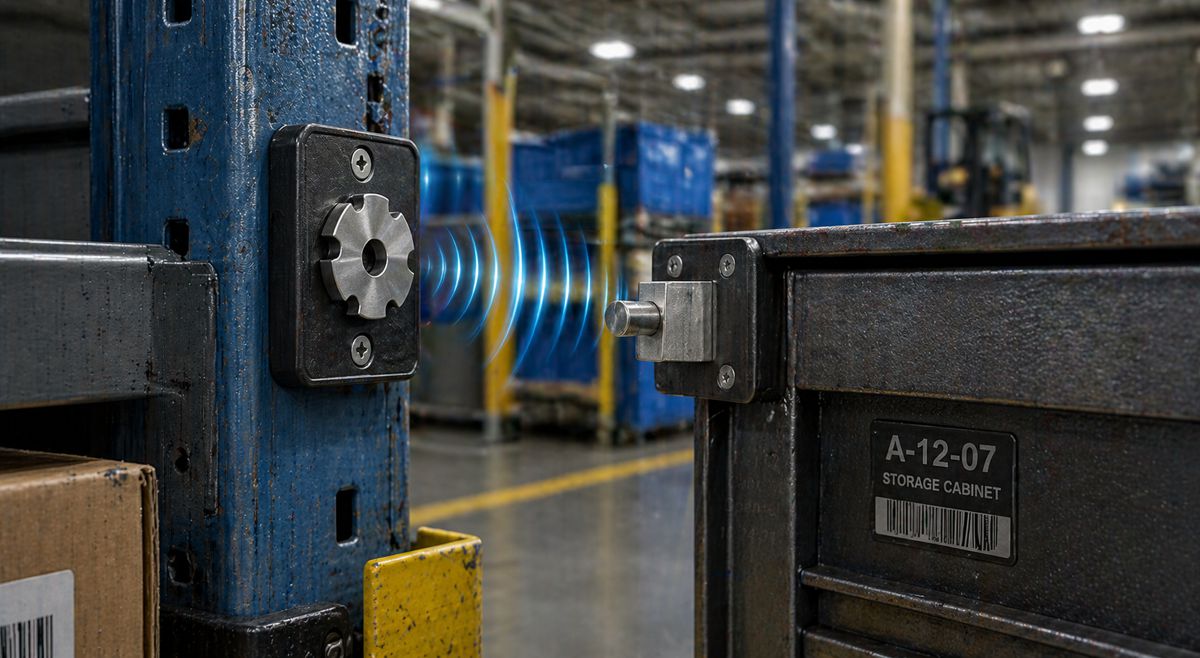
The concept is straightforward. A small metal disc, mounted on a cabinet, drawer, doorframe or other fixed point, is paired with a tab attached to the moving part. When the door or drawer opens, the tab strikes the metal tag. That brief impact creates an ultrasonic pulse above the range of human hearing.
Nearby wearable or embedded receivers can detect and log the signal. No batteries sit inside the tag itself. No wireless charging is required. No mains connection needs to be installed. Instead, the motion of the object supplies the energy needed to create the signal.
That matters because sensor maintenance is one of the least glamorous but most expensive parts of smart estate management. Replacing batteries across a housing portfolio, airport terminal, healthcare campus or municipal building stock can consume labour budgets quickly. Strip away that requirement, and suddenly many monitoring use cases become more commercially realistic.
Tiny Tags With Unique Acoustic Fingerprints
The metal tags are not identical washers stamped out at random. Their geometry determines the ultrasonic frequency they emit. Each disc contains a centre hole and carefully designed cut-outs around the outer edge, allowing engineers to tune resonance characteristics.
“Those unique fingerprints can be used for smart home sensing, or what we call ‘activity recognition,’” said Yibo Fu, a robotics Ph.D. student who led development of the tags.
That means one tag on a medicine cabinet could be distinguished from another on a refrigerator door, wardrobe, utility cupboard or water tap. A receiving device would know not only that something moved, but which object moved.
In infrastructure terms, this is where the idea becomes compelling. Distinguishable passive identifiers can create event-based monitoring systems at extremely low cost, especially where full IoT devices would be excessive.
Why Privacy Could Be a Major Selling Point
Many current smart home and building systems rely on cameras, microphones or networked occupancy sensors. While effective, they often raise concerns around surveillance, data retention and cyber risk. This new approach sidesteps much of that debate.
The tags emit short-range ultrasound only when physically triggered. They do not continuously listen, watch or transmit. The signal also dissipates quickly, meaning only nearby devices are likely to detect it.
That short operating range creates a natural privacy boundary. In homes, assisted living facilities or staff welfare areas, such restraint may prove more socially acceptable than cameras or always-on microphones. For policymakers shaping smart city standards, privacy-preserving sensing is becoming increasingly important as public trust becomes central to digital adoption.
Built for Scale Through Simplicity
Another notable aspect of the project is computational efficiency. Rather than relying on complex machine learning models to interpret signals, the researchers created a rules-based detection algorithm with hardcoded logic.
That may sound less fashionable than AI-heavy alternatives, but from an infrastructure perspective it is highly practical. Lower processing demands mean lower power use, cheaper hardware, simpler deployment and easier integration into embedded devices.
For contractors and estate operators, technology that works reliably with modest compute requirements often wins over more sophisticated systems that require specialist hardware or cloud subscriptions. In other words, elegant simplicity can beat technological theatre.
Thousands of Potential Identifiers
The engineering behind the discs was supported by modelling work from Bolei Deng and colleagues in the Daniel Guggenheim School of Aerospace Engineering. Their simulations explored how geometry affects vibration and resonance.
The team reportedly identified nearly 1,300 initial designs capable of producing distinct ultrasonic frequencies. Only a fraction were tested, suggesting considerable room for expansion.
“We could select 20 or 50 or 100 designs and it most likely still works,” Deng said. “And with more careful design, I think the total number of available tags can be very, very large — easily thousands — because the ultrasound frequency range is very broad.”
That scalability is significant. Large facilities, hospitals, warehouses, campuses and transport hubs may need hundreds or thousands of uniquely identifiable sensing points. If each costs pennies rather than pounds, deployment models change dramatically.
Real World Uses Beyond the Home
While the technology has obvious smart home potential, broader infrastructure use cases may be even more interesting.
In healthcare and assisted living, tags on bathroom doors, taps or medicine cabinets could help carers identify unusual inactivity or distress signals while preserving dignity. In logistics, shelves, archive systems and storage boxes could be monitored for movement events. In waste management, bins and containers could be tracked when opened, emptied or repositioned.
Gyms and rehabilitation centres could use them to count repetitions on weights or exercise equipment. Public washrooms, maintenance cupboards or restricted access cabinets could gain simple event logging without complex retrofits.
For construction sites, temporary compounds and rental assets, passive tags may offer a low-cost way to monitor access or equipment use during project delivery.
Implications for Smart Infrastructure
The construction and infrastructure sectors often discuss digital twins, connected assets and data-led operations. Yet many portfolios still struggle with the basics of sensor deployment economics. Devices fail, batteries die, networks drift, maintenance gets deferred.
Battery-free event sensing could help bridge the gap between ambition and practicality. Not every asset requires a fully connected edge computer. Sometimes operators simply need to know whether a door opened, a valve moved, a cabinet was accessed, or an item was used.
That lighter-touch sensing layer could complement more advanced systems rather than replace them. A transport depot, for example, may use high-end telemetry for machinery while using passive ultrasonic tags for lockers, cabinets and routine access points.
Quiet Innovation With Commercial Promise
The project has already generated public attention after Fu showcased the tags online, attracting strong engagement and fresh ideas from viewers in specialist industries. That reaction hints at a broader truth. Markets often recognise useful tools before formal commercialisation begins.
For manufacturers, facilities management firms and proptech investors, the opportunity may lie in turning a clever lab prototype into robust, easy-to-install commercial products. Packaging, mounting systems, receivers, software dashboards and sector-specific integrations would all need development.
Still, the core idea is strong: low-cost physical intelligence without batteries, noise or surveillance creep.
A Smarter Future Through Less Technology
There is a lesson here for the wider infrastructure world. Progress does not always come from adding more electronics, more cloud layers or more complexity. Sometimes it comes from removing them.
These tiny ultrasonic tags suggest that the next wave of smart environments may be powered not by bigger devices, but by smaller, simpler and more thoughtful ones. For an industry chasing efficiency, resilience and trust, that could be music nobody can hear.