Ferrovial Wins $1.5 Billion Grand Parkway Contract in Houston
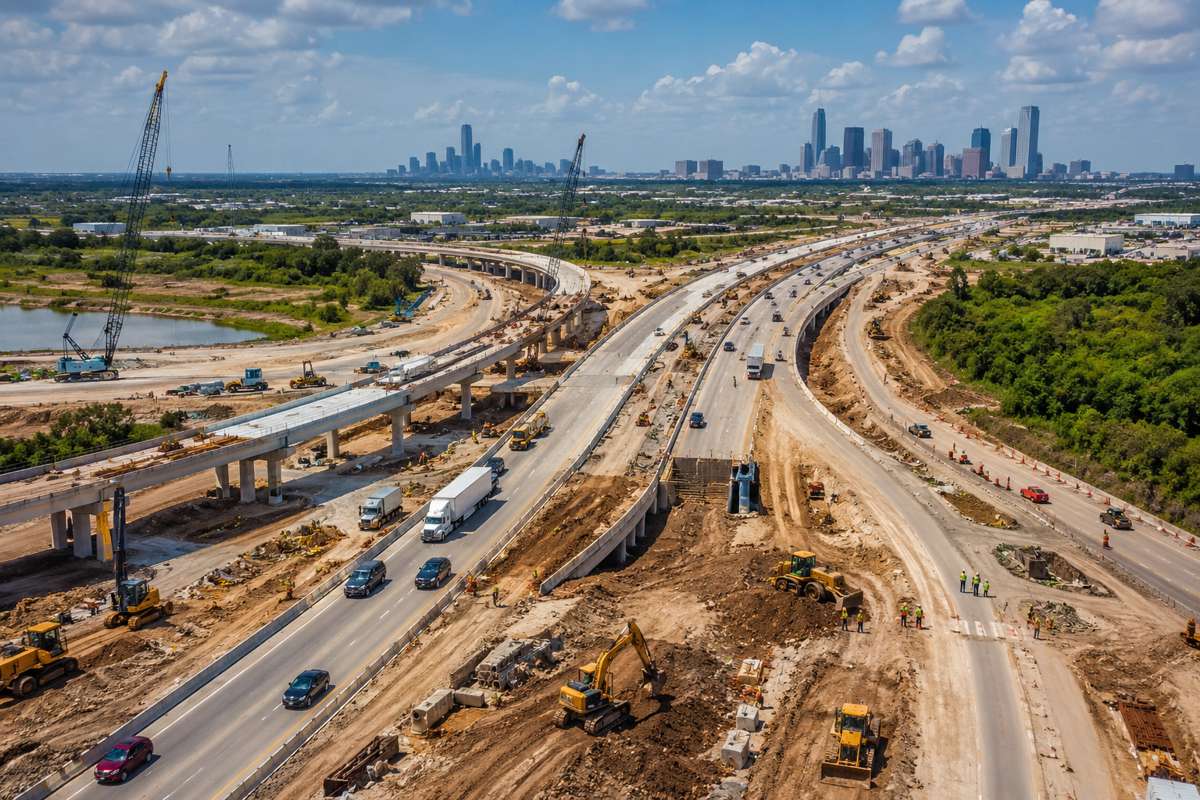
Houston’s relentless population growth and industrial expansion continue reshaping infrastructure priorities across Texas, and the latest phase of the SH 99 Grand Parkway project illustrates just how critical strategic highway investment has become for the region. Spanish infrastructure giant Ferrovial has secured a major contract from the Texas Department of Transportation to design, build and maintain Segment B-1 of the SH 99 Grand Parkway southeast of Houston, in a project valued at approximately $1.47 billion.
The award covers almost 15 miles of new infrastructure crossing Brazoria and Galveston Counties, extending one of the largest orbital highway systems in the United States. More than simply another highway expansion, the scheme reflects a wider shift underway across North America where transport authorities are attempting to future-proof fast-growing metropolitan regions against mounting congestion, climate threats and logistical pressures.
Houston already serves as one of the world’s most important energy, petrochemical and freight hubs. As freight volumes rise and residential development pushes further into surrounding counties, pressure on the existing highway network has intensified. State agencies increasingly view outer loop corridors like SH 99 as essential infrastructure that can redistribute traffic flows, improve freight resilience and strengthen evacuation routes during extreme weather events.
Briefing
- Ferrovial awarded approximately $1.47 billion SH 99 Grand Parkway Segment B-1 contract in Texas
- Project includes nearly 15 miles of new highway infrastructure southeast of Houston
- Scheme features four new tolled lanes, frontage roads and major interchange upgrades
- Contract includes long-term capital maintenance responsibilities for up to 15 years
- Infrastructure expansion strengthens mobility, freight movement and hurricane evacuation capacity across southeast Texas
Houston’s Expanding Infrastructure Demands
The Houston metropolitan area has become one of America’s fastest-growing economic regions, fuelled by energy investment, manufacturing growth, logistics expansion and inward migration. According to data from the United States Census Bureau, the wider Houston region has consistently ranked among the country’s largest growth markets over the past decade, adding significant pressure to road capacity and commuter corridors.
That rapid expansion has transformed the Grand Parkway from a long-term transport concept into a critical strategic artery. When fully completed, the 184-mile loop will function as a massive circumferential highway intended to relieve pressure from Houston’s inner beltways while opening new development corridors around the metropolitan edge.
Segment B-1 forms part of the broader southern extension of SH 99, linking key industrial and residential zones southeast of Houston. The corridor is expected to improve regional connectivity between employment centres, freight facilities and suburban communities that have experienced accelerating growth in recent years.
Infrastructure analysts have increasingly pointed to orbital highways as vital tools for managing urban sprawl in major US cities. Rather than concentrating traffic through congested city centres, outer loops allow freight operators and commuters to bypass bottlenecks while supporting new commercial development along peripheral corridors.
What the SH 99 Segment B-1 Project Includes
The contract awarded to Ferrovial includes the construction of four new tolled lanes that will be operated by TxDOT. The scheme also incorporates discontinuous frontage roads, direct connectors between SH 35 and the new SH 99 alignment, and operational improvements to SH 35 itself.
Importantly, the project is structured as a design-build contract combined with a capital maintenance term of up to 15 years. That arrangement reflects a growing preference among transport authorities for lifecycle-based procurement models that integrate long-term maintenance obligations directly into major infrastructure delivery contracts.
Rather than focusing solely on initial construction, these models attempt to improve asset durability, reduce long-term operational costs and create stronger accountability around infrastructure performance. Contractors are therefore incentivised not only to deliver projects quickly but also to ensure long-term operational reliability.
The project is expected to reach substantial completion during winter 2031–2032, assuming final contract execution proceeds as anticipated this summer.
Ferrovial Strengthens Its Texas Footprint
The latest award further consolidates Ferrovial’s growing role within Texas transport infrastructure. The company has already been involved in previous SH 99 projects, including Segments H and I-1, giving it extensive operational experience within the Grand Parkway programme.
Texas has become one of the most competitive infrastructure markets in North America as population growth drives sustained demand for roads, bridges, airports and utility upgrades. State agencies have increasingly relied on large-scale design-build partnerships to accelerate delivery schedules while controlling long-term asset performance.
In a statement announcing the award, Ignacio Gaston, Ferrovial Construction CEO, said: “We’re proud to work with TxDOT on this important project for the growing Houston region. This award reflects our shared commitment to delivering high-quality infrastructure that serves Texas communities.”
He added: “Building on our success with SH 99 Segments H and I-1, we look forward to enhancing mobility and connectivity across southeast Texas.”
The company’s North American portfolio has expanded steadily in recent years, particularly across transportation infrastructure and managed lanes projects. Texas remains especially attractive due to its large infrastructure funding pipeline, relatively streamlined procurement environment and strong population growth forecasts.
Freight Logistics and Economic Development
Beyond commuter mobility, the SH 99 expansion carries substantial implications for freight and industrial logistics across southeast Texas. Houston’s strategic importance as an energy and shipping hub means transport reliability has become increasingly intertwined with national supply chain resilience.
The Port of Houston continues handling record cargo volumes, while nearby petrochemical facilities, manufacturing plants and distribution centres rely heavily on efficient highway access. Congestion delays across existing corridors can create cascading impacts throughout industrial supply chains, particularly during peak freight periods.
Improved connectivity between SH 99 and SH 35 could therefore support broader industrial efficiency by reducing journey times and improving freight routing flexibility. Infrastructure economists frequently note that orbital highway systems can unlock major economic value by reducing dependency on overloaded central corridors.
The project is also expected to stimulate further commercial and residential development in Brazoria and Galveston Counties, where population growth has intensified demand for new transport infrastructure. Large highway investments often act as catalysts for logistics parks, retail development and industrial expansion along newly connected corridors.
Hurricane Resilience and Emergency Preparedness
One of the more strategically important elements of the SH 99 project relates to emergency evacuation capacity. Southeast Texas remains highly vulnerable to hurricanes and severe weather events originating from the Gulf Coast, placing enormous pressure on regional transport systems during evacuation scenarios.
Following disasters such as Hurricane Harvey, state and regional agencies have increasingly prioritised infrastructure resilience within transport planning. Additional highway capacity and alternative evacuation routes are now viewed as critical components of regional emergency management strategies.
Segment B-1 is expected to improve evacuation efficiency for communities southeast of Houston by expanding route options and reducing dependence on already congested corridors. That may prove increasingly important as climate scientists continue warning about the growing intensity and frequency of extreme weather events affecting Gulf Coast states.
Transport infrastructure resilience has become a central theme across global infrastructure policy discussions. Governments are no longer simply building roads for traffic capacity alone. Increasingly, they are designing transport networks capable of supporting emergency response, disaster recovery and long-term climate adaptation.
Design Build Procurement Continues Gaining Momentum
The SH 99 contract also highlights the continued rise of design-build procurement across major US infrastructure projects. Traditional sequential procurement models have gradually given way to more integrated approaches intended to accelerate timelines and improve coordination between engineering and construction teams.
Design-build delivery allows contractors greater flexibility to optimise engineering decisions, manage construction sequencing more efficiently and reduce fragmentation across project phases. Infrastructure owners often favour the model for complex transport schemes where schedule certainty and risk allocation are especially important.
Long-term maintenance responsibilities further extend that integrated approach by encouraging contractors to prioritise durability and operational efficiency from the outset. Transport agencies increasingly regard lifecycle-based procurement as essential for improving infrastructure value over decades rather than simply reducing initial construction costs.
That evolution mirrors broader trends across the international construction sector, where public authorities are under pressure to deliver larger infrastructure programmes with tighter budgets, rising material costs and growing public scrutiny around asset performance.
Texas Continues Building for Long Term Growth
Texas has emerged as one of the defining infrastructure growth stories in North America. Population increases, industrial investment and continued migration from other US states have created extraordinary pressure on transport networks across major metropolitan regions including Houston, Dallas-Fort Worth, Austin and San Antonio.
The SH 99 Grand Parkway programme represents part of a much wider infrastructure transformation reshaping the state’s economic geography. Massive highway investments are increasingly intertwined with logistics growth, housing expansion, industrial development and regional competitiveness.
For construction firms, engineering specialists and infrastructure investors, Texas continues offering one of the most active transport development pipelines in the western world. Projects such as Segment B-1 demonstrate how strategic highway expansion remains central to economic planning even as transport systems evolve toward greater digitalisation and smarter mobility management.
By the time the latest Grand Parkway segment reaches completion early next decade, Houston’s outer growth corridors may look very different from today. Yet the underlying objective remains familiar: creating infrastructure capable of supporting economic growth while maintaining mobility across one of America’s most dynamic metropolitan regions.