Acoustic Science Is Revealing Hidden Infrastructure Risks
For as long as crews have fretted over what’s lurking beneath a carriageway, the instinct has been the same: stand on the surface, point the kit downward, and hope the signal bounces back with something useful. That habit has held for decades across the survey trade, and it carries a quiet flaw. Sending energy from above a hidden tunnel or void means a good deal of the useful information scatters sideways or downward, never returning to the sensors waiting up top. Researchers at Oak Ridge National Laboratory (ORNL), the Department of Energy facility in Tennessee, reckoned the fix might be almost embarrassingly simple. Turn the whole thing on its head.
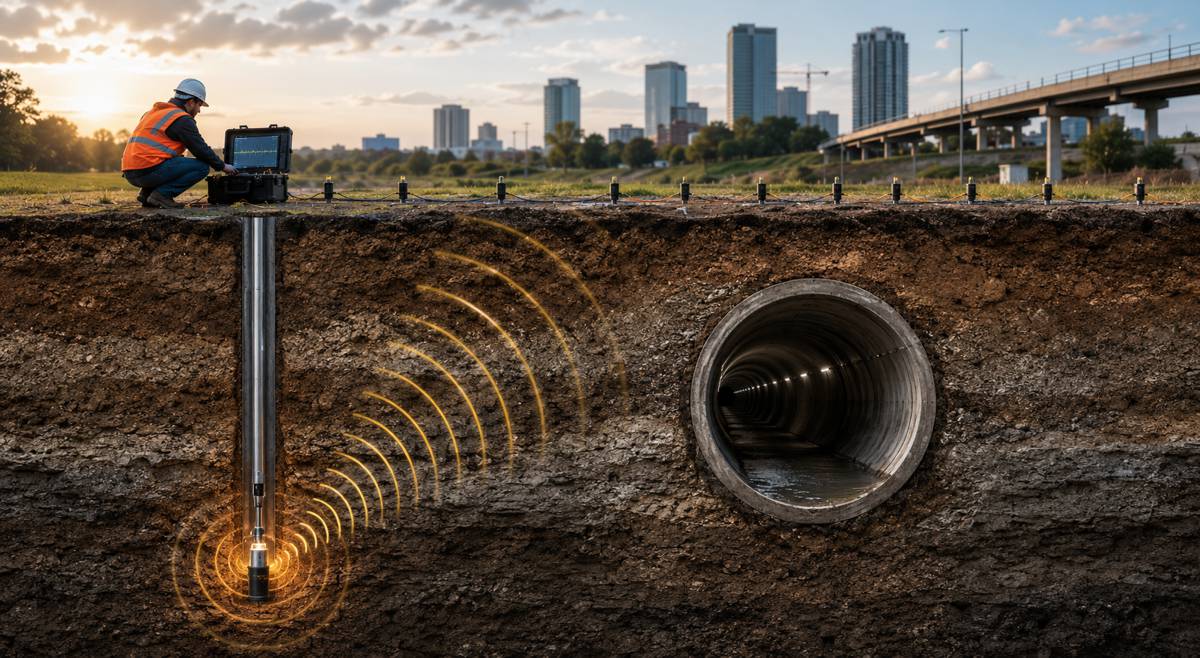
Their field experiment, run on the laboratory’s own campus, did exactly that. Rather than firing sound down towards a suspected cavity, the team generated acoustic signals from boreholes sunk beneath the target and listened for what came up. The result was a clean, repeatable marker of a buried structure that older surface-down techniques had a habit of missing. For an industry that loses time, money and occasionally lives to ground that gives way without warning, a more reliable way to spot what’s hiding underfoot isn’t a laboratory curiosity. It’s the sort of thing that reshapes how roads, rail corridors and critical sites get checked before anyone breaks ground.
Briefing
- ORNL flipped conventional tunnel detection by sending acoustic signals upward from below-ground boreholes rather than down from the surface, capturing scatter that’s normally lost.
- The approach generated a distinct subharmonic signal, a lower-frequency response created as sound waves bend around a tunnel, picked up by surface geophones.
- A field test used a 40-foot (roughly 12-metre) steel tunnel buried about 10 feet (3 metres) down, with the sound source placed as deep as 30 feet (9 metres).
- The signal appeared only when the tunnel was present and only when sound came from beneath it, hinting that the method could also indicate tunnel depth.
- The work matters for highways, railways and secure sites, where undetected voids and tunnels threaten ground stability and have long defeated standard survey tools.
Why Hidden Voids Keep Infrastructure Owners Awake
The economics here are blunt. Voids beneath the surface, whether they’re natural cavities, old mine workings, washed-out soil around a failing pipe or a deliberately dug tunnel, sit out of sight until the ground above can’t hold its own weight any longer. When it goes, it tends to go fast and expensive. In Florida alone, sinkhole-related repairs have been estimated at around 300 million US dollars a year, and that figure only covers the patching and utility restoration, not the disruption to traffic, freight and daily life while a road sits closed for weeks or months.
Asset managers across the highways and rail sectors have learned the hard way that emergency repair costs a multiple of proactive treatment. Filling a void before it collapses is cheap by comparison with excavating a swallowed lane and rebuilding it. The catch has always been confidence: you can’t grout what you can’t find, and surveying blind costs almost as much as ignoring the problem. A detection method that flags a buried structure with a clear, distinctive fingerprint speaks directly to that gap, because it lets engineers act on evidence rather than on a hunch and a hope.
Where The Usual Survey Toolkit Runs Out Of Road
Geophysical surveying isn’t short of instruments. Crews routinely reach for seismic surveys, ground-penetrating radar and electrical resistivity, and each has earned its place. The trouble is that each also hits a wall in the conditions that matter most. Ground-penetrating radar, for instance, struggles to see much past roughly 40 feet, and it performs poorly in damp, clay-rich soils or cluttered urban ground, which is precisely where a lot of infrastructure lives. One cross-border tunnel found between San Diego and Tijuana ran nearly 100 feet down, well beyond what radar could realistically reach.
Seismic methods carry their own awkward trade-off. Sent from above, higher-frequency signals can pick out small cavities but fade quickly as they push through the earth, while lower-frequency signals travel farther yet tend to gloss over the finer detail. Layer on what some researchers call a halo effect, where fracturing around a tunnel blurs its edges and helps it blend into the surrounding geology, and you start to see why the field has such a patchy record. A US Army Corps of Engineers report put it plainly, noting that geophysical detection of clandestine tunnels has met with limited success over several decades and that a reliable solution has yet to be found. Plenty of tunnels, it turns out, still get discovered the old-fashioned way, through tip-offs rather than science.
Flipping The Signal On Its Head
What ORNL’s team did was borrow a technique well established in oil and gas work, vertical seismic profiling, and run it backwards. In its standard form, that method drops sensors into a borehole and records energy waves generated up at the surface. The researchers swapped the roles, planting the acoustic source below the target tunnel and arranging the listening gear above it. That single reversal is the heart of the whole idea.
When sound travels up from beneath and meets a tunnel, it bends, or diffracts, around the structure and throws off a subharmonic signal, a lower-frequency response that surface sensors can pick out. As lead researcher Mike Kass explained: “Our hypothesis was that if we reversed direction, sending the signal from below a potential tunnel instead of above, we could improve detection by capturing signal scatter that otherwise is lost.” The payoff is twofold. Not only does the signal confirm that something’s down there, but because it showed up only when the source sat below the tunnel, it offers a clue about depth, which is one of the hardest variables to pin down with existing kit.
Inside The Field Test
Theory’s one thing, muddy reality another, so the team built a proper test bed. They buried a 40-foot steel tunnel, about 12 metres long, roughly 10 feet beneath the surface, then drove vertical boreholes and placed an acoustic source as deep as 30 feet down. Up top sat an array of geophones, the sensitive vibration sensors that do the actual listening. Crucially, they recorded how sound moved through the ground both before and after the tunnel went in, giving themselves a clean before-and-after comparison rather than a single ambiguous reading.
The data held up. “During testing, the geophones detected a distinct subharmonic signal,” said Charles Finney, a senior research and development researcher at the laboratory. “Subsequent measurements showed the signal consistently appeared only when the tunnel was present and only when the sound originated beneath it.”
That consistency is what separates a promising fluke from a usable mechanism. A reading that turns up reliably under controlled conditions, and vanishes just as reliably when the cause is removed, is the kind of thing engineers can eventually build a procedure around.
From Highways To Hard Borders
The infrastructure case is the obvious one, yet the same physics travels well into security work, where the stakes have always been high and the detection record frustrating. Cross-border tunnels have been a recurring headache for authorities, with US officials at one point uncovering a fresh one every few months, some fitted with lighting and ventilation. The most notorious reminder of the problem was the mile-long tunnel that let drug boss Joaquín “El Chapo” Guzmán slip out from beneath a Mexican prison cell in 2015. Ports, prisons, military bases and other secure perimeters all share the same vulnerability to what’s quietly being dug below them.
Commercial detection systems already lean on seismic and acoustic sensing for exactly these settings, which tells you the appetite is there. What’s been missing is a method that copes with depth and difficult soils without drowning operators in false alarms. By reaching beneath the target and reading the scatter that surface methods throw away, ORNL’s approach nudges at both weaknesses at once, and it does so using sensing hardware that the geophysical trade already understands.
Where The Work Heads Next
Plenty of homework remains before any of this turns up in a contractor’s standard workflow. The team plans to test the method across different soil types, since ground behaviour is rarely as obliging as a controlled campus plot, and to refine how the signals get analysed. There’s also work to do on how timing and signal strength might be tuned to produce more detailed imaging, the difference between knowing something’s down there and knowing its shape, size and exact position.
The project leaned on ORNL’s Laboratory Directed Research and Development Seed Money Programme and drew on the National Transportation Research Centre, a DOE user facility, with contributions from Kass, Finney, Omar Marcillo, Monica Maceira and Derek Splitter. The findings sit in a DOE technical report titled “Advancing Tunnel Detection Via Vertical Acoustic Profiling.”
For the engineers, investors and policymakers who carry the cost of ground that fails without warning, the appeal is straightforward. A detection method that’s more honest about what’s hiding beneath a road or a rail line, and roughly how deep it sits, is worth a great deal long before the first spade goes in.