Nuclear Power Moves Into the AI Infrastructure Race
The rapid expansion of artificial intelligence, hyperscale cloud computing and high-performance data processing is creating a power challenge that conventional grids are struggling to handle. Across North America and Europe, utilities are already warning of transmission bottlenecks, rising peak demand and growing concerns over long-term grid stability as energy-hungry data centres multiply at unprecedented speed.
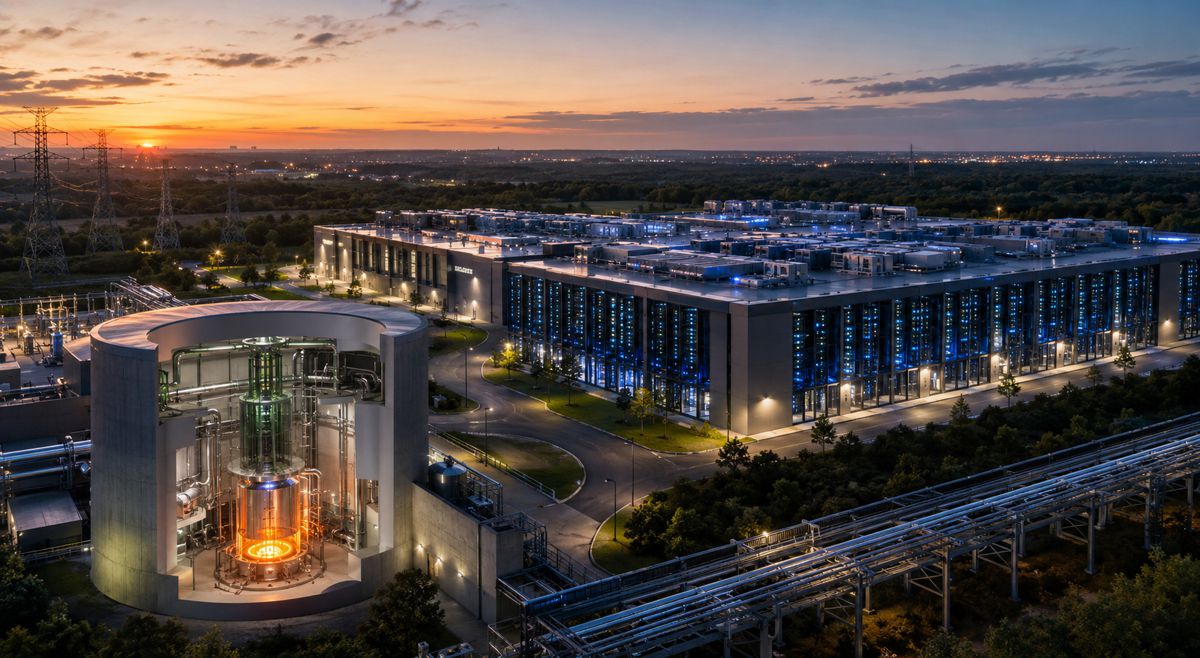
A new alliance between Terrestrial Energy and Riot Platforms signals a notable shift in how future digital infrastructure may be powered. The two companies have announced plans to collaborate on integrating Terrestrial Energy’s Generation IV Integral Molten Salt Reactor technology with Riot-developed large-scale data centres, initially exploring opportunities in Texas and Kentucky before assessing wider deployment possibilities across the United States.
What makes the announcement particularly significant is not merely the involvement of nuclear energy in data centre operations, but the type of nuclear technology being proposed. Rather than relying on traditional gigawatt-scale reactors requiring vast construction programmes and decades-long timelines, the partnership centres on small modular nuclear systems designed specifically for distributed industrial applications. That changes the commercial equation considerably for energy-intensive sectors such as AI computing, advanced manufacturing and digital infrastructure.
The announcement also arrives at a moment when governments, investors and infrastructure planners are rethinking long-term energy security strategies. Large technology firms including Microsoft, Amazon and Google have already moved aggressively into nuclear energy partnerships to secure future electricity supplies for AI growth. Riot and Terrestrial Energy now appear intent on positioning themselves within that same emerging market, albeit with a more vertically integrated infrastructure model focused on co-located generation and computing capacity.
Briefing
- Riot Platforms and Terrestrial Energy plan to develop co-located advanced nuclear plants and large-scale data centres in the United States
- The partnership focuses on Terrestrial Energy’s Generation IV Integral Molten Salt Reactor technology
- Candidate deployment locations include Riot’s existing facilities in Texas and Kentucky
- The project targets growing AI, hyperscale cloud and high-performance computing energy demand
- The IMSR design uses standard-assay low enriched uranium, avoiding current HALEU supply chain constraints affecting some SMR developers
AI Growth is Reshaping Global Power Demand
The timing of this partnership reflects profound changes underway in the global energy market. Artificial intelligence workloads require enormous amounts of electricity, and the infrastructure supporting AI applications is expanding at extraordinary speed. According to projections from the International Energy Agency, global electricity consumption from data centres could more than double before the end of the decade, driven largely by AI inference and training systems.
That surge is already placing stress on regional grids. In parts of the United States, utilities are delaying or reassessing data centre connections because existing transmission infrastructure cannot support anticipated demand growth. Northern Virginia, one of the world’s largest data centre hubs, has become a case study in the challenges associated with hyperscale expansion, where power availability increasingly dictates development timelines.
Traditional renewable generation alone cannot always satisfy hyperscale operators seeking continuous 24-hour baseload electricity. Wind and solar remain central to decarbonisation strategies, yet intermittency creates operational challenges for facilities requiring uninterrupted computing performance. Battery storage helps smooth fluctuations, though long-duration reliability at hyperscale levels remains commercially complex and expensive.
This is where advanced nuclear developers see opportunity. Small modular reactors promise continuous low-carbon electricity generation without the emissions profile of natural gas plants. If deployed successfully, they could offer data centre operators predictable long-term energy pricing alongside greater independence from volatile grid conditions.
Molten Salt Reactors Re-enter the Nuclear Conversation
Molten salt reactors have long occupied a curious place within nuclear engineering history. The underlying technology was first demonstrated decades ago during experiments conducted at Oak Ridge National Laboratory in the United States during the 1960s. However, commercial deployment never materialised as the nuclear industry consolidated around water-cooled reactor designs.
Now, with pressure mounting to decarbonise industrial systems while simultaneously expanding electricity supply, molten salt technology is returning to the spotlight. Terrestrial Energy’s Integral Molten Salt Reactor, or IMSR, is among several Generation IV reactor concepts competing for commercial relevance in the evolving nuclear sector.
Unlike conventional reactors, molten salt systems operate using liquid fuel and coolant configurations designed to achieve higher operating temperatures and improved thermal efficiency. Terrestrial Energy argues that its approach enables simplified reactor construction, modular deployment and flexible industrial integration. Those characteristics are especially attractive for distributed energy applications such as chemical processing, heavy industry and data centre infrastructure.
Importantly, the company’s IMSR design avoids dependence on high-assay low enriched uranium, commonly known as HALEU. That has become a major issue across the advanced nuclear sector. Many next-generation reactor developers rely on HALEU fuel enriched between 15 and 20 percent U235, yet commercial-scale fuel supply chains remain limited, particularly following geopolitical disruptions affecting Russian uranium exports.
Terrestrial Energy instead plans to utilise standard-assay low enriched uranium enriched below five percent U235, which aligns more closely with existing global nuclear fuel infrastructure. From a commercial standpoint, that may significantly reduce deployment risk compared with competing advanced reactor concepts.
Data Centres are Becoming Industrial Energy Hubs
For decades, data centres were often treated as relatively passive infrastructure assets connected to municipal electricity grids. That model is changing rapidly.
Modern hyperscale facilities increasingly resemble industrial energy hubs requiring strategic power procurement, dedicated substations and sophisticated energy management systems. In several markets, electricity access has become the primary constraint on expansion rather than land availability or construction capability.
Riot Platforms’ evolution reflects that transition. Originally associated primarily with Bitcoin mining operations, the company has expanded aggressively into broader digital infrastructure development. Its facilities in Texas and Kentucky already operate at significant scale, and the company is now positioning itself within the high-density computing market serving AI and hyperscale clients.
The partnership with Terrestrial Energy suggests Riot sees nuclear integration not merely as a sustainability exercise, but as a long-term competitive advantage. Reliable baseload power could become one of the most valuable strategic assets in the digital economy over the next decade.
“This partnership brings together two companies with sector leading capabilities to unlock the tremendous value in IMSR Plant supply to data center operations and to build long-term strategic depth in Riot Platforms’ power-first strategy,” said Simon Irish, CEO of Terrestrial Energy.
“Riot has proven it can build and operate large-scale digital infrastructure, and our small and modular IMSR Plant is designed to deliver the reliable, low-cost power those operations need. Together, we see a clear path to deploying IMSR’s clean energy at scale for AI and HPC.”
The reference to AI and high-performance computing is especially notable. AI training clusters consume extraordinary amounts of electricity, often drawing hundreds of megawatts continuously. Future generations of AI infrastructure may require gigawatt-scale power demand comparable to large industrial regions.
Hybrid Energy Design Could Reduce Deployment Risk
One of the more commercially important elements within the announcement concerns the IMSR plant’s hybrid energy configuration capability.
Terrestrial Energy states that the plant’s non-nuclear thermal and electric systems remain physically separated from regulated nuclear systems. That architectural approach potentially allows integration with supplementary energy sources such as natural gas during early project phases or periods requiring additional resilience.
From an infrastructure development perspective, that flexibility matters enormously. Fully nuclear-powered facilities often face long licensing timelines and significant upfront capital requirements. Hybrid configurations could allow phased deployment strategies where data centre operations commence before full nuclear capacity becomes operational.
That approach may help address one of the longstanding challenges facing advanced nuclear projects, namely the mismatch between technology development timelines and the speed demanded by commercial infrastructure markets.
Riot’s expertise in hyperscale data centre development could also prove valuable here. The company says it will evaluate optimised configurations using its completed Basis of Design framework tailored for large-scale tenants. In practical terms, that means the nuclear systems and digital infrastructure may be engineered together rather than retrofitted after construction.
Texas Could Become a Critical Battleground
Texas is emerging as one of the most important testing grounds for the future relationship between energy infrastructure and digital computing.
The state already hosts massive data centre development activity, extensive renewable energy generation and substantial industrial power demand. It also operates under the ERCOT grid system, which has experienced significant scrutiny following recent extreme weather events and growing electricity demand pressures.
Riot’s existing Texas operations therefore offer a logical starting point for evaluating advanced nuclear integration. The state’s relatively flexible energy market structure and pro-development regulatory environment may provide conditions more favourable for early deployment than many other jurisdictions.
Kentucky presents a different strategic angle. The region has historically been tied to traditional energy production, yet it is increasingly seeking new industrial investment opportunities linked to technology and infrastructure growth. Advanced nuclear-powered digital infrastructure could align with broader economic diversification strategies across parts of the American interior.
Regulatory Reality Still Looms Large
Despite growing enthusiasm surrounding small modular reactors, commercial deployment remains far from guaranteed. Advanced nuclear developers still face substantial regulatory, financing and public acceptance hurdles before widespread rollout becomes realistic.
The United States Nuclear Regulatory Commission continues evaluating multiple advanced reactor designs, though licensing pathways remain lengthy and expensive. Construction financing also presents considerable challenges. Even smaller modular systems require major capital commitments and long-term investor confidence.
Supply chain development will also prove critical. Although Terrestrial Energy’s reliance on standard-assay fuel may reduce one constraint, specialised manufacturing capability for advanced reactor components still requires scaling.
Public perception presents another factor. Nuclear energy support has improved in several Western countries as governments pursue decarbonisation goals, yet local opposition can still delay or derail infrastructure projects. Co-locating nuclear systems with major industrial facilities may ease some concerns, though community engagement will remain essential.
Infrastructure Strategy is Entering a New Era
What makes this partnership noteworthy is not simply the nuclear technology itself, but the broader shift it represents in infrastructure thinking.
Electricity generation, industrial development and digital infrastructure are increasingly converging into integrated strategic ecosystems. AI expansion is accelerating that convergence dramatically. Future economic competitiveness may depend less on conventional real estate advantages and more on reliable access to scalable energy systems.
For construction, engineering and infrastructure sectors, that creates substantial implications. Delivering next-generation digital infrastructure will require expertise spanning energy systems, modular construction, advanced cooling, transmission networks, industrial automation and regulatory coordination.
If advanced nuclear systems become commercially viable for hyperscale infrastructure, entirely new categories of industrial development could emerge around dedicated energy-computing campuses. That would reshape regional investment patterns, transmission planning and industrial land use strategies across multiple markets.
The Riot and Terrestrial Energy partnership does not guarantee that outcome. Many advanced nuclear projects remain years away from commercial operation, and the sector still faces genuine economic and regulatory obstacles. Yet the direction of travel is becoming increasingly difficult to ignore.
The global race to power artificial intelligence infrastructure is no longer just a software story. It is rapidly becoming one of the defining energy and infrastructure challenges of the modern industrial economy.