Why Pole Foundation Planning Matters in Road Lighting Projects
Road lighting failures are rarely caused by the luminaire itself. More often, long-term problems begin below ground, where foundation design, anchor bolt alignment and site preparation determine whether a lighting installation remains safe and reliable for decades. In many municipal, road, solar street lighting and infrastructure projects, the pole foundation is one of the most critical elements for long-term safety and installation reliability.
A poorly planned foundation can lead to pole tilting, anchor bolt mismatch, cracked concrete, unstable installation, water accumulation, delayed commissioning and safety concerns after project handover. These problems are often discovered late, when poles have already arrived on site or when civil works have already been completed.
For EPC contractors, civil contractors, consultants and municipal project teams, pole foundation planning should be reviewed before procurement and site work begin. A lighting pole is not an isolated product. It must be coordinated with the foundation, anchor bolts, cable routing, site conditions and installation drawings as part of the complete road lighting system.
Pole Foundations Are Part of the Lighting System
A lighting pole is more than a vertical support structure. It carries the luminaire, arm, brackets, cables and, in solar street lighting projects, the solar panel and sometimes the battery system. The pole is also exposed to wind, vibration, rain, corrosion and long-term outdoor loading.
Because of this, the foundation directly affects the stability and service life of the entire lighting installation. Even if the luminaire and pole are correctly selected, the project may still face installation or safety problems if the foundation does not match the pole design and site conditions.
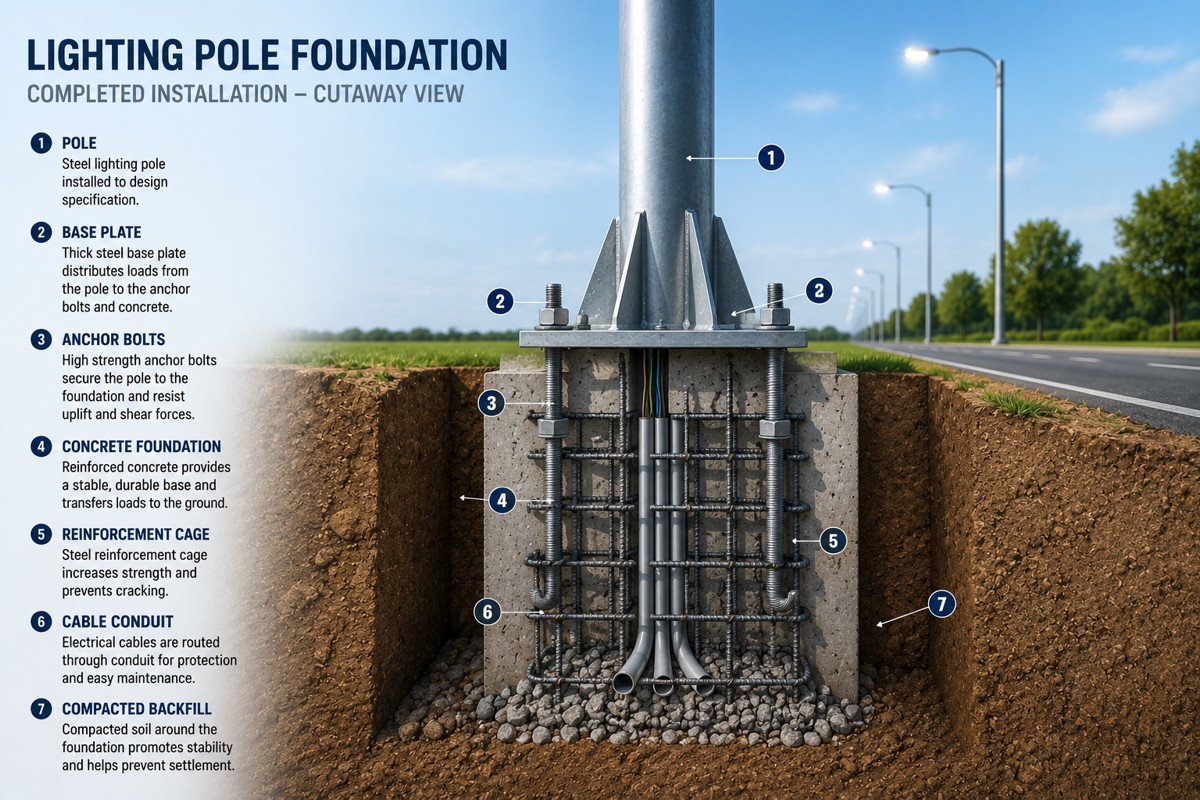
According to Sunlurio’s pole and foundation engineering guidance, a practical review should consider the pole height, pole material, base plate size, anchor bolt layout, foundation depth, concrete strength, soil condition and local wind exposure.
In road lighting projects, the foundation is usually the interface between the lighting supplier, civil contractor and project engineer. If this interface is not clearly defined, the site team may face avoidable rework. Typical issues include anchor bolts placed in the wrong position, cable conduits not aligned with the pole base, or foundations prepared before the final pole drawing is approved.
Early coordination reduces these risks and helps the project move from procurement to installation with fewer surprises.

Site Conditions Can Change Foundation Requirements
Foundation requirements vary significantly between highways, urban streets, industrial estates, rural roads and coastal environments.. A pole foundation that is suitable for one site may not be appropriate for another. Open highways, coastal roads, industrial zones, parking areas, rural roads and urban streets can all require different foundation planning.
Wind exposure is one of the most important factors. A pole installed along an open highway or coastal road may face stronger wind pressure than a pole installed in a sheltered urban street. If solar panels, long outreach arms or multiple luminaires are installed on the same pole, the wind load may increase further.
Soil condition also matters. Soft soil, filled ground, sloped roadsides and drainage areas may require more careful civil review than stable compacted soil. Underground utilities can also limit the available foundation position or depth.
Drainage is another common site issue. If water collects around the foundation, it may affect the surrounding soil, accelerate corrosion around exposed metal parts or create long-term maintenance problems. In road projects where foundations are close to drainage channels, shoulders or unpaved areas, water movement should be reviewed before construction.
| Site Condition | Primary Design Consideration |
|---|---|
| Coastal road | Wind exposure and corrosion protection |
| Soft soil | Bearing capacity and foundation depth |
| Open highway | Higher wind load and pole stability |
| Industrial yard | Vehicle movement and impact risk |
| Solar street light project | Panel wind load and pole orientation |
| Roadside drainage area | Water accumulation around foundation |
Solar street light poles may need additional review because the solar panel can significantly increase the wind-facing area. In some projects, the panel angle and orientation may also affect how loads are transferred to the pole and foundation.
What Contractors Should Review Before Civil Work Starts
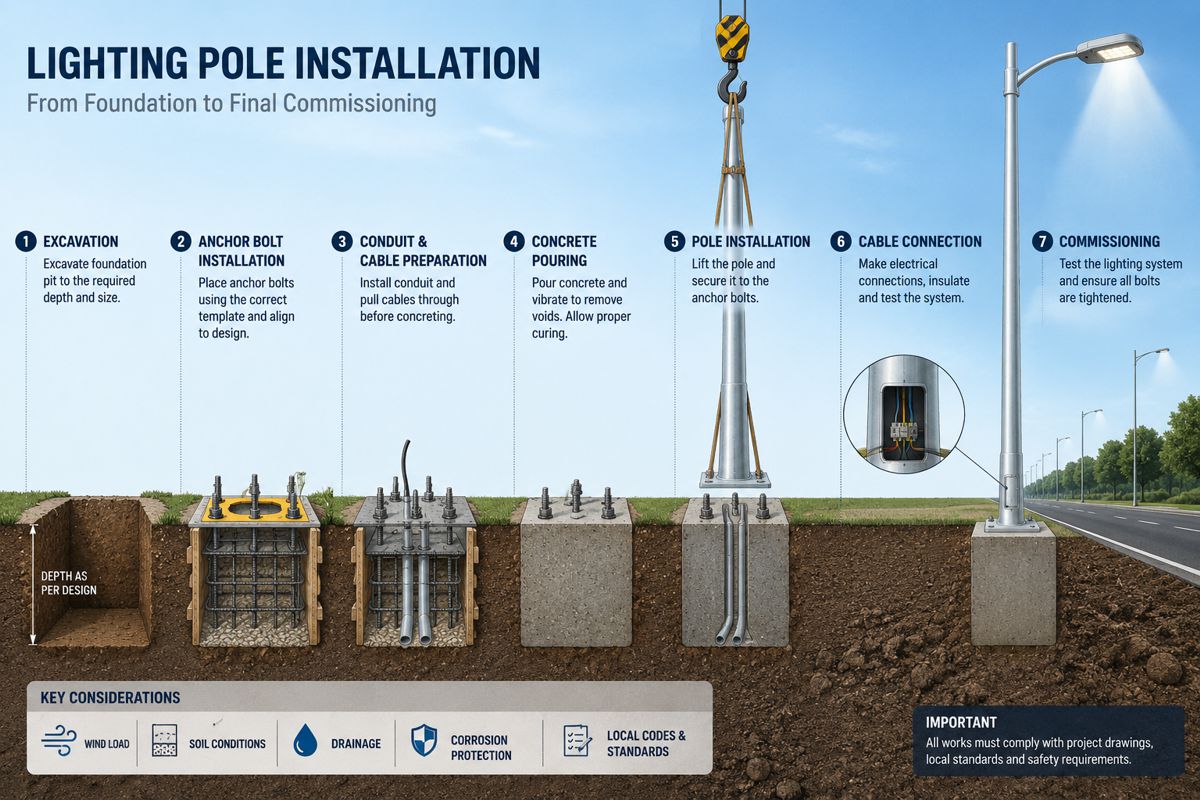
Foundation planning should be completed before site excavation, concrete pouring or anchor bolt installation. Once civil work begins, changes become more expensive and can delay installation.
Before civil work begins, contractors should review pole height, wind exposure, base plate size, anchor bolt layout and foundation details. A practical foundation design guide can help project teams understand the basic items that should be checked before installation.
Key items to review include:
- Pole height
- Pole type and material
- Arm length and luminaire arrangement
- Base plate size and thickness
- Anchor bolt diameter
- Anchor bolt length and spacing
- Anchor bolt template
- Concrete foundation size
- Foundation depth
- Reinforcement requirements
- Soil condition
- Wind speed requirement
- Cable conduit position
- Grounding requirement
- Local structural code
- Site access for lifting and installation equipment
The anchor bolt template is especially important. If the bolt spacing does not match the pole base plate, the pole may not be installable without cutting, drilling, rework or full foundation replacement. These are not minor site adjustments; they can affect both safety and project schedule.
Cable conduit position should also be confirmed before concrete work. A conduit that exits in the wrong location can interfere with the pole base plate, block cable entry or require extra cutting on site. For public road projects, these small coordination issues can become expensive when repeated across hundreds or thousands of poles.
Common Foundation Problems in Road Lighting Projects
Many pole foundation problems are practical site coordination issues rather than complex engineering failures. They occur because drawings, product details and civil work are not aligned early enough.
One common issue is anchor bolt mismatch. The civil contractor may prepare foundations based on an old drawing, a generic template or a different pole type. When the lighting poles arrive, the base plate holes do not align with the installed bolts.
Another problem is copying foundation dimensions from a previous project without checking the new site conditions. Pole height, wind exposure, soil condition and installed accessories may be different. A copied foundation may look convenient during tendering but create risk during installation.
Cable conduit placement is also a frequent source of rework. If the conduit does not align with the pole’s cable entry position, the installation team may need to modify the conduit, adjust the pole base or make unsafe field changes.
Concrete curing time can be overlooked when project schedules are tight. Installing poles before the foundation has reached sufficient strength can increase installation risk, especially for taller poles or sites with strong wind exposure.
Drainage around the foundation is another practical issue. Poor drainage can lead to standing water near the pole base, soil weakening and accelerated corrosion. This is especially relevant for roadside shoulders, low-lying areas and projects with seasonal rainfall.
A further risk appears when the civil contractor and lighting supplier work from different drawings. The civil team may follow a foundation drawing while the lighting supplier updates the pole base plate or anchor bolt layout. Without document control, site work may continue based on outdated information.
Wind load and pole accessories should also be reviewed together. A pole carrying only one luminaire is not the same as a pole carrying a long arm, dual luminaires, solar panel, camera bracket, banner arm or other accessories. These added elements can change the loading condition and should not be ignored.
Solar Street Light Poles Need Additional Coordination
Solar street lighting projects require closer coordination between the pole, foundation and energy system. Compared with conventional grid-connected lighting, solar street lights often include additional components mounted on or inside the pole.
The solar panel is the most obvious factor. It adds wind-facing surface area and may be installed at an angle, which can increase wind load. In open road, coastal or high-wind areas, this should be reviewed before finalizing pole height and foundation details.
Battery weight and installation position may also affect the pole design. Some systems place the battery inside the pole, while others use a battery box or integrated luminaire design. The weight distribution and maintenance access should be considered in the overall installation plan.
Pole orientation is also important for solar charging. A foundation may be prepared correctly from a structural perspective but placed in a position where the panel is shaded by trees, buildings, road signs or other poles. Once the foundation is poured, repositioning the pole can be difficult.
Panel shading should therefore be reviewed before final pole locations are confirmed. This is especially important for village roads, campus roads, industrial parks and urban streets where obstacles are common.
Solar lighting projects should coordinate the pole, foundation, panel direction and maintenance access together. A technically correct foundation is not enough if the final pole location reduces solar charging or makes battery and controller maintenance difficult.
Documentation Reduces Site Rework
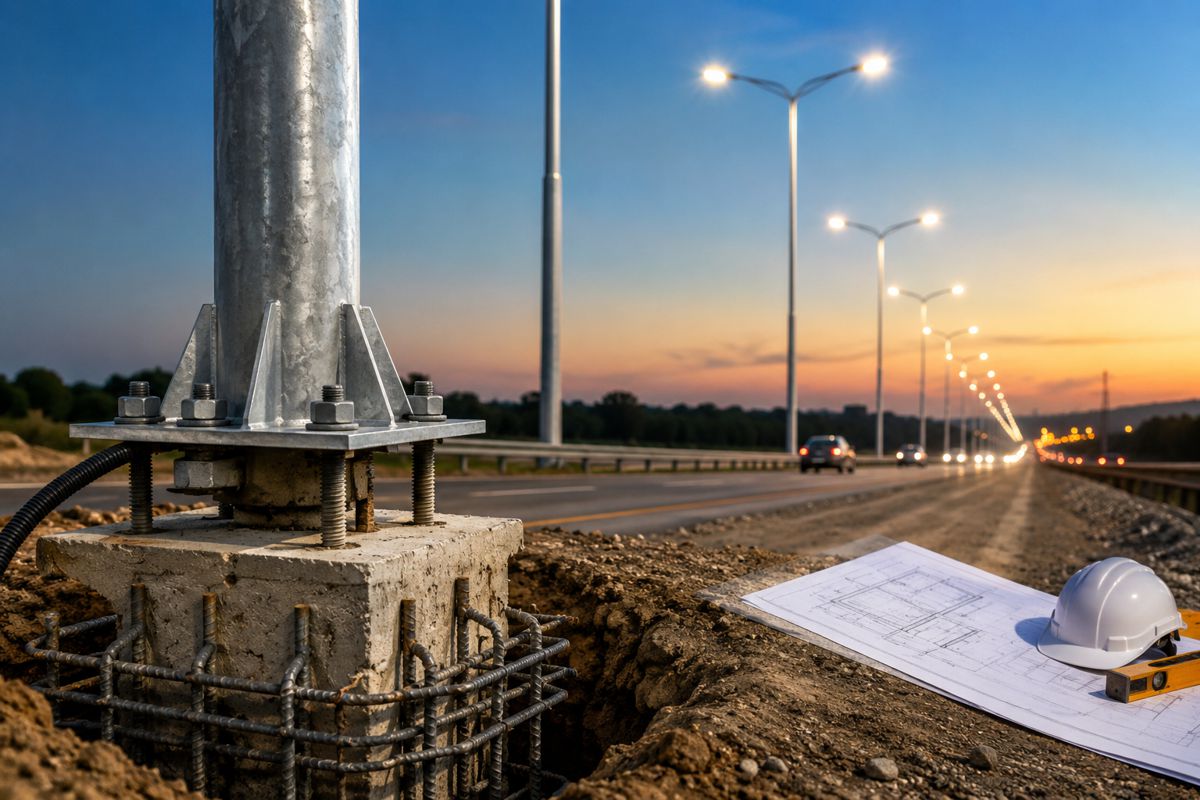
Clear documentation is one of the most effective ways to reduce foundation-related rework. In road lighting projects, multiple parties may be involved: project owner, consultant, EPC contractor, civil contractor, lighting supplier, installation team and inspection team.
If each party works from different assumptions, site errors become more likely. A complete document package helps align expectations before materials are ordered and before civil work begins.
For larger road lighting projects, Sunlurio’s engineering team supports coordination of pole drawings, foundation references, installation notes, BOQ requirements and project documentation before procurement and site work begin.
Important documents may include:
- Foundation drawings
- Pole drawings
- Base plate drawings
- Anchor bolt layout
- Anchor bolt template
- Cable routing notes
- Grounding notes
- Installation instructions
- BOQ coordination
- Technical submittals
- Inspection references
- Handover documents
Good documentation does not replace structural review, but it reduces ambiguity. It helps the civil team prepare the correct foundation, the installation team understand the pole interface and the project team verify that procurement and site work are based on the same technical information.
A Practical Pre-Installation Checklist
Before pole installation begins, EPC and civil teams can use a simple checklist to confirm whether the key foundation and installation items have been reviewed.
| Area | What to Confirm |
|---|---|
| Pole | Height, material, arm length and base plate |
| Foundation | Size, depth, concrete grade and reinforcement |
| Anchor bolts | Diameter, length, spacing and template |
| Site | Soil condition, wind exposure and drainage |
| Electrical | Cable entry, conduit position and grounding |
| Solar system | Panel direction, shading and wind load |
| Documentation | Drawings, BOQ, installation notes and approvals |
| Responsibility | Supplier, civil contractor and EPC coordination |
This checklist is not a replacement for project-specific structural design. However, it helps project teams identify common coordination gaps before they become site problems.
For projects with repeated pole installations, even a small drawing mismatch can create major delays when multiplied across many locations. A pre-installation review is therefore a practical risk control step, not just an administrative process.

Planning the Foundations
Pole foundation planning is not a minor construction detail. It directly affects road lighting safety, installation quality and long-term maintenance.
For EPC contractors, reviewing the foundation before procurement helps reduce installation errors, avoid site delays and improve project handover. A good road lighting project depends not only on choosing the correct luminaire or pole, but also on ensuring that the foundation, anchor bolts, civil work and documentation are coordinated before installation begins.
Ultimately, successful road lighting projects are built from the ground up. Careful coordination between structural design, civil engineering and lighting specification helps avoid costly rework, improves public safety and delivers infrastructure that will continue performing reliably throughout its design life.