AI Takes the Wheel as Uber, Lyft and NVIDIA Redefine Global Mobility
The race to build truly autonomous, AI-driven mobility ecosystems has entered a decisive phase. What was once framed as a contest between individual robotaxi developers is now evolving into something far broader and more consequential: a platform-driven transformation of global transport networks. At the centre of this shift sits NVIDIA, aligning itself with both Uber and Lyft to reshape not just how vehicles operate, but how entire mobility systems are designed, deployed and scaled.
These parallel announcements signal more than incremental progress. They point to the emergence of a unified AI infrastructure layer underpinning ride-hailing, logistics and urban transport. For construction professionals, infrastructure planners and policymakers, the implications stretch well beyond passenger convenience. This is about how cities will be built, managed and optimised in the coming decade.
From Ride Hailing to Infrastructure Platforms
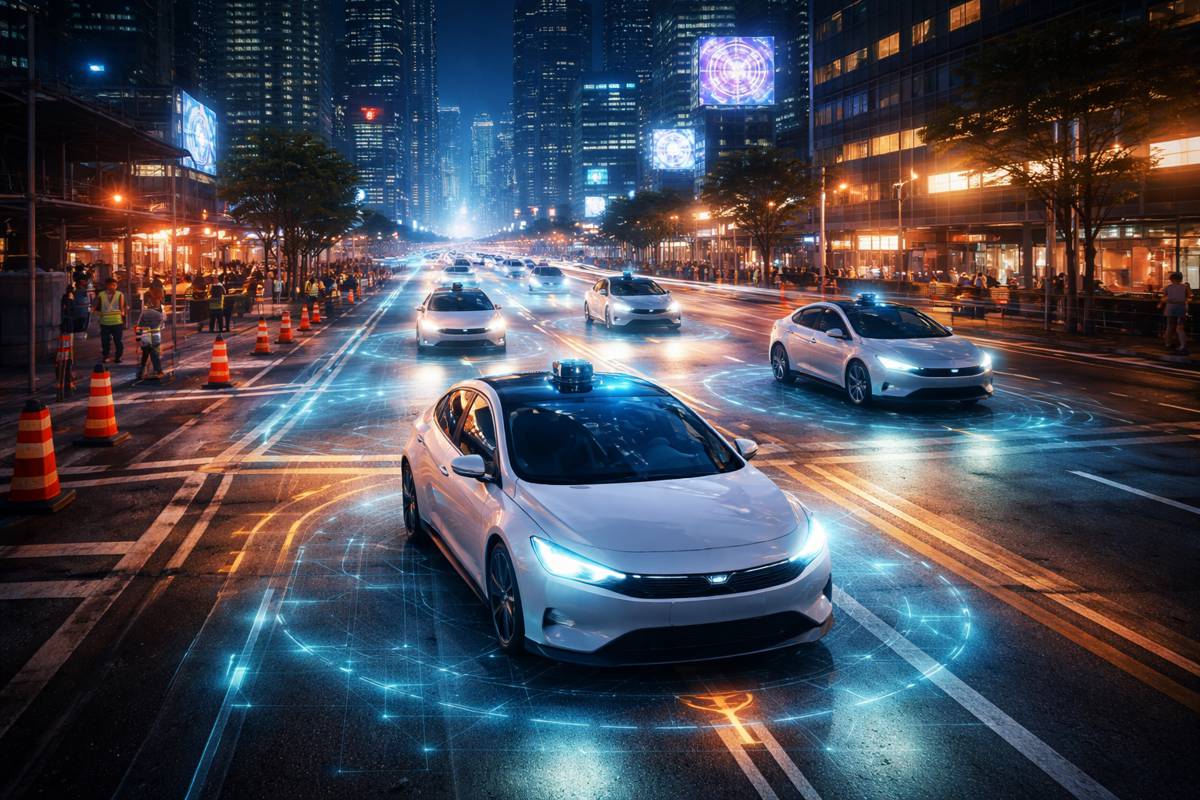
Uber’s expanded partnership with NVIDIA sets out a clear ambition: to deploy a global fleet of fully autonomous vehicles powered entirely by NVIDIA software. Initial launches are planned for Los Angeles and San Francisco in 2027, with a rapid scale-up targeting 28 cities worldwide by 2028.
This is not simply a fleet rollout. It represents a transition from ride-hailing as a service to mobility as infrastructure. By integrating NVIDIA’s full-stack autonomous driving platform into its global network, Uber is effectively positioning itself as an orchestrator of autonomous transport systems rather than just a marketplace for drivers and passengers.
Dara Khosrowshahi, CEO of Uber, framed the shift in pragmatic terms: “Autonomous technology holds enormous promise to make transportation safer, more reliable, and more accessible,
“By expanding our partnership with NVIDIA and combining advanced AI with Uber’s global network and operating experience, we are laying the foundation for an increasingly multi-player AV world, ensuring broad commercialization and helping to bring robotaxi service to more riders over time.”
The language matters. The emphasis is not on replacing drivers overnight, but on enabling a multi-player ecosystem where automakers, technology providers and platform operators converge. That collaborative model is likely to define how autonomous mobility scales in practice.
NVIDIA’s Full Stack Play in Physical AI
At the core of both Uber and Lyft’s strategies lies NVIDIA’s increasingly dominant role as a full-stack provider of AI infrastructure for mobility. The company’s DRIVE Hyperion platform serves as the reference architecture for autonomous vehicle development, combining high-performance computing, sensor fusion and safety-certified systems.
However, the more significant development is NVIDIA Alpamayo, a reasoning-based AI model designed to handle what engineers often call long-tail scenarios. These include unpredictable construction zones, temporary traffic diversions, erratic pedestrian behaviour and other edge cases that have historically limited the reliability of autonomous systems.
Unlike earlier rule-based or perception-heavy approaches, Alpamayo introduces chain-of-thought reasoning into physical environments. In practical terms, that means vehicles are no longer just reacting to sensor inputs but interpreting complex situations in a more human-like way.
Jensen Huang, founder and CEO of NVIDIA, captured the significance of this shift: “The ‘ChatGPT moment’ for physical AI has arrived—robotic systems can now reason about the complexities of the physical world,
“Uber is building one of the world’s most expansive autonomous ride-hailing platforms. We are delighted to connect NVIDIA’s large ecosystem of robotaxi-ready partners to the Uber network to bring the magic of robotaxis to cities worldwide.”
For infrastructure stakeholders, this evolution is critical. Roads are not controlled environments. They are dynamic, often chaotic systems shaped by construction activity, weather, human behaviour and regulatory constraints. AI that can reason through these variables changes the equation entirely.
A Phased Approach to Scaling Autonomy
Uber’s deployment strategy reflects the realities of scaling autonomous systems in complex urban environments. Rather than rushing to full autonomy, the company plans a phased rollout in each city.
The process begins with data-collection vehicles designed to train AI models on local driving conditions. This is followed by operator-led deployments, where human oversight remains in place, before transitioning to fully driverless Level 4 operations.
This incremental approach aligns with broader industry trends. Companies such as Waymo and Cruise have demonstrated that localised data and gradual scaling are essential for achieving safe and reliable autonomous performance. Each city presents unique challenges, from road layouts and signage to driving culture and regulatory frameworks.
For construction and infrastructure sectors, this phase introduces an interesting feedback loop. Data collected from autonomous fleets can provide detailed insights into road conditions, traffic patterns and infrastructure performance, potentially informing future design and maintenance strategies.
Lyft’s Strategy Centres on AI Infrastructure
While Uber focuses on fleet deployment, Lyft is taking a complementary approach by embedding AI deeper into its operational backbone. Announced at the NVIDIA GTC AI Conference, Lyft’s collaboration with NVIDIA spans enterprise AI infrastructure, mapping systems and future autonomous fleet architectures.
Rather than positioning itself solely as a robotaxi operator, Lyft is investing in the underlying intelligence that powers mobility platforms. This includes predictive modelling, real-time optimisation and advanced mapping capabilities.
Siddharth Patil, EVP of Rideshare Experience & Marketplace at Lyft, highlighted the broader ambition: “This collaboration represents how AI infrastructure will be the backbone of modern mobility,
“As part of our continued focus on enhancing every aspect of our service today, we’re excited to leverage NVIDIA’s industry-leading GPU computing and AI platforms to improve how we match riders with drivers and how we map and navigate our cities, while continuing to build the foundation for the autonomous future we’re pioneering together.”
This dual focus on present-day efficiency and future autonomy reflects a pragmatic understanding of the market. Autonomous vehicles may still be scaling, but AI-driven optimisation is already delivering measurable benefits across existing operations.
Mapping the Real World in Real Time
One of the most consequential aspects of Lyft’s strategy lies in its investment in next-generation mapping platforms. Traditional digital maps, while accurate, often struggle to keep pace with real-world changes such as roadworks, temporary closures and evolving urban layouts.
By integrating vision-language reasoning and multimodal AI, Lyft aims to create a more dynamic mapping system capable of identifying and correcting errors in near real time. This approach leverages vast amounts of mobility data generated through daily rides, feeding continuous updates into the mapping ecosystem.
The implications for construction and infrastructure are significant. Roadworks, lane closures and temporary diversions could be integrated into digital maps almost instantly, improving navigation safety and reducing congestion. At the same time, infrastructure operators could gain access to richer datasets reflecting how roads are actually used.
Accelerated Computing and Marketplace Efficiency
Beyond mapping, Lyft is deploying NVIDIA’s AI Enterprise suite to enhance compute-intensive workflows across its platform. This includes everything from rider-driver matching algorithms to large-scale data processing and optimisation workloads.
By leveraging technologies such as RAPIDS Accelerator and cuOpt, Lyft aims to reduce compute costs while improving operational efficiency. In practical terms, this means faster response times, more accurate matching and better utilisation of resources across its network.
Rishi Dhall, VP of NVIDIA Automotive Business, underscored the scale of the opportunity: “From optimizing millions of daily rides to mapping complex road environments, this collaboration demonstrates AI’s power to solve real-world challenges at massive scale, and establishes the groundwork for the next era of autonomous transportation.”
For investors and policymakers, these efficiency gains are not trivial. They translate into lower operating costs, improved service reliability and increased scalability, all of which are essential for sustainable mobility systems.
The Rise of Hybrid Autonomous Ecosystems
Both Uber and Lyft are converging on a similar long-term vision: hybrid ecosystems where multiple types of vehicles coexist on a single platform. This includes fleet-owned autonomous vehicles, partner-deployed systems and potentially consumer-owned autonomous cars.
Lyft’s acquisition of Freenow, with its established European operations, further extends this vision into new markets. By combining local regulatory expertise with global AI infrastructure, the company is positioning itself to scale across diverse geographies.
This hybrid model reflects a broader industry reality. Fully autonomous fleets are unlikely to replace all human-driven vehicles overnight. Instead, the transition will be gradual, with different levels of autonomy coexisting for years to come.
For urban planners and infrastructure developers, this means designing systems that can accommodate both human and machine drivers, often within the same physical space.
Implications for Construction and Infrastructure
The expansion of AI-driven mobility platforms has direct implications for the construction and infrastructure sectors. Autonomous vehicles rely heavily on high-quality road infrastructure, clear signage and consistent maintenance standards.
At the same time, the data generated by these systems offers unprecedented visibility into how infrastructure performs in real-world conditions. This creates opportunities for more data-driven planning, predictive maintenance and smarter investment decisions.
Construction zones, often cited as a major challenge for autonomous systems, are also becoming a focal point for innovation. AI models capable of interpreting temporary layouts and dynamic environments could improve safety for both workers and road users.
Moreover, the integration of AI into mobility platforms may influence future infrastructure design. Roads could be built with embedded sensors, digital connectivity and standardised layouts optimised for both human and autonomous traffic.
A New Operating System for Mobility
Taken together, these developments point to the emergence of a new operating system for mobility. NVIDIA provides the computational backbone and AI models, while Uber and Lyft act as distribution platforms connecting vehicles, riders and infrastructure.
This layered architecture mirrors the evolution of other industries, where platforms and ecosystems have replaced standalone products. In mobility, the shift is particularly profound because it touches physical infrastructure, regulatory frameworks and public safety.
The transition will not be without challenges. Regulatory approvals, public acceptance and technical reliability remain critical hurdles. However, the direction of travel is increasingly clear.
Setting the Stage for Autonomous Cities
As Uber prepares to deploy autonomous fleets across multiple continents and Lyft embeds AI into every layer of its operations, the foundations for autonomous cities are being laid.
The convergence of AI, mobility platforms and infrastructure systems is creating a feedback loop where data continuously improves performance, safety and efficiency. Over time, this could lead to transport networks that are not only autonomous but also self-optimising.
For construction professionals, investors and policymakers, the message is straightforward. Autonomous mobility is no longer a distant prospect. It is becoming an integral part of how cities function, and the decisions made today will shape how these systems evolve.
The real story is not just about robotaxis. It is about the transformation of mobility into a fully integrated, AI-driven infrastructure layer that will underpin the next generation of urban development.