Power, Ports, Exaflops and Europe’s AI Infrastructure Race
Europe is assembling more computing power in a single year than at any point in its history, and the numbers behind that expansion are now large enough to reshape how the continent thinks about industrial capacity, energy and sovereignty. A record 35 AI-focused high-performance computing systems are in development across the region, spanning national supercomputing centres, EuroHPC AI factories and academic institutions, and collectively they will place next-generation infrastructure in front of more than three million researchers.
NVIDIA, which supplies the accelerated computing behind more than 90% of that buildout, puts the figure at roughly 800 AI exaflops deployed or announced since last year. For an industry that measures progress in megawatts, concrete and connection dates, the more consequential story is not the raw compute but what it demands from the physical world around it.
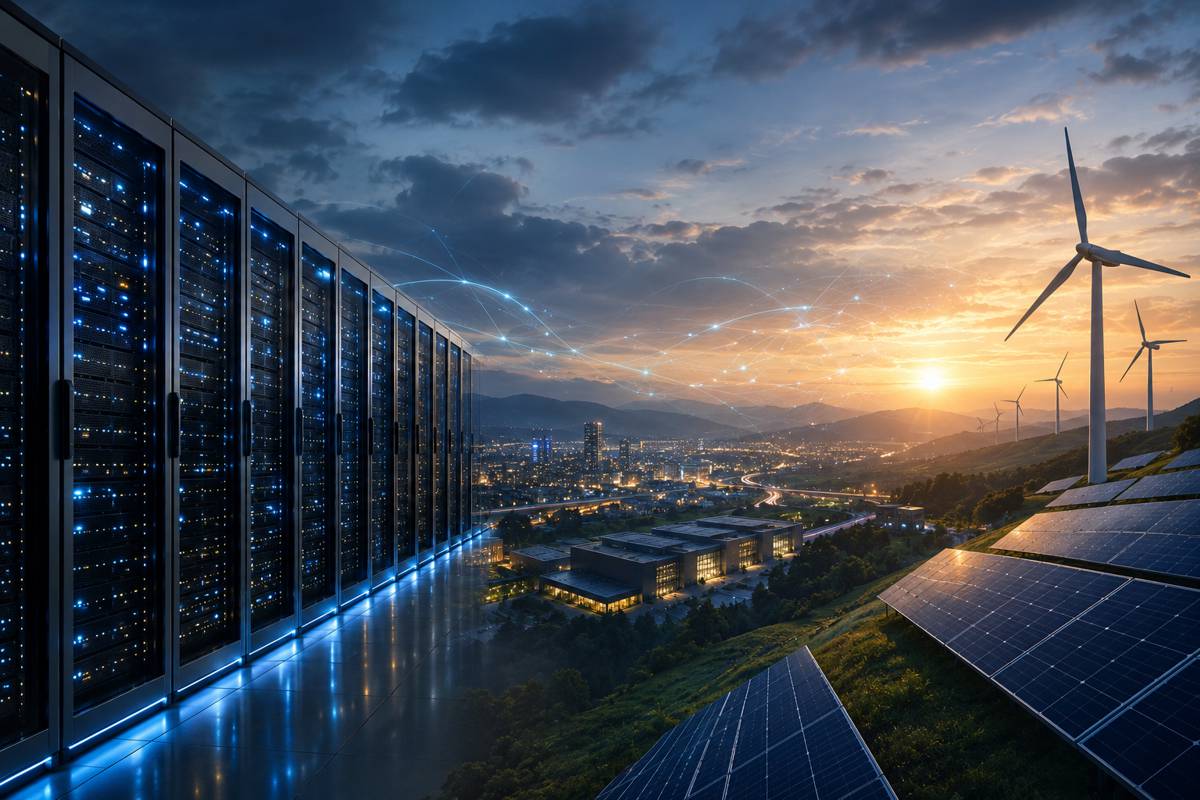
That demand is where the announcement stops being a technology headline and becomes an infrastructure one. The machines named in this expansion, from Barcelona Supercomputing Center’s upgraded MareNostrum 5 to Germany’s first AI factory in Stuttgart, will draw power at a scale that is already straining European grids, and they arrive at a moment when connection queues in the busiest hubs stretch far longer than the time it takes to build the data hall itself.
The result is a widening gap between the pace of Europe’s compute ambitions and the pace at which transmission networks, substations and clean generation can be built to feed them. That gap is now the defining constraint on the whole programme, and it is squarely a construction, energy and permitting problem.
Briefing
- A record 35 NVIDIA-based AI supercomputers are under development across Europe, the region’s largest one-year expansion, backed by roughly €10 billion of EuroHPC investment over 2021–2027 and a further €20 billion InvestAI facility earmarked for up to five AI “gigafactories”.
- The systems represent around 800 AI exaflops deployed or announced in a year, with NVIDIA hardware now behind more than 90% of Europe’s AI factory buildout and 81% of the global TOP500 supercomputer list.
- Grid access, rather than chips or capital, is emerging as the binding constraint: Eurelectric warns high-voltage connections routinely take five to ten years against 18–24 months to build a data centre, and connection queues in major hubs now run to several years.
- Siemens Energy has cut simulation times by up to 77% on hydrogen-capable gas turbine burners using NVIDIA-accelerated design and additive manufacturing, pointing to where industrial decarbonisation engineering is heading.
- Wave-energy developer Eco Wave Power is piloting ocean-powered data centres at the Port of Los Angeles, reflecting a wider shift of compute infrastructure toward ports and coastlines in search of cooling, water and generation.
A continental buildout with a sovereignty motive
The scale of this expansion only makes sense against the policy machinery driving it. Through the EuroHPC Joint Undertaking, the European Commission and member states have committed close to €10 billion to supercomputing and AI factory infrastructure across the current budget period, with a separate €20 billion InvestAI facility structured to seed up to five much larger AI gigafactories. Council Regulation (EU) 2026/150 has since widened EuroHPC’s mandate to cover both those gigafactories and quantum technologies, and the network already counts 19 operational AI factories alongside 13 lighter-touch access “antennas”.
The consistent thread running through the Commission’s framing is digital sovereignty: the ambition to develop, train and operate advanced AI on European soil, under European data rules, rather than renting the capability from overseas cloud providers.
NVIDIA’s platforms sit at the centre of that push, which gives the company an unusually strong position in a market Europe is explicitly trying to make more autonomous. The buildout leans on the NVIDIA Blackwell and Hopper architectures, tied together with Quantum InfiniBand networking and the CUDA-X software stack, and the flagship installations read like a map of national industrial strategy.
Barcelona Supercomputing Center’s AI factory, the first EuroHPC AI-specific installation, will expand MareNostrum 5 with GB300 NVL72 and GB200 NVL4 systems to deliver up to roughly 20 exaflops of AI training and 33 exaflops of inference for a consortium of Spain, Portugal and Türkiye. Italy’s IT4LIA is larger still, with more than 8,000 GPUs producing 82 exaflops of training and 164 of inference, developed by CINECA with the Italian Ministry of University and Research and the country’s cybersecurity agency. As BSC director Mateo Valero Cortés framed the upgrade: “With the upgrade to MareNostrum5 and NVIDIA accelerated computing, the consortium composed of Spain, Portugal and Türkiye will make available to European researchers the tools to tackle some of the world’s most complex challenges, from climate modeling to biomedical discovery.”
The national character of each system is deliberate. Bavaria is routing 1,000 GPUs into its Blue Swan platform across the FAU Erlangen and LRZ centres to underpin a home-grown multimodal foundation model, with the state’s science minister Markus Blume noting that the project involves building: “a special computing infrastructure at Friedrich-Alexander University in Erlangen — the biggest GPU cluster you can find at any German university.”
Stuttgart’s HammerHAI, procured through the EU’s AI Factories initiative and installed by HPE, has been positioned as Germany’s first AI factory aimed explicitly at industry and engineering. Michael Resch, who directs the High-Performance Computing Center Stuttgart, described it as: “secure, national AI infrastructure that will help researchers and industrial users accelerate simulation, inference and scientific discovery, strengthening Europe’s ability to turn advanced computing into real-world breakthroughs.” NVIDIA chief executive Jensen Huang put the wider bet in blunter terms: “AI is the new instrument of science, and Europe is building the infrastructure to put it in the hands of millions of researchers.”
Where the power comes from, and how it connects
Every one of these systems needs firm, continuous electricity, and this is where Europe’s ambitions run into physics and permitting. AI data centres draw large, sustained loads that regional grids were never designed to absorb, and the industry consensus is hardening around a single point: the scarce resource is no longer silicon but grid capacity.
The International Energy Agency expects data centre electricity demand to double by 2030, with AI-focused facilities growing faster still, while European projections cited across the sector point to demand from data centres rising by well over 150% by 2035. Against that, the physical network moves slowly. Eurelectric has warned that high-voltage transmission projects routinely take five to ten years to progress from application to delivery, against the 18 to 24 months it takes to build the data centre they are meant to supply, and connection queues in the busiest hubs now extend for years.
The policy response so far has been to slow demand rather than accelerate supply, which is itself a signal to developers and investors. Ireland’s utility regulator has imposed strict conditions on new data centre connections around Dublin, the Netherlands has used moratoria to pause hyperscale permits, and Denmark has been weighing limits of its own as AI load presses against national capacity.
The World Economic Forum has characterised the shift, arguing that access to the grid, rather than chips, capital or algorithms, is increasingly the binding constraint on AI deployment. For construction and infrastructure firms, that reframing is significant: the value is migrating toward the parties who can secure firm power, deliver substations and transmission upgrades on compressed timelines, and navigate the permitting bottleneck. The compute buildout has, in effect, become a grid buildout, and the two are no longer moving at the same speed.
Compute moves to the coast
One consequence of the power squeeze is geographic. As grid connections tighten inland, developers are looking to sites with access to water, cooling and generation, and that is pushing a growing share of infrastructure toward ports and coastlines. It is a shift that Eco Wave Power, a wave-energy developer within NVIDIA’s Inception startup programme, is trying to turn to its advantage.
The company keeps its power conversion, hydraulics and control electronics on land while capturing energy from waves breaking against existing breakwaters and sea walls, an approach designed to avoid the storm-damage failures that sank earlier offshore designs. Its founder and chief executive Inna Braverman argues that the coincidence of siting is the opportunity: “We have a possibility to link AI factories directly to wave energy, because a lot of data centers are moving toward the coast.” The same logic, she notes, explains the location choices themselves: “They need cooling and water, so they’re now located in ports.”
The technical case rests on consistency as much as scale. Braverman makes the point that: “Wave energy is the least intermittent source of renewable energy,” contrasting it with solar generation interrupted by night, winter and cloud, and the density of seawater, roughly 800 times that of air, allows meaningful energy to be captured from comparatively small devices. Eco Wave Power already operates projects in Jaffa Port in Israel and the Port of Los Angeles, with further schemes in development in Portugal, Taiwan and India, and a pilot at Los Angeles is testing whether wave energy can power a data centre outright, without drawing on the grid at all.
The engineering discipline that makes this credible is digital twins built with NVIDIA Omniverse libraries, which simulate wave conditions, structural behaviour and deployment configurations before installation begins and then run predictive maintenance and forecasting once systems are live. That combination of coastal siting, off-grid generation and simulation-led planning is an early template for how energy and compute infrastructure may be co-located rather than treated as separate builds.
Simulation reshapes industrial decarbonisation
The infrastructure story extends into heavy industry, where the same accelerated computing is compressing the engineering cycles behind clean-energy hardware. Siemens Energy has been applying its Siemens Xcelerator portfolio, accelerated by NVIDIA Omniverse libraries, CUDA-X and AI infrastructure, to unify design, computational fluid dynamics and manufacturing for gas turbines capable of running on up to 100% hydrogen.
Burning hydrogen at turbine scale is a genuinely hard physics problem, involving extreme heat, complex combustion behaviour and fluid dynamics that are difficult to model, and getting the burner geometry right has historically demanded long, iterative test campaigns. The value of pulling simulation and manufacturing into a single workflow is that design variants can be explored virtually and then validated quickly using additively manufactured combustors.
The efficiency gain is concrete: the workflow cuts simulation times by up to 77%, which shortens the path from concept to a hydrogen-capable, lower-carbon turbine that can be deployed in real generating plant. For an infrastructure and energy audience, the wider point is that this is where a meaningful portion of industrial decarbonisation will actually be won, not in headline commitments but in the unglamorous engineering of burners, combustors and control systems that let existing thermal assets run on cleaner fuels.
Accelerated simulation lowers both the cost and the risk of that transition, and it hints at a procurement shift in which the ability to iterate designs in a digital environment becomes as important to industrial suppliers as their physical manufacturing base.
The next hardware wave, and its supply chain
Even as Europe installs its current generation of systems, NVIDIA has set the terms for the one after it. At the ISC High Performance conference in Hamburg, the company detailed its Vera Rubin platform, which pairs Rubin GPUs with Vera CPUs over NVLink-C2C in a direct liquid-cooled architecture and is aimed at scientific computing that needs both high-precision simulation and AI in the same machine.
A Vera Rubin system offers more than seven exaflops of AI performance alongside five petaflops of native double-precision FP64 capability across up to 144 GPUs, enough to rival established entries on the TOP500 from a single rack. Huang framed the stakes around time to discovery: “Scientific discovery is now a race between the complexity of the world’s greatest challenges and the computing systems built to solve them.”
The commercial mechanics behind that platform matter as much as its specifications. Global system builders including Bull, Dell Technologies, GIGABYTE, HPE and Supermicro are bringing Vera Rubin systems to market as direct liquid-cooled racks, which spreads the deployment capability across the established HPC supply chain rather than concentrating it.
The early adopters signal where the next round of large builds will land: the Leibniz Supercomputing Centre’s Blue Lion, powered by Vera Rubin and HPE Cray technology, is scheduled to come online in 2027 with roughly 30 times the capability of its current system, while in the United States the Department of Energy’s Doudna machine at Lawrence Berkeley and Los Alamos National Laboratory’s next-generation systems have both been committed to the platform.
For European centres and their construction partners, the practical implication is that today’s installations are already being followed by a more demanding, more power-hungry generation, reinforcing the need to solve the energy and connection questions now rather than at the next procurement cycle.
Quantum and GPUs converge
Alongside the classical buildout, Europe is consolidating a lead in the hybrid territory where quantum processors are wired into GPU supercomputers. NVIDIA’s open, qubit-agnostic CUDA-Q platform is the connective tissue, and the roster of institutions adopting it reads as a who’s-who of European research. CINECA, EuroHPC and Pasqal are integrating a neutral-atom quantum processor at CINECA’s centre, with the hybrid environment deployed through the Slurm scheduler so that optimisation and materials-science problems can be split between quantum and classical hardware. Fraunhofer FOKUS is linking CUDA-Q to the Eclipse Qrisp quantum programming language, and Barcelona Supercomputing Center has deployed an analog quantum computer from Qilimanjaro Quantum Tech, which has folded CUDA-Q into its own software kit.
The most striking result came from Jülich, where researchers working with NVIDIA fully simulated a universal 50-qubit quantum computer on the JUPITER system, surpassing the previous 48-qubit record. The achievement rested on JUPITER’s tightly coupled CPU–GPU memory in its GH200 Grace Hopper Superchips, which lets a quantum state that exceeds GPU memory spill into CPU memory with little performance penalty. That capability matters strategically because today’s physical quantum hardware still cannot outperform classical machines on useful problems, which makes large-scale simulation the primary tool for designing and stress-testing the algorithms that future quantum computers will eventually run.
For investors watching the quantum theme, the signal is that Europe’s near-term quantum advantage is being built on GPU supercomputers rather than on quantum hardware alone, and that the two technology tracks are increasingly commercially intertwined.
What the machines are already proving
The case that this infrastructure earns its cost rests on what the current flagship, JUPITER, has delivered in its first full year as Europe’s first exascale system. Running on Grace Hopper Superchips at Forschungszentrum Jülich, it has trained a foundation model that maps the human brain’s microarchitecture at cellular scale, drawing on 6.5 petabytes of data across thousands of GPUs in under five days. It has also underpinned a climate breakthrough that speaks directly to infrastructure planning: a novel configuration of the ICON model, which won the Gordon Bell Prize for Climate Modelling, became the first to simulate a coupled Earth system, ocean, atmosphere, land and the full carbon cycle, at one-kilometre resolution.
As Daniel Klocke of the Max Planck Institute for Meteorology explained: “At a global resolution of just 1 kilometer, many of these interactions emerge directly from the laws of physics rather than being approximated,” giving researchers a far more precise view of the processes driving climate change.
The same system is now feeding the infrastructure of the future as well as modelling it. A collaboration between Ericsson and Jülich is using JUPITER to train AI for the evolution of 5G and the design of 6G networks, with a focus on brain-inspired, energy-efficient architectures that could lower the power cost of running radio and core networks — a notable priority given the energy debate surrounding AI itself.
Thomas Lippert, who directs the Jülich Supercomputing Centre, argues that the breadth is the point: “With JUPITER, Europe doesn’t just join the exascale era — it leads it, across the widest range of science and AI of any system worldwide.” Taken together, brain mapping, kilometre-scale climate, next-generation networks and record quantum simulation make the case that exascale has moved from a research milestone into working production infrastructure.
The bottleneck that will decide the outcome
Strip away the exaflops and the announcement resolves into a single strategic tension. Europe has the capital, the political will and now the hardware to build compute at unprecedented scale, and the sovereignty argument driving that investment is only strengthening.
What it does not yet have is a grid that can connect these machines on anything close to the timeline the compute is arriving on, and the current answer, pausing or restricting demand through moratoria and connection limits, buys time without solving the underlying shortfall. The developers, contractors and utilities that can compress the delivery of firm power, transmission and substation capacity are moving into the position that chipmakers occupied a year ago: holding the scarce input that everything else depends on.
For construction and infrastructure firms, that repositioning is the commercial opening. The next phase of Europe’s AI buildout will be defined less by procurement of servers than by the physical works around them, grid connections, dedicated generation, coastal and port siting, water and cooling, and the co-location of energy and compute that projects like the Los Angeles wave-power pilot are beginning to test.
Investors reading the space would do well to track connection queues, permitting reform and firm-power contracts as closely as they track GPU shipments, because those are the variables that will decide whether the 800 exaflops now announced actually come online where and when they are needed. The compute race, in other words, has quietly become an infrastructure race, and Europe’s standing in the first will hinge on how quickly it can win the second.