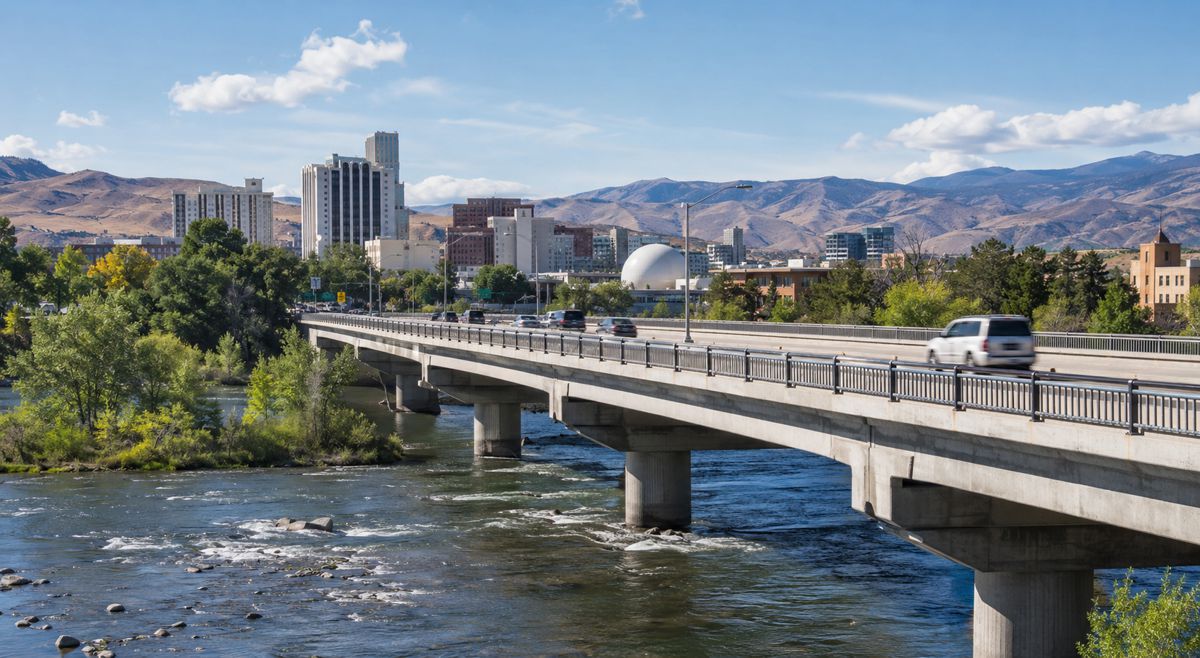
Granite Joint Venture Advances Major Bridge Renewal in Reno
A mid-size bridge award in northern Nevada rarely moves markets, but the selection of a Granite-led joint venture to steer the replacement of Reno’s Keystone Avenue Bridge is worth reading as more than a local infrastructure story.
Keystone Bridge Partners, formed by Granite with geotechnical specialist Condon-Johnson & Associates, has been chosen by the Regional Transportation Commission (RTC) of Washoe County to deliver preconstruction services for the scheme under the Construction Manager at Risk (CMAR) method. The dollar value at this stage is small, yet the shape of the deal tells the industry a good deal about how American cities are now tackling their inheritance of mid-century structures: with federal bridge money, a collaborative delivery model that front-loads engineering and cost certainty, and a vertically integrated contractor able to convert a preconstruction seat into a much larger construction award later.
The bridge itself explains why this matters on the ground. Opened in 1966, the Keystone Avenue crossing carries a four-lane north–south corridor over the Truckee River, linking the residential neighbourhoods of west Reno to the downtown core and Interstate 80. It handles roughly 13,000 vehicle trips a day and offers no dedicated provision for pedestrians or cyclists, a shortfall the new scheme is designed to correct.
Replacing any Truckee crossing is harder than the modest construction estimate suggests, because the river’s status as a protected natural and cultural resource pulls the work into an extended environmental and permitting process before a single pier is poured. For the wider construction and infrastructure ecosystem, Keystone is a useful case study in how the United States is grinding through a bridge backlog that federal data still measures in the tens of thousands.
Briefing
- Keystone Bridge Partners, a Granite-led joint venture with Condon-Johnson & Associates, has won preconstruction services for the Keystone Avenue Bridge Replacement in Reno under the CMAR delivery model.
- The scheme replaces a structurally deficient 1966 Truckee River crossing carrying about 13,000 daily trips, with a new multi-span steel beam girder structure plus approach, drainage, utility and multimodal works.
- Preconstruction runs from Q2 2026 to Q1 2028, with major construction scheduled for Q2 2028 to Q3 2029; the construction phase is expected to be valued at US$50–60 million when awarded.
- The project is led by the RTC of Washoe County with NDOT and the City of Reno, and is federally supported through the Bridge Formula Program created under the 2021 infrastructure law.
- The award lands as Granite reports a record US$7.0 billion committed and awarded backlog and builds out a Nevada pipeline that already includes preconstruction on the I-80 East Widening.
The collaborative contract behind the award
The choice of CMAR is the commercially significant part of this announcement. Under the model, the contractor is brought in alongside the designer during preconstruction to price the work, test buildability, manage risk and value-engineer the design before committing to a guaranteed price for construction. For an owner such as the RTC, that collaboration is attractive on a constrained urban river site where ground conditions, utility conflicts and environmental limits can wreck a fixed-price bid.
It also gives Granite an early, paid seat at the table and a strong position to carry the scheme into the far larger construction phase, anticipated at US$50–60 million once awarded. Condon-Johnson’s presence in the venture is telling in its own right, since foundation and shoring expertise is precisely what a multi-span crossing over an active river demands.
Chris Burke, Granite Regional Vice President, framed the win around the company’s public-sector relationships, saying the scheme “reflects Granite’s continued commitment to delivering resilient, community-focused infrastructure” and that the team is “excited to again partner with the RTC to find collaborative solutions to best serve Reno and the travelling public.”
The reference to partnering again is not incidental. Granite has leaned hard into best-value and collaborative procurement as a deliberate strategy, and the approach has helped lift its committed and awarded backlog to a record level, reported at US$7.0 billion at the end of 2025, up around a third year on year. Set against a recent preconstruction agreement on Nevada’s I-80 East Widening, the Keystone award reinforces a regional pipeline of publicly funded, multi-year work that offers the kind of revenue visibility investors have rewarded across the infrastructure contracting sector.
Rebuilding a 1966 crossing over a protected river
The engineering brief is substantial for a structure of this size. The scope covers demolition of the existing bridge and construction of a new multi-span steel beam girder structure, alongside reconstruction of the Keystone Avenue approaches, new retaining walls, drainage improvements and utility relocations. A new multi-use path connecting to Vine Street and improvements to nearby roadways round out a package that is as much a corridor upgrade as a bridge swap.
The multi-span steel girder form is a pragmatic choice for a river crossing of this length, allowing spans to be sized around the channel and floodplain while keeping fabrication and erection within familiar, well-understood methods.
What separates Keystone from a routine replacement is the setting. The Truckee River’s designation as a natural and cultural resource means the venture must work through federal environmental review and permitting, with the U.S. Army Corps of Engineers and the Federal Highway Administration among the stakeholders, before construction can begin. That process is one of the main reasons Washoe County’s Truckee crossings have proved slower and costlier to replace than structures elsewhere in Nevada.
The corridor works also address long-standing operational complaints, including the absence of pedestrian and cycle facilities and an awkward junction arrangement where Keystone meets California Avenue, giving the RTC a chance to fold multimodal safety improvements into a project it would have to fund and permit regardless.
What ‘structurally deficient’ really means — and why the funding clock is ticking
The label attached to the Keystone bridge deserves unpacking, because it is widely misunderstood. Under Federal Highway Administration criteria, a bridge is classified as structurally deficient, now more often described as being in poor condition, when a key element such as the deck, superstructure or substructure is rated poor or worse during inspection.
It is a maintenance and investment flag, not a declaration that a structure is unsafe; a deficient bridge remains open and monitored while a replacement is planned. Keystone fits that pattern of an ageing but still-serviceable crossing whose time has come. The national backdrop shows why it is far from alone: the American Road and Transportation Builders Association’s 2025 analysis put more than 47,000 of the country’s roughly 616,000 bridges in the deficient category, with about 6.7 per cent of the inventory rated poor and an estimated repair bill of US$467 billion.
That backlog is the reason a small Reno award connects to a much larger funding story. The Keystone replacement is supported through the Bridge Formula Program, the dedicated bridge funding stream established under the 2021 Infrastructure Investment and Jobs Act, which routes federal money to states specifically for structures like this one. By the middle of 2025, states had committed roughly three-fifths of the formula funds released to that point, leaving a substantial tranche still to be put to work before the law’s authorisation lapses in September 2026.
For contractors and owners alike, that timetable creates real urgency to move projects from planning into procurement, and it helps explain why schemes that spent years in feasibility and environmental study, Keystone among them, are now converting into contractor awards. Reno’s crossing is one of several Truckee structures in line for replacement, alongside the Arlington, Sierra Street and Greg Street bridges, underlining how concentrated the local challenge has become.
What Reno’s rebuild signals for mid-size America
For all its modest headline value, the Keystone award is a clean illustration of the template that will replace much of mid-century America’s civil infrastructure over the coming decade: federal bridge funding, a collaborative delivery model that shares design and cost risk, and a vertically integrated contractor that can supply both the engineering and the materials.
Preconstruction runs to early 2028 and construction into 2029, so the tangible work sits some way off, but the commercial logic is immediate. Granite banks preconstruction fees and a favoured position on a US$50–60 million build, while the RTC gains cost certainty and buildability input on a technically awkward, heavily permitted river site. The investment read is equally straightforward, with the contractor’s record backlog and Nevada pipeline riding the tailwind of federal infrastructure spending, tempered by the open question of how that funding is reauthorised beyond 2026.
The genuine tests lie ahead rather than in the announcement. The venture must turn a preconstruction mandate into a signed guaranteed price without the environmental and permitting programme slipping, and it must manage the ground and river conditions that make Truckee crossings unforgiving.
If it succeeds, Reno gets a safer, multimodal corridor to replace a structure that has served for nearly six decades, and the wider sector gets another data point on whether collaborative delivery can reliably move ageing bridges from deficient inventory to finished asset.
On the evidence of how quickly feasibility studies are now maturing into contractor awards, mid-size cities across the country will be watching how cleanly this one runs.