Fluor Reaches Major Milestone on Chicago’s $2.1 Billion Transit Modernisation
The most consequential fact about the Chicago Transit Authority’s Red and Purple Line Modernization is not its price tag, though at $2.1 billion it stands as the largest completed capital project in the agency’s history.
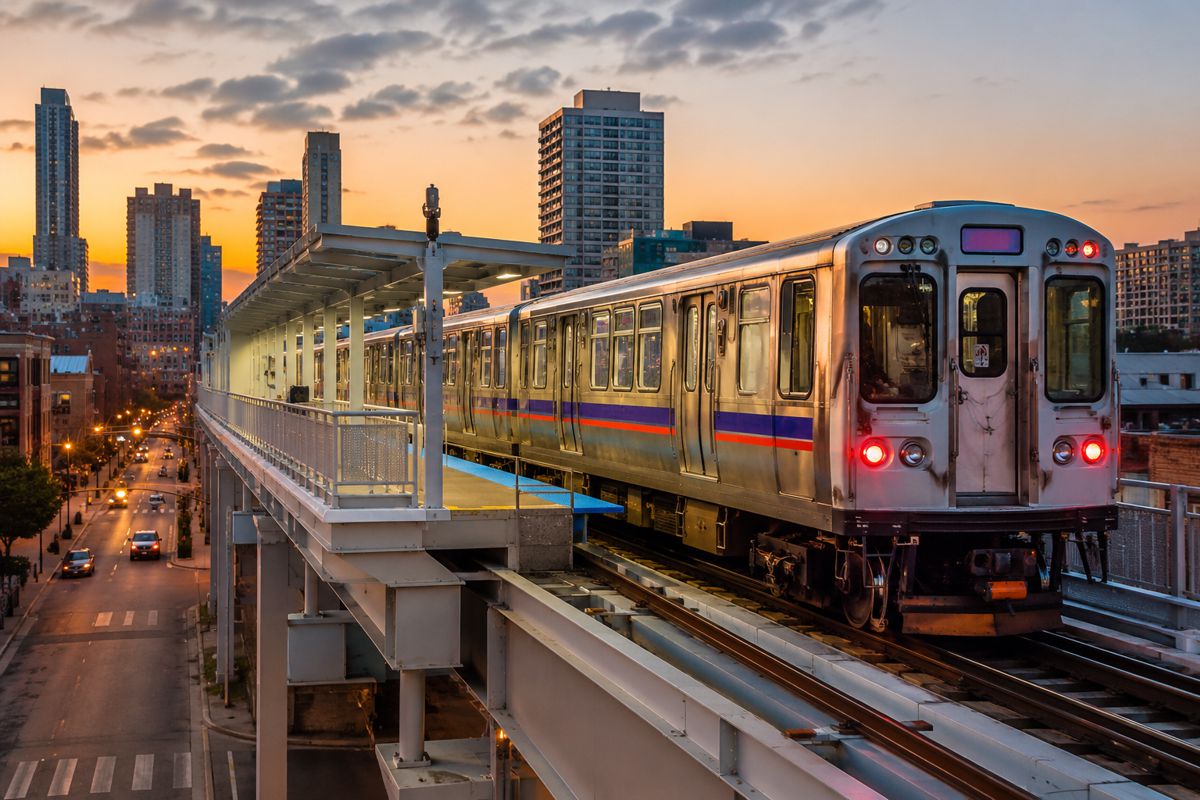
Fluor Corporation and its joint-venture partner Walsh Construction rebuilt more than two miles of hundred-year-old elevated railway, replaced four stations and installed an entirely new signalling backbone, all while the trains carrying tens of thousands of daily riders kept running overhead.
For an industry now confronting a vast inventory of ageing metropolitan rail assets across North America and Europe, that combination of scale, structural renewal and uninterrupted service is the part worth studying.
Substantial completion, confirmed at the start of July, matters to construction firms, transit agencies and infrastructure investors for reasons that go well beyond a ribbon-cutting. RPM Phase One is a working demonstration of how a legacy elevated network can be renewed in place, in a dense urban corridor, under a design-build delivery model, and against a funding structure that was itself tested by an extraordinary federal dispute during the build.
Each of those threads carries lessons for the pipeline of similar projects now competing for capital, and each helps explain why a station rebuild in north-side Chicago has resonance for planners in New York, London or any city living with early-twentieth-century transit infrastructure.
Briefing
- Fluor and Walsh Construction have reached Substantial Completion on the CTA’s $2.1 billion Red and Purple Line Modernization Phase One, the largest completed capital project in the authority’s history, with final completion scheduled for November 2026.
- The programme replaced just over two miles of century-old elevated track between Lawrence and Bryn Mawr and rebuilt four stations as fully accessible facilities, with the permanent structures opening in the summer of 2025.
- A new Red-Purple Bypass at Clark Junction removes a long-standing track conflict and improves throughput for Red, Purple and Brown Line services, while 11 miles of new digital track-circuit signalling lift capacity and enable future upgrades.
- Delivery involved a wider consortium including Stantec on design, Hitachi on signalling and Meade as electrical contractor, with rail service maintained along the alignment throughout construction.
- The project drew on a federal Full Funding Grant Agreement alongside local tax-increment financing, an arrangement thrown into sharp relief when Washington briefly froze funds in late 2025 before a court ordered their release.
A commercial milestone measured against a difficult delivery
The headline number frames the achievement, but its commercial weight comes from the conditions under which it was earned. Since work began in 2019, the joint venture has been operating in one of the most constrained environments in heavy civil construction: a narrow elevated corridor threaded through residential neighbourhoods, with active passenger services that could not be suspended. That constraint dictated methods, sequencing and cost in ways that a greenfield rail project never faces, and it is precisely why agencies watching from other cities regard the completion as instructive rather than routine.
Shawn West, President of Fluor’s Infrastructure business, framed the moment in terms of the partnerships that carried it, saying: “Reaching Substantial Completion on this landmark project is a testament to the strength of our partnerships, the commitment of our teams, and our shared focus on delivering transformational infrastructure. The RPM Phase One project will have a lasting impact on Chicago’s transit system and the communities it serves. I could not be more proud of what this team has accomplished.”
For Fluor, the milestone lands at a useful point commercially. The company reported revenue of $15.5 billion for 2025 and sits at 292 on the Fortune 500, and its infrastructure arm has been building a record of delivering technically awkward transport work to schedule. Closing out a project of this profile strengthens the reference case Fluor can put in front of transit clients weighing similar renewal programmes, at a time when public agencies are increasingly selective about which contractors they trust with live-network megaprojects.
The distinction between substantial completion now and final completion in November 2026 is more than administrative: substantial completion signals that the asset is operational and the client has accepted it into service, with the remaining window reserved for closeout, snagging and demobilisation rather than construction risk.
Federal grants, local value capture and a funding fight that tested the model
The financing behind RPM Phase One is as significant to policymakers as the concrete and steel are to engineers. The programme was underpinned by a Full Funding Grant Agreement with the Federal Transit Administration, which committed more than a billion dollars in federal money, including roughly $957 million through the Core Capacity programme, a funding stream created under the 2012 surface transportation law specifically to expand capacity on crowded existing lines.
That federal contribution was matched locally through a tax-increment financing district established around the north-side corridor and through the agency’s own sales-tax revenue, a blended structure that has become something of a template for how large American transit renewals are paid for. It is a model built on the assumption that a signed federal grant is money in the bank.
That assumption was severely tested in the closing stages of the build. In October 2025, during a federal government shutdown, the White House budget office moved to withhold a combined $2.1 billion earmarked for RPM and the separate Red Line Extension, citing a review of contracting rules tied to disadvantaged-business participation. The CTA provided more than 1,000 pages of information in response to federal requests, but said the transport department had not communicated with it or resumed funding.
The agency ultimately sued the Department of Transportation and the FTA in March 2026, and a federal court granted a temporary restraining order ruling the suspension impermissible and directing that payments resume. The FTA then reopened its reimbursement portal, and the CTA submitted $114.5 million in invoices for project expenses.
The episode is a cautionary case study for anyone financing infrastructure against federal grant agreements: even commitments described as backed by the full faith and credit of the government proved vulnerable to political intervention, and only litigation restored the cash flow. For investors and lenders modelling the risk profile of publicly funded transport work, that is a material data point rather than a footnote.
Building an elevated railway around the trains that use it
The engineering story sits at the heart of why RPM Phase One is worth close attention from construction professionals. The centrepiece is the Red-Purple Bypass at Clark Junction, where the old layout forced northbound Brown Line trains to cross the main line at the same level, throttling capacity across three services. The solution replaced that flat crossing with a flying junction, carrying the Brown Line over the main tracks on a raised flyover and straightening the alignment to the north.
The flyover was built from steel plate girders while much of the adjacent new viaduct used precast, prestressed concrete girders, a pairing of materials chosen to suit the different spans and loadings involved. Removing a single conflict point of this kind delivers throughput gains that ripple across the wider network, which is why bypass structures of this sort tend to sit near the top of transit agencies’ capital priorities.
The reconstruction between Lawrence and Bryn Mawr demanded methods designed expressly to minimise disruption. Deep shafts were drilled sixty to eighty feet into the ground and filled with concrete to form foundations for new track-support columns, and the replacement bridges and tracks were built using an overhead gantry system that reduced both community impact and the land the contractor needed for staging.
Running alongside the structural work, 11 miles of new digital track-circuit signalling replaced ageing equipment; the immediate benefit is added capacity and reliability, but the strategic value lies in laying a modern control platform capable of supporting future signalling and rolling-stock upgrades. Delivering all of this without taking the line out of service is the discipline that separates ordinary rail renewal from the harder category of live-network reconstruction, and it is the capability transit clients most want to see proven before awarding the next contract.
A delivery consortium and a pipeline in waiting
The result was produced by a delivery ecosystem rather than a single firm, and the composition of that team reflects how large transit work is now assembled. The Fluor-Walsh joint venture led construction, with Stantec responsible for design, Hitachi supplying the signalling and Meade acting as electrical contractor. That structure spreads technical risk across specialists while keeping accountability concentrated in the joint venture, an arrangement that suits agencies wary of the interface failures that plague fragmented delivery models. For the supply chain, participation in a flagship programme of this visibility carries reputational value that feeds directly into future bids.
The completion also arrives with a clear pipeline behind it. RPM Phase One always covered only the first segment of a far larger modernisation ambition on the north side, and the CTA has been studying subsequent phases whose timing has hinged on securing further federal support. Running in parallel is the Red Line Extension, a separate and much larger undertaking to push the line roughly five and a half miles south from its current terminus, at an estimated cost of about $5.7 billion, with construction beginning in 2026 and completion targeted for 2030.
The extension would be the first rail extension in Chicago in three decades, and it was caught alongside RPM in the same funding freeze, which underlines how tightly the fortunes of the completed project and the next one are bound together. Contractors reading the market will note that proving delivery on Phase One is the strongest possible credential for the work still to come.
From viaduct to value, and what completion signals next
One of the less obvious dividends of RPM Phase One plays out at street level. Replacing the old embankment structure with a new elevated viaduct freed roughly ten blocks of public space beneath the tracks, land that had been sealed off for a century. The CTA has since moved to capture that value directly, finalising designs for the reclaimed space and inviting proposals for the sale of land in the Lakeview neighbourhood, with construction on the new public realm slated across 2026 and 2027.
This is land-value capture in practice, and it reframes a transit rebuild as an instrument of neighbourhood regeneration rather than a purely operational upgrade, an angle that increasingly interests both municipal planners and private developers.
Taken together, the completion offers a measured signal about the state of American transit renewal. On the technical side, it confirms that century-old elevated networks can be rebuilt in place, without service shutdowns, using established civil methods and disciplined delivery. On the commercial and policy side, it demonstrates both the strength of the blended federal-and-local funding model and its fragility when political will wavers, a tension the industry will be managing for years.
The projects that follow, on the north side and on the Far South Side, will test whether the delivery capability proven here can be sustained through a more contested funding environment. For an infrastructure sector weighing where the next generation of transit investment will flow, RPM Phase One is less an endpoint than a benchmark against which those decisions will be measured.