Infrastructure That Can Sail Away: The Logic Behind the VITAL Kraaken
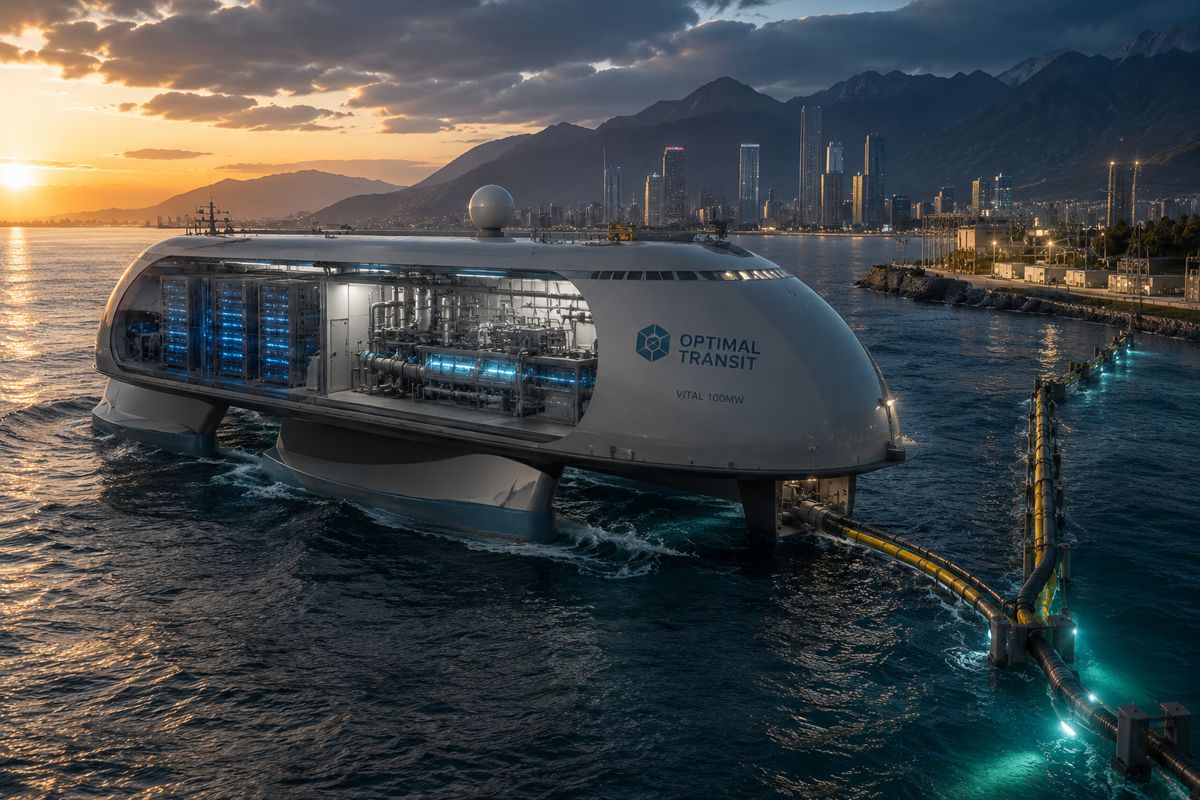
Optimal Transit, the maritime engineering partnership of InMar Technologies and OptiFuel Systems, has unveiled a second configuration of its Kraaken platform, and the more revealing way to read it has little to do with floating computers. The Beaufort, South Carolina company announced the Blue Economy VITAL 100 MW Kraaken on 11 August, redirecting a share of the vessel’s output away from artificial intelligence workloads and toward direct utility service: continuous baseload electricity and desalinated fresh water, exported to shore through a quick-disconnect umbilical.
On the surface it is a data centre that also makes power and water. The commercially significant reading is that critical infrastructure capacity is being repackaged as a relocatable industrial asset, one that arrives finished from a shipyard rather than being assembled across years of site works, interconnection studies and permitting.
That distinction matters because the binding constraint on new power, water and compute is no longer principally the cost of generation. It is the time, the land and the connection queue. The International Energy Agency reported in its Electricity 2026 assessment that over 2,500 GW of renewable, large-load and storage projects are currently stalled in grid queues worldwide, a backlog that has turned interconnection from a project risk into a structural ceiling on deployment.
In the United States alone, over 2,060 gigawatts of total generation and storage capacity were actively seeking connection to the grid at the end of 2025, and the median time from interconnection request to commercial operation now exceeds five years for projects reaching that milestone. Against that backdrop, a piece of infrastructure that sidesteps the queue entirely is less a novelty than a response to the market’s most expensive bottleneck.
Jeff Kline, President of InMar Technologies, framed the reallocation in terms of purpose rather than hardware. “The VITAL 100 MW configuration takes the same core capabilities and asks a different question: what happens when you point some of that output directly at a coastline that doesn’t have reliable power or clean water? The answer is a single vessel that can serve the equivalent of a small city – indefinitely, from offshore, with no connection to the existing grid.”
The claim rests on a mission-flexible design in which one standardised hull, one self-powering engine and one mooring system can be tuned to prioritise different outputs. In the VITAL allocation, according to the company, roughly 40 MW of baseload electricity and about 30 million litres of fresh water per day flow to shore while some 60 MW of capacity remains available for AI-grade compute.
Briefing
- Optimal Transit has announced the VITAL 100 MW Kraaken, a second configuration of its self-powered SWATH vessel that exports baseload electricity and desalinated water to shore alongside AI compute capacity, targeting the same land, water and grid constraints now stalling infrastructure worldwide.
- The company puts the vessel’s all-in capital cost at approximately $587 million and estimates an equivalent land-based bundle of power plant, desalination facility and data centre shell at $750 million to $1.33 billion, with a six-to-ten-year build timeline against roughly three years for the vessel.
- The commercial thesis is relocatable capacity: the vessel connects through a quick-disconnect umbilical, can reposition within hours ahead of storms, and can be redeployed between missions or jurisdictions without stranding the asset.
- The economics are strongest in markets where the alternative is diesel self-generation, which independent studies place well above grid parity across sub-Saharan Africa, South and Southeast Asia and the Pacific.
- The platform remains at the engineering and financing stage rather than in service, with American Bureau of Shipping-ready drawings and digital-twin validation of the Digital Ocean Thermal engine still to be completed.
The Real Constraint Is Time, Land and Water
For most of the past decade the conversation about new generation focused on the falling cost of solar, wind and storage. That framing has been overtaken by a harder problem, which is that even fully financed projects cannot reach revenue because they cannot get connected, sited or permitted at the speed demand now requires.
Lawrence Berkeley National Laboratory found that only 13 percent of the capacity that submitted interconnection requests between 2000 and 2020 had reached commercial operation by the end of 2025, while 75 percent had been withdrawn. A market in which three-quarters of proposed capacity never gets built is a market with a structural supply problem, and it is that problem, rather than any shortage of engineering ambition, that gives a queue-immune asset its commercial rationale.
The same squeeze now defines the economics of artificial intelligence infrastructure, where land, water and power have become the gating factors rather than silicon. Data centres consume billions of gallons of water each year for cooling, and the Council on Foreign Relations, citing Bloomberg analysis, notes that about two-thirds of new US data centres built or in development since 2022 sit in water-stressed areas.
The wider water picture compounds the pressure, with the World Resources Institute finding that 25 countries housing a quarter of the global population face extremely high water stress each year, and at least four billion people live under highly water-stressed conditions for at least one month annually. A platform that generates its own power offshore and manufactures its own fresh water through desalination is, in that context, addressing two scarcities at once rather than competing for either.
What Optimal Transit is really selling, then, is not a vessel so much as a way around the permitting and interconnection gauntlet that has become the industry’s dominant cost in time. The company’s argument is that a coastal city, an industrial zone or a national utility can obtain firm power, potable water and sovereign compute from a single offshore mooring agreement, sidestepping the three separate development tracks that land-based provision would demand.
Whether the engineering delivers on that promise at scale is a separate question, examined later, but the market logic is coherent. The value has migrated from the megawatt to the connection, and the party that can supply capacity without waiting in the queue holds something the queue cannot easily price.
One Asset Instead of Three Construction Projects
The financial case Optimal Transit presents turns on collapsing three construction projects into one hull. The company puts the vessel’s all-in capital cost at approximately $587 million and contrasts it with a comparable land-based bundle: a 40 MW power plant, a desalination facility producing close to eight million gallons a day, and a 60 MW data centre shell, which it estimates would together require between $750 million and $1.33 billion across three sites, three permitting processes and three interconnection efforts.
On the company’s figures the vessel delivers the same output bundle for roughly 44 to 78 percent of the land-based cost. Those numbers are the company’s own and should be read as a vendor estimate rather than an independently audited comparison, but the structural point beneath them is harder to dispute.
The stronger part of the argument is the timeline, and here the external evidence is unambiguous. Optimal Transit claims the vessel reaches operation in around three years against a six-to-ten-year path for the land-based equivalent, and the interconnection data supports the direction of that gap even before permitting and zoning are added. With the median project now spending more than five years in the queue before commercial operation, a coastal developer weighing a land-based data centre or power plant is committing capital that will sit idle for years before it earns.
The time value of that difference is substantial, and in fast-moving AI markets the ability to reach revenue in a single financing cycle rather than two or three is itself a competitive advantage that a spreadsheet comparison of headline capital costs tends to understate.
There is a deeper commercial implication in the standardisation the platform assumes. Optimal Transit has described a production ambition of up to twenty 100 MW platforms a year through shipyards worldwide, contingent on future financing, with each hull built to a common specification and its computing hardware refreshed as technology moves on.
If that manufacturing model holds, infrastructure capacity begins to behave less like a bespoke construction project and more like a serially produced industrial good, priced and delivered against a catalogue rather than negotiated site by site. That is a meaningful shift for infrastructure owners and financiers accustomed to treating every megawatt and every cubic metre of water as a one-off, and it is the part of the proposition most likely to reshape procurement thinking if the engineering is proven out.
A Utility Case That Stands Before a Single Server Is Leased
The most durable commercial argument for the VITAL configuration is that it does not depend on the data centre business at all. In markets where the grid is unreliable, the realistic alternative to a Kraaken is not cheap grid power but diesel self-generation, the generators that hospitals, ports, factories and households run because the network cannot be depended upon. Optimal Transit places the cost of that self-generation at roughly $0.40 to $0.55 per kilowatt-hour across the markets it is targeting, and independent analysis broadly supports that range.
The International Finance Corporation’s study of back-up generation found annual spending of $30 billion to $50 billion on generator fuel in developing markets, with a full service cost ranging from around $0.40 per kilowatt-hour to several dollars in the most remote locations, while separate estimates put the average back-up self-generation cost in Africa at about $0.47 per kilowatt-hour, roughly three times the cost-reflective grid tariffs in countries such as Nigeria and Uganda.
Against that benchmark the vessel is a utility investment that can pay its way on power and water alone, with compute as an additional revenue stream rather than a precondition. That reordering matters for how such assets might be financed and deployed. In sub-Saharan Africa, South and Southeast Asia and the Pacific Islands, the buyer does not need to believe in the AI thesis to justify the acquisition; the baseline it is displacing is expensive, dirty and already being paid for.
For infrastructure investors, a project whose returns rest on replacing diesel rather than on speculative data centre demand carries a different and arguably more defensible risk profile, particularly where multilateral development finance is already engaged in closing the same energy and water gaps.
Mobility as a Form of Risk Management
The feature that separates the VITAL Kraaken most sharply from any land-based equivalent is the simplest one: it can leave. Each vessel connects to shore through a quick-disconnect mooring and umbilical system that Optimal Transit says has been used in industrial maritime applications for more than four decades.
If a storm approaches, the vessel disconnects, repositions and reconnects when conditions clear, without writing down the underlying asset. If political or regulatory conditions change, the same asset can be moved to another site or jurisdiction. If a mission ends, the vessel is redeployed to the next one, which turns a fixed sunk cost into something closer to a mobile capital good that can chase demand across a coastline or a region.
That mobility reframes disaster response in particular, and the historical case for it is stark. When Hurricane Maria struck Puerto Rico in September 2017 it caused the longest blackout in United States history, taking roughly eleven months for power to be restored to all customers whose structures were deemed safe. NASA’s satellite analysis estimated that Puerto Ricans lost around 3.9 billion hours of access to electric power in the six months after the storm, with rural communities accounting for 61 percent of that loss and some interior areas going without power for more than 120 days.
More than two hundred thousand people ultimately left the island, many because the loss of electricity dragged on so long. A relocatable vessel would not have reversed the wind damage, but a pair of them, pre-positioned or deployed within days of landfall, could in principle have injected tens of megawatts and millions of gallons of fresh water directly into the coastal grid independent of the shattered terrestrial transmission network that made the recovery so slow.
The commercial reading of that capability is that resilience itself becomes a product. Governments and utilities in exposed coastal regions increasingly budget for the cost of catastrophic outages, and an asset that can be contracted as standing capacity, moved out of harm’s way and reconnected afterwards offers a form of insurance that fixed infrastructure cannot. Whether buyers will pay for pre-positioned mobile capacity in the way they pay for conventional plant is untested, but the underlying need is well documented and growing as extreme weather intensifies.
The Engine, the Hull and the Question of Proof
The technology underneath the proposition draws on ideas with a long lineage rather than untested experimentation, which is central to how Optimal Transit manages the risk of a novel platform. The Kraaken uses a small waterplane area twin hull, a configuration prized for stability in open water, and the company stresses its reliance on commercial off-the-shelf components with established histories in demanding maritime service.
Power comes from what Optimal Transit calls its patented Digital Ocean Thermal engine, which combines the thermal gradient of the ocean with recovered waste heat and incorporates multi-stage Rankine cycle technology and green ammonia synthesis to produce continuous carbon-free electricity. The principle sits within the family of ocean thermal energy conversion, a baseload marine technology first proposed in the nineteenth century and valued precisely because it can deliver round-the-clock power alongside desalinated water rather than the intermittent output of wind and solar.
That lineage is a strength and a caution in equal measure. Ocean thermal conversion has attracted renewed and serious interest, with Global OTEC advancing a commercial-scale platform for São Tomé and Príncipe and Ocean Thermal Energy Corporation working under a contract with the US Army to design a 17.2-megawatt ocean thermal and desalination system for the garrison at Kwajalein Atoll in the Marshall Islands, structured around a long-term agreement to buy both electricity and fresh water.
Defence and island-nation demand is real, and the technology’s ability to co-produce power and water is exactly what the VITAL configuration monetises. The historical difficulty has been cost and the corrosive marine environment, which is why the engineering validation still ahead of Optimal Transit is the pivot on which the commercial case turns.
On the company’s own account, the platform is at the engineering and capital-raising stage rather than in service. Proceeds from an ongoing Series A round are expected to fund American Bureau of Shipping-ready drawings and a digital-twin validation of the Digital Ocean Thermal engine, with standardised production contingent on a planned later financing round.
Buyers and investors should therefore weigh the VITAL Kraaken as a designed and costed proposition rather than a proven operating asset, and the gap between a compelling configuration on paper and a hull delivering firm power and water to a coastline is where the commercial scrutiny properly belongs. None of that diminishes the strategic logic; it simply locates the decision at the point where diligence matters most.
Where the Offshore Compute Race Is Heading
The VITAL announcement lands in a field that has moved quickly from research to deployment, which is the clearest signal of where value and competition are concentrating. China has gone furthest toward operation, with an offshore wind-powered undersea data centre off Shanghai’s Lingang Special Area reaching full commercial service in 2026. That project, drawing about $226 million in investment and designed for 24 MW of capacity, uses the surrounding ocean as a heat sink, requires no freshwater, and cuts land use by more than 90 percent compared with above-ground facilities.
Private capital is following the same logic: the wave-powered floating computing venture Panthalassa raised a $140 million Series B round led by Peter Thiel in 2026, and Aikido Technologies has unveiled a floating platform integrating offshore wind, storage and compute in a single structure. Microsoft’s earlier Project Natick trials, though discontinued commercially, established that submerged deployments could achieve lower hardware failure rates and seeded much of the current interest.
What distinguishes the Optimal Transit approach within that field is the decision to export utility outputs to shore rather than simply host compute at sea, and to keep the asset mobile rather than fixing it to the seabed. The company’s roadmap points beyond single vessels toward what it calls a Sovereign Power Park, in which five hulls co-located within a two-mile offshore zone would deliver, on its figures, roughly 200 MW of baseload power, 40 million gallons of fresh water a day and 300 MW of compute, enough to serve a metropolitan area or a large industrial cluster without land or fuel.
That vision of clustered, modular, relocatable capacity is the sharpest expression of the underlying thesis, and it points to a market in which infrastructure is increasingly bought as a movable industrial product.
For infrastructure owners, utilities and investors, the strategic takeaway is to watch the constraint rather than the vessel. The reason offshore and relocatable capacity is attracting Chinese state deployment, Thiel-backed venture funding and defence procurement at the same moment is that land, water, permitting and interconnection have become the scarce inputs across both utilities and AI infrastructure.
Optimal Transit’s VITAL Kraaken may or may not be the platform that proves the model at scale, but the direction it points toward, infrastructure capacity delivered as a mobile asset that arrives finished and can be moved, is a response to structural pressures that are not going to ease. Industry leaders who treat that shift as a curiosity rather than a signal risk being slow to a market that is already forming around them.
Key Industry Questions
- How is the VITAL 100 MW Kraaken different from the original Kraaken data centre? The two configurations share the same hull, self-powering engine and mooring system, but allocate output differently. The original platform, unveiled in July 2026, directed almost all of its net capacity to hosted AI compute. The VITAL configuration reallocates a larger share toward utility service, exporting around 40 MW of baseload electricity and roughly 30 million litres of fresh water a day to shore while retaining about 60 MW for compute. The change is one of purpose rather than hardware, which is central to Optimal Transit’s mission-flexible design philosophy. It positions the same asset to serve coastlines that need power and water first and computing capacity second.
- Do the cost comparisons hold up against real land-based projects? The headline figures are the company’s own and function as a vendor estimate rather than an audited comparison. Optimal Transit puts the vessel at approximately $587 million against a $750 million to $1.33 billion land-based bundle, giving a claimed 44 to 78 percent cost advantage. The timeline claim is better supported by independent data. With the median grid-connected project now spending more than five years in the interconnection queue before commercial operation, and permitting and zoning adding further delay, the several-year advantage the company describes for an offshore asset is directionally consistent with documented reality, even if the precise capital figures warrant buyer scrutiny.
- Why have grid connection queues become such a serious obstacle? Interconnection queues have swelled far faster than the transmission system can absorb, turning a once-routine process into a multi-year bottleneck. More than 2,500 GW of projects are stalled in queues worldwide, and in the United States only around 13 percent of capacity that requested connection between 2000 and 2020 had been built by the end of 2025. The result is that even financed, shovel-ready projects cannot reach revenue on any predictable schedule. That delay is now the dominant cost in new power and large-load development, which is why assets that avoid the queue entirely command commercial attention regardless of their headline price.
- Can a vessel realistically substitute for grid infrastructure? For a discrete coastal load, the concept is credible; as a wholesale replacement for a national grid, it is not, and the company does not claim otherwise. A single VITAL Kraaken is designed as a standalone utility node serving a city-scale demand, with multi-vessel clusters intended to reach metropolitan or industrial-zone scale. The realistic role is to supply firm capacity to coastlines that are underserved, unreliable or recovering from disaster, and to complement rather than displace terrestrial networks. Its advantage lies in speed of deployment and independence from the connection queue, not in matching the scale of established grid infrastructure.
- What is ocean thermal energy conversion, and is the self-powering claim proven? Ocean thermal energy conversion generates electricity from the temperature difference between warm surface water and cold deep water, and can co-produce fresh water through desalination. It is a genuine baseload marine technology with a long history and renewed momentum, including defence and island-nation projects. The Kraaken’s Digital Ocean Thermal engine draws on that principle combined with recovered waste heat. The self-powering claim is coherent in engineering terms but not yet independently validated at this platform’s scale; Optimal Transit’s own roadmap places digital-twin validation of the engine ahead of it, which is where technical diligence should focus.
- How could relocatable infrastructure change disaster response? Fixed power and water infrastructure fails precisely when it is most needed and can take months or years to restore, as Puerto Rico’s eleven-month blackout after Hurricane Maria demonstrated. A relocatable vessel can be pre-positioned or deployed within days and connected directly to a coastal grid independent of damaged terrestrial transmission, injecting power and desalinated water where they are otherwise unavailable. It can then move out of harm’s way ahead of the next storm. This reframes resilience as a contractable service, allowing exposed regions to procure standing capacity rather than rebuilding vulnerable fixed assets after every event.
- Who else is competing in offshore and ocean-based infrastructure? The field has moved from research to deployment. China operates an offshore wind-powered undersea data centre off Shanghai, drawing roughly $226 million for 24 MW, cooled by seawater and using no freshwater. Venture-backed entrants include Panthalassa, which raised a $140 million round led by Peter Thiel for wave-powered floating compute, and Aikido Technologies, which integrates wind, storage and compute on a single floating platform. Microsoft’s discontinued Project Natick seeded much of the interest. Optimal Transit differs by exporting power and water to shore and keeping its asset mobile rather than submerged and fixed.
- What has to happen before the VITAL Kraaken can be deployed? The platform is at the engineering and financing stage rather than in service. Optimal Transit expects an ongoing Series A round to fund American Bureau of Shipping-ready engineering drawings and a digital-twin validation of the Digital Ocean Thermal engine, with standardised production dependent on a later financing round. Buyers and investors should therefore treat the VITAL configuration as a designed and costed proposition rather than an operating asset. The decisive milestones to watch are engine validation, class approval and a first-of-kind build, after which the gap between the paper case and demonstrated performance can properly be judged.
Strategic Takeaways
- The scarce input in new infrastructure has shifted from generation cost to connection, land, water and permitting time, and assets that bypass the interconnection queue can command value that conventional capital-cost comparisons understate.
- Standardised, serially produced and relocatable infrastructure could change procurement from bespoke site-by-site development toward catalogue-style acquisition, a shift infrastructure owners and financiers should begin to model even before the technology is proven at scale.
- The most defensible commercial case for offshore utility vessels lies in markets where the alternative is diesel self-generation at three to four times developed-market grid costs, where power and water alone can justify the asset without relying on speculative AI demand.
- Mobility turns resilience into a contractable product, offering exposed coastal regions a way to procure standing, relocatable capacity rather than repeatedly rebuilding vulnerable fixed assets after disasters.
- The decisive uncertainty is engineering maturity rather than market logic; with the platform still at Series A and its self-powering engine awaiting digital-twin validation, diligence should concentrate on class approval and a first-of-kind build rather than on the configuration’s undoubted commercial appeal.