Standby Power Moves to the Centre of the AI Data Centre Buildout
The tightest constraint on the artificial intelligence buildout has quietly shifted from processors to power, and specifically to the physical equipment that delivers and secures it. Developers can place orders for accelerators faster than utilities can connect new load or manufacturers can build the transformers, switchgear and standby generators that keep a hyperscale campus running through an outage.
An engine-plant extension in eastern France carries more weight than a routine supplier ceremony. When Liebherr and Rehlko marked the strategic capacity expansion at the Liebherr-Components site in Colmar on 2 June, they were placing a marker on one of the AI economy’s genuine bottlenecks, the availability of dependable generating equipment at scale.
The commercial logic sits in the timing and the geography rather than the event itself. The Colmar investment adds nearly 12,000 square metres and, once fully ramped, is set to more than double engine output at the plant that supplies Rehlko’s KD Series generators. It lands within days of Rehlko committing to a new assembly facility in Kenosha, Wisconsin, aimed at the same demand curve.
Two capacity moves on two continents, upstream engine manufacturing in France and downstream enclosure assembly in the United States, describe a coordinated industrial push to lift standby power off the critical path for data centre delivery. For contractors, infrastructure owners and investors, the underlying signal is that whoever controls engine capacity increasingly controls how quickly digital infrastructure can be switched on.
That reframing matters because the standby generator has moved from a commodity line item to a scheduling determinant. On a hyperscale build, the electrical equipment can represent a small share of total project cost yet account for most of the delay risk, and generating sets are now among the longest-lead items on the procurement calendar. An engine plant doubling its throughput is therefore not simply a manufacturing story. It is a statement about where value, competition and purchasing power are concentrating across the construction and infrastructure supply chain as the sector absorbs a decade of compressed demand.
Briefing
- Liebherr’s Colmar components site is expanding by nearly 12,000 square metres in a move set to more than double engine production capacity, supplying the high-performance diesel engines behind Rehlko’s KD Series data centre generators.
- The Colmar expansion pairs with Rehlko’s separately announced 160,000 square foot assembly facility in Kenosha, Wisconsin, which will build eFRAME enclosures for backup generator solutions up to 4 MW and forms part of a plan to lift capacity by more than 400 per cent through the decade.
- The International Energy Agency projects electricity generation for data centres rising from 460 TWh in 2024 to over 1,000 TWh in 2030, with data centre demand having already jumped 17 per cent during 2025.
- Large standby generators are now quoted on lead times measured in tens of weeks to more than two years, turning speed to deployment into a decisive commercial advantage in a market where hyperscale downtime is costed in hundreds of thousands of dollars per hour.
- Rehlko, the former Kohler Energy carved out under Platinum Equity ownership in 2024, is competing against Caterpillar, Cummins, Rolls-Royce and others in what has become an effective oligopoly for large data centre backup power.
Power Availability, Not Silicon, Is Setting the Pace
The scale of the demand pulling these investments forward is now well documented. The International Energy Agency’s Energy and AI analysis projects that electricity generation supplying data centres will climb from 460 TWh in 2024 to more than 1,000 TWh in 2030, reaching around 1,300 TWh by 2035 in its base case. Its updated April 2026 assessment records that data centre electricity demand grew by 17 per cent during 2025, with consumption at AI-focused facilities rising far faster, and it expects overall data centre demand to double by 2030 while AI-specific demand triples. The capital behind that curve is enormous, with the five largest technology companies pushing combined data centre capital expenditure beyond 400 billion dollars in 2025 and preparing a further increase of roughly three quarters in 2026.
What has changed in the last eighteen months is the location of the constraint. The IEA’s newer work is explicit that AI deployment is increasingly running into physical bottlenecks that limit how quickly capacity can expand, singling out supply chains for energy equipment, transformers, grid connections and advanced chip manufacturing.
Industry procurement analysis tells the same story from the buyer’s side, with power availability rather than land or permitting now the leading cause of construction delay across the major markets. This is the market condition that gives an engine plant expansion its significance. When the gating item on a multi-billion dollar campus is the equipment that keeps the lights on during a grid event, the firms that can manufacture and assemble that equipment at volume acquire unusual leverage over project timetables and, by extension, over developer decisions.
Owning the Engine, Controlling the Lead Time
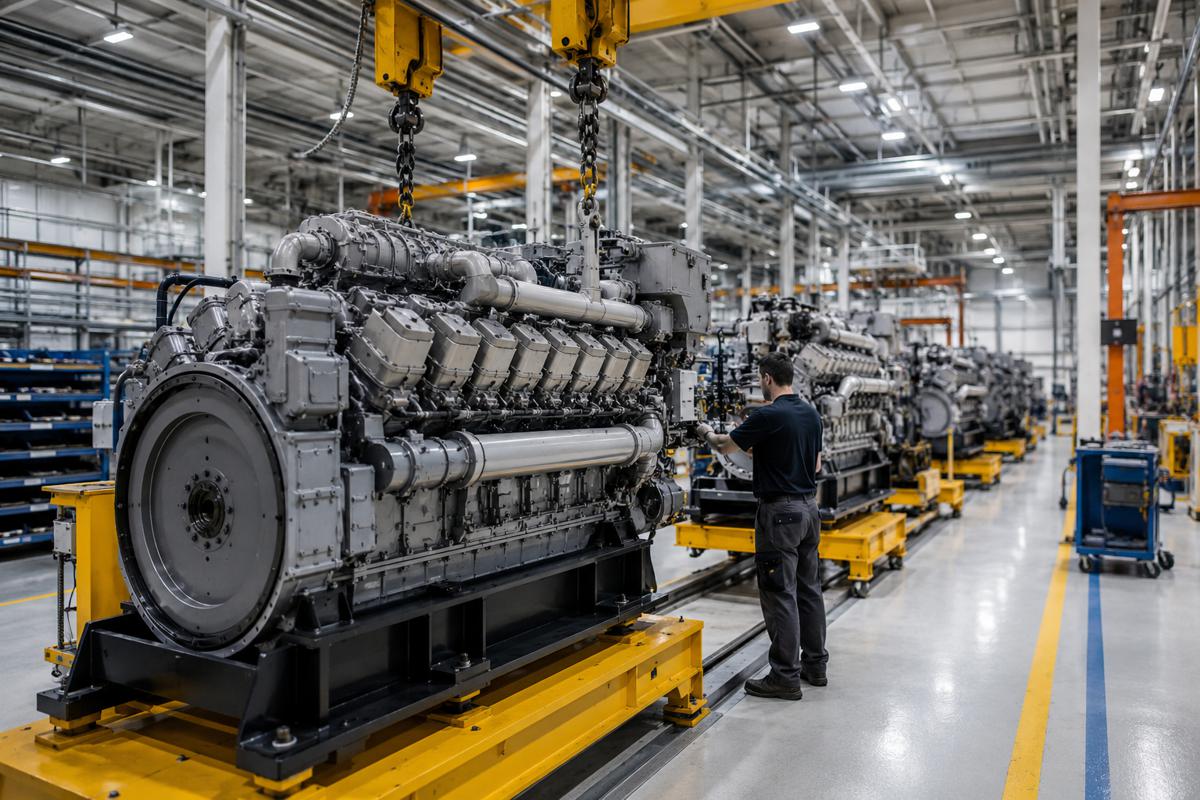
The strategic core of the Colmar and Kenosha moves is vertical control of the slowest part of the generator. Liebherr-Components Colmar designs, manufactures and tests the diesel engines at the heart of Rehlko’s large industrial gensets, including the co-developed G-drive units and the 18-litre KD18L06 that powers the latest KD700 and KD750 machines, alongside the newer D99 engine family offered in V12, V16 and V20 displacements.
Rehlko then integrates those engines into complete generator systems and, increasingly, into pre-engineered eFRAME enclosures that arrive on site ready to install. Doubling engine output in France while expanding enclosure assembly in Wisconsin addresses both ends of that chain at once, which is precisely the combination that shortens delivery.
This matters commercially because a significant part of the market relies on third-party engines, leaving genset builders exposed whenever an upstream engine supplier reaches capacity. By deepening a single, decade-long engineering relationship rather than buying engines on the open market, Rehlko is buying schedule certainty as much as horsepower.
Jens Krug, Managing Director of Liebherr-Components Colmar SAS, framed the investment in relationship terms, noting that “This expansion reflects more than an investment in capacity — it demonstrates our long-term commitment to our partnership with Rehlko, to the Colmar site, and to the sustained growth of our industrial capabilities.”
The engineering ambition is equally concrete, with the earlier May 2025 collaboration explicitly targeting better production efficiencies and improved lead times, the two variables that now decide data centre delivery dates. For a family-owned components business, an anchor customer scaling into hyperscale backup power converts a specialist engine line into a strategic industrial platform.
The Procurement Reality Behind the Investment
The urgency reads clearly in the numbers facing buyers. Diesel generators in the mid megawatt range have been quoted on lead times of roughly fifty to eighty weeks through 2026, with the largest units stretching well beyond two years, and transformers and grid-tie equipment running longer still. Set against downtime costs at a large data centre estimated in the region of 500,000 to 900,000 dollars per hour, the calculus for operators is straightforward, and it explains why capacity that can be delivered sooner commands both attention and commitment. Speed to deployment has become a competitive weapon rather than a service promise.
Rehlko’s own order book illustrates how fast that demand is converting into contracts, with the company reporting 1.8 gigawatts of new purchase agreements for its diesel backup generators across North America inside a sixty day window.
Brian Melka, President and Chief Executive Officer of Rehlko, tied the Colmar ceremony directly to that pipeline, stating that “This ceremony is an important milestone for our growth strategy as we scale our capacity to support the accelerating digital backbone. As data center demand continues to grow, customers are prioritizing resilient, scalable power solutions with zero downtime. This expansion demonstrates our commitment to disciplined decision-making and follow-through, strengthening our ability to convert a growing backlog into long-term revenue and capture additional market share in the data center sector while reinforcing our leadership in critical energy solutions.” The disciplined framing is deliberate, because in a market where hyperscale buyers reserve manufacturing slots months in advance with partial payments, the ability to convert a backlog into shipped product on schedule is the differentiator that separates the leaders from the also-rans.
An Oligopoly Rewritten by Capacity
Large data centre backup power remains a concentrated market, effectively an oligopoly in which Caterpillar sits first and Cummins a clear second, together accounting for much of the installed base at hyperscale sites. The competitive pressure is visible in the wider order books, with Caterpillar reporting a backlog of around 63 billion dollars across its energy and transportation business early in 2026, and Rolls-Royce confirming that data centres now represent more than 80 per cent of the power-generation revenue in its Power Systems division as it takes orders stretching into 2027 and 2028. Generac and Mitsubishi round out a field in which every serious player is racing to add throughput.
Rehlko competes squarely within that group, with its KD3250 machine rated at 3,250 kW standby sitting in the same hyperscale node band as Caterpillar’s C175 platform and the Cummins QSK60 units. In a market where the leading suppliers all face similar delivery constraints, incremental capacity is one of the few levers that can genuinely move competitive share.
That is why the Colmar and Kenosha announcements are best read as share-capture strategy rather than routine expansion. When customers cannot obtain enough equipment from the incumbents on an acceptable timeline, a well-capitalised challenger that can double engine supply and expand assembly simultaneously stands to win volume that would otherwise have gone to larger rivals, and to do so precisely when the demand curve is at its steepest.
Two Ownership Models, One Industrial Bet
The deal also brings together two contrasting corporate structures aligned behind the same thesis. Rehlko is the rebranded Kohler Energy, established as a stand-alone business in May 2024 when Platinum Equity completed its carve-out from Kohler Company, with the former parent retaining an investment stake. Private equity ownership tends to reward disciplined capital deployment and rapid conversion of backlog into revenue, which is exactly the language Rehlko’s leadership now uses.
Liebherr, by contrast, is a family-run group founded in 1949 that employed more than 55,000 staff and posted combined revenues above 14 billion euros in 2025, and it approaches the partnership through the lens of long-term industrial alignment rather than near-term financial engineering.
The convergence is instructive for anyone weighing where infrastructure capital is flowing. A private-equity-backed energy resilience specialist and a multi-generational European engineering group have reached the same conclusion about standby power at the same moment, and both are committing physical capacity to it.
For investors, that alignment across very different ownership cultures is a stronger signal than either firm’s announcement in isolation, because it suggests the demand is structural rather than speculative. It also positions the European industrial base, and Colmar specifically, as a beneficiary of a demand surge often assumed to be an American and Asian phenomenon, reinforcing the strategic value of engine manufacturing capacity on the continent.
Reading the Capacity Signal
The wider lesson for construction and infrastructure leaders is that the components securing digital infrastructure have become infrastructure in their own right. Grid connection queues and interconnection delays are pushing operators toward more onsite generation, not less, even as emissions rules tighten and battery storage and hybrid configurations begin to reshape parts of the standby stack.
Diesel remains the default for hyperscale resilience because of its transient response and multi-day fuel autonomy, and the near-term investment is flowing accordingly, yet the direction of travel toward Tier 4 compliance and cleaner configurations is unmistakable. The firms expanding capacity now are also the firms best placed to fund that transition.
For procurement teams, the practical implication is that generating capacity should be treated with the same strategic seriousness as land, power contracts and chip allocation, and reserved early. For infrastructure owners and their financiers, the Colmar and Kenosha expansions are useful evidence that the standby power bottleneck is being addressed with real industrial commitment rather than marketing, which should ease, though not eliminate, one of the constraints slowing the buildout.
The broader takeaway is that the AI capacity race extends far beyond the data hall, reaching back through enclosures and gensets to the engine lines in places like Colmar, where a decade-old partnership is now quietly helping to set the pace of the entire digital economy.
Key Industry Questions
- Why is standby power a bottleneck for AI data centres rather than just chips? Processors can be ordered and shipped comparatively quickly, but the electrical equipment that powers and protects a campus cannot. Transformers, switchgear and large standby generators carry lead times that now run from many months to more than two years, and grid connections face lengthy queues. The International Energy Agency has explicitly identified energy equipment supply chains and grid connections among the physical bottlenecks limiting how fast data centres can expand. Because a hyperscale facility cannot operate to the required availability standards without resilient backup power, generating capacity has become a scheduling determinant. The result is that power equipment, a modest share of total project cost, accounts for a disproportionate share of delay risk and now shapes when a facility can actually come online.
- How does the Colmar engine plant fit into Rehlko’s data centre supply chain? Liebherr-Components Colmar designs, manufactures and tests the diesel engines that sit at the heart of Rehlko’s KD Series generators, including co-developed G-drive units and the 18-litre engine powering the latest KD700 and KD750 machines. Rehlko integrates those engines into complete generator systems and pre-engineered enclosures for deployment at data centres. Colmar therefore occupies the upstream, engine-manufacturing position in the chain, while Rehlko’s assembly operations sit downstream. Expanding Colmar’s output while simultaneously enlarging enclosure assembly in Wisconsin addresses both ends at once, which is what shortens overall delivery time and gives the partnership schedule certainty that rivals relying on open-market engines may struggle to match.
- What lead times do operators face for large standby generators? Industry procurement analysis for 2026 places diesel generators in the mid megawatt range on lead times of roughly fifty to eighty weeks, with the largest hyperscale units stretching well beyond two years. Transformers and generator step-up equipment can run longer still. These windows have reordered the buyer’s calendar, with equipment now typically reserved twelve to eighteen months before a site is mobilised and manufacturing slots held with partial payment. Against downtime costs estimated at 500,000 to 900,000 dollars per hour for a large facility, operators are willing to commit early and pay to secure capacity, which is why suppliers able to deliver sooner are winning both attention and firm orders in a supply-constrained environment.
- Who are the main competitors in data centre standby power? The market is concentrated, functioning as an effective oligopoly. Caterpillar leads, with Cummins a clear second, and together they account for much of the installed base at hyperscale sites. Rolls-Royce, through its MTU and Power Systems operations, is a major force and now derives more than 80 per cent of its power-generation revenue from data centres. Generac, Mitsubishi and Rehlko complete the leading group. Rehlko’s KD3250, rated at 3,250 kW standby, competes directly in the hyperscale node band alongside Caterpillar’s C175 and Cummins QSK60 platforms. In a field where all the leaders face similar delivery constraints, additional manufacturing capacity is one of the few levers capable of shifting competitive share.
- Does controlling engine manufacturing give Rehlko a real advantage? It provides schedule certainty, which in the current market is a genuine commercial edge. A meaningful part of the generator industry relies on third-party engines, leaving builders exposed whenever an upstream supplier reaches capacity. By deepening a decade-long relationship with Liebherr and helping fund a doubling of engine output at Colmar, Rehlko secures priority access to the slowest component in its product. Combined with expanded enclosure assembly in Wisconsin, that vertical control shortens delivery and reduces the risk of an engine constraint stalling shipments. In a market where the ability to convert backlog into delivered product on time separates winners from the rest, controlling engine supply is arguably as valuable as the engineering performance of the machines themselves.
- What does Rehlko’s ownership structure mean for its strategy? Rehlko is the former Kohler Energy, established as a stand-alone company in May 2024 when Platinum Equity completed a carve-out from Kohler Company, which retained an investment stake, and rebranded the following September. Private equity ownership typically emphasises disciplined capital allocation and rapid conversion of order backlog into revenue, and that is precisely the language Rehlko’s leadership uses when describing its capacity investments. The structure encourages fast, targeted expansion aimed at capturing share during a demand surge. Its partner Liebherr, a family-owned group, brings a longer industrial horizon. The alignment of two very different ownership cultures behind the same standby power thesis suggests the underlying demand is structural rather than opportunistic.
- How does grid difficulty affect demand for onsite backup generation? Lengthy interconnection queues and constrained grid capacity are pushing data centre operators toward greater onsite generation, both to secure resilience and, in some cases, to bridge periods before full grid connection is available. As primary markets reach capacity limits, developers are moving to energy-rich secondary locations and investing more heavily in behind-the-meter power. That dynamic increases demand for large standby and prime-rated generating equipment at precisely the moment when supply is tight. It also raises interest in flexible configurations, including onsite battery storage and hybrid arrangements, though diesel standby remains the default for hyperscale resilience because of its transient response and extended fuel autonomy during prolonged outages.
- What should investors take from the Colmar and Kenosha expansions? The clearest signal is that the AI capacity race extends well beyond chips and servers into the industrial base that manufactures power equipment. When a private-equity-backed energy specialist and a family-owned European engineering group commit physical capacity to the same segment within days of each other, the demand is more likely structural than speculative. Investors should note that value is concentrating in the ability to deliver generating equipment at volume and on schedule, that European engine manufacturing is a direct beneficiary of a demand surge often framed as American and Asian, and that standby power capacity now deserves the same strategic scrutiny as land, grid access and semiconductor allocation when assessing data centre exposure.
Strategic Takeaways
- Standby generating capacity has become a scheduling determinant for data centre delivery, meaning firms that can manufacture and assemble engines and gensets at volume now hold unusual leverage over project timelines and developer decisions.
- Vertical control of the engine, the slowest component in a generator, is emerging as a decisive competitive advantage, favouring suppliers with secured engine supply over those exposed to open-market capacity constraints.
- Incremental manufacturing capacity is one of the few levers capable of shifting share in a concentrated market, so the Colmar and Kenosha expansions are best understood as share-capture strategy timed to the steepest part of the demand curve.
- The alignment of contrasting ownership models, private equity and family enterprise, behind the same standby power bet is a strong indicator that data centre power demand is structural, with European engine manufacturing positioned as a direct beneficiary.
- Procurement teams and infrastructure financiers should treat generating capacity with the same strategic seriousness as land, grid connection and chip allocation, reserving equipment early while tracking the gradual shift toward Tier 4 compliance, battery storage and hybrid configurations.