Seven Liebherr Cranes Coordinate Ulm’s B10 Bridge Reconstruction
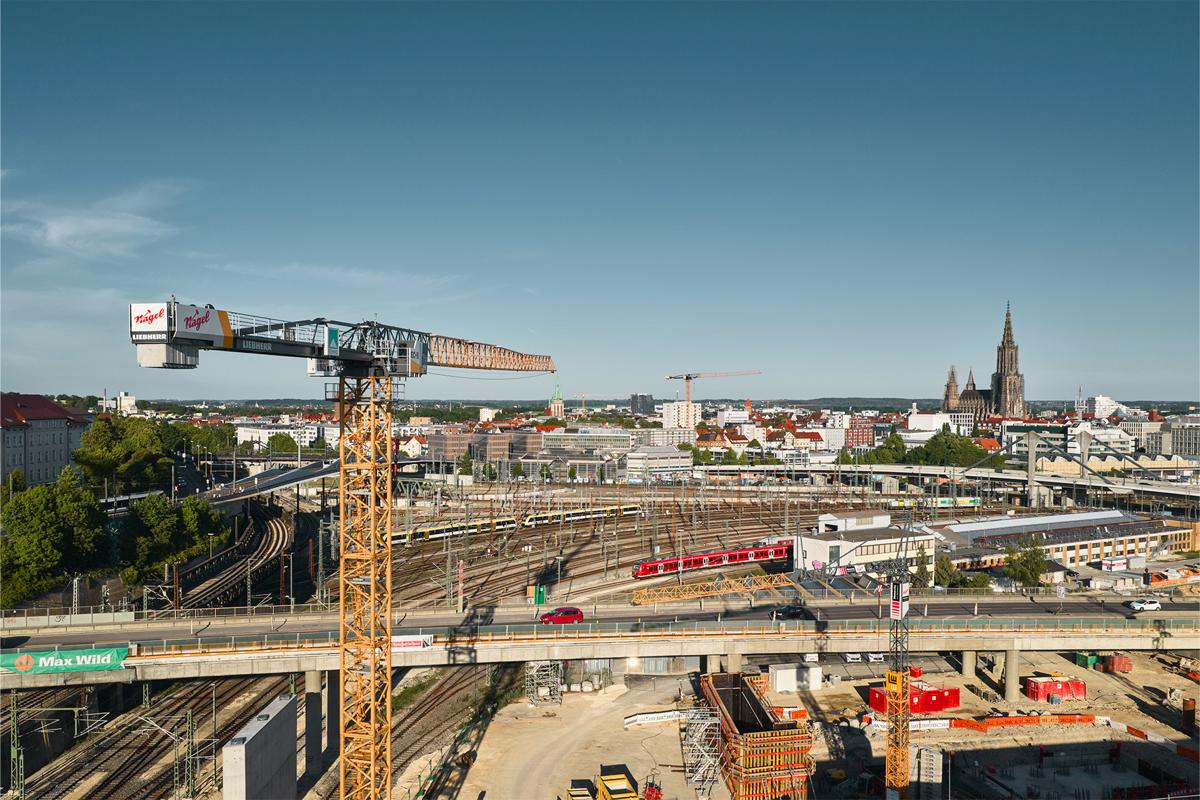
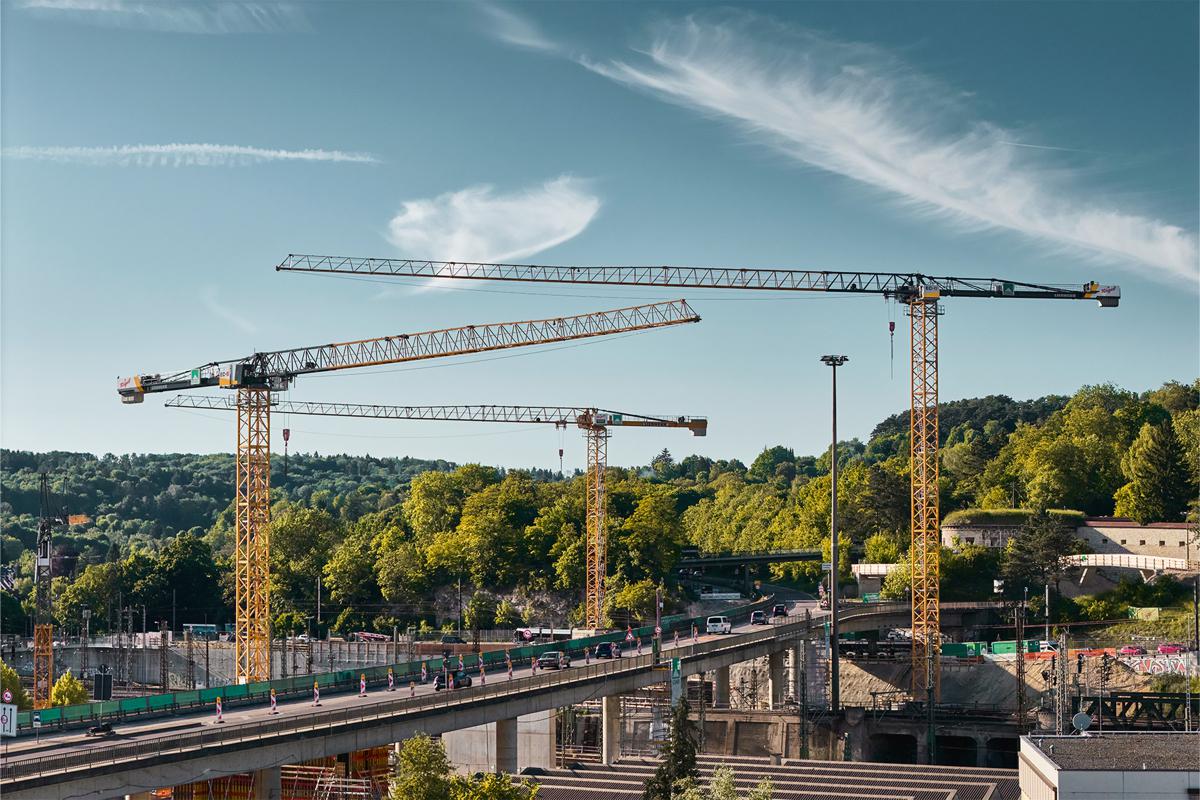
Replacing a major road bridge above an operating railway is as much a problem of space and logistics as it is one of lifting capacity. In Ulm, Germany, seven Liebherr tower cranes are being assembled into a coordinated lifting system for the reconstruction of the Wallstraßenbrücke, where the B10 crosses one of the city’s busiest rail corridors.
The bridge forms part of a much larger reconstruction of the B10 through Ulm. The route is the principal north-south transport axis through Ulm and Neu-Ulm and carries up to 86,000 vehicles a day. The programme includes replacement of the Wallstraßenbrücke, construction of an approximately 200-metre Blaubeurer Tor tunnel and extensive changes to the surrounding road network.
For ARGE B10, the consortium of Matthäus Schmid Bauunternehmung and LEONHARD WEISS delivering the bridge project, the construction environment leaves little room for conventional site logistics. Railway infrastructure remains immediately below the works, road traffic continues around the project and heavy formwork and reinforcement components still have to reach precise positions across a long and fragmented working area.
Rather than relying on a small number of large cranes, the lifting plan developed with Nagel Mietservice combines high-capacity flat-top tower cranes with smaller self-erecting machines. The result is a crane network designed to separate heavy structural lifts from the continuous movement of smaller materials around the site.
Briefing
- Seven Liebherr tower cranes are supporting construction of the replacement Wallstraßenbrücke in Ulm.
- Two 520 EC-B 20 Fibre flat-top cranes provide the principal heavy-lifting capacity.
- The larger 520 EC-B installation operates with an 80-metre jib, 52-metre hook height and maximum capacity of 20 tonnes.
- Smaller top-slewing and self-erecting cranes distribute materials through constrained areas of the site.
- The complete Wallstraßenbrücke is scheduled to reopen to traffic in summer 2029.
Rebuilding the Wallstraßenbrücke
Built between 1967 and 1969, the existing Wallstraßenbrücke has reached the point where complete replacement is required. The new bridge will extend for 187 metres and is being constructed in two principal stages so that transport movements can be maintained while the old structure is progressively removed.
Work on the western half dominates the first phase, with construction running through 2026 and 2027. The eastern half follows from late 2027, with the complete replacement bridge scheduled to reopen in summer 2029.
The Wallstraßenbrücke is only one component of the wider B10 reconstruction. Ulm is also replacing the bridge at Blaubeurer Tor with a tunnel and reorganising the surrounding junctions. The city describes the overall B10 programme as one of its largest and most expensive infrastructure projects, with total costs exceeding €300 million.
The logistics extend well beyond the bridge itself. Southbound B10 traffic through the construction area has been diverted, while northbound traffic continues through the corridor. Below the bridge, railway operations impose another set of restrictions on construction sequencing, access and lifting.
ARGE B10 appointed Ulm-based Nagel Mietservice to develop the crane and logistics concept in collaboration with the contractors. Nagel is responsible for project management and technical planning as well as supplying crane capacity for Matthäus Schmid.
Heavy Lifting Across the Site
The principal lifting machines are two Liebherr 520 EC-B 20 Fibre flat-top cranes erected in March 2026.
Nagel Technik Service installed the first on 12 March. Configured with an 80-metre jib and 52-metre hook height, the crane can lift up to 20 tonnes and provides coverage across the main construction area. Its duties include handling formwork units and reinforcement cages required around the bridge and railway infrastructure.
A second 520 EC-B 20 Fibre was erected four days later on the opposite side of the site. Its configuration is deliberately different, using a 60-metre jib and 35-metre hook height to support faster handling cycles in the denser part of the construction area. Together, the machines provide overlapping heavy-lift coverage without forcing every operation through a single crane position.
The 520 EC-B 20 Fibre can be configured with a maximum radius of 83 metres and has a rated maximum lifting capacity of 20 tonnes. At maximum radius, Liebherr specifies a 2.9-tonne lifting capacity.
Its fibre hoist rope is central to the crane’s lifting characteristics. The rope weighs substantially less than conventional steel rope, reducing dead weight within the lifting system. Liebherr’s published data for the model shows an approximately 40% increase in jib-head lifting capacity compared with the corresponding steel-rope crane, although the precise advantage varies according to configuration and operating point.
That characteristic is particularly useful where long jib configurations are required. Extending coverage normally imposes a penalty at the outer reaches of the jib, where rope and component weight consume part of the crane’s available capacity. Reducing that dead weight allows more of the available capacity to be used for the load itself.
Liebherr states that its high-tensile fibre rope has approximately four times the service life of steel rope and uses visible wear indicators to help operators assess its condition. Repair systems can also allow certain damaged sections to be dealt with without immediately replacing the complete rope. Crane availability has to be maintained through changing construction phases while the lifting geometry around the bridge evolves.
Dividing the Logistics
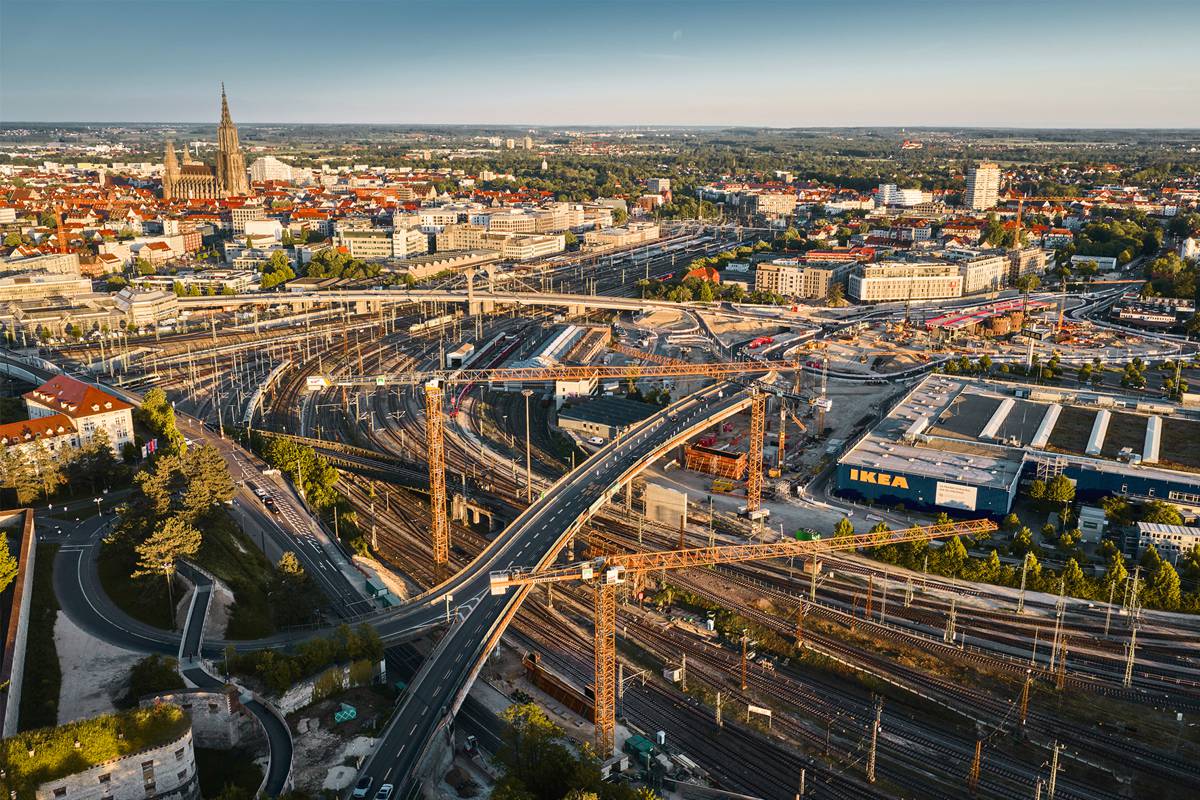
Heavy lifting is only part of the workload. A Liebherr 81 K self-erecting crane at Blaubeurer Tor handles material distribution, peripheral supply and smaller logistical movements. Its comparatively compact footprint and rapid erection characteristics suit areas where deploying another large tower crane would consume valuable working space.
A 202 EC-B flat-top crane joined the system in April 2026 to support formwork and reinforcement operations. Three additional self-erecting cranes are being deployed by LEONHARD WEISS for local material handling within the site.
This creates a hierarchy of lifting capacity. The large 520 EC-B machines can remain available for loads and reaches that require them, while smaller cranes deal with repetitive supply work closer to individual construction areas. A crane capable of lifting 20 tonnes at shorter radii is an expensive and operationally valuable resource to occupy moving relatively light materials around a local workface.
The arrangement also provides flexibility as the bridge progresses. Construction sites rarely retain the same lifting requirements from demolition through substructure works, reinforcement, formwork, concrete construction and finishing. Crane locations, hook heights and useful radii change as the structure rises and access routes move.
Working Above the Railway
The railway beneath the Wallstraßenbrücke creates the most demanding part of the operating environment. Formwork sections and reinforcement cages have to be positioned accurately around railway infrastructure where access from ground level is restricted, combining reach with controlled load movement rather than relying on capacity alone.
The crane system must also coexist with the wider construction programme. The B10 reconstruction is being undertaken while Ulm continues to move road traffic through and around one of its principal urban transport corridors, with diversion routes and altered traffic management remaining in place through the multi-year works.
Crane planning therefore forms part of the construction methodology. Slewing areas, tower positions, jib intersections, material delivery points and lifting sequences have to be considered alongside rail operations, road traffic and the changing geometry of the bridge.
Crane Planning as Site Infrastructure
Seven cranes may appear excessive when considered purely in terms of maximum lifting capacity. Viewed as a material distribution system spread across a long, constrained bridge site, the arrangement is easier to understand. Two large flat-top machines provide reach and heavy-lift capability, while smaller cranes absorb the continuous flow of reinforcement, formwork and general construction materials.
The approach requires considerable planning at the front end. Crane foundations, tower positions, erection and dismantling sequences, overlapping working radii and site access all have to be coordinated with the construction programme. On a site above railway infrastructure and beside heavily trafficked roads, those decisions cannot easily be changed once work is under way.
Ulm’s replacement Wallstraßenbrücke will eventually remove every trace of the temporary lifting system assembled to build it. Until then, the seven cranes form an operating network above the project, moving everything from major reinforcement cages to the routine materials that keep individual workfaces productive.
For a bridge being reconstructed while the transport systems around and beneath it continue to function, that network is part of the engineering of the job itself.
Key Industry Questions
- Why are seven tower cranes being used on the Wallstraßenbrücke project? The construction area is long, congested and divided by road and railway infrastructure. Using several cranes allows heavy lifting and routine material distribution to take place across different work zones without relying on one or two machines for every movement.
- What is the largest crane on the project? Two Liebherr 520 EC-B 20 Fibre flat-top cranes provide the principal heavy-lifting capacity. The model has a maximum lifting capacity of 20 tonnes and can be configured with a jib of up to 83 metres.
- Why does the 520 EC-B use fibre rope? High-tensile fibre rope is considerably lighter than conventional steel rope. Reducing rope and lifting-system dead weight can increase the payload available at longer radii. Liebherr specifies approximately 40% greater jib-head lifting capacity for the 520 EC-B 20 Fibre compared with its steel-rope equivalent.
- Why use smaller self-erecting cranes alongside large tower cranes? Smaller cranes can handle routine material distribution and local lifting without occupying the large cranes. They also require less space and can be useful where site geometry makes a permanent large tower crane unnecessary.
- When will the new Wallstraßenbrücke open? Ulm currently schedules complete traffic reopening of the replacement Wallstraßenbrücke for summer 2029.
- How busy is the B10 through Ulm? The B10 is the principal north-south transport axis through Ulm and Neu-Ulm, with traffic volumes of up to approximately 86,000 vehicles per day.
- What else is included in Ulm’s B10 reconstruction? The wider programme includes the Wallstraßenbrücke replacement, an approximately 200-metre tunnel replacing the Blaubeurer Tor bridge and major alterations to the surrounding road network and junctions.
- What is the wider value of distributed crane planning? Matching different crane sizes and configurations to particular lifting duties can reduce unnecessary use of high-capacity equipment and improve material flow as construction progresses through different phases.
Strategic Takeaways
- Crane capacity is only one part of lifting design. Coverage, cycle time, site access and material distribution can determine the optimum fleet more than maximum tonnage alone.
- Fibre rope has practical advantages at long radii. Lower dead weight can translate into additional usable lifting capacity at the jib head.
- Smaller cranes can protect the productivity of larger machines. Routine supply movements do not necessarily need high-capacity lifting resources.
- Complex bridge sites benefit from early crane integration. Foundations, radii, rail interfaces, traffic management and construction sequencing make lifting equipment part of the temporary works strategy.
- Fleet configuration affects lifting economics. Several appropriately configured machines may achieve better utilisation than concentrating capacity in fewer large cranes.