ADB Backs $350m Upgrade of Azerbaijan’s North-South Railway Corridor
Azerbaijan’s railway connection with Russia is set for a major technical overhaul following the Asian Development Bank’s approval of a $350 million loan to modernise 192 kilometres of double-track railway between Bilajari and Yalama. The investment will replace ageing electrification, signalling and telecommunications equipment on a route that carries both passenger services and international freight, strengthening one of the country’s principal transport links with its northern neighbour.
The project will convert the railway from direct current to alternating current electrification, introduce modern train control systems and improve communications along the corridor. It follows earlier rehabilitation of the track itself, allowing Azerbaijan Railways (ADY) to concentrate on the electrical and operational infrastructure that determines how efficiently trains can use the route.
The investment comes as Azerbaijan handles increasing volumes of transit freight. According to the country’s Ministry of Digital Development and Transport, international transit traffic exceeded 9.1 million tonnes during the first seven months of 2026, an increase of 11.6% compared with the corresponding period in 2025. Traffic on the North-South corridor rose by 14.3%, although these figures cover wider transport activity rather than the Bilajari–Yalama railway alone.
Briefing
- ADB has approved a $350 million loan to modernise the 192-kilometre Bilajari–Yalama railway.
- The double-track, 1,520 mm-gauge route connects the Baku area with Azerbaijan’s northern border with Russia.
- The programme includes conversion to 25 kV AC electrification, modern signalling and upgraded telecommunications.
- The main design-and-build contract was advertised internationally, with an estimated construction and design period of 42 months.
- Environmental safeguards, international procurement requirements, customs procedures and sanctions compliance form part of the project’s wider regulatory context.
Modernising an Established Freight Route
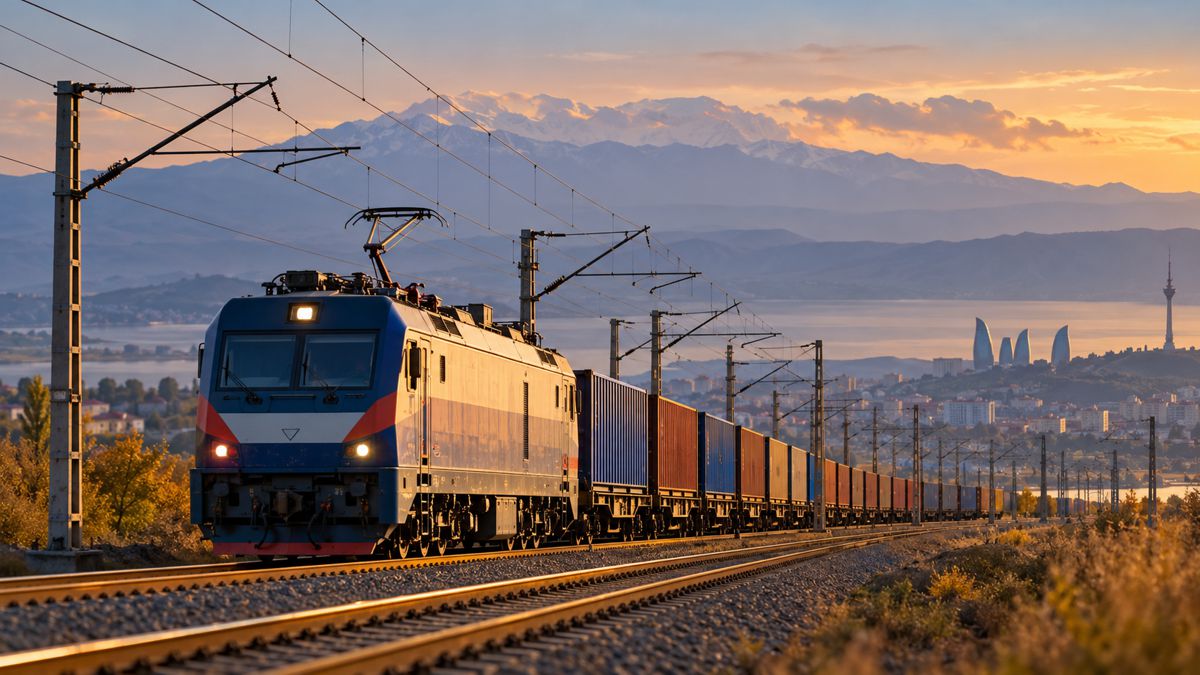
The Bilajari–Yalama railway occupies an important position in Azerbaijan’s transport network. Running north from the Baku area towards the Russian border, it carries domestic services and international freight associated with the western branch of the International North-South Transport Corridor (INSTC).
The corridor is intended to improve freight connections between Russia, Azerbaijan, Iran and markets further south, including India and the Persian Gulf. It forms part of a broader network of railways, roads and maritime services rather than a continuous railway operating under a single technical or regulatory system.
Azerbaijan’s position between these markets has encouraged investment in transport infrastructure and border facilities. The government has also pursued bilateral agreements intended to improve railway coordination, including an agreement with Russia covering the development of transit freight traffic along the North-South corridor.
The Bilajari–Yalama project addresses a section of railway where much of the physical track infrastructure has already been rehabilitated. ADB’s earlier Railway Sector Development Program supported the upgrading of the 166-kilometre Sumgait–Yalama section, alongside measures to improve ADY’s corporate governance, financial management and operational performance.
The new investment turns attention to the systems that support train movements. The published procurement documentation describes a conventional 1,520 mm-gauge railway with 15 stations, where existing electrification, signalling and telecommunications equipment requires replacement. The scope includes design and construction, with an estimated delivery period of 42 months.
Converting to Modern AC Electrification
The conversion from direct current to 25 kV alternating current electrification is one of the largest engineering components of the programme.
High-voltage AC electrification is widely used on modern mainline railways because it allows substantial traction power to be transmitted with comparatively low current. Lower current reduces resistive losses in the electrical supply system and can permit greater distances between traction substations, depending on the design and operating requirements.
These characteristics are particularly useful on freight railways, where heavy trains place considerable demands on traction power. Electrical performance can affect locomotive operation, energy costs and the reliability of services over long distances.
The project will involve new overhead line equipment, supporting structures, substations and associated cabling. These installations must be designed around the railway’s existing track geometry, station layouts and operational requirements, with the electrical protection and control systems coordinated across the route.
Changing the traction power system also raises questions about locomotive compatibility. Equipment designed exclusively for DC operation cannot simply operate under a 25 kV AC supply. The transition will require compatible rolling stock or suitable arrangements for operating between electrical systems, particularly where services continue onto adjoining routes.
The project documentation establishes the intended AC standard, but the final arrangements for locomotive deployment and transitions between electrification systems have not been confirmed in the material reviewed.
ADB expects the conversion to reduce energy consumption, maintenance expenditure and greenhouse gas emissions. The eventual savings will depend on locomotive performance, train movements, the efficiency of the replacement electrical infrastructure and the electricity supply used to power it.
Signalling and Railway Communications
The electrification programme will be accompanied by the replacement of signalling and telecommunications systems along the Bilajari–Yalama route.
On a railway carrying both passenger and freight traffic, signalling determines how trains are separated, routed and authorised to proceed. Modern interlocking, train detection and control equipment can improve operational reliability while allowing railway operators to manage train movements more effectively.
The practical benefits depend on the selected signalling architecture and the operating conditions of the route. Train capacity is influenced by permissible speeds, braking distances, signalling intervals, station layouts and the availability of suitable paths for different types of service.
The telecommunications component will include railway network communications, fibre-optic and wireless systems, and onboard electronic devices. These provide the connections required between trackside equipment, control facilities and trains.
Replacing several interdependent systems on an operating railway is considerably more complicated than installing equipment on a new alignment. Electrical isolation, signalling changeovers, temporary operating arrangements and commissioning must be coordinated with existing services. Testing will also need to establish that the completed installations operate safely together before they enter regular service.
The planned 42-month design-and-build period provides an indication of the project’s scale, although it should not be treated as a confirmed completion date until the contractual programme and commencement arrangements are established.
Legal and Regulatory Framework
The Bilajari–Yalama project will operate within several overlapping legal and regulatory frameworks, covering domestic railway safety, international procurement, environmental protection and cross-border freight movement.
Within Azerbaijan, the replacement electrical and signalling systems must satisfy the applicable national requirements governing railway infrastructure, technical safety and operation. The conversion to 25 kV AC will require appropriate engineering approvals and safety verification before the replacement infrastructure can be commissioned.
Technical compatibility is particularly important on an international railway. Azerbaijan and Russia share the 1,520 mm railway gauge, avoiding the track-gauge changes encountered on some other international corridors. Common gauge does not, however, guarantee compatibility between traction power supplies, signalling equipment or operating procedures.
The new installations will need to support safe operation within Azerbaijan while accommodating the requirements of services travelling beyond the national network. Cross-border arrangements concerning rolling stock, train documentation, operational responsibility and technical acceptance remain relevant regardless of the improvements made to the domestic infrastructure.
Procurement is another significant consideration. ADB’s project documentation specifies that goods, works and services will be procured under the bank’s applicable procurement policy and directives. The principal electrification, signalling and telecommunications works package was advertised through international open competitive bidding using a single-stage, two-envelope procedure.
The bidding documentation also identifies eligibility requirements for participating contractors. International procurement provides access to specialist railway engineering suppliers, while imposing formal requirements concerning tender evaluation, contractual compliance and the administration of publicly financed works.
Environmental and social obligations extend beyond the railway’s existing right of way. ADB’s project records classify the investment as Category B for both environment and involuntary resettlement, and identify a draft initial environmental examination, a land acquisition and resettlement framework, and social due diligence documentation.
These assessments address the potential effects of construction and infrastructure installation, including any land requirements and impacts on affected communities. The existence of a previously established railway does not eliminate the need to assess additional substations, electrical installations, access arrangements or other associated works.
ADB’s environmental and social requirements have also undergone a transition, with a new Environmental and Social Framework taking effect in January 2026 for projects meeting its applicability criteria. The precise framework governing Bilajari–Yalama should therefore be determined from its approved project documentation rather than assumed from the loan approval date.
Cross-Border Trade and Sanctions Compliance
The railway’s connection with Russia introduces a further regulatory dimension, particularly for freight moving between jurisdictions subject to different trade restrictions.
Azerbaijan is not a member of the European Union, and the Bilajari–Yalama investment does not itself establish any new sanctions restrictions. Nevertheless, businesses using the wider North-South corridor may be subject to EU, UK, US or other applicable sanctions and export-control rules, depending on their jurisdiction, the goods involved, the parties to a transaction and the route taken.
European restrictions relating to Russia include controls on certain goods, technologies and services, as well as provisions governing transit and the prevention of sanctions circumvention. The rules distinguish between different categories of cargo and commercial arrangements. Freight passing through Russian territory is not automatically prohibited, but particular movements may be restricted or require additional compliance checks.
For logistics operators and freight customers, this creates a need for reliable documentation of cargo origin, destination, ownership and end use. Financial institutions, insurers and transport providers may also apply their own due diligence procedures when assessing transactions involving sanctioned jurisdictions or designated entities.
These considerations are separate from the railway’s technical modernisation. A faster and more reliable route does not alter the legal status of the goods it carries, while infrastructure investment cannot remove restrictions imposed by another jurisdiction.
The regulatory environment also affects procurement and equipment supply. International contractors involved in railway electrification and signalling must assess the export-control requirements applicable to their equipment, software and technical services, particularly where products incorporate controlled technologies or are subject to restrictions on onward transfer.
For the wider region, the challenge is maintaining commercially useful transport connections while accommodating different national customs systems, technical requirements and international trade obligations.
Azerbaijan has been developing electronic transit procedures and digital freight documentation to reduce administrative delays. Its transport authorities have identified work on electronic consignment notes, permit systems and data exchange as part of the country’s wider logistics programme.
Border infrastructure is also receiving attention. Government monitoring has included improvements at the Yalama railway border checkpoint, alongside work at other customs and transport facilities. These measures complement the railway investment, although their implementation and operational results are separate from the ADB-financed systems programme.
Railway Investment and Regional Freight Economics
The economic case for modernising Bilajari–Yalama rests partly on improving the performance of an existing transport asset rather than constructing a new railway.
Earlier track rehabilitation has addressed much of the physical infrastructure. Replacing the electrical and control systems can allow that investment to deliver better operational results, particularly where ageing equipment contributes to maintenance demands or limits railway performance.
The project also forms part of a wider effort to improve freight transport through Azerbaijan. The country’s transport ministry reported that North-South corridor transit volumes increased during the first seven months of 2026, while East-West corridor traffic also recorded growth.
These figures suggest continued demand for international transport services, although the distribution of traffic between individual railway sections, road routes and other modes is not established by the headline statistics.
For railway operators, commercial performance depends on several factors that infrastructure investment can influence but cannot entirely control. Traction energy costs, locomotive availability, maintenance expenditure and train reliability all affect the economics of moving freight. Border clearance, terminal handling and onward connections determine how consistently those benefits can be delivered across an international route.
The International North-South Transport Corridor also remains dependent on infrastructure and operational arrangements beyond Azerbaijan. The incomplete Rasht–Astara railway connection in Iran is one example of a wider network constraint, although its development is separate from the Bilajari–Yalama project.
Azerbaijan and Russia have established bilateral cooperation arrangements covering the development of transit freight traffic, reflecting their shared interest in improving the corridor’s capacity and operating performance. Such agreements provide a framework for coordination, but the movement of individual consignments remains subject to applicable customs, commercial and regulatory requirements.
Delivery and Institutional Capacity
Alongside the engineering investment, ADB will support improvements to the project management capabilities of Azerbaijan Railways.
Large railway systems contracts place considerable demands on the organisation responsible for delivery. Electrical engineering, signalling, telecommunications, civil works and operational safety must be coordinated across numerous suppliers and technical disciplines. Contract administration and quality assurance become particularly important where new equipment must be integrated with existing infrastructure.
The procurement programme includes specialist project management and construction supervision services, reflecting the technical complexity of the work.
ADB’s previous support for ADY included reforms to corporate governance and financial management. The latest programme continues that institutional development while concentrating on the delivery of new infrastructure.
The project also includes measures intended to expand opportunities for women in technical, supervisory and management positions within the railway organisation. The announcement does not provide detailed employment targets or implementation arrangements.
ADB Country Director for Azerbaijan Sunniya Durrani-Jamal said: “Modernizing Azerbaijan’s railway infrastructure will make the country’s rail transport network more competitive, energy-efficient, and environmentally sustainable,”
She added: “The project will make rail operations safer, more cost-effective, and create stronger regional connectivity.”
The approved financing gives Azerbaijan the opportunity to modernise a railway that has already benefited from substantial track rehabilitation. The next phase will be measured through the reliability of its new electrical and signalling equipment, the performance of train services and the ability to maintain operations during installation.
Beyond the railway itself, the effectiveness of the North-South corridor will continue to depend on coordination between national networks, border authorities and freight operators. Modern infrastructure can reduce delays within Azerbaijan, but international transit remains a shared operational and regulatory undertaking.
Key Industry Questions
- What is the scope of the Bilajari–Yalama railway project? The project covers modernisation of electrification, signalling and telecommunications systems along 192 kilometres of double-track railway between Bilajari and Yalama.
- What electrification system will be installed? The published procurement documentation specifies modernisation to 25 kV AC electrification, replacing the existing DC infrastructure.
- How long will construction take? The main design-and-build procurement documents identify an estimated 42-month period, including design. A confirmed completion date depends on the contractual commencement and delivery programme.
- Will existing locomotives be compatible with the new electrification? Compatibility depends on locomotive specifications. DC-only equipment cannot operate directly from a 25 kV AC supply without appropriate conversion or alternative operating arrangements.
- What environmental requirements apply to the project? ADB records classify the project as Category B for environment and involuntary resettlement, with environmental assessment and land acquisition documentation published as part of project preparation.
- Which procurement rules govern the investment? The project is subject to ADB’s applicable procurement policy and directives, with international competitive bidding specified for the principal systems works.
- Does the project change trade restrictions affecting Russia? No. The railway investment does not modify sanctions or customs requirements. Freight movements remain subject to the laws and restrictions applicable to the goods, parties and jurisdictions involved.
- How does the project support the International North-South Transport Corridor? It modernises a northern railway connection used for freight movements towards Russia, supporting the operational performance of Azerbaijan’s section of the wider corridor.
- What other infrastructure affects the corridor’s performance? Border facilities, freight terminals, connecting railway networks and incomplete sections elsewhere on the route can influence overall transit times and capacity.
- How will the investment affect railway operating costs? ADB expects lower energy consumption and maintenance expenditure, although quantified savings will depend on the completed system and actual operating conditions.
Strategic Takeaways
- Modernising electrification and signalling after track rehabilitation allows Azerbaijan to build on existing railway investment without constructing a new alignment.
- The transition to 25 kV AC introduces rolling stock compatibility and electrical interface requirements that must be resolved during implementation.
- International procurement creates opportunities for specialist railway contractors, with technical qualification and contractual compliance central to delivery.
- Cross-border freight competitiveness depends on customs coordination, commercial documentation and sanctions compliance alongside railway performance.
- Strong project management and commissioning arrangements will be essential to replacing interconnected systems while maintaining railway operations.