Inside Kilmac’s Full-Stack Trimble Investment and What it Signals for Civil Engineering
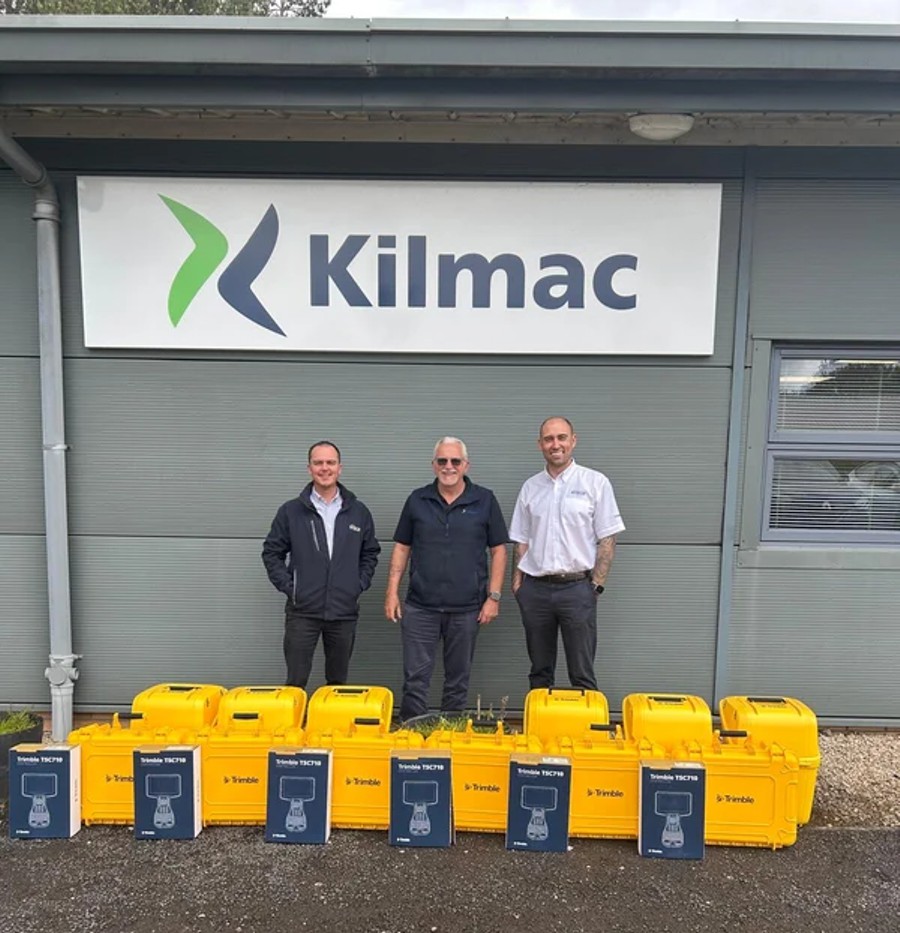
Kilmac Ltd. has taken delivery of six Trimble SPS720 total stations, six Trimble R780 GNSS smart antennas and six Trimble TSC710 data collectors running Trimble Siteworks, supplied through SITECH UK & Ireland. On paper this is a routine equipment transaction by a Dundee-headquartered civil engineering and groundworks contractor.
Read against what is happening in the construction technology market, it is something more interesting: another mid-tier subcontractor closing the last gap between its machines and its office, and in doing so buying into a recurring-revenue model that is quietly reshaping who captures value in earthworks.
The significance lies in the word “complete”. Kilmac already ran Trimble on-machine grade control. Adding off-machine survey hardware, Siteworks in the field, Trimble Business Centre in the design office and Works Manager as the data conduit means the business now operates a single vendor ecosystem from model to blade to as-built record. That is the configuration technology vendors have spent a decade trying to sell, because a contractor running one connected stack behaves very differently as a customer from one running a total station from one supplier, machine control from another and a design package from a third.
The order also lands at a moment when Scottish groundworks contractors are being asked to deliver tighter tolerances on more demanding public sector projects with a workforce the industry cannot readily replace.
Briefing
- SITECH UK & Ireland has delivered six Trimble SPS720 total stations, six Trimble R780 GNSS rovers and six TSC710 data collectors running Trimble Siteworks to Kilmac, completing the contractor’s transition to a full Trimble Civil Construction Technology ecosystem across office, field and machine.
- The investment supports Kilmac’s work on the £76 million Clackmannanshire Wellbeing Hub and Lochies School campus at the Pavilions in Alloa, a Passivhaus-standard project involving large-scale earthworks, surface and foul water drainage, service tracking and landscaping.
- Trimble’s Field Systems segment, which houses civil construction hardware and software, grew both revenue and annualised recurring revenue by 12% in the first quarter of 2026, with the company reporting record ARR of $2.435 billion and targeting $3 billion by 2027.
- Avoidable error costs UK construction between 10% and 25% of project value according to the Get It Right Initiative, with a best estimate of 21%, against average sector margins closer to 3%.
- SITECH UK & Ireland sits within Finning, the Caterpillar dealer for the UK and Ireland, giving a machine distributor a brand-agnostic technology annuity across mixed fleets.
The Commercial Logic Of Selling The Whole Stack
Trimble has spent the past six years converting itself from a positioning hardware business into a software company with a hardware distribution advantage, and the numbers show how far that has travelled. The company closed 2025 with just under $3.6 billion in revenue and annualised recurring revenue of $2.39 billion, up 14% on an organic basis, having grown ARR from $1.3 billion in 2020 through a programme of 23 divestitures and 13 acquisitions.
By the first quarter of 2026, ARR had reached a record $2.435 billion with recurring revenue accounting for 64% of the total, and management has set out targets of $3 billion in ARR and $4 billion in revenue by 2027. Field Systems, the division that contains civil construction, grew revenue and ARR by 12% in the quarter, with the company pointing to infrastructure and data centre demand as the drivers.
That transformation depends on transactions like the Kilmac order rather than on any single large enterprise deal. A contractor that buys a total station buys a depreciating asset; a contractor that adopts Siteworks, Business Centre and Works Manager together enters a subscription relationship with switching costs that compound with every project archived in the system.
Trimble has begun offering Siteworks positioning systems on subscription terms specifically to remove the capital hurdle, which converts a one-off margin into an annuity and lowers the barrier for smaller firms that would otherwise defer the purchase. The company’s own framing of its Connect & Scale strategy, positioning itself as the layer that reconciles the digital model with physical execution, is precisely the value proposition Kilmac has now bought in full.
For contractors, the corresponding question is whether ecosystem lock-in is worth accepting. The honest answer is that the alternative carries its own costs, and they are rarely measured. Mixed-vendor sites generate translation losses at every handover between design, setting out and machine, and those losses surface as coordinate errors, superseded design files on a controller and rework that nobody attributes to software incompatibility. Consolidating on a single stack trades procurement flexibility for a shorter and more auditable data chain, which is a defensible bargain when the work is public sector and the tolerances are unforgiving.
Rework Is Where The Return Actually Sits
Productivity claims in construction technology tend to be framed around speed, but the more durable financial case is error avoidance. Research by the Get It Right Initiative found that the measured direct cost of avoidable error runs at roughly 5% of project value, and that once unrecorded process waste, latent defects and indirect costs are counted the true figure sits between 10% and 25%, with a best estimate of 21% and an annual cost to UK construction of around £21 billion.
Set against average industry margins of roughly 3%, error is not a quality issue at the margin of the business; it is several times the profit line. GIRI’s own root-cause work identified setting out, drainage and concrete works among the categories where error concentrates, which maps almost exactly onto the scope Kilmac performs.
Evidence that this can be moved is now reasonably robust. A GIRI productivity training programme running across Kier, BAM UK and Ireland, VolkerStevin and Taylor Woodrow trained 4,575 delegates across 25 projects over 26 months and identified and avoided £92.6 million of errors, close to 10% of the value of the projects concerned.
Digital setting out attacks the same problem from a different direction, by removing the manual transcription steps where coordinate and level errors are introduced and by making the correct design version the only version available in the field. Works Manager exists chiefly to close that particular loophole, pushing revised models to controllers and machines over the air rather than relying on a site engineer to remember which revision is current.
Bert Hope, Procurement Director at Kilmac Ltd., frames the benefit in delivery terms, noting that working with SITECH has enabled the company “to integrate Trimble technology into all facets of our operation, but to benefit from ongoing training and 24/7 support to ensure we are able to deliver projects on time and within budget.” The reference to training and support is not incidental. Survey-grade hardware is largely commoditised at the sensor level, and the difference between a system that reduces rework and one that sits in a van comes down to competence, calibration discipline and how quickly a fault is resolved when a crew is standing idle.
The Clackmannanshire Project Is A Genuine Test Of Tolerance
The £76 million Wellbeing Hub and Lochies School campus at the Pavilions site in Alloa West is the kind of project that exposes weak groundworks control. Delivered for Clackmannanshire Council through hub East Central Scotland with Robertson Construction Central East as principal contractor, alongside JM Architects, Blyth & Blyth on civil and structural engineering and BakerHicks on mechanical and electrical, the campus combines swimming pools, a games hall, fitness suites, a five-a-side pitch and soft play with a single-storey school for pupils with profound and complex additional support needs.
Council reporting has the scheme on track for completion in autumn 2027, with the steel frame erected, the pool basin structure effectively complete and the car park finished.
What raises the technical stakes is that the campus is being built to Passivhaus standards, among the first large-scale leisure and education facilities in Scotland to do so. Passivhaus performance depends on continuity of insulation and airtightness at the junctions between substructure and superstructure, which places real consequence on slab levels, service penetrations and the accuracy of drainage runs set before the envelope goes up.
Kilmac’s package on the site covers large-scale earthmoving, surface and foul water drainage systems, service tracking works and landscaping, all of it sequenced around a building whose energy model assumes the details were built as drawn. Getting a gully invert wrong on a conventional leisure centre is an inconvenience; getting insulation continuity wrong beneath a Passivhaus school is a certification problem.
The project also illustrates why public clients increasingly care about their subcontractors’ digital maturity. The scheme draws on the Scottish Government and COSLA Learning Estate Investment Programme, is supported by close to £1 million from sportscotland, and is forecast to attract 275,000 visitors a year while generating £2.14 million in annual social value alongside 36 permanent full-time jobs. Investment cases built on those numbers are sensitive to programme slippage, and clients working through the hub model have both the reporting apparatus and the appetite to ask how a groundworks contractor demonstrates that what was built matches what was designed.
Technology As A Response To A Workforce That Is Not Arriving
Scotland’s construction labour position gives the investment a harder edge than a productivity narrative alone would suggest. CITB analysis indicates the Scottish industry needs more than 17,950 additional workers over the next five years simply to replace those it is losing, against a UK requirement averaging around 41,200 extra workers annually between 2026 and 2030. The shortfall is not evenly distributed across trades, and CITB’s occupational forecasting points to particularly strong relative demand for civil engineers, surveyors and construction project managers, which are exactly the roles that carry setting out responsibility on a groundworks package.
Six matched survey kits distributed across a business employing around 180 people is a deliberate ratio. It allows crews on separate sites to work to the same models, procedures and reporting formats without a scarce senior engineer physically attending each one, and it makes engineers interchangeable between sites because the interface does not change.
The TSC710 controller reinforces that logic, running Android 14 with Google Mobile Services certification on a seven-inch touchscreen with a physical keyboard, which lowers the training burden for younger recruits who have never encountered a proprietary field computer and shortens the time before an apprentice can be trusted with a rover.
Liam Payne, Technical Sales Consultant at SITECH UK & Ireland, points to a longer arc of adoption, observing that “SITECH has worked closely with Kilmac for over four years helping to broaden the scope of the company’s technology adoption. This most recent investment completes the company’s transition to a full-suite of Trimble Civil Construction Technology, delivering a fully connected site for maximum productivity.” He adds that “It’s great to see continued investment in connected site technology and digital construction workflows across Scotland, and we look forward to continuing to support the Kilmac team who have been early adopters in much of the technology we now see as essential across the industry.” The phrase worth noting there is “now see as essential”, which marks the point at which connected site technology stops being a differentiator and becomes a condition of entry.
The Dealer Channel Is Quietly Capturing The Margin
The structure behind this deal deserves more attention than it usually gets. SITECH UK & Ireland operates within Finning, the authorised Caterpillar dealer for the UK and Ireland, which acquired the SITECH dealership and runs it as a standalone technology business supplying customers regardless of machine make, type or model. A Caterpillar distributor therefore holds a growing revenue stream that is indifferent to whether the customer’s excavators wear Cat, Volvo, Komatsu or Develon badges, and that revenue arrives as subscriptions, training, professional services, calibration and support contracts rather than as cyclical iron sales.
That hedge matters in a market where machine demand fluctuates with interest rates and public capital budgets while technology attachment rates keep climbing. It also explains why Caterpillar and Trimble extended their Caterpillar Trimble Control Technologies joint venture in October 2024, more than two decades after founding it, with an agreement structured around wider distribution and an interoperable grade control platform open to other technology providers and equipment manufacturers.
Both parties concluded that fighting over a closed ecosystem was worth less than owning the standard across mixed fleets, and the dealer network is the mechanism through which that standard reaches contractors like Kilmac.
For contractors, the practical consequence is that the dealer relationship has become as commercially significant as the vendor relationship. Kilmac’s four-year engagement with SITECH, culminating in a full-stack transition, is the pattern the channel is built to produce: an initial machine control sale, incremental additions, and eventually a customer whose survey data, machine files and project archives all live inside one supported environment.
Contractors negotiating their own path through this should be pricing the support and training component with the same rigour they apply to hardware, because that is where the recurring cost and the recurring value both sit.
What This Means For Procurement And The Subcontractor Tier
Scotland’s public pipeline gives this a commercial horizon. The Scottish Government’s Infrastructure Delivery Pipeline, published in January 2026, sets out more than £11 billion of investment over four years, including £4.1 billion towards 36,000 affordable homes, £1.2 billion for rail fleet and ferry renewal and £700 million for two new prisons, against total Scottish construction output projected at close to £17.5 billion in 2026. Groundworks and civil engineering packages sit at the front of almost every one of those programmes, and the subcontractors who win them will increasingly be selected on evidence of delivery certainty rather than lowest price alone.
Digital capability is becoming part of that evidence. Main contractors operating under framework and hub arrangements are carrying model-based coordination obligations of their own, and a groundworks subcontractor who can accept a federated model, work to it directly and return survey-verified as-built data reduces the principal contractor’s risk in a way that is visible during prequalification.
The corollary is a widening gap within the subcontractor tier, between firms able to fund a connected ecosystem and firms still setting out from paper drawings and rented kit. Subscription pricing narrows that gap somewhat, but it does not close the competence gap, which takes years of training investment to build.
Infrastructure owners have a role here too. Requiring survey-verified digital records at handover, rather than accepting them as a bonus, would convert contractor investment in positioning technology from a discretionary productivity play into a specified deliverable with a price attached. That would reward the firms that have already committed capital and would give asset operators something more useful than a set of drawings when they come to maintain a drainage network twenty years later.
Where Scottish Groundworks Goes From Here
Kilmac’s position is instructive because the company is neither a national tier-one contractor with a dedicated digital construction department nor a small operator experimenting at the edges. Founded in 2004 by Athole McDonald and Richard Kilcullen and now headquartered at Delta House in Dundee’s Technology Park with a workforce of more than 180 across Dundee, Dunfermline and site-based offices, it occupies the band of the market where the majority of Scottish groundworks capacity actually sits. Its track record across Madras College in St Andrews, the Broughty Ferry flood prevention scheme, the University of Edinburgh’s Nucleus building and the James Hutton Institute expansion is the profile of a firm whose clients are largely public bodies and their framework partners.
When that band of the market standardises on connected workflows, the change propagates quickly, because main contractors begin to assume the capability exists and write their coordination procedures accordingly. Two developments are worth watching over the next eighteen months: whether subscription pricing pulls a meaningful number of smaller groundworks firms into the same ecosystem, and whether Scottish public clients start specifying survey-verified digital as-builts as a contractual deliverable.
Both would accelerate the shift already underway, and both would strengthen the commercial case for the contractors who moved first. On the evidence of Trimble’s Field Systems growth and the trajectory of the dealer channel behind it, the market has already decided which direction it is travelling.

Key Industry Questions
- What does a “complete” Trimble ecosystem actually mean in practice for a groundworks contractor? It means design data, field measurement and machine execution all move through one supported environment rather than being translated between systems. In Kilmac’s case, models are prepared in Trimble Business Centre, distributed to controllers and machines through Works Manager, used for setting out and grade checking via Siteworks on TSC710 controllers with R780 GNSS antennas and SPS720 total stations, and fed back as measured data. The practical benefits are version control, consistent coordinate handling and a single audit trail. The practical cost is reduced procurement flexibility and a dependency on one vendor’s roadmap and one dealer’s service performance, which is why support and training terms matter as much as hardware pricing.
- How much of the return on this kind of investment comes from rework reduction rather than speed? Most of it, on the available evidence. The Get It Right Initiative estimates avoidable error at 10% to 25% of project value with a best estimate of 21%, against average UK construction margins near 3%. Even a modest reduction in setting out and drainage errors therefore outweighs incremental gains in survey speed. A GIRI training programme across four major contractors avoided £92.6 million of error across 25 projects, close to 10% of project value, demonstrating that the number is addressable. Digital setting out contributes by eliminating manual transcription and ensuring superseded designs cannot reach the field, which are among the most common and least visible sources of downstream cost.
- Why does Passivhaus certification raise the stakes for groundworks accuracy? Passivhaus performance depends on continuous insulation and airtightness across the junctions where substructure meets superstructure. Slab levels, service penetrations and drainage positions set during the groundworks phase determine whether those junctions can be detailed as designed. Errors that would be absorbed by tolerance on a conventional building can create thermal bridging or force redesign of the envelope, with consequences for certification rather than merely for finish quality. On the Clackmannanshire campus, where insulation is being installed beneath the school and the pool basin structure sits within the same certified envelope, the earthworks and drainage package effectively sets the ceiling on achievable building performance.
- Is Trimble’s move to subscription pricing good or bad for contractors? It is a trade. Subscription terms remove the capital hurdle, which allows smaller contractors to access survey-grade positioning without a large upfront outlay and makes it easier to scale kit up or down with workload. The cost is that technology moves from the balance sheet to overhead, becomes a permanent operating expense and creates dependency on continued payment for continued capability. For firms with steady public sector workloads the arithmetic usually favours subscription. For firms with volatile order books, the fixed monthly commitment carries real risk, and rental arrangements through the dealer may suit project-specific requirements better than a full subscription.
- What does Finning’s ownership of SITECH mean for contractors running mixed fleets? SITECH UK & Ireland operates as a standalone technology business within Finning, the Caterpillar dealer for the UK and Ireland, and supplies Trimble systems across machines of any make. Contractors therefore do not need to run Cat iron to access the technology or the support network. The wider significance is structural: a machine distributor is building a recurring technology revenue stream that is uncorrelated with equipment sales cycles. That gives the dealer commercial reason to invest in training, calibration and response capability, which is generally to the contractor’s advantage, though it also concentrates both machine and technology support in a single supplier relationship.
- How does connected survey technology help with the construction skills shortage? It raises the output of experienced staff rather than replacing them. CITB analysis indicates Scotland needs more than 17,950 additional workers over five years, with particularly strong relative demand for civil engineers, surveyors and project managers. Standardised survey kits and interfaces allow a senior engineer to oversee several sites without attending each daily, make engineers interchangeable between projects and shorten the training period before a junior can work independently. Modern controllers running mainstream operating systems reduce the learning curve further. None of this creates competence on its own, which is why ongoing training arrangements with the dealer form a substantive part of the value.
- Will digital capability become a formal prequalification requirement for groundworks subcontractors? It is already an informal one on framework and hub-procured work. Main contractors carrying model-based coordination obligations prefer subcontractors who can accept federated models directly and return survey-verified data, because it reduces their own delivery risk. Formalising that expectation would depend on public clients specifying digital as-built deliverables in contract rather than treating them as good practice. Scotland’s Infrastructure Delivery Pipeline commits more than £11 billion over four years, and clients managing programmes of that scale have clear incentives to standardise handover data requirements. Contractors anticipating that shift are better positioned than those waiting for it to be mandated.
- What should a contractor evaluate before committing to a single-vendor ecosystem? Total cost over a realistic replacement cycle, including subscriptions, training, calibration and extended warranty, rather than headline hardware price. Dealer response times and the location of service capability matter enormously when a system failure idles a crew. Compatibility with the model formats main contractors and consultants actually issue should be verified rather than assumed. It is also worth assessing internal readiness honestly, since the technology returns very little without engineers who understand control networks and coordinate systems. Finally, contractors should consider how project data will be exported and retained if the vendor relationship ends, because archived as-built records have long-term value beyond the software that produced them.
Strategic Takeaways
- Construction technology value is migrating from hardware margin to recurring software and support revenue, and every full-stack adoption by a mid-tier contractor strengthens that model while raising the cost of switching later.
- Rework, not speed, is where digital setting out pays for itself, with avoidable error running at multiples of typical construction margins and concentrated in exactly the setting out and drainage activities groundworks contractors perform.
- Passivhaus and other performance-certified public buildings transfer real technical risk into the groundworks package, making survey accuracy a certification issue rather than a quality preference.
- The equipment dealer channel has become a strategic control point, with Caterpillar’s UK distributor holding a brand-agnostic technology annuity that is insulated from machine sales cycles and increasingly central to how contractors access capability.
- Digital maturity is emerging as a competitive divider within the subcontractor tier, and public clients could accelerate that shift decisively by specifying survey-verified digital as-builts as contractual deliverables rather than optional extras.