OnRobot Delivers Hands On Automation Strategy for Nevada Manufacturers
Northern Nevada’s manufacturing sector is booming, but beneath the growth lies a structural tension that’s becoming impossible to ignore. As production demand accelerates across industries such as precision machining, electronics, and industrial equipment, the availability of skilled labour simply hasn’t kept pace. Into that widening gap steps automation, no longer a distant ambition but an operational necessity.
OnRobot’s upcoming “Build Your Automation Roadmap” event in Reno is less a promotional showcase and more a timely intervention. Scheduled for April 9th, 2026, the event reflects a broader shift taking place across global manufacturing, where companies are moving quickly from curiosity about robotics to active deployment on the shop floor.
Labour Shortages Are Reshaping Industrial Strategy
Manufacturers in Northern Nevada are facing a tightening labour market that mirrors trends seen across the United States and much of the developed world. With regional unemployment hovering around 4 percent, close to historic lows, the pool of available workers has shrunk to a point where recruitment alone can no longer sustain growth.
This isn’t just anecdotal pressure. Research from the University of Nevada, Reno, commissioned by the Nevada Office of Workforce Innovation, highlights persistent workforce gaps across key sectors including fabricated metal production, CNC machining, and electronics manufacturing. These are not peripheral industries but core pillars of the region’s economic expansion.
The situation reflects a broader structural issue. According to data from the U.S. Bureau of Labor Statistics and industry bodies such as the National Association of Manufacturers, the country could face millions of unfilled manufacturing roles by the end of the decade if current trends continue. Ageing workforces, skills mismatches, and shifting career preferences are all contributing to a labour pipeline that’s struggling to replenish itself.
Automation Is No Longer Optional
Faced with these constraints, manufacturers are increasingly turning to automation not as a long-term investment, but as a near-term survival strategy. Robotics and smart tooling are stepping in to stabilise production, maintain output levels, and reduce reliance on hard-to-fill roles.
Kristian Hulgard, General Manager for the Americas at OnRobot, framed the challenge: “Northern Nevada has become one of the most dynamic manufacturing regions in the country, but that growth is creating real pressure on employers who simply can’t hire fast enough to keep up. Automation isn’t a future consideration for manufacturers here, it’s an immediate operational need. This event is about giving the region’s manufacturers a clear, practical path forward.”
His remarks capture a sentiment that’s becoming increasingly common across the industry. Automation is shifting from being a competitive advantage to a baseline requirement. Companies that fail to adopt risk falling behind not just in productivity, but in their ability to fulfil contracts and maintain operational continuity.
From Concept to Implementation on the Shop Floor
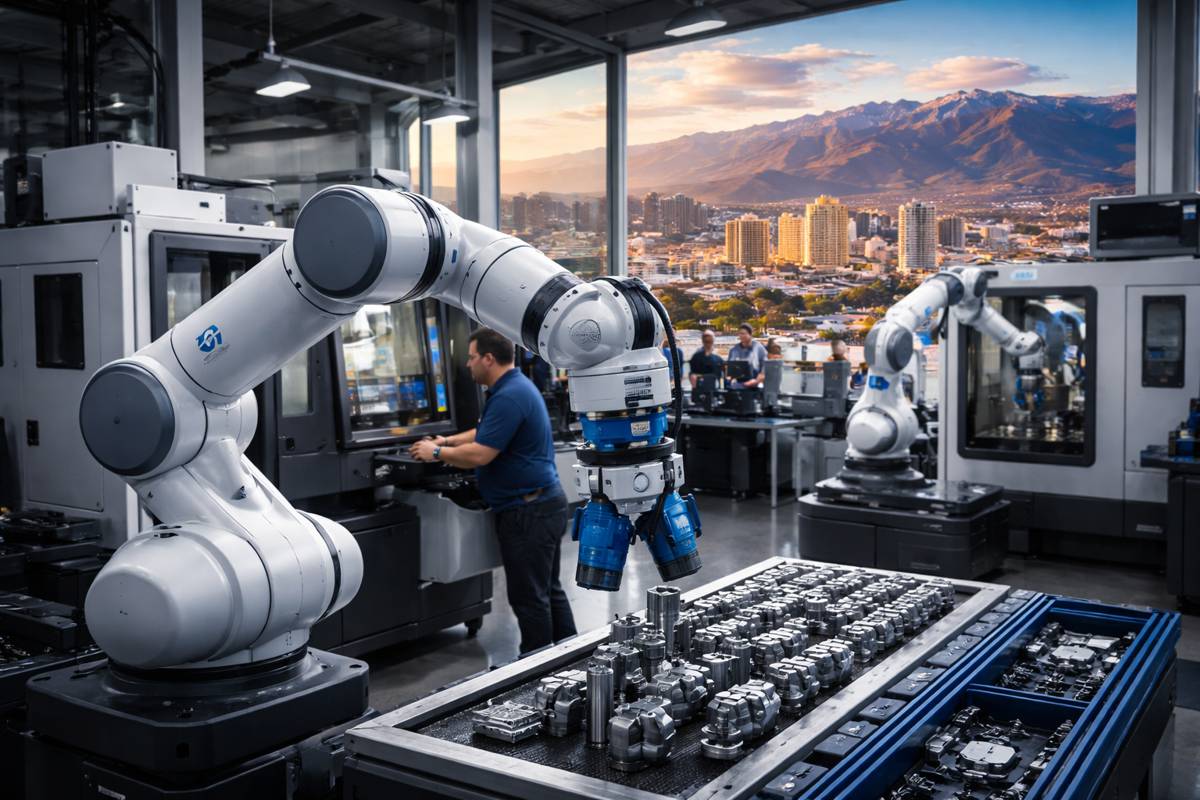
What sets the Reno event apart is its focus on practical deployment rather than abstract discussion. Attendees will see live demonstrations of FANUC industrial robots equipped with end-of-arm tooling designed for real-world manufacturing tasks.
Applications on display include machine tending, material handling, assembly, packaging, and quality inspection. These are not experimental use cases but everyday processes where automation can deliver immediate returns. By focusing on familiar workflows, the event aims to bridge the gap between interest and implementation.
This approach aligns with a wider industry trend. Manufacturers are increasingly prioritising solutions that can be deployed quickly, require minimal programming, and integrate with existing systems. The emphasis has shifted from complex, bespoke robotics projects to modular, off-the-shelf solutions that can be scaled over time.
The Rise of Collaborative and Flexible Automation
A key driver behind this transition is the evolution of collaborative robotics and plug-and-produce tooling. Unlike traditional industrial robots that often require extensive integration and safety infrastructure, newer systems are designed to work alongside human operators and adapt to changing production needs.
OnRobot’s portfolio reflects this shift. Its tooling ecosystem, which includes grippers, sensors, vision systems, and screwdriving solutions, is built around interoperability across multiple robot brands. This reduces integration complexity and allows manufacturers to standardise their automation approach across different production lines.
Equally significant is the emergence of automated deployment platforms such as D:PLOY. These systems aim to remove one of the biggest barriers to adoption: programming expertise. By enabling rapid setup and configuration, they allow manufacturers to deploy automation solutions within hours rather than weeks.
This democratisation of automation is particularly important for small and medium-sized enterprises, which often lack the resources for large-scale engineering projects. By lowering technical and financial barriers, modern automation solutions are expanding access across the manufacturing landscape.
Industry Collaboration and Knowledge Sharing
Beyond the technology itself, the Reno event underscores the importance of collaboration within the automation ecosystem. Alongside OnRobot, companies such as FANUC America and Nevatio Engineering will contribute expertise spanning robotics, integration, and supply chain strategy.
Brian La Plante of FANUC America will lead live demonstrations, offering insights into how manufacturers can approach their automation journey in a structured and achievable way. Meanwhile, Marc Magarin of Nevatio Engineering will focus on the practical realities of sourcing components and maintaining project momentum.
This multi-stakeholder approach reflects the complexity of modern automation projects. Successful implementation often requires coordination between hardware providers, software developers, integrators, and end users. Events like this create a forum where those perspectives can converge, helping manufacturers make informed decisions.
A Regional Story with Global Implications
While the focus is on Northern Nevada, the underlying dynamics are global. Manufacturing hubs across Europe, North America, and parts of Asia are grappling with similar labour constraints and productivity pressures.
In Europe, for instance, Eurostat data points to declining working-age populations in several key industrial economies. In Japan, one of the world’s most advanced manufacturing nations, automation has long been a response to demographic challenges. The United States now finds itself navigating comparable territory, albeit with its own regional variations.
Reno’s experience offers a microcosm of this broader transformation. Rapid industrial growth, driven in part by reshoring trends and supply chain diversification, is colliding with labour market limitations. Automation is emerging as the mechanism that reconciles these forces.
Lowering the Barriers to Entry
Historically, automation has been associated with high capital costs and long implementation timelines. That perception is changing. Advances in modular design, standardised interfaces, and user-friendly software are reducing both the financial and operational hurdles.
Manufacturers can now start small, automating a single process before expanding to other areas. This incremental approach reduces risk and allows companies to build internal expertise over time. It also aligns with the realities of modern production, where flexibility and adaptability are just as important as efficiency.
OnRobot’s emphasis on off-the-shelf solutions and unified platforms is part of this broader shift. By simplifying integration and reducing dependency on specialised programming skills, these systems make automation more accessible to a wider range of businesses.
Building a Workforce for the Future
It would be a mistake to view automation purely as a substitute for labour. In practice, it’s reshaping the nature of work within manufacturing. As repetitive and physically demanding tasks are automated, the demand for technical skills, system oversight, and process optimisation is increasing.
This creates both challenges and opportunities. Workforce development programmes, such as those highlighted in the Nevada study, will play a critical role in ensuring that employees can transition into these new roles. Training in robotics, data analysis, and digital systems will become increasingly important.
At the same time, automation can help make manufacturing careers more attractive by reducing physical strain and improving workplace safety. In that sense, it’s not just about filling gaps, but about redefining what manufacturing work looks like in the years ahead.
A Practical Step Forward for Manufacturers
Events like “Build Your Automation Roadmap” are ultimately about turning strategy into action. By combining live demonstrations, expert insights, and real-world applications, they provide manufacturers with a clearer understanding of what automation can deliver and how to get started.
The timing couldn’t be more relevant. As labour shortages persist and demand continues to rise, the pressure on manufacturers to adapt will only intensify. Those that move decisively stand to gain not just in productivity, but in resilience and long-term competitiveness.
For Northern Nevada, the event represents a practical step towards addressing one of its most pressing industrial challenges. For the wider industry, it serves as another signal that automation is no longer a question of if, but how quickly it can be implemented.