Danjiang Bridge Opens New Gateway to Northern Taiwan
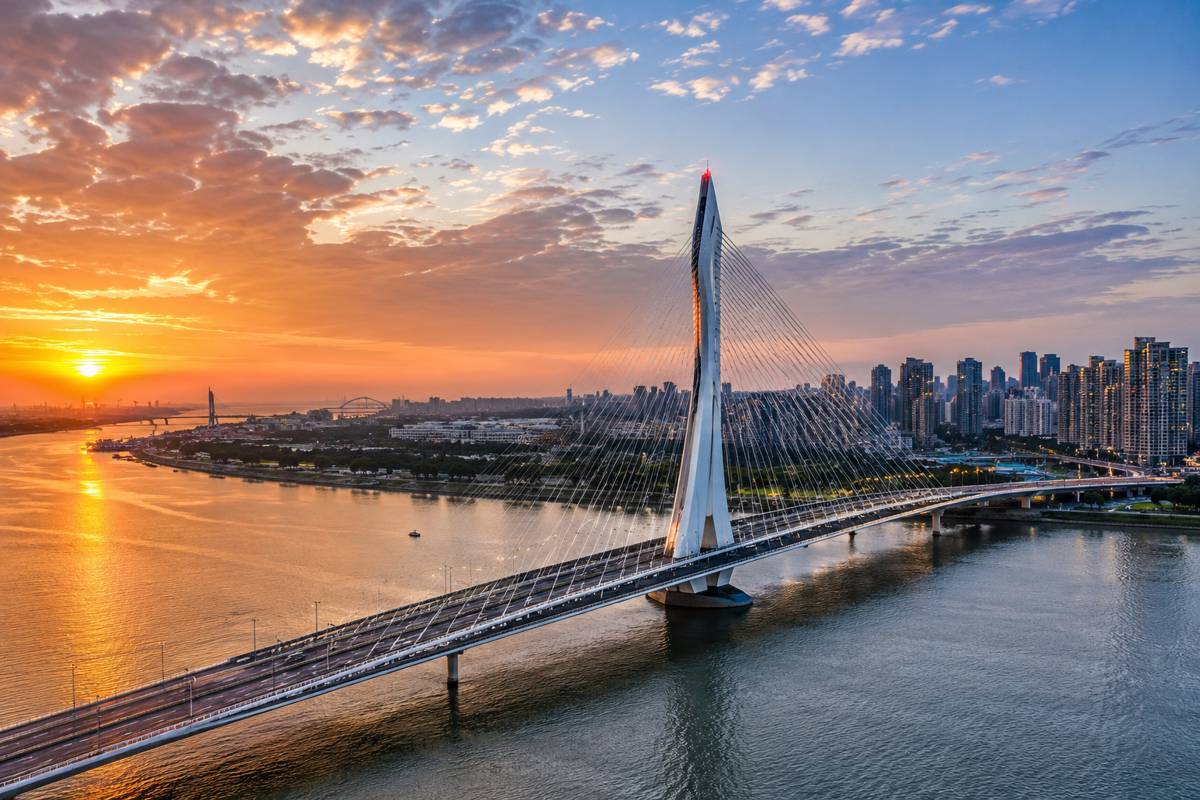
Nearly three decades after it was first proposed, the Danjiang Bridge in northern Taiwan is finally opening to traffic, delivering one of Asia’s most technically ambitious transport projects and creating a striking new landmark across the mouth of the Tamsui River. The bridge officially opens on May 12 following an inauguration ceremony attended by senior political leaders including President Lai Ching-te, Premier Cho Jung-tai and Transportation Minister Chen Shih-kai.
The project arrives at a time when governments across the world are under growing pressure to modernise ageing transport networks while reducing congestion, improving regional mobility and creating infrastructure capable of supporting long-term economic growth. In Taiwan’s case, the Danjiang Bridge is far more than a visually dramatic crossing. It is a strategic transport connection designed to improve movement between New Taipei City, the Port of Taipei and Taiwan Taoyuan International Airport while easing pressure on one of the region’s busiest road corridors.
Stretching nearly one kilometre across the Tamsui River estuary, the bridge has already attracted international attention for its engineering and architectural significance. Designed by the late Zaha Hadid, the structure has been recognised by global architecture and engineering observers as one of the defining infrastructure projects of 2025. Its completion also reflects the persistence required to deliver major infrastructure in densely populated urban regions where environmental reviews, procurement delays and complex construction conditions can derail projects for years.
Briefing
- The Danjiang Bridge officially opens to traffic on May 12 after nearly 30 years of planning and delays
- The structure is the world’s longest single-mast asymmetric cable-stayed bridge
- The crossing will cut travel between Tamsui and Bali by approximately 15 kilometres and save around 25 minutes journey time
- Authorities expect traffic on existing routes, including the Guandu Bridge corridor, to fall by roughly 30 percent
- The bridge was designed by Zaha Hadid and has been recognised internationally as a major architectural and engineering achievement
A Bridge Designed to Solve Real Transport Problems
While much of the international attention has focused on the bridge’s appearance, the real significance lies in its role within Taiwan’s wider transport network. Northern Taiwan has long struggled with congestion around the Guandu Bridge, a vital crossing linking communities along the Tamsui River corridor. Population growth, expanding commuter traffic and increasing airport connectivity demands have steadily intensified pressure on the existing infrastructure.
The Danjiang Bridge forms a key part of the larger Tamsui River crossing and road improvement programme intended to redistribute traffic and improve resilience across the network. Once operational, the new route is expected to significantly reduce journey times between Tamsui and Bali districts, providing a more direct connection for both passenger vehicles and freight traffic moving through the region.
For logistics operators and commercial transport providers, those time savings matter. A reduction of 25 minutes per journey may sound modest in isolation, yet across thousands of daily vehicle movements the cumulative economic impact becomes substantial. Reduced fuel consumption, improved freight reliability and lower congestion costs all contribute to wider productivity gains.
Infrastructure planners worldwide are increasingly focused on this kind of network efficiency. Rather than simply expanding roads, modern transport investment now prioritises strategic bottlenecks where targeted interventions can unlock wider regional benefits. The Danjiang Bridge is a textbook example of that approach in practice.
Engineering at the Edge of the Estuary
Building across the mouth of the Tamsui River was never going to be straightforward. Estuary environments are notoriously difficult for bridge construction due to unstable seabed conditions, tidal influences, corrosion risks and unpredictable wind behaviour. Engineers working on the Danjiang Bridge reportedly faced significant underwater leaks as well as strong winds sweeping through the river mouth during construction.
Those conditions partly explain why the project endured repeated delays and failed tender attempts after it was first proposed in 1998. Large-scale bridge projects frequently encounter escalating technical and financial risks, particularly when the structure itself pushes the boundaries of conventional engineering practice.
The Danjiang Bridge’s defining feature is its asymmetric cable-stayed design supported by a single curved mast. Unlike conventional cable-stayed bridges that often rely on symmetrical towers and balanced cable systems, this configuration required highly precise engineering calculations to manage load distribution and aerodynamic stability.
Single-mast asymmetric bridges remain relatively rare globally because they introduce additional structural complexity. The design demands sophisticated modelling to control torsional forces and vibration behaviour, especially in coastal environments exposed to strong crosswinds. Advances in digital engineering, structural simulation software and high-performance materials have made these projects increasingly achievable over the past decade, though they still require exceptional construction management and specialist expertise.
The completed bridge now holds the distinction of being the world’s longest single-mast asymmetric cable-stayed bridge, placing Taiwan firmly on the global map for advanced bridge engineering.
Zaha Hadid’s Architectural Legacy Lives On
The bridge also represents one of the final realised transport infrastructure projects connected to Zaha Hadid’s design legacy. Known internationally for fluid architectural forms and technically daring structures, Hadid’s influence extended well beyond museums and cultural buildings into transport hubs, airports and infrastructure.
For the Danjiang Bridge, the mast’s sweeping curved form was reportedly inspired by the movements of dancers from Taiwan’s renowned Cloud Gate Dance Theatre. That artistic influence is visible in the bridge’s silhouette, which avoids the rigid industrial appearance commonly associated with large transport structures.
Yet aesthetics alone do not explain why projects like this matter. Increasingly, governments see landmark infrastructure as part of national branding and economic positioning. High-profile bridges, airports and rail stations often become symbols of technological capability and modernisation, attracting investment, tourism and international recognition.
President Lai reflected that sentiment during the inauguration ceremony, stating: “This bridge is Taiwan’s pride. It will become a landmark for Taiwan and another calling card for the country on the international stage.”
He added: “I also hope people across the country can, through the construction of the Danjiang Bridge, feel the respect Taiwan has earned internationally. If we stand united and work together, Taiwan will certainly become even better.”
CNN recently included the Danjiang Bridge among 11 architecture projects expected to shape the world in 2025, further reinforcing the project’s international profile.
The Long Road from Proposal to Completion
Major infrastructure schemes rarely follow smooth timelines, and the Danjiang Bridge proved no exception. Proposed initially in the late 1990s, the project became entangled in environmental assessments, procurement complications and repeated design revisions before construction finally began in 2019.
Such delays are increasingly common worldwide. Environmental scrutiny has intensified substantially over the past two decades, particularly for projects located near sensitive waterways and urban ecosystems. Public opposition, regulatory requirements and rising construction costs frequently extend infrastructure delivery schedules far beyond original expectations.
Taiwan’s experience mirrors challenges seen across Europe, North America and parts of Asia where major transport projects can spend years navigating approval systems before physical construction even begins. While critics often point to these delays as evidence of bureaucratic inefficiency, supporters argue the scrutiny helps produce more sustainable and resilient infrastructure outcomes.
In the Danjiang Bridge’s case, environmental concerns surrounding the Tamsui estuary played a central role in the prolonged review process. Balancing transport expansion with ecological protection remains one of the defining infrastructure challenges of the modern era.
The eventual completion of the bridge therefore represents not only an engineering achievement but also a demonstration of long-term political persistence and institutional commitment.
Asia Continues Expanding Its Infrastructure Leadership
The Danjiang Bridge arrives during a period of sustained infrastructure expansion across Asia, where governments continue investing heavily in transport modernisation despite economic uncertainty and global supply chain pressures.
According to the Asian Development Bank, infrastructure demand across developing Asia and the Pacific exceeds US$1.7 trillion annually, driven by urbanisation, population growth and economic transformation. Transport connectivity remains central to those investments, with bridges, ports, rail systems and highways forming the backbone of regional development strategies.
Taiwan occupies a particularly interesting position within this wider infrastructure landscape. Despite geographic constraints and dense urban development, the island continues investing aggressively in transport resilience, digital infrastructure and advanced engineering capability. Projects like the Danjiang Bridge help reinforce Taiwan’s reputation for technical sophistication and infrastructure quality.
There is also a growing recognition that infrastructure projects increasingly serve multiple purposes simultaneously. They are expected to improve mobility, support economic growth, withstand climate pressures and contribute to national identity. The Danjiang Bridge manages to touch all four objectives in a single project.
Its elegant form may capture the headlines, but the long-term value will ultimately be measured in how effectively it improves daily movement for residents, businesses and freight operators across northern Taiwan.
A New Landmark with Practical Purpose
The global infrastructure sector has no shortage of visually impressive projects. What separates enduring infrastructure from architectural spectacle is whether it solves real-world transport problems while remaining economically useful for decades to come.
Early indications suggest the Danjiang Bridge is positioned to achieve both. It delivers measurable transport efficiency improvements while simultaneously establishing a new architectural identity for the region. That balance is not easy to achieve, particularly on infrastructure projects operating under intense technical, environmental and political scrutiny.
For Taiwan, the bridge represents a statement of engineering capability and long-term infrastructure ambition. For the wider construction and transport sector, it provides another example of how complex urban transport challenges increasingly require multidisciplinary solutions blending engineering, architecture, environmental management and strategic regional planning.
After nearly 30 years of setbacks, redesigns and construction challenges, the Danjiang Bridge is finally ready to carry traffic across the Tamsui River. The wait has been long, but infrastructure capable of reshaping regional mobility often is.