UAE Targets Global Manufacturing Leadership With $49 Billion Push
The United Arab Emirates has unveiled one of the most aggressive industrial expansion strategies currently emerging from the Gulf region, pledging $49 billion in industrial procurement opportunities while accelerating plans to localise more than 5,000 products across strategic sectors. The announcement, delivered during the fifth edition of the Make it in the Emirates forum in Abu Dhabi, signals a decisive shift in how the UAE intends to position itself within the global industrial economy over the coming decade.
Far from being another regional investment showcase, the latest commitments reveal a broader economic transformation taking shape across the Emirates. The UAE is attempting to reduce dependence on imports, deepen domestic manufacturing capability, strengthen industrial resilience and build long-term economic security in sectors tied to chemicals, healthcare, food systems, advanced manufacturing and energy transition technologies. At the same time, the country is using its geographic position, sovereign wealth and energy infrastructure to establish itself as a global industrial gateway connecting Asia, Europe and Africa.
The timing is hardly accidental. Supply chain disruption, geopolitical tension, maritime security concerns and the fragmentation of global trade routes have pushed governments worldwide to rethink industrial policy. From the United States and Europe to India and the Gulf states, nations are increasingly prioritising domestic production capacity in areas once considered comfortably globalised. The UAE’s latest industrial commitments place it firmly within that international race for industrial sovereignty.
Dr. Sultan Al Jaber, UAE Minister of Industry and Advanced Technology, framed the initiative as a response to a changing geopolitical and economic landscape. Speaking at the event, he said: “History remembers the challenges nations face. But it also remembers how nations respond to them and what they build next.”
Briefing
- UAE announced $49 billion in industrial procurement opportunities over the next decade
- More than 5,000 products are targeted for localisation under the industrial sovereignty strategy
- TA’ZIZ unveiled $40.5 billion in agreements to expand UAE chemical production capacity
- A new $270 million National Industrial Resilience Fund aims to create 4,000 jobs
- ADNOC separately revealed $54.4 billion in procurement opportunities and planned projects
Gulf Industrial Policy Enters a New Phase
The Make it in the Emirates initiative has evolved rapidly since its launch, but this year’s announcements demonstrate a far more ambitious scale and urgency. What initially began as an industrial diversification programme has matured into a coordinated national strategy aimed at insulating the UAE economy from external shocks while simultaneously attracting international manufacturers and investors.
The Gulf region has historically relied heavily on imported industrial goods, despite possessing some of the world’s most valuable energy resources. That model is now being recalibrated. Saudi Arabia, Qatar and the UAE are all investing aggressively in downstream industries, advanced manufacturing and industrial technology ecosystems. However, the UAE appears increasingly focused on combining industrial production with global logistics, finance and export capability rather than merely replacing imports.
Dr. Al Jaber directly linked industrial development to national resilience and economic security. “Economic security cannot be imported — it must be built and protected,” he said during the opening session.
The strategy reflects wider global concerns about the fragility of international supply chains exposed during recent years. Pandemic disruption, Red Sea shipping instability, sanctions regimes, semiconductor shortages and energy market volatility have all reinforced the importance of domestic industrial capacity. Governments that once prioritised cost efficiency above all else are now weighing resilience and sovereignty far more heavily.
TA’ZIZ Expands the UAE Chemical Manufacturing Base
Among the most significant announcements was the expansion programme led by TA’ZIZ, the industrial ecosystem and chemicals platform backed by ADNOC and ADQ. The company unveiled $40.5 billion worth of agreements designed to expand the UAE’s domestic chemical production capability, including financing support for the country’s first world-scale methanol production plant.
Methanol is becoming increasingly important across global industrial supply chains. Traditionally used in chemicals and manufacturing, it is now also being explored as a lower-emission marine fuel and hydrogen carrier. Global demand is forecast to rise steadily as shipping, petrochemicals and clean energy sectors seek alternative feedstocks and fuel solutions.
For the UAE, developing domestic methanol capacity strengthens industrial integration across refining, petrochemicals and export manufacturing while reducing reliance on imported chemical intermediates. It also positions the country more competitively in emerging energy transition markets where chemical feedstocks are becoming strategically important.
The scale of TA’ZIZ’s expansion underlines the UAE’s determination to move further downstream within the hydrocarbons value chain rather than relying predominantly on crude exports. Gulf producers increasingly recognise that future economic competitiveness depends not simply on extracting energy resources, but on controlling value-added industrial processing and advanced manufacturing.
Industrial Resilience Fund Targets Import Substitution
The launch of the National Industrial Resilience Fund adds another layer to the UAE’s industrial strategy. Backed by $270 million in funding, the initiative aims to stimulate domestic production capability while supporting local manufacturers in replacing imported products currently sourced internationally.
Officials estimate the programme could ultimately substitute industrial imports worth up to $24.5 billion, with annual reductions estimated at roughly $820 million. The fund is also expected to generate around 4,000 industrial jobs as manufacturing capacity expands.
Import substitution strategies have re-emerged globally as governments attempt to reduce vulnerability to external market shocks. While such policies historically carried mixed economic results, modern industrial strategies differ substantially from the protectionist models of previous decades. Today’s programmes often focus on strategic sectors tied to national security, healthcare, semiconductors, food systems and advanced manufacturing rather than broad-based import replacement.
The UAE’s approach appears designed to combine targeted localisation with continued openness to international investment and export markets. Rather than isolating the economy, the strategy aims to embed foreign manufacturers within the Emirates through partnerships, local production incentives and integrated supply chains.
Maritime Security and the Strait of Hormuz Remain Central Concerns
Dr. Al Jaber also addressed the geopolitical realities shaping global trade and industrial investment decisions. Referencing maritime instability and regional tensions, he warned of the economic consequences associated with disruption to the Strait of Hormuz, one of the world’s most critical energy shipping corridors.
“When a vital artery such as the Strait of Hormuz is closed, it does not only affect one region – it affects the entire global economy,” he said.
He added: “Freedom of international navigation is non-negotiable and cannot be compromised.”
The remarks highlight how closely industrial strategy and geopolitical security have become intertwined. Manufacturing competitiveness now depends not only on labour costs or tax policy, but also on secure logistics corridors, stable energy supply and resilient transport infrastructure.
The UAE continues to position itself as a relatively stable logistics and industrial hub within an increasingly uncertain global environment. Its ports, airports, free zones and transport infrastructure remain among the most advanced in the Middle East, giving the country a strategic advantage in attracting manufacturers seeking access to regional and international markets.
ADNOC Procurement Strategy Drives Industrial Growth
The announcements also build upon ADNOC’s growing role as an industrial catalyst within the UAE economy. Just one day before the Make it in the Emirates event, ADNOC unveiled $54.4 billion in procurement opportunities and planned projects linked to its industrial expansion programme.
The state energy giant has increasingly become a central driver of domestic manufacturing growth through its In-Country Value programme, which encourages suppliers to establish production and services within the UAE rather than relying on imports. This policy has accelerated local capability development across engineering, fabrication, chemicals, equipment manufacturing and industrial services.
Energy companies globally are playing a larger role in industrial diversification as governments seek to leverage existing energy infrastructure and capital to stimulate broader manufacturing ecosystems. In the Gulf region particularly, national oil companies are no longer simply energy producers. They are increasingly functioning as industrial development engines and strategic investors.
That shift is helping create substantial opportunities for international construction firms, industrial contractors, engineering consultancies, automation providers and logistics operators. Large-scale chemical plants, advanced manufacturing facilities and industrial parks all require major infrastructure investment, creating ripple effects throughout the construction and industrial technology sectors.
UAE Signals Confidence Beyond Oil Dependence
Dr. Al Jaber also addressed the UAE’s recent departure from OPEC and OPEC+, describing the decision as a long-term economic strategy rather than a political manoeuvre.
“It is not directed against anyone,” he said, adding that the move “gives us greater ability to accelerate investment, expand, and create value.”
The comments reinforce the UAE’s broader ambition to balance its traditional hydrocarbons strength with industrial diversification and advanced manufacturing growth. While oil and gas remain foundational to the country’s economy, the leadership is clearly attempting to position the Emirates for a more diversified industrial future.
Recent figures shared during the forum suggest the strategy is already gaining momentum. Dr. Al Jaber stated that the UAE industrial sector’s contribution has reached $54.5 billion, representing a 70 per cent increase since 2021. Industrial exports reportedly climbed to $71.4 billion, including $25.1 billion in advanced industrial exports.
Those numbers reflect substantial growth in sectors beyond raw hydrocarbons, including chemicals, metals, advanced manufacturing and industrial technologies. The UAE is increasingly competing not only as an energy producer, but as a manufacturing and industrial services platform.
Building an Industrial Hub for Three Continents
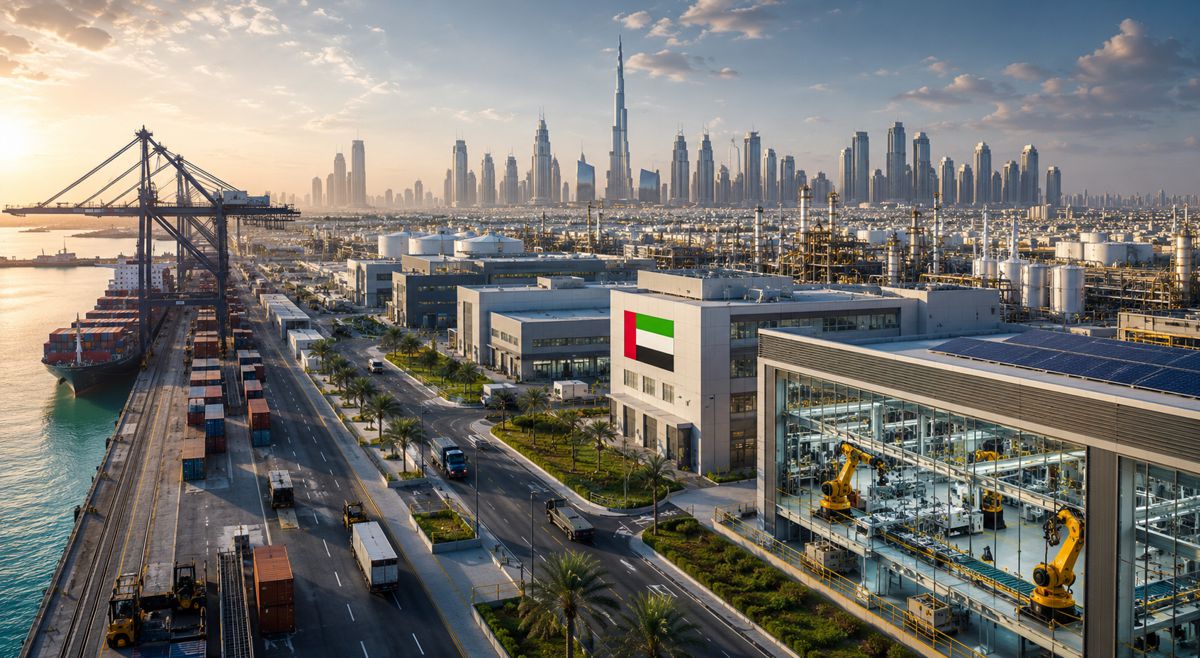
One of the UAE’s strongest advantages remains its geographic position. Sitting between Europe, Asia and Africa, the Emirates has spent decades building logistics infrastructure capable of supporting global trade flows. Ports such as Jebel Ali already serve as critical gateways for regional commerce, while free zones continue attracting multinational manufacturers and logistics operators.
Dr. Al Jaber emphasised these advantages while addressing international investors during the forum, highlighting the UAE’s regulatory flexibility, transport connectivity and access to global markets.
The industrial expansion strategy is therefore about far more than domestic consumption. The UAE aims to become a production and export base capable of supplying international markets across multiple sectors, particularly as manufacturers seek alternatives to increasingly fragmented global supply chains.
Construction firms, industrial technology providers and infrastructure investors are likely to watch developments closely. Industrial diversification at this scale requires substantial capital deployment across transport, utilities, industrial facilities, automation systems and logistics networks. The resulting pipeline of projects could reshape parts of the Gulf construction and industrial landscape over the next decade.
UAE Manufacturing Ambitions Accelerate
The announcements made during Make it in the Emirates reveal a country moving decisively beyond traditional resource dependency and deeper into industrial strategy, manufacturing resilience and global supply chain positioning. While hydrocarbons continue to underpin the UAE economy, the focus is shifting steadily toward what those resources can enable rather than merely what they can export.
For the global construction and infrastructure sectors, the implications extend well beyond the Gulf itself. Large-scale industrial localisation programmes generate demand for engineering expertise, industrial facilities, logistics infrastructure, automation technology and advanced construction capability. They also reinforce a wider global trend where industrial resilience, strategic manufacturing and economic sovereignty are becoming central government priorities.
The UAE is betting heavily that the future industrial economy will favour nations capable of combining energy security, advanced logistics, flexible regulation and domestic production capability. Judging by the scale of investment now flowing into the sector, Abu Dhabi appears determined to ensure the Emirates sits firmly within that future.