JCB DualDrive Repositions Groundworks Productivity
Backhoe loaders have long been the Swiss Army knife of the construction industry. They dig trenches, shift material, load trucks and tackle utility work with a versatility few machines can rival. Yet even in a sector increasingly obsessed with electrification, automation and digital workflows, one stubborn issue continues to drain time and money from construction sites across the world: machine repositioning.
That seemingly minor interruption between digging cycles often adds up to hours of lost productivity over the course of a project. Operators stop work, rotate seats, retract stabilisers, manoeuvre the machine and reset before resuming excavation. On congested urban projects or large-scale groundworks operations, those repeated pauses quietly chip away at margins, programme schedules and operator efficiency.
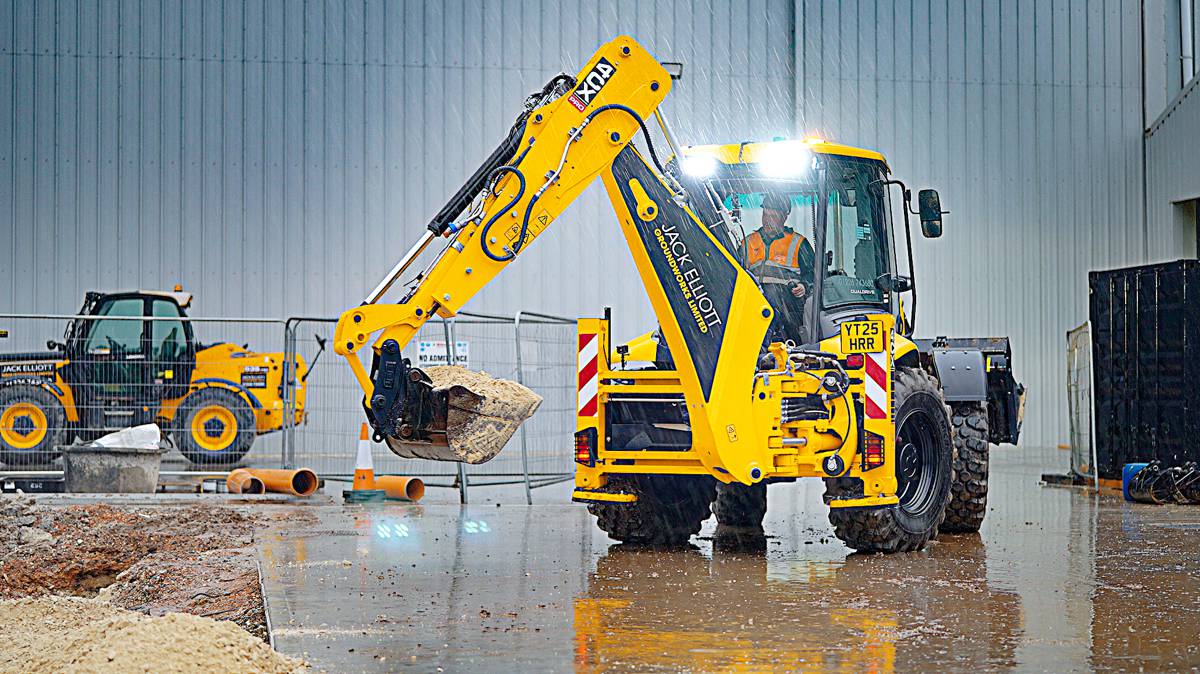
That’s precisely where the latest generation of JCB’s DualDrive technology is finding traction among contractors. In South Yorkshire, Barnsley-based contractor Jack Elliott Groundworks Ltd says its new JCB 4CX Pro DualDrive backhoe loader is dramatically reducing task times while easing operator fatigue on busy projects. The machine, supplied through JCB dealer TC Harrison, is now being used across a wide variety of groundworks activities, from ditching operations to rapid repositioning on larger infrastructure and commercial developments.
The significance extends beyond one contractor or one machine model. Across the global construction industry, firms are increasingly scrutinising operational inefficiencies that traditionally went unquestioned. Labour shortages, rising project costs and tighter delivery schedules are forcing contractors to seek productivity gains wherever they can find them. Incremental improvements in machine operation are now translating directly into commercial advantage.
Briefing
- JCB’s 4CX Pro DualDrive is helping contractors reduce repositioning times during excavation and groundworks operations
- Barnsley contractor Jack Elliott Groundworks Ltd reports major productivity improvements and reduced operator fatigue
- DualDrive enables simultaneous machine movements, cutting downtime between digging cycles
- The technology reflects growing industry demand for smarter operator-focused equipment design
- Backhoe loaders continue to play a critical role in utility, roadbuilding and infrastructure projects worldwide
Repositioning Time Becomes a Major Cost Factor
On paper, repositioning a backhoe loader might appear trivial. In reality, the repeated process can become one of the largest hidden drains on operational efficiency. Traditional backhoe operation requires the driver to rotate the seat, raise stabilisers, shift the machine and reconfigure the controls before restarting excavation.
Multiply that by dozens or even hundreds of repositioning movements per day and the productivity losses become substantial. On projects involving trenching, drainage installation, roadside utility works or housing developments, machine movement can account for a surprisingly large percentage of operational downtime.
Contractors are now measuring those inefficiencies more closely than ever. Global construction inflation, combined with persistent labour shortages across Europe and North America, has pushed site managers to focus on operational optimisation rather than simply adding more labour or equipment.
The challenge is especially acute in the groundworks sector, where projects are often won on tight margins and programme certainty. Delays of even a few hours can create knock-on effects across subcontractors, materials deliveries and follow-on trades.
For contractors operating fleets of versatile machines like backhoe loaders, reducing non-productive movement is increasingly viewed as low-hanging fruit.
JCB Refines a Classic Machine for Modern Construction
JCB has occupied a dominant position in the global backhoe loader market for decades. The company famously invented the backhoe loader concept in 1953 and has continued evolving the platform ever since. While excavators have taken over some traditional backhoe applications in recent years, the machine remains hugely important in utility work, highways maintenance, municipal operations and smaller infrastructure projects.
The 4CX Pro DualDrive represents part of JCB’s attempt to modernise the backhoe’s role on contemporary construction sites. The system allows operators to drive the machine while remaining facing the excavator controls, eliminating the need to rotate seating positions during repositioning.
That may sound like a modest engineering adjustment, but operationally it changes the rhythm of excavation work entirely. Instead of stopping operations between digging cycles, operators can perform multiple movements simultaneously.
Jack Elliott, Director of Jack Elliott Groundworks Ltd, explained how the system has altered site operations: “JCB DualDrive adds value on site in a number of ways. Certainly less fatigue for the operator and a reduction in the amount of time required to do a set task. Repositioning now can be done in a matter of seconds, whereas before you’d be lifting your bucket, spinning your seat around, lifting your stabilisers, driving forward. Now all this operation can be done simultaneously, with 2 or 3 actions happening at the same.
“DualDrive certainly makes the job easier and faster. It has made a great machine even better, bringing time savings, greater comfort and efficiencies across our business. We won’t get another backhoe loader without it.”
Those comments reflect a broader trend emerging across equipment purchasing decisions. Contractors are increasingly prioritising operator ergonomics and workflow efficiency alongside traditional concerns like fuel consumption and lifting capability.
Operator Fatigue Moves Centre Stage
Construction has historically lagged behind sectors like aviation and logistics when it comes to ergonomics and human-factor engineering. That is gradually changing as workforce shortages intensify and experienced operators become harder to recruit and retain.
Operator fatigue is now recognised as a serious productivity and safety issue. Long hours spent repeatedly rotating seats, repositioning controls and carrying out repetitive machine movements can contribute to physical strain and reduced concentration levels over time.
Studies from organisations including the European Agency for Safety and Health at Work have repeatedly highlighted the impact of repetitive movement and poor ergonomics on musculoskeletal injuries within the construction sector. Machine manufacturers are responding with redesigned cabins, improved suspension systems, joystick controls and simplified workflows.
DualDrive fits directly into that evolution. By allowing operators to remain in a more natural working position during repositioning, the system reduces unnecessary physical movement throughout the working day.
The benefits are not purely physical. Mental fatigue also plays a major role in excavation work, particularly on utility projects where operators must constantly monitor buried services, pedestrians, traffic management systems and nearby workers.
Reducing operational complexity can help maintain concentration levels while improving overall site safety.
Groundworks Sector Faces Mounting Pressure
The UK groundworks market has experienced significant change over the last five years. Rising material costs, tighter environmental regulations and increasing pressure on housing delivery have forced contractors to become leaner and more efficient.
Groundworks specialists now operate in an environment where productivity improvements can determine profitability. Machine utilisation rates, fuel consumption and labour efficiency are all under growing scrutiny.
Jack Elliott Groundworks Ltd reflects the trajectory of many successful regional contractors. Established in 2007 with a single JCB mini excavator, the company has expanded steadily and now operates a fleet of 12 JCB machines across South Yorkshire.
That growth mirrors wider consolidation trends within the UK construction supply chain. Contractors capable of investing in newer, more efficient equipment are often better positioned to secure larger infrastructure and commercial contracts.
Equipment choice has therefore become increasingly strategic. Machines are no longer viewed simply as tools but as productivity assets capable of influencing project delivery performance.
Backhoe Loaders Continue to Defy Predictions
Despite repeated predictions of their decline, backhoe loaders continue to maintain a strong position in many construction markets. Their versatility remains difficult to replace, particularly for contractors handling varied work scopes across multiple sites.
Unlike dedicated excavators or wheel loaders, backhoes can transition rapidly between digging, loading and material handling tasks without requiring additional transport or support equipment.
That flexibility remains especially valuable in urban environments, municipal works and smaller infrastructure projects where site access and equipment budgets may be constrained.
Globally, the backhoe loader market continues to hold substantial value. Industry analysts from firms such as Fortune Business Insights and MarketsandMarkets continue to forecast stable long-term demand, particularly in developing infrastructure markets across Asia, Africa and Latin America.
Utility upgrades, road expansion projects and water infrastructure improvements all continue to support demand for versatile equipment platforms.
Manufacturers are therefore focusing less on replacing the backhoe concept and more on refining its efficiency through smarter hydraulics, operator-assistance systems and improved mobility.
Smart Productivity Gains Matter More Than Ever
The construction equipment industry is entering a period where evolutionary improvements may prove more commercially important than headline-grabbing breakthroughs.
While autonomous machinery and fully electric fleets dominate conference discussions, many contractors remain focused on practical productivity gains that can deliver immediate financial returns.
Reducing cycle times by seconds rather than minutes may sound marginal, yet over months of operation those savings accumulate significantly. Faster repositioning reduces idle time, improves machine utilisation and helps operators complete tasks more efficiently.
For fleet owners, the implications stretch further. Greater productivity can potentially reduce fleet size requirements, lower fuel usage and minimise project delays.
Those efficiencies matter enormously as contractors navigate volatile economic conditions, persistent inflationary pressures and rising wage costs.
Technology that simplifies machine operation without introducing unnecessary complexity is likely to gain the strongest foothold in the market.
A Familiar Machine Evolves with the Industry
Construction equipment rarely changes overnight. Most innovation arrives gradually through refinements that improve safety, comfort and productivity over time. JCB’s DualDrive system reflects that reality.
Rather than reinventing the backhoe loader, the company has focused on eliminating operational friction from a proven machine platform. For contractors like Jack Elliott Groundworks Ltd, that practical approach appears to be delivering measurable results on site.
The wider industry is paying attention. As infrastructure projects become more demanding and labour markets remain constrained, contractors are increasingly seeking equipment that helps operators work smarter rather than simply harder.
Backhoe loaders may be among the oldest machine concepts still widely used in construction, but their continued evolution suggests they remain far from obsolete. If anything, smarter operator-focused systems could help secure their relevance for years to come.