Rio Tinto Celebrates 60 Years and 8 Billion Tonnes of Pilbara Iron Ore Exports
For six decades, the iron ore fields of Western Australia’s Pilbara region have quietly helped shape the modern world. From the steel skeletons of megacities to bridges, railways, ports, data centres and renewable energy infrastructure, the region’s vast reserves have underpinned industrial growth across Asia and beyond.
Now, mining giant Rio Tinto has reached another landmark in that long industrial story, shipping its eight billionth tonne of iron ore from the Pilbara to global markets.
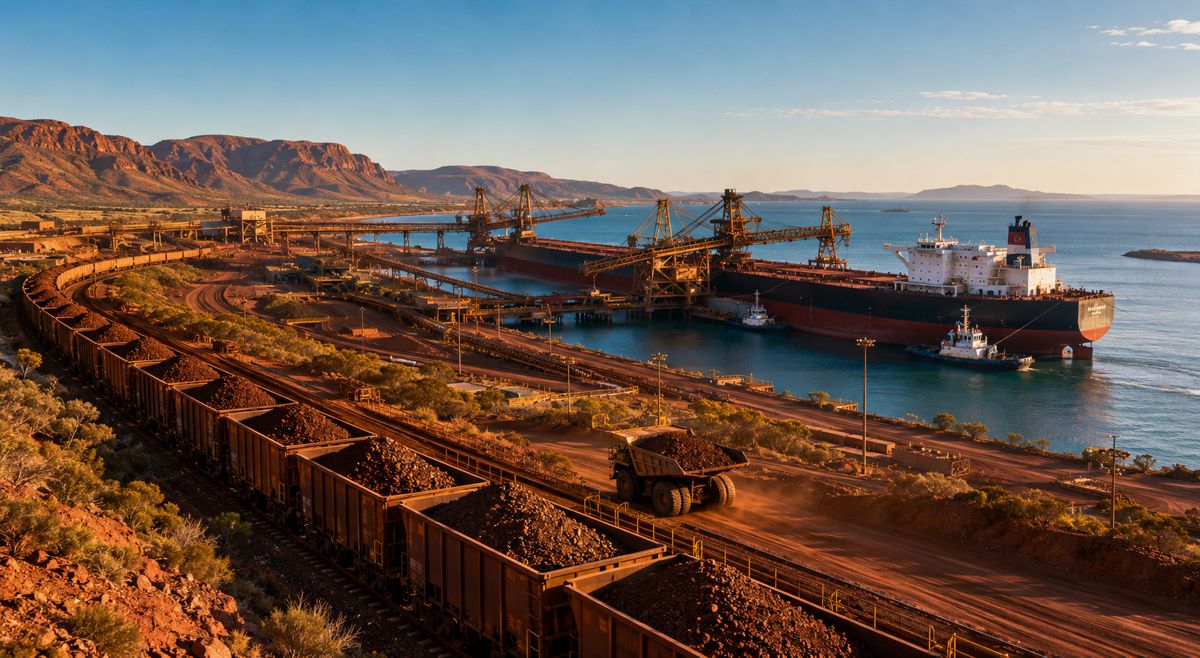
The milestone cargo departed Cape Lambert aboard the Juno Horizon on 19 May 2026, bound for longstanding customer Nippon Steel Corporation in Japan. While the shipment itself represents another vessel leaving one of the world’s busiest bulk export terminals, the symbolism stretches far beyond a single cargo movement. The achievement reflects 60 years of uninterrupted iron ore production, rail logistics, port expansion and industrial partnership between Australia and Asia.
Rio Tinto’s first Pilbara shipment sailed to Japan in August 1966, helping establish one of the defining resource partnerships of the post-war industrial era. Since then, the Pilbara has evolved into one of the most sophisticated mining and logistics ecosystems on Earth, supplying steelmakers that have fuelled urbanisation across Japan, China, South Korea, India and Southeast Asia. What began as a frontier mining venture has become critical infrastructure supporting the global economy.
The latest milestone also arrives during a period of profound change for the mining sector itself. Iron ore remains central to construction and manufacturing worldwide, yet miners now face mounting pressure to decarbonise operations, improve social accountability and secure future supply for increasingly complex industrial demand. Rio Tinto’s latest announcement therefore speaks not only to historic production volumes, but also to the future direction of global steelmaking and infrastructure development.
Briefing
- Rio Tinto has shipped its eight billionth tonne of iron ore from Western Australia’s Pilbara region.
- The milestone cargo departed Cape Lambert aboard the Juno Horizon bound for Nippon Steel in Japan.
- The achievement marks 60 years since Rio Tinto’s first Pilbara shipment in 1966.
- Rio Tinto continues advancing the massive Rhodes Ridge development to secure long-term Pilbara output.
- Pilbara iron ore remains central to global infrastructure, manufacturing and energy transition projects.
The Pilbara’s Role in Building Modern Economies
The Pilbara is far more than a mining district. Over the past half-century it has evolved into one of the world’s most important industrial supply regions, supporting everything from skyscraper construction in Asia to automotive manufacturing, shipbuilding and renewable energy infrastructure.
Stretching across a vast and remote section of Western Australia, the region contains some of the planet’s richest iron ore reserves. Rio Tinto, alongside competitors such as BHP and Fortescue, helped transform the Pilbara into a globally significant export powerhouse supported by privately operated railways, autonomous mining fleets and deepwater bulk ports capable of handling enormous Capesize vessels.
The scale is difficult to comprehend. According to Rio Tinto, eight billion tonnes of Pilbara iron ore could produce enough steel for more than 161,000 Perth Optus Stadiums, 134,000 Tokyo Skytrees or over 46,000 Beijing National Stadiums.
Yet the true significance lies less in symbolic comparisons and more in economic dependency. Australia remains the world’s largest iron ore exporter, with the Pilbara accounting for the overwhelming majority of national shipments. According to Geoscience Australia and the Australian Bureau of Statistics, iron ore exports continue to represent one of the country’s largest sources of export revenue, supporting thousands of jobs, regional development programmes and national infrastructure investment.
Japan’s Enduring Strategic Partnership
The destination of the eight billionth tonne shipment carries considerable historical weight. Japan was Rio Tinto’s first international customer when Pilbara exports commenced in 1966, and the relationship remains strategically important today.
Post-war Japan required enormous quantities of imported raw materials to fuel reconstruction and industrial expansion. Australian iron ore became a cornerstone of that transformation, helping Japanese steelmakers build the manufacturing capability that later positioned the country as a global industrial leader.
The partnership between Rio Tinto and Nippon Steel has therefore lasted through multiple industrial eras, from post-war rebuilding to modern high-tech manufacturing. Even as China became the dominant force in global steel demand during the early 2000s commodity boom, Japanese customers retained a critical role in maintaining long-term supply stability.
Rio Tinto Iron Ore Chief Executive Matthew Holcz acknowledged the significance of that relationship, stating: “Japan was Rio Tinto’s first customer for iron ore exports, and that partnership remains a cornerstone of our business today. As global steel demand increases, we’ll continue to invest in our Pilbara operations and local communities for decades to come.”
The statement reflects a broader reality within global resource markets. Long-term industrial partnerships are increasingly valued in an era marked by geopolitical uncertainty, supply chain fragmentation and growing concerns over critical material security.
Mining Infrastructure on a Continental Scale
One reason the Pilbara remains globally competitive lies in its extraordinary logistics infrastructure. Rio Tinto’s integrated mining system includes mines, heavy haul railways, ports, processing facilities and autonomous operational technologies working together across enormous distances.
The company operates one of the world’s largest privately owned rail networks, transporting iron ore from inland mines to export terminals at Dampier, Cape Lambert and other coastal facilities. Automation has become increasingly important, with autonomous haul trucks, drilling systems and advanced remote operations centres helping improve efficiency and safety.
Cape Lambert itself has become one of the world’s most important bulk export terminals. The port handles vast quantities of iron ore every year, connecting Australian resources directly to steel mills across Asia.
This industrial scale has also reshaped regional communities. Rio Tinto says its Pilbara operations have supported the development of towns including Karratha, Wickham, Tom Price, Paraburdoo, Pannawonica and Dampier. The company also supports additional communities through regional fly-in fly-out operations extending from the Kimberley to the Great Southern region.
Resource development in remote regions often creates complicated social and environmental dynamics, however. Housing affordability, workforce pressures, Indigenous heritage management and environmental sustainability remain ongoing challenges throughout the Pilbara.
Indigenous Partnerships and Social Expectations
Mining companies operating in Australia now face far greater scrutiny over Indigenous engagement and heritage protection than they did during earlier decades of Pilbara development.
The industry continues to grapple with the consequences of heritage destruction incidents, most notably the Juukan Gorge disaster in 2020, which significantly damaged Rio Tinto’s reputation globally and triggered leadership changes within the company.
Rio Tinto’s latest milestone announcement places visible emphasis on Traditional Owner partnerships. Holcz stated: “We are also grateful to the Traditional Owners groups across the Pilbara for their ongoing partnership, and for the knowledge, guidance and stewardship they continue to share with us.”
While such statements have become standard within the sector, investor expectations around ESG performance have changed substantially. Mining companies are increasingly judged not only by production volumes and profitability, but also by their relationships with Indigenous communities, environmental stewardship and operational transparency.
Institutional investors, sovereign wealth funds and global steel customers are all placing greater emphasis on responsible sourcing frameworks. For major miners, maintaining social licence has become inseparable from long-term operational stability.
Rhodes Ridge Signals the Next Chapter
Although the eight billion tonne milestone celebrates the past, Rio Tinto is simultaneously focused on securing future production capacity.
The company is advancing studies at Rhodes Ridge, a major undeveloped iron ore deposit in the Pilbara in which Rio Tinto holds a 50% interest. According to the company, the site has potential long-term production capacity of around 100 million tonnes annually.
Rhodes Ridge is considered one of the world’s largest undeveloped high-quality iron ore deposits. Development of the project could prove essential in helping Rio Tinto maintain its medium-term Pilbara production target of between 345 and 360 million tonnes per annum.
This future pipeline matters because the global iron ore market is entering a more complicated period. China’s property slowdown has affected steel demand growth, while many established Pilbara mines face gradual ore depletion over time. At the same moment, steelmakers are demanding higher-grade iron ore products capable of supporting lower-carbon steel production.
High-grade ore can help reduce emissions intensity during steelmaking by improving blast furnace efficiency and lowering coking coal consumption. As decarbonisation pressures increase, premium iron ore assets may become strategically more valuable.
Iron Ore’s Changing Place in the Energy Transition
Iron ore remains deeply connected to the global energy transition, despite increasing focus on electrification and renewable technologies.
Wind turbines, transmission towers, rail systems, ports, battery factories and large-scale renewable infrastructure all require enormous quantities of steel. The International Energy Agency has repeatedly highlighted the importance of steel and critical minerals in enabling the global shift toward low-carbon infrastructure systems.
At the same time, steelmaking itself remains one of the world’s largest industrial sources of carbon emissions. That creates a paradox for miners and steel producers alike. Demand for steel is likely to remain strong, particularly across emerging economies, but the methods used to produce it must evolve rapidly.
Rio Tinto has increasingly invested in research partnerships related to low-carbon steelmaking technologies, including direct reduced iron pathways and alternative processing methods. The long-term competitiveness of Pilbara iron ore may depend partly on how effectively it integrates into cleaner industrial production systems.
Global infrastructure spending also continues to support underlying demand. Large transport corridors, urbanisation projects, industrial reshoring initiatives and energy network upgrades across Asia, the Middle East and parts of Africa all require substantial steel consumption.
A Resource Legacy Still Expanding
Few industrial supply chains have influenced modern development as profoundly as Pilbara iron ore exports. Over 60 years, Rio Tinto’s operations have helped support urban growth, industrialisation and infrastructure expansion across multiple continents.
The shipment of eight billion tonnes is therefore not merely a mining milestone. It reflects the emergence of Australia as a strategic resource superpower and highlights how deeply interconnected global infrastructure systems have become.
Yet the next chapter will likely look very different from the previous one. Automation, decarbonisation, Indigenous engagement, geopolitical competition and supply chain resilience are reshaping expectations across the mining industry.
Pilbara iron ore still sits at the centre of global industrial development, but future success may depend less on sheer export volume and more on how responsibly, efficiently and sustainably those tonnes are produced.
As the Juno Horizon heads toward Japan carrying Rio Tinto’s latest milestone shipment, the voyage also serves as a reminder that the infrastructure shaping the future still begins with raw materials extracted from some of the world’s most remote landscapes.