The Construction Technology Being Engineered for Earth and Beyond
For most of the past half century, construction has been the industry that innovation seemed to forget. While manufacturing, logistics and communications were rebuilt around automation, sensors and software, the business of moving earth and pouring foundations changed remarkably little. That reputation is now being challenged from two directions at once, and the capital markets have started to pay attention.
In Austin, a company barely two years old and founded by former SpaceX engineers has closed one of the largest early-stage rounds the construction technology sector has seen. In a materials laboratory a few states away, researchers have quietly brought building samples back from orbit that returned stronger than when they left.
The thread connecting these developments is a proposition that would have sounded fanciful a decade ago. It holds that the robotics, control systems and materials science being built to make construction faster and cheaper on Earth are the same tools that will eventually raise landing pads, roads and habitats on the Moon and Mars. For construction professionals, infrastructure owners and investors, the near-term significance has little to do with space and a great deal to do with what that ambition is pulling into the present. Money, engineering talent and research attention are flowing towards an industry that has spent decades starved of all three, and the timing coincides with acute demand for housing, energy infrastructure and industrial capacity across the United States and beyond.
Taken together, the two stories describe an industry beginning to think of itself differently. Construction is being reframed as a frontier discipline rather than a mature and static one, and the organisations pursuing that reframing are attracting the kind of backers and researchers who normally gravitate to aerospace and advanced manufacturing. The question for the wider sector is no longer whether such ideas are credible, but how quickly the productivity gains they promise can reach real job sites.
Briefing
- TerraFirma has raised approximately $115 million, including a $100 million Series A led by Kleiner Perkins, to scale a platform that retrofits standard heavy equipment into remotely operated, semi-autonomous machines.
- The company says a single skilled operator can run several machines from screens, making each operator up to 300% more effective, and it plans to hire around 300 people while building a Texas factory and a mission control centre.
- United States construction labour productivity has fallen at roughly 0.6% a year since 1965 while the wider economy grew at about 1.6%, a gap economists link directly to housing shortages and deferred infrastructure.
- University of Delaware geopolymers made from simulated lunar and Martian regolith survived 201 days mounted outside the International Space Station on NASA’s MISSE-20 mission, with several samples measuring stronger than identical batches kept on Earth.
- Both efforts rest on the same wager, that construction technology proven on Earth becomes the foundation for building off-world, an arena already drawing NASA, ICON and competing national space programmes.
A Fifty-Year Problem That Finally Has a Price Tag
The commercial logic behind the current wave of investment starts with a number that has troubled economists for years. According to Goldman Sachs Research, labour productivity in United States construction has fallen at an average pace of around 0.6% a year since 1965, at the same time as productivity across the wider economy climbed at roughly 1.6% annually. The consequences compound quietly across decades.
A 2022 analysis cited by the Federal Reserve Bank of Richmond concluded that the construction sector alone accounted for about a third of the decline in trend gross domestic product growth since the Second World War, a loss equivalent to roughly one trillion dollars every five years. Few industries carry a drag on national prosperity of that scale, and fewer still have tolerated it for so long.
The reasons are structural rather than accidental. Goldman Sachs attributes much of the underperformance to tightening land-use regulation, limited innovation and measurement issues, noting that most of the major machines used on site today had already been invented by the 1950s. McKinsey has warned separately that, on current trajectories, global construction output could fall short of demand by around forty trillion dollars cumulatively by 2040, with a skilled-labour shortage compounding the problem as an experienced generation of workers approaches retirement.
In the United States alone, construction job vacancies nearly doubled between 2017 and 2023. This is the context that makes a construction technology company an attractive destination for venture capital, because the gap between what the sector delivers and what it could deliver has rarely been wider or better quantified.
TerraFirma’s founders frame the situation in similar terms, though with a builder’s optimism rather than an economist’s caution.
“Construction is the foundation everything else is built on, and it’s been going backward for fifty years,” said Noah Schochet, the company’s chief executive and co-founder. “America built the transcontinental railroad, the interstate highway system, and the Hoover Dam. There’s no reason we can’t build at that scale again, and there’s no first-principles reason construction can’t become 10x faster, cheaper, and safer. TerraFirma exists to help America build again and then take that capacity into the cosmos.” The ambition is deliberately large, but the underlying diagnosis is one that mainstream research now broadly supports.
A $115 Million Bet on Rebuilding How America Builds
The headline development is financial. TerraFirma has raised approximately $115 million, anchored by a $100 million Series A led by Kleiner Perkins, with participation from Bain Capital Ventures, Glade Brook Capital Partners, BANNER VC, Saga Ventures, Trust Ventures, Definition, PEAK6, Magnetar Capital and Ravelin Capital. The angel roster reads like a directory of hard-technology operators, drawing founders, executives and engineers from SpaceX, Anduril, Base Power, Shinkei and Hadrian. For a company founded only in 2024, a syndicate of that calibre signals conviction that goes beyond a single product, and it places construction robotics firmly within the same investment thesis that has funded defence, energy and advanced manufacturing startups over the past few years.
The capital is earmarked for building capacity rather than simply extending a runway. TerraFirma intends to expand its engineering, manufacturing, operations and construction teams, and has told reporters it plans to hire in the region of 300 people over the coming year while standing up a factory in Texas and a dedicated mission control centre. Roughly half of its engineering team has previously worked at SpaceX, Tesla or the Boring Company, which shapes both its culture and its appetite for building hardware and software together.
Josh Coyne, a partner at Kleiner Perkins, tied the raise explicitly to demonstrated traction rather than promise alone. “TerraFirma is succeeding at real-world scale, proving the business model works, and securing government and commercial contracts. This is clearly where the industry is headed,” he said.
That traction is grounded in ordinary work rather than showcase projects. Recent commercial jobs include site preparation, excavation and grading for a new Starbucks in North Austin, a sports arena in Spicewood and a power substation in New Braunfels supporting electricity delivery to homes. The company is also working with the United States government on infrastructure and logistics projects in demanding international environments, a strand of work that broadens its addressable market well beyond private developers.
Schochet has argued that the opportunity is fundamentally about unblocking everything else, telling CNBC in an interview around the raise that infrastructure is a bottleneck to almost every industry that needs to innovate over the coming decades. For infrastructure owners watching from the sidelines, the practical takeaway is that a well-capitalised new entrant is now competing for the same earthworks and site-preparation contracts that established firms have long treated as routine.
Keeping the Operator in Command
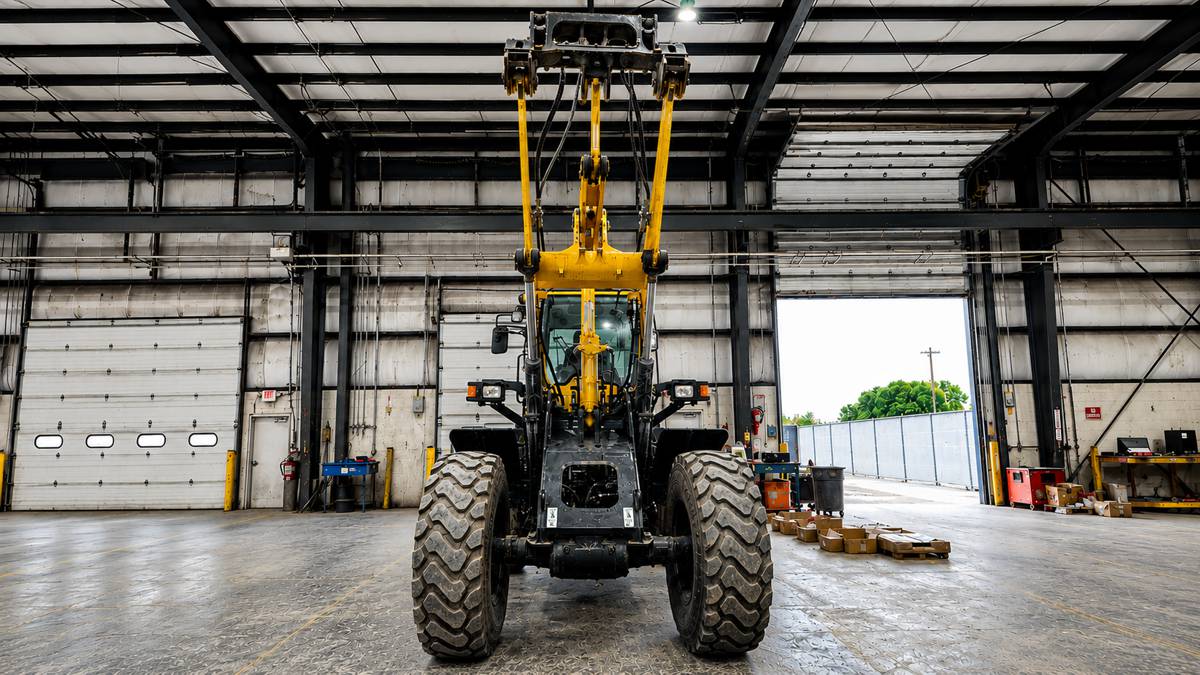
What TerraFirma is selling is not a single machine but a full-stack approach to how sites are run. The platform combines AI-enabled pre-construction software, a remote command-and-control centre and retrofitted heavy machinery, converting excavators, dozers, loaders, rollers, skid steers and other standard equipment into semi-autonomous robots that no longer need an operator in the cab. Crucially, the company has chosen to keep skilled operators at the centre of the system rather than design them out of it.
From screens, and in some cases familiar interfaces such as games controllers, a single operator can orchestrate several machines at once, applying years of hard-won judgement across a fleet instead of a single vehicle. TerraFirma says this can make each operator up to 300% more effective, while turning cab-bound roles into safer, higher-paying jobs conducted at a distance from the hazards of an active site.
The emphasis on augmentation rather than replacement is a deliberate strategic choice, and one that helps with adoption in an industry wary of losing skilled labour.
“It is not about trying to fully automate construction equipment,” said Noah McGuinness, the company’s chief technology officer. “Making construction truly faster and cheaper requires innovating on operations and technology together across the full stack. We believe autonomy is a part of the solution, but driving real change requires building a whole ecosystem of technology that is directly informed by rapid iteration and lessons from the field.” That philosophy carries an implicit critique of pure-software or full-autonomy approaches, arguing instead that operations and hardware must evolve in step with each other, tested continually on live projects.
TerraFirma is not entering an empty field. Established equipment makers including Caterpillar and John Deere have invested heavily in their own autonomy and remote-operation programmes, and the broader market for connected machinery is expanding quickly. What distinguishes the newcomer is its decision to operate as a vertically integrated contractor that builds and uses its own robotics and software in the field, keeping tight feedback between the technology and the job. Whether that model scales as cleanly as a lighter, licence-based approach remains an open commercial question, but it gives the company an unusually direct line of sight into how its systems perform under real conditions.
The Materials Problem Nobody Can Ship Around
Robotics solves only half of the construction equation. The other half is what those machines actually place, and this is where the second story becomes essential to the first. On Earth, materials can be trucked in from a supplier as needed. Beyond it, there are no supply yards, and lifting cement or aggregate off the planet is prohibitively expensive, which makes local materials not a preference but a necessity.
Researchers at the University of Delaware have spent years pursuing a practical answer that lies quite literally underfoot, in the lunar and Martian dust known as regolith. “Regolith is essentially a clay-like silicate material,” said Norman Wagner, the Unidel Robert L. Pigford Chair in Chemical Engineering. “It is one of the most abundant materials on both Earth and the moon, which makes it interesting for construction.”
Wagner’s laboratory develops geopolymers, a cement alternative that binds clays into a strong solid through chemical reactions rather than the high-temperature, energy-intensive processing conventional cement requires. The aim is to produce usable construction material from regolith with minimal additives, an approach that has clear implications for sustainable building on Earth as well as off it, given cement’s substantial carbon footprint.
To test whether such materials could survive beyond the laboratory, the team sent thin plates made from commercially available simulated lunar and Martian regolith to the International Space Station as part of NASA’s MISSE-20 mission. The samples were mounted outside the station for 201 days, during which they circled the Earth 3,216 times, travelled more than 82 million miles and endured temperature swings and a cumulative ultraviolet dose that would degrade many terrestrial materials.
The results, published in Advances in Space Research, were encouraging in a way that surprised even the researchers. The geopolymers did not deteriorate, and in several cases came back measuring stronger than identical samples kept on Earth for the same period. To put that durability in engineering terms, independent reporting of the study noted that a forty-metre landing pad just over a centimetre thick would require only around fifteen cubic metres of material, and that the stresses expected on a vertical take-off and landing pad sit well below the strengths the samples demonstrated.
Wagner has stressed that laboratory confidence is no substitute for orbital testing, observing in coverage of the work that materials cannot be fully understood until they are actually exposed to the hostile conditions of space. For an industry contemplating construction where failure carries extreme consequences, that empirical grounding matters as much as the headline result.
Teaching Machines to Read the Regolith
A material that performs well in one batch is of limited use if it cannot be reproduced reliably from whatever soil happens to be underfoot, and lunar clays are not uniform. To address that variability, Wagner’s team turned to machine learning in a separate study published in Acta Astronautica. The researchers built a model that predicts how strong a finished geopolymer will be based on the characteristics of the starting regolith and the way it is processed, effectively giving future builders a way to anticipate performance before committing material to a structure. On a distant surface where a failed pour cannot simply be redone, that kind of predictive assurance is not a convenience but a prerequisite for trusting on-site manufacturing at all.
Complementary work from the same laboratory, appearing in a special issue of the Journal of Rheology devoted to material behaviour beyond Earth, examined how these mixtures behave while being handled before they set. The team identified a critical gel point, the moment at which the material shifts from a workable slurry into a solidifying structure. Mixing or shearing the material before that transition did not affect how long it took to harden or how strong it finally became, which suggests engineers have real flexibility in how they pump, shape and process it without compromising quality.
That finding dovetails neatly with the robotics story, because flexible, forgiving materials are precisely what automated and semi-autonomous placement systems need. A construction stack that pairs machines capable of running with minimal human intervention with materials that tolerate imperfect handling is one that could operate on Earth with fewer people, and eventually off Earth with almost none.
An Industry Forming Around Off-World Infrastructure
Neither company is working in isolation, and the wider picture is of an ecosystem taking shape around the idea of building off-world. NASA has spent several years advancing in-situ resource utilisation, the practice of manufacturing what a mission needs from local materials, through programmes such as the Moon to Mars Planetary Autonomous Construction Technology project managed at Marshall Space Flight Center.
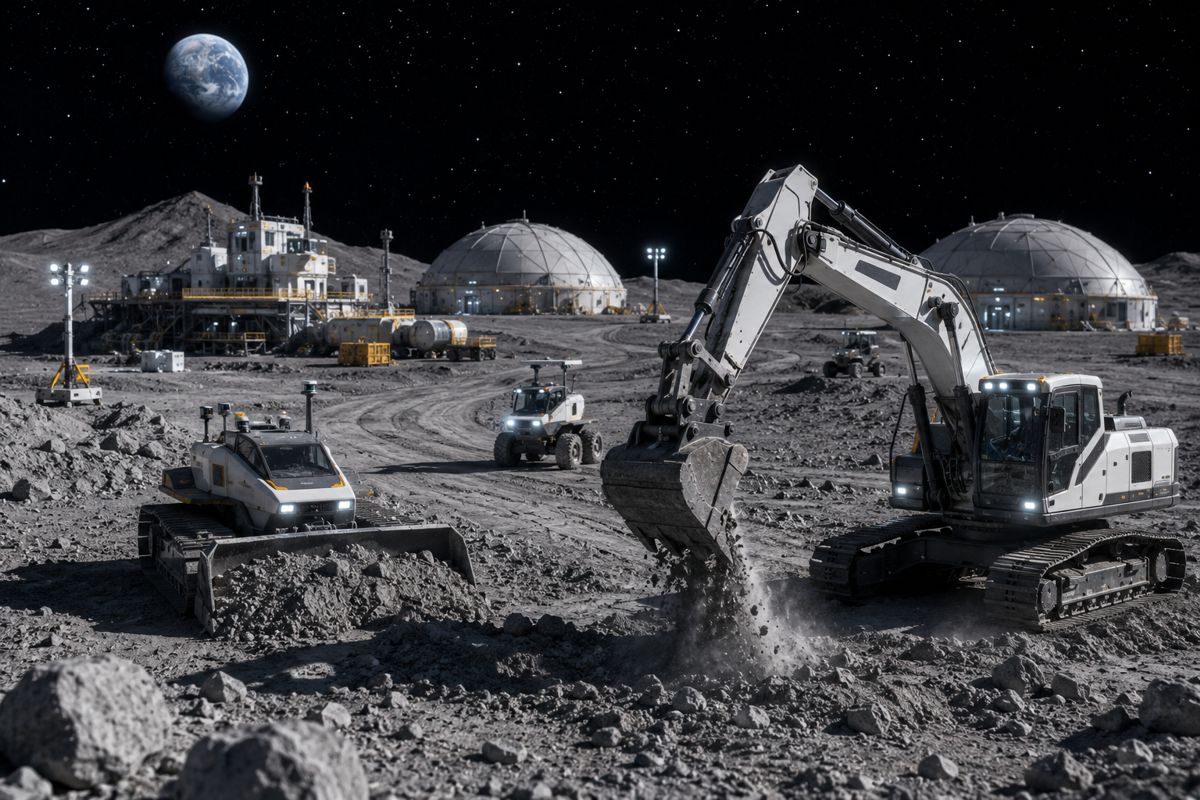
Fellow Austin company ICON, whose lunar construction work Highways.Today has tracked since 2022, is developing a system that uses lasers to fuse regolith into ceramic-like structures for landing pads, roads and habitats. The agency’s Artemis programme is targeting the lunar south pole, where permanently shadowed regions are thought to hold water ice, and a permanent presence there will require exactly the kind of radiation-shielded, locally built infrastructure that geopolymers and autonomous construction are intended to provide.
The strategic dimension has grown sharper as the field has matured. China’s International Lunar Research Station has emerged as an alternative framework to the United States-led Artemis Accords, drawing its own group of partner nations and creating a competitive dynamic reminiscent of the original space race.
Terrestrial construction capability now starts to look like a strategic asset rather than a purely commercial one, since the nation or bloc that can build reliably off-world will hold a meaningful advantage in any sustained lunar economy. For investors, the appeal of companies like TerraFirma is partly that they earn revenue today on Earth while retaining exposure to that longer arc. Schochet has been candid that the sequencing matters, framing the space ambition as something to be built on the economic drivers that already move the world rather than on a lunar economy that does not yet exist.
The Ground Beneath the Next Fifty Years
Stripped of its more cosmic framing, what these two developments share is a refusal to accept that construction must stay slow, dangerous and stubbornly resistant to improvement. In the near term the payoff is entirely terrestrial. Faster site work, fleets run by fewer and better-paid operators from safer positions, and materials that demand less energy to produce all address problems the sector faces on every project, from housing estates to substations to industrial plants.
If even part of the fifty-year productivity decline can be reversed, the effect on housing affordability, infrastructure delivery and national output would dwarf anything happening beyond the atmosphere. The commercial case stands on its own before space enters the conversation at all.
The longer horizon is where ambition and engineering meet. A robotics stack that keeps skilled operators in command, paired with materials science that turns whatever lies underfoot into dependable structure, is a combination that travels.
TerraFirma’s leadership has said as much, with Schochet arguing that “the technology that we are building today to solve critical challenges here on Earth will be highly reusable to solve those same challenges on the Moon and Mars.”
Whether the first off-world landing pad is poured this decade or considerably later, the more immediate story is that serious capital, serious research and serious talent have concluded construction is worth rebuilding from first principles. For an industry long overlooked by innovation, that shift in attention may prove the most consequential development of all.
Key Industry Questions
- How does TerraFirma’s approach differ from fully automating a construction site? TerraFirma deliberately keeps skilled operators in charge rather than removing them. Instead of replacing human judgement with algorithms, it retrofits standard machines so that one operator can supervise several remotely from screens or familiar controllers. The company argues that full autonomy alone cannot deliver the gains the sector needs, and that operations and technology have to evolve together, tested continually on live projects. Practically, this means the workforce is redeployed rather than displaced, with cab-bound roles becoming remote positions that the company says are safer and better paid. The model also eases adoption in an industry protective of experienced labour, because it frames technology as a multiplier of skilled operators rather than a threat to them.
- Why has construction productivity fallen for so long, and can technology actually reverse it? Economists point to structural causes rather than a single failure. Goldman Sachs Research links much of the decline to tightening land-use regulation, limited innovation and measurement difficulties, noting that most core construction machinery predates 1960. The result is a fall of roughly 0.6% a year in United States construction labour productivity since 1965, against growth of about 1.6% in the wider economy. Technology can help, but only if paired with changes to how work is organised on site. Automation, predictive software and modern materials address the innovation gap directly, though regulation and workforce shortages remain outside any single company’s control. The consensus is that reversal is possible but requires sustained investment rather than a one-off intervention.
- How does operating heavy equipment remotely improve safety and pay? Removing the operator from the cab separates the worker from the most hazardous parts of a site, including unstable ground, dust, vibration and the risk of rollover or collision. Operators instead work from a screen-based station, often in a controlled environment, which reduces physical exposure and fatigue. Because one operator can then oversee multiple machines, their output rises substantially, and companies argue this justifies higher wages for a more skilled, supervisory role. The shift also widens the potential labour pool, since remote operation is less physically demanding than traditional equipment work. The net effect is a job that looks closer to fleet management than manual operation, with safety and productivity improving together rather than in tension.
- What are geopolymers, and why are they favoured over conventional cement for lunar construction? Geopolymers are a cement alternative that binds clay-like materials into a solid through chemical reactions rather than the high-temperature manufacturing that ordinary cement requires. That distinction matters on the Moon, where energy is scarce and heavy processing equipment is impractical to transport. Because regolith is a silicate material abundant on both the Moon and Mars, geopolymers can in principle be produced almost entirely from local resources with minimal additives. The same properties make them attractive on Earth, where avoiding energy-intensive cement production would cut carbon emissions from one of the built environment’s largest sources. In short, they promise usable structural material with far less energy and imported mass than conventional concrete.
- What did the MISSE-20 results prove, and what are the limits? The experiment showed that geopolymers made from simulated lunar and Martian regolith could survive 201 days of direct space exposure outside the International Space Station without degrading, and in several cases came back stronger than Earth-bound controls. That is meaningful evidence that the material’s chemistry holds up under vacuum, radiation and extreme temperature cycling. The limits are equally important. The tests used simulants rather than genuine regolith, took place in low-Earth orbit rather than on a planetary surface, and involved small plates rather than full structures. Real lunar dust, lower gravity and manufacturing at scale all remain to be validated. The findings are a strong proof of concept rather than a finished construction method.
- Why does building successfully on Earth matter to companies with off-world ambitions? Revenue and iteration are the practical reasons. Earning income from terrestrial projects funds development without relying on a space economy that does not yet exist, and every real job provides data that improves the technology. Building on Earth also lets companies refine robotics, software and materials under demanding but recoverable conditions, so that failures are learning opportunities rather than mission-ending events. Strategically, the same stack that raises a substation or a car park is intended to raise a landing pad later, which means terrestrial contracts double as a testbed for off-world capability. The sequencing keeps ambition grounded in commercial reality while preserving exposure to a much larger long-term opportunity.
- Who else is competing in off-world construction, and where does this leave established manufacturers? The field already includes NASA’s in-situ resource programmes, Austin-based ICON with its laser-based regolith fusion system, and national efforts such as China’s International Lunar Research Station. On Earth, established manufacturers including Caterpillar and John Deere have their own autonomy and remote-operation programmes, giving them scale, dealer networks and installed bases that startups lack. The likely outcome is not winner-takes-all but a layered market, with incumbents supplying machines and platforms while specialist entrants push vertical integration and off-world applications. For established players, the arrival of well-funded newcomers is a signal to accelerate rather than a threat to dismiss, since the underlying demand for productivity gains benefits every serious participant.
- What should investors and infrastructure owners take from a $115 million construction-technology round? A round of this size, led by a tier-one venture firm, signals that construction technology is now viewed through the same lens as defence, energy and advanced manufacturing, where hardware and software are built together. For investors, it validates a thesis that the sector’s long productivity decline represents a large, quantifiable opportunity rather than an intractable problem. For infrastructure owners, it means a new class of well-capitalised contractor is entering the market for earthworks and site preparation, potentially reshaping cost and delivery expectations. The prudent response is to watch how quickly these systems demonstrate reliability at scale, since capital validates ambition but only field performance validates the business.
Strategic Takeaways
- Construction technology has entered the same investment tier as defence and advanced manufacturing, and a $115 million round led by a tier-one firm suggests the sector’s productivity gap is now treated as a large addressable opportunity rather than a permanent condition.
- The most commercially durable model pairs automation with skilled human operators rather than replacing them, easing adoption in a labour-protective industry and positioning remote operation as a route to safer, higher-value jobs rather than headcount reduction.
- Materials innovation and robotics are converging, and construction stacks that combine forgiving, low-energy materials with semi-autonomous placement will deliver value on Earth first, with off-world capability as an extension of the same core technology.
- Geopolymers point towards a lower-carbon alternative to conventional cement, giving the research a near-term terrestrial payoff in sustainable construction that stands independently of any lunar application.
- Off-world construction is becoming a strategic as well as commercial arena, with NASA, ICON and competing national programmes forming an ecosystem in which terrestrial building capability increasingly reads as a national asset worth monitoring for future procurement and investment.