Bio-Based Chemistry Recycling Roads at Room Temperature
For most of the past four decades the road industry has been measured by how much it builds. The more instructive question now is how much it can keep, and how much of what it tears up it can put straight back down. That shift formed the focus of a presentation at the Bituroad 2026 conference in Tbilisi, where Dr Bert Jan Lommerts and QuanXin Xu introduced a new generation of water-free, plant-derived rejuvenating oils designed to recycle reclaimed asphalt at, and in some cases well below, room temperature. Rather than relying on conventional emulsion technology, the approach uses renewable bio-based oils to restore the properties of aged bitumen, making it possible to produce serviceable pavements from almost entirely reclaimed material with significantly reduced energy demand.
The commercial logic is straightforward once the trend lines are laid side by side. National networks in the most heavily built economies are approaching completion, refinery output is changing the availability and quality of the bitumen those networks were designed around, and the volume of reclaimed asphalt pavement coming off milling machines each year is climbing into the hundreds of millions of tonnes. A technology that turns that reclaimed material from a disposal problem into a paving-grade feedstock addresses cost, carbon and supply in a single move, which is why the chemistry on show in Tbilisi matters well beyond the emulsion specialists in the room.
Lommerts, a former two-term president of the International Bitumen Emulsion Federation and now chief technology officer of China’s XiYueFa Group, framed the work through his consultancy Reddy Solutions Caribbean, whose stated remit is to act as “Your Consulting Partner for Circular and Protective Construction Materials.”
Briefing
- A bio-based liquid described as a cold-mix oil, blending a diffusion enhancer, a rejuvenator and a bitumen replenishment component, allows aged binder in reclaimed asphalt to be regenerated and mixed at ambient temperature rather than in a hot plant.
- Field applications presented include pothole and patch repairs using 98.5 per cent upgraded reclaimed asphalt with 1.5 per cent oil, machine paving from factory-produced cold mix, paving at temperatures as low as minus ten to minus twelve degrees Celsius, and near-total reclaimed-asphalt microsurfacing.
- Worldwide reclaimed asphalt sales are put at roughly 300 million tonnes a year, projected to reach around 600 million tonnes, with an estimated value climbing towards 14 billion US dollars by 2033 on an averaged basis across five market forecasts.
- The technology is positioned to unlock the fine, bitumen-rich reclaimed fractions that hot-mix plants struggle to reuse because of emissions and agglomeration, converting a low-value residue into microsurfacing-grade material.
- Reported laboratory and trial results are said to meet the Chinese cold-patching and semi-flexible standard JT/T 972-2015 and the ISSA compatibility protocol, with pothole repairs holding up beyond four years and cold-paved sections beyond three.
From Building Roads To Keeping Them
The starting premise is a market in transition. Lommerts pointed to China, where his presentation stated that roughly 90 per cent of the national network has now been completed, as the clearest example of a system pivoting from construction towards preservation, maintenance, renovation and recycling. The scale is not in doubt. China’s expressway network alone had reached about 190,700 kilometres by the end of 2024, the largest in the world by length, connecting more than 99 per cent of cities with populations above 200,000.
When a network of that size is largely in place, the economic centre of gravity moves from laying new pavement to protecting the asset base already on the ground, and every decision becomes a cost-driven trade-off between intervention now and reconstruction later.
That reframing of maintenance as value rather than expense is where the engineering meets the balance sheet. Citing a Shanghai case study by Fang and Sun published in Applied Sciences, the presentation argued that “Integrating long-term durability into preventive maintenance decisions transforms infra-structure management from a reactive cost center into a proactive value strategy. The application in Shanghai demonstrates that timely, data-driven interventions maximize the structural integrity of vital infrastructure, minimize traffic congestion caused by unplanned maintenance, and represent a crucial step forward for the sustainable development of urban transportation networks.”
The point for asset owners is that preservation treatments applied while a pavement is still in good condition extend its life far more cheaply than rehabilitation applied once it has deteriorated, and the same principle now extends to what happens to the material once it finally comes up.
Reclaimed Asphalt As A Strategic Feedstock
Reclaimed asphalt pavement has quietly become one of the most valuable waste streams in construction. The presentation put annual worldwide reclaimed asphalt sales and reuse at around 300 million tonnes, rising towards 600 million tonnes, with an average sale price near 25 US dollars per tonne and a market value trending towards 14 billion US dollars by 2033 based on the average of five independent projections. Those numbers sit comfortably alongside third-party analysis.
Several market researchers value the global recycled asphalt market at somewhere between 9.8 and 10.5 billion US dollars in 2024, with forecasts to 2033 ranging from roughly 12.6 to 16.2 billion depending on methodology, and the United States alone already recycles the overwhelming majority of the asphalt it removes. The direction of travel is consistent across sources, and it points towards reclaimed asphalt becoming a mainstream raw material rather than a by-product.
The difficulty has always been that not all reclaimed asphalt is equal. Coarse, aggregate-rich fractions slot neatly into hot-mix recipes, but the fine, bitumen-rich fractions are far harder to handle. The presentation drew on published work indicating that finer, binder-heavy fractions release higher emissions during hot processing, and that they agglomerate during grinding, storage and heating, which makes them sticky and awkward to reintroduce.
Those fines tend to pile up unused, and the presentation was candid that an excess of fine fractions is difficult to reuse in conventional plants. A cold, bio-based process that positively wants the bitumen-rich fines reverses that logic, because the very characteristic that troubles a hot plant becomes an asset when the aim is to regenerate binder at ambient temperature.
The Bio-Based Cold-Mix Oil At The Centre
At the core of the work is a plant-derived liquid the team calls a cold-mix oil, engineered to do three jobs at once. It combines a bio-based diffusion enhancer, typically a small fraction of the blend, with a bitumen replenishment component and a bio-based rejuvenator that together restore the softness, ductility and rheology of aged binder.
Rather than melting old bitumen with heat, the oil works by diffusion, migrating into the aged film and merging with it so that, in the presentation’s imagery drawn from fluorescence microscopy, the old aged mastic and the fresh rejuvenator gradually become a single phase over two to four months at room temperature. The rate of that diffusion is governed by molecular weight and compatibility, which is where the formulation science earns its value, since matching viscosity, polarity, molecular weight and component volume fractions to the aged binder determines how quickly and how completely regeneration takes place.
The practical appeal of the oil is as much about the working environment as the chemistry. It is described as a liquid at twenty degrees Celsius that carries no volatile solvents and produces no fumes, making it pleasant and safer to handle on site and a cleaner alternative to solvent-based cold mixes. Its place in the wider bio-economy is deliberate.
Positioned within a biomass cascading model, road binders and emulsion additives represent a route to add value to bio-based streams that would otherwise be burned for energy, which strengthens the sustainability case without competing with higher-value pharmaceutical or food uses.
XiYueFa’s research base gives the claims some institutional weight, with a dedicated centre reported to employ 25 staff and six international experts and to collaborate with four universities across a chain of knowledge that runs from molecular chemistry through formulation and composites to contracting.
From Laboratory To Road
The clearest test of any binder technology is what happens under traffic, and the presentation walked through a sequence of field applications of increasing ambition. The first was the humble pothole. Mixed on site from 98.5 per cent upgraded reclaimed asphalt and just 1.5 per cent of the cold-mix oil, repairs were reported to mix easily, compact with an adjusted scheme, cure quickly and last beyond four years, outperforming solvent-based systems while meeting Chinese standards.
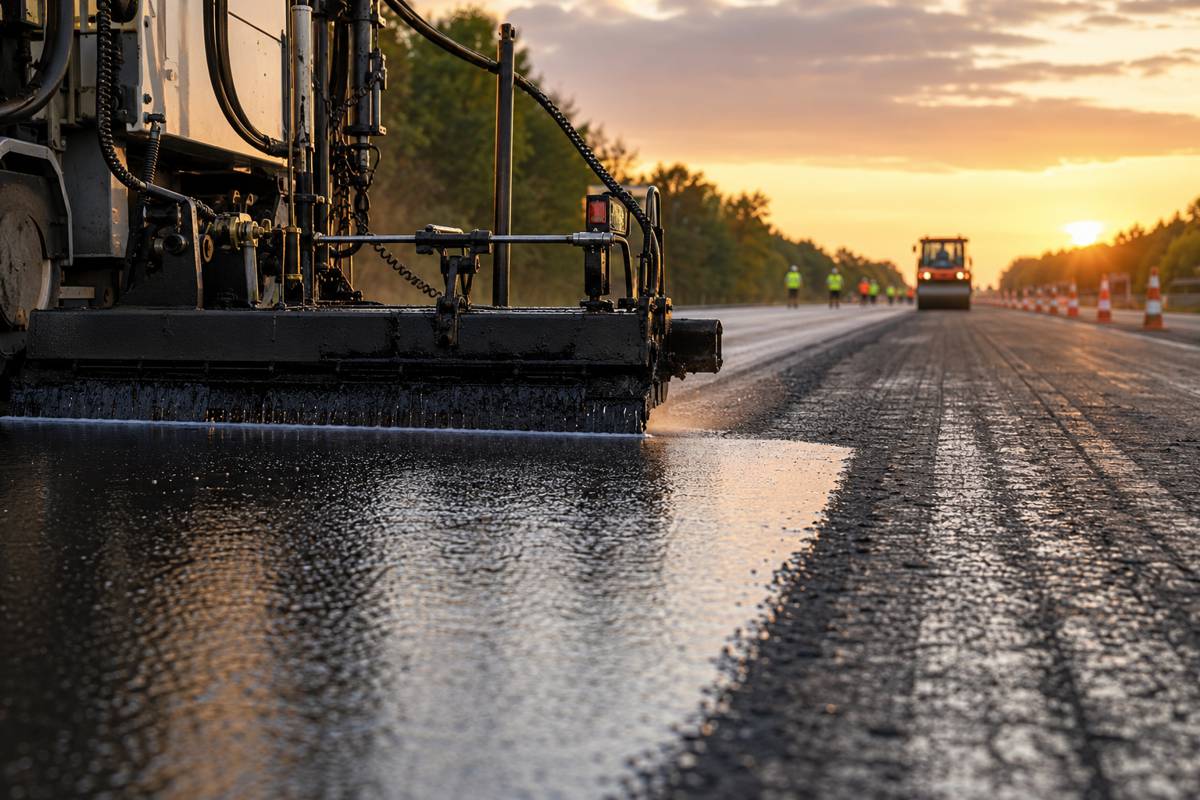
From there the work scaled up to machine paving of factory-produced cold mix at room temperature, and then to a more demanding proposition still, paving below freezing point at temperatures of minus ten to minus twelve degrees Celsius with a reported service life beyond three years. Cold-weather paving windows are a genuine operational constraint in continental and mountainous regions, so extending the season during which crews can lay durable surface has direct scheduling and cost value.
Two preservation applications round out the picture. The first is MicroSeal, a sprayable fog seal or surface dressing filled with 30 to 40 per cent selected ultra-black sand, built on an abrasion-resistant and temperature-resistant binder that stays workable at night, when it is sprayed in slots between eleven at night and five in the morning at rates above five kilometres per shift.
It is under development for high-traffic urban arteries, with the Beijing “Black and Bright” project targeting the city’s third ring road, where night working and rapid return to service are essential. The second, and the stated final objective, is microsurfacing built from close to 100 per cent reclaimed asphalt, using an optimised fine fraction graded from zero to five millimetres bound with 1.5 to 2 per cent of the oil in emulsified form. Trial sections were reported to be pre-wetted, laid, rolled and opened to traffic within about two hours, with compaction shown to be the trigger that drives the oil to diffuse and the mixture to set.
Meeting The Standards And The Commercial Case
Performance claims only carry weight when they are pinned to recognised specifications, and here the presentation set its results against established benchmarks. Cold-paving and semi-flexible mixtures were compared to the Chinese standard JT/T 972-2015, with the semi-flexible variant reported to deliver dynamic stability above 7,000 cycles per millimetre at 70 degrees Celsius, a demanding measure of resistance to rutting under heat and load. Compatibility of the reclaimed-asphalt microsurfacing systems was assessed using the ISSA TB-144 Schulze-Breuer and Ruck protocol, the industry’s standard method for judging whether an emulsion and aggregate will bond durably, alongside abrasion, adhesion and integrity ratings.
An adjusted emulsifier system was shown to matter as much as the binder itself, because reclaimed aggregate lacks the strong electrostatic attraction that virgin stone offers a cationic emulsifier, and compensating for that through improved affinity, greater surface contact and mechanical de-emulsification during rolling is what allowed abrasion resistance to reach acceptable levels.
The strategic prize is the combination of these threads rather than any single result. If reclaimed asphalt can be regenerated cold, if the awkward fine fractions become the preferred feedstock rather than a residue, and if the resulting mixtures meet national standards for patching, paving and microsurfacing, then the economics of maintenance change for owners, contractors and suppliers alike.
Lower processing energy, reduced dependence on virgin bitumen at a moment when refineries in China no longer yield straight-run bitumen of the old quality, and a productive home for material that would otherwise be stockpiled all point in the same commercial direction. The presentation also signalled where this is heading next, with XiYueFa looking to new partners across the Middle East and Asia, the regions where network expansion and maintenance budgets are both growing fastest.
The Circular Road Ahead
What Lommerts and Xu presented in Tbilisi is less a single product than a coherent argument about where flexible pavements are going. The industry that spent a generation learning to build at scale is now learning to preserve and to recycle at scale, and the binder chemistry is being redesigned around that reality rather than retrofitted to it.
Bio-based diffusion enhancers, rejuvenators and replenishers that work cold offer a way to close the loop on asphalt without the energy penalty of reheating and without the solvents that have long made cold mixes a compromise. For an audience of contractors, suppliers and road authorities, the appeal is that circularity and performance are being presented as complementary rather than competing goals.
The work is still moving from trials towards routine deployment, and the honest measure of it will be independent field data gathered over full maintenance cycles in varied climates. Even at this stage, though, the underlying proposition is a confident one and a welcome corrective to the assumption that sustainability in road building means accepting less.
If a road surface can be lifted, regenerated and relaid using a fraction of the virgin material and none of the heat, the reclaimed asphalt piling up beside every milling operation stops being a cost to manage and starts being a resource to bank. That is a future the industry has every reason to build towards, and the chemistry to get there is now on the table.
Key Industry Questions
- What exactly is a bio-based cold-mix oil, and how does it differ from a conventional rejuvenator? A conventional rejuvenator softens aged binder, usually as part of a hot or warm process. The cold-mix oil presented combines three functions in one plant-derived liquid, pairing a rejuvenator with a bitumen replenishment component and a diffusion enhancer that helps the blend migrate into and merge with aged binder at ambient temperature. It is formulated to carry no volatile solvents and to produce no fumes, which distinguishes it from solvent-based cold mixes. The practical difference is that regeneration and mixing can happen without a hot plant, so reclaimed asphalt can be reprocessed on site or in a cold factory mix rather than being reheated, cutting both energy use and worker exposure.
- Why are fine reclaimed asphalt fractions such a problem, and how does this help? Fine, bitumen-rich fractions are the part of reclaimed asphalt that hot-mix plants handle least well. They release higher emissions during heating, and they agglomerate during grinding, storage and processing, becoming sticky and difficult to feed back into a mix. As a result they often accumulate unused. A cold, diffusion-driven process inverts the problem, because a high binder content in the fines becomes useful rather than troublesome when the aim is to regenerate that binder at ambient temperature. The near-total reclaimed-asphalt microsurfacing described uses an optimised fine fraction graded from zero to five millimetres, which turns a low-value residue into a paving-grade feedstock.
- Can this really produce durable roads, or is it only suitable for minor repairs? The applications presented span a range from small repairs to surfacing. Pothole and patch repairs using 98.5 per cent reclaimed asphalt were reported to last beyond four years, machine-paved cold mix beyond three, and microsurfacing trials were opened to traffic within about two hours of laying. The mixtures were measured against the Chinese standard JT/T 972-2015 and the ISSA TB-144 compatibility protocol, with the semi-flexible variant reported at dynamic stability above 7,000 cycles per millimetre at 70 degrees Celsius. The candid caveat is that these are laboratory and trial results, and long-term independent field data across multiple climates and traffic levels will be the deciding evidence.
- How significant is the reclaimed asphalt market commercially? It is large and growing. The presentation put worldwide reclaimed asphalt sales and reuse at around 300 million tonnes a year, rising towards 600 million tonnes, at roughly 25 US dollars per tonne. Independent researchers value the global recycled asphalt market at between about 9.8 and 10.5 billion US dollars in 2024, with forecasts to 2033 ranging from roughly 12.6 to 16.2 billion. The growth is driven by rising virgin material costs, sustainability regulation and the sheer volume of pavement now reaching the end of its first life. Technologies that raise the proportion of reclaimed material a mixture can carry increase the value that can be extracted from that stream.
- Why does bitumen availability matter to this story? Bitumen is a refinery product, and refineries are changing under the pressures of the energy and material transitions, carbon reduction and shifting trade patterns. The presentation noted that real straight-run bitumen is no longer available in China, which means the binder the industry relied on is changing in both availability and quality. Regenerating the binder already locked into reclaimed asphalt reduces exposure to that uncertainty, because a proportion of the binder demand is met from material the road network has already paid for. That supply-security argument sits alongside the cost and carbon case, and it is likely to grow more prominent as refinery output continues to evolve.
- What role does temperature play, and why is sub-zero paving notable? Temperature governs both the diffusion that regenerates the binder and the window during which crews can work. Because the oil is a liquid at twenty degrees and drives diffusion at room temperature, mixing does not require a hot plant. The presentation went further, reporting machine paving at temperatures of minus ten to minus twelve degrees Celsius with a service life beyond three years. Cold-weather paving is a real operational constraint in continental and mountainous regions, where the conventional season is short. Extending it lets authorities schedule durable maintenance across more of the year, which has direct value for network availability and for the productivity of paving crews and equipment.
- How does the emulsifier system affect reclaimed asphalt performance? Reclaimed aggregate behaves differently from virgin stone. A cationic emulsifier bonds strongly to fresh mineral surfaces through electrostatic attraction, but reclaimed particles are already coated in aged binder, so that attraction is weaker. The presentation described an adjusted emulsifier system that compensates by improving affinity between the aged binder and the emulsifier, increasing surface contact, and using mechanical de-emulsification during rolling to help the system break and set. Test data indicated that the adjusted system markedly improved abrasion resistance compared with a standard formulation. The wider lesson is that recycling at high reclaimed content is as much an emulsion-engineering challenge as a binder one.
Strategic Takeaways
- Preservation, maintenance and recycling are becoming the dominant economic activity in mature road networks, and binder chemistry is now being designed around keeping and reusing pavements rather than only building new ones.
- Reclaimed asphalt is shifting from a disposal cost to a strategic feedstock, and technologies that raise the reclaimed content a mixture can carry, especially the difficult fine fractions, directly increase the value recoverable from every milling operation.
- Cold, bio-based regeneration of aged binder offers a route to lower processing energy, reduced solvent use and less exposure to changing virgin bitumen supply, aligning the sustainability case with the supply-security case.
- Sub-zero and room-temperature paving windows extend the maintenance season and could reshape scheduling, procurement and equipment utilisation for authorities working in cold or mountainous regions.
- The commercial proposition rests on independent field validation over full maintenance cycles, so asset owners and investors should watch for long-term performance data against national standards before treating near-total reclaimed-asphalt surfacing as routine.