Rail Meets Airport Operations and the Case for Transferring Logic, Not Systems
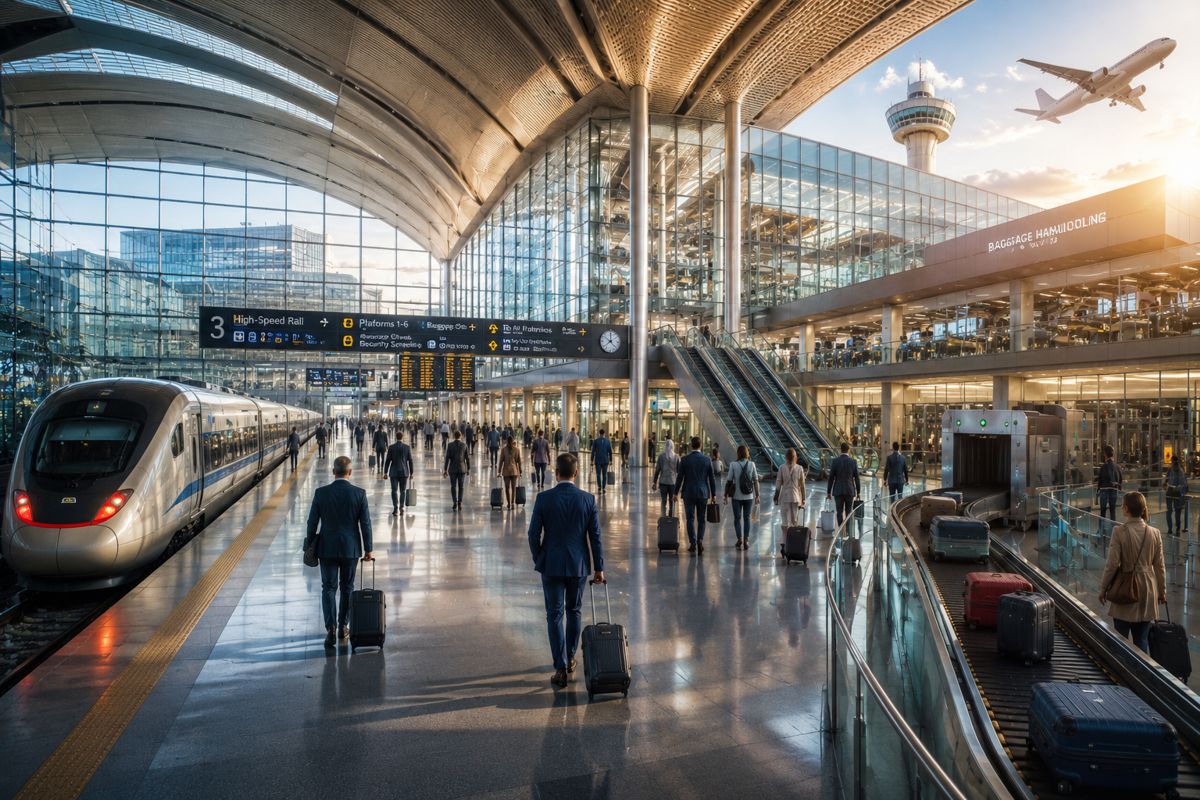
Transport infrastructure is converging on a single operating reality. Whether the building is an airport terminal or a mainline railway station, the underlying engineering problem is increasingly the same: move large volumes of people and their baggage through a secure, interdependent environment without letting a fault in one subsystem cascade into the next.
That convergence is quietly changing where commercial value sits. The most portable asset in modern transport engineering is no longer a particular conveyor, screening machine or software licence, but the operational logic that governs how those elements behave together. In conversation for this feature, Andrei Iacobita, managing director of the system integrator IESYS, sets out why the next phase of transport modernisation will depend on transferring that logic between sectors rather than copying the systems that embody it.
The commercial backdrop gives the argument its weight. The global baggage handling systems market was valued at around USD 11.5 billion in 2024 and is forecast to grow steadily into the next decade, yet it remains strikingly fragmented, with the ten largest suppliers accounting for only a small share of total revenue. That structure tells its own story. Buyers are not purchasing a commodity off a shelf; they are commissioning bespoke, project-based systems where integration skill, control logic and lifecycle support decide the outcome more than headline price.
A 2026 study published in npj Sustainable Mobility and Transport, built around a real-world case at Shanghai Hongqiao, frames the operational stakes plainly, noting that integrated transport hubs require “reliable, fine-grained forecasts of crowd distribution to safeguard operations”. The finding reflects a wider shift. Modern hubs need individual assets to function as one coordinated operating environment, with data, automation and human oversight aligned around passenger flow, and that is precisely the discipline that airports have spent decades refining.
Briefing
- The global baggage handling systems market was worth roughly USD 11.5 billion in 2024 and remains highly fragmented, with the top ten suppliers holding only a single-digit share of revenue, keeping competition centred on integration skill rather than price.
- Vanderlande’s acquisition of Siemens Logistics for about EUR 300 million, completed in 2025, has concentrated ownership at the top of the airport automation market while leaving delivery-level competition open to specialist integrators.
- Railway stations and integrated transport hubs now form a distinct and growing segment of the smart baggage handling market, driven by multimodal travel and the fitting of airport-style services into rail stations.
- IESYS delivered a baggage handling and reconciliation system across six railway stations in Saudi Arabia, re-engineering airport-derived principles rather than transplanting an airport workflow into a new building.
- Andrei Iacobita argues that operational logic, not sector-specific technology, is the transferable asset, and that rail needs airport engineering experience translated onto its own terms rather than airport systems copied wholesale.
Where The Market Value Is Concentrating
The clearest signal of where commercial power is moving came in 2025, when Vanderlande completed its purchase of Siemens Logistics for approximately EUR 300 million, folding one of the best-known names in airport automation into an already dominant baggage and cargo handling business. Consolidation at that level usually implies a market maturing towards a handful of scaled suppliers, and in airports that is broadly true. The picture at the delivery layer is more nuanced.
The wider baggage handling market stays fragmented because most projects are one-off engineering commissions shaped by station geometry, regulatory regime and local operating conditions, which rewards firms that compete on customisation, control expertise and long-term service rather than on unit cost alone. That gap between concentrated ownership and dispersed delivery is where specialist integrators earn their place.
The more consequential development for infrastructure owners is the emergence of rail as a defined end-market in its own right. Analysts now treat railway stations, high-speed lines and integrated transport hubs as a separate segment of the smart baggage handling market, estimated at around a tenth of the total and expanding as multimodal travel grows and stations acquire airport-like services.
That reframing matters commercially because it changes the procurement question a rail operator faces. The decision is no longer whether to buy a productised airport solution, but whether to buy the capability to adapt airport-grade engineering to a railway’s very different passenger journey. On the evidence, adaptation capability is becoming the scarcer and more valuable asset, and it sits with the integrators who understand both environments rather than with any single piece of hardware.
Principles Travel Further Than Technology
Airports and railway stations run on different operating models, but they share a common engineering burden. Both must handle high passenger volumes, maintain security to a regulated standard, and keep several interdependent systems working in concert so that the wider journey is never disrupted. In each setting, a fault in one area can quickly degrade throughput elsewhere, which is why resilience and exception handling matter as much as raw processing capacity.
Iacobita’s central contention is that expertise travels further than any specific technology, because the most useful lessons live in the operational logic behind a system rather than in its components. That logic covers how equipment, software and people interact, how exceptions are identified and resolved, and how operators keep visibility when conditions change unexpectedly.
Transferring that knowledge is not the same as importing a fixed technical solution, and the distinction is more than semantic. It means understanding why an approach works, then redesigning it around a new environment with its own constraints. This is where the IESYS pedigree becomes relevant. The company built its reputation on turnkey airport baggage systems, including recent installations at Oradea and Iasi in Romania that integrated explosive detection screening, dual-view X-ray and centralised SCADA supervision.
Carrying that discipline into rail did not involve reproducing an airport in a station concourse. It required the underlying principles, automated routing, integrated screening, fail-safe design and real-time exception handling, to be re-engineered for a passenger flow that behaves nothing like an airport’s.
Adapt, Do Not Replicate
Baggage handling is where the difference between adaptation and replication becomes concrete. Airport passengers typically arrive well ahead of departure, move through defined processing stages and remain within tightly controlled flows, which gives designers predictable dwell times and generous windows for screening and sortation. Rail passengers behave differently. They often arrive much closer to departure, move more freely through the station, and generate sharp peaks around timetables rather than a smoothed processing curve.
Routing logic, screening and exception handling therefore have to operate within shorter windows and against far less predictable behaviour, which is a genuine re-engineering task rather than a configuration change.
IESYS applied that approach in delivering a baggage handling and reconciliation system across six railway stations in Saudi Arabia for the country’s national railway operator. Saudi Arabia Railways is a useful illustration of why the work was needed, because its North passenger network is built in airport-terminal style, with airport-style security screening and staffed baggage desks that open two hours before departure. The kingdom carried tens of millions of rail passengers in 2024 across its intercity and urban systems, and rail sits at the centre of Vision 2030 ambitions to turn prestige corridors into a functioning logistics and mobility network.
The network required consistent control logic and familiar interfaces despite differences in station layout and local operating conditions. The project did not reproduce an airport workflow in another building; it translated airport-derived principles into systems designed for rail’s tighter timings and freer passenger movement.
Security Built Into The Flow
Security screening is the clearest example of transferable operational logic, and also the one where poor design is most costly. Inspection works best when it is engineered into the baggage flow from the outset rather than bolted on as a discrete stage. Where X-ray and detection systems sit as a separate step, they tend to create bottlenecks precisely when volumes peak. The alternative is a conveyor network and control layer that treat each screening result as an instruction, using it to determine the bag’s next movement. Cleared bags continue automatically while exceptions are diverted for further inspection, so security supports operational continuity instead of competing with it.
The critical link is between the physical and digital layers, and this is where integration expertise earns its return. Mechanical equipment moves the bag, but it is the combination of ticketing data, baggage identity and the screening result that determines its route through the system. When those data streams are exchanged in real time, the network can reconcile every item against its passenger and its clearance status without human intervention at each junction.
That capability is becoming more demanding as detection standards evolve and suppliers push higher-resolution, modular screening hardware into the market, since the control logic has to keep pace with equipment that is itself being upgraded on a rolling basis. Building screening into the flow is therefore not only an efficiency choice but a way of future-proofing the system against tightening regulation.
One Network, Consistent Visibility
The same logic scales up when infrastructure spans several stations rather than a single terminal. Local layouts will always differ, but the underlying control philosophy should stay familiar from one site to the next. Shared workflows and consistent interfaces create a common operating model, which lets staff move between locations without relearning how the system behaves and makes maintenance more predictable across the network. For an operator running six stations, that consistency has direct commercial value: it lowers training overhead, reduces the risk of human error during exceptions, and turns maintenance from a series of site-specific puzzles into a repeatable discipline.
Consistency depends on visibility, and the two operate at different levels. Local human-machine interfaces give station teams immediate access to alarms and baggage exceptions, while SCADA-based supervision gives control teams a wider view of how the whole network is performing. The value lies in the relationship between those layers.
Rather than monitoring conveyors, screening equipment and control systems as isolated assets, operators can see how activity in one area affects the rest, which is the same coordinated awareness the npj researchers identified as essential to safeguarding hub operations. For infrastructure owners weighing lifecycle cost, that combined visibility is what separates a network that degrades gracefully under load from one that surprises its operators.
Translating Experience, Not Copying Systems
The lesson reaches well beyond baggage handling. As transport infrastructure grows more interconnected, the organisations best placed to support it will be those that can recognise which engineering principles genuinely travel between sectors and which must be redesigned for a new operating environment. That judgement is difficult to productise, which is why it tends to reward integration specialists over hardware vendors, and why the fragmented delivery layer of the baggage market has proved so resistant to consolidation even as ownership concentrates at the top. Rail operators modernising their stations are, in effect, buying a translation service as much as a system.
For industry leaders, the practical implication is a procurement one. The strongest returns are likely to come from partners who can demonstrate not just a product portfolio but a track record of adapting proven logic to unfamiliar conditions, because that is where reliability, throughput and regulatory compliance are actually won or lost.
As Iacobita frames it, rail does not need airport technology copied into stations; it needs airport engineering experience translated into systems that work on rail’s own terms. With multimodal travel expanding and station modernisation accelerating across Asia, the Gulf and Europe, the operators who internalise that distinction now will be the ones setting the standard for the integrated hubs that follow.
Key Industry Questions
- Why are railway stations adopting airport-style baggage handling systems? Modern intercity and high-speed rail stations increasingly resemble airports in throughput, security requirements and passenger expectations, particularly where they serve international, pilgrimage or high-volume corridors. Airport-style baggage handling brings automated routing, integrated screening and reconciliation that let stations process larger volumes securely without adding manual bottlenecks. Analysts now treat rail and integrated hubs as a distinct segment of the smart baggage handling market, estimated at roughly a tenth of the total and growing on the back of multimodal travel. Saudi Arabia offers a visible example, with its North passenger stations built in terminal style and equipped with airport-style screening and staffed baggage desks. The driver is not prestige but operational necessity as passenger numbers and security standards rise together.
- How does rail baggage handling actually differ from an airport’s? The systems share engineering principles but face very different passenger behaviour. Airport passengers usually arrive well before departure, move through defined stages and stay within controlled flows, giving designers predictable processing windows. Rail passengers tend to arrive closer to departure, move more freely through the station and create sharp peaks around timetables. That compresses the time available for routing, screening and exception handling, and makes demand far less predictable. The consequence is that airport routing logic cannot simply be transplanted; it has to be re-engineered for shorter windows and more variable flow. This is why practitioners describe the task as adaptation rather than replication, and why integration expertise matters more than any single piece of hardware.
- How large is the baggage handling systems market and who leads it? The global market was valued at around USD 11.5 billion in 2024, with forecasts pointing to steady mid-single-digit annual growth into the next decade. Leading suppliers include Vanderlande, Siemens Logistics, BEUMER Group, Daifuku, Fives, Alstef and Smiths Detection, alongside numerous regional integrators. The market is notably fragmented, with the ten largest players holding only a single-digit share of total revenue. That reflects a procurement model based on bespoke, project-specific commissions rather than standardised products, where suppliers compete on customisation, control expertise and long-term service. For buyers, the fragmentation means supplier selection turns heavily on demonstrated integration capability and lifecycle support rather than on catalogue pricing.
- What did Vanderlande’s acquisition of Siemens Logistics change? Vanderlande completed its purchase of Siemens Logistics for about EUR 300 million in 2025, consolidating two significant airport automation businesses under one owner. The deal strengthened Vanderlande’s global airport logistics footprint and its end-to-end baggage and cargo capabilities. Its wider significance is what it reveals about market structure: ownership is concentrating at the top of the airport segment, even as delivery-level competition stays open to specialists. That combination shapes how infrastructure owners should think about risk, since scale at the vendor level does not remove the need for integrators who can adapt systems to specific stations, regulations and passenger flows. Consolidation and fragmentation are, in this market, coexisting rather than cancelling each other out.
- Why do system integrators matter more than product vendors here? Because baggage handling outcomes depend on how components behave together rather than on any single machine. Conveyors, X-ray systems, control software, ticketing data and human oversight must be aligned around passenger flow, and that alignment is engineered, not bought. The market’s fragmentation reflects this, with buyers commissioning bespoke systems shaped by station geometry and local conditions. Integrators earn their value by translating proven operational logic into a new environment, handling exceptions, fail-safes and real-time routing that off-the-shelf hardware cannot resolve on its own. As rail stations adopt airport-grade complexity, the ability to adapt that logic becomes the scarce, defensible skill, which is why integration expertise is increasingly where commercial value concentrates.
- How does inline security screening improve throughput? When screening is built into the baggage flow rather than run as a separate stage, each inspection result becomes an instruction that determines the bag’s next movement. Cleared bags continue automatically, while flagged items are diverted for further inspection without halting the wider flow. That avoids the bottlenecks that appear when X-ray checkpoints sit in isolation, particularly during timetable peaks. The approach depends on real-time exchange between the physical conveyors and the digital layer of ticketing data, baggage identity and screening results. Done well, it lets security and throughput reinforce one another instead of competing. It also future-proofs the system, since control logic designed to act on screening results can accommodate higher-resolution detection hardware as standards tighten.
- What role does SCADA play in multi-station baggage operations? SCADA-based supervision gives control teams a network-wide view of performance, sitting above the local human-machine interfaces that station staff use for immediate alarms and exceptions. The value is in the relationship between the two levels. Instead of monitoring conveyors, screening equipment and control systems as isolated assets, operators can see how activity in one area affects the rest of the network. That coordinated awareness is what allows a multi-station system to degrade gracefully under load rather than fail unexpectedly. It also supports predictable maintenance and consistent operating models across sites, which lowers training overhead and reduces the risk of error during exceptions. For infrastructure owners, that combined visibility is a significant factor in lifecycle cost and reliability.
- What should infrastructure owners look for when procuring cross-sector engineering? The priority is evidence of adaptation rather than a product catalogue alone. Owners should look for suppliers who can demonstrate that they understand why an approach works in one sector and how to redesign it for another, since transplanted solutions rarely survive a different passenger journey intact. Consistent control logic and familiar interfaces across sites, integrated screening designed into the flow, fail-safe routing and layered visibility from local interfaces to SCADA supervision are practical markers of that capability. Track record in comparable conditions carries more weight than headline scale, given how project-specific these systems are. The underlying question is whether a partner can translate operational logic across environments, because that is where reliability and compliance are ultimately decided.
Strategic Takeaways
- Commercial value in transport automation is shifting from proprietary hardware to transferable operational logic, favouring integrators who can adapt airport-grade engineering to rail’s different passenger flow over vendors selling standardised systems.
- The baggage handling market’s split personality, concentrated ownership at the top following Vanderlande’s acquisition of Siemens Logistics but fragmented, project-based delivery below, means supplier selection should weigh demonstrated integration capability more heavily than scale or price.
- Rail is now a defined growth segment of the smart baggage handling market, so station modernisation programmes should be scoped around adaptation of proven principles rather than the wholesale import of airport systems.
- Building security screening into the baggage flow, rather than treating it as a separate checkpoint, protects throughput during timetable peaks and future-proofs systems against tightening detection standards.
- Consistent control logic and layered visibility across multiple stations lower training and maintenance costs and improve resilience, making them material considerations in lifecycle cost as much as engineering preferences.