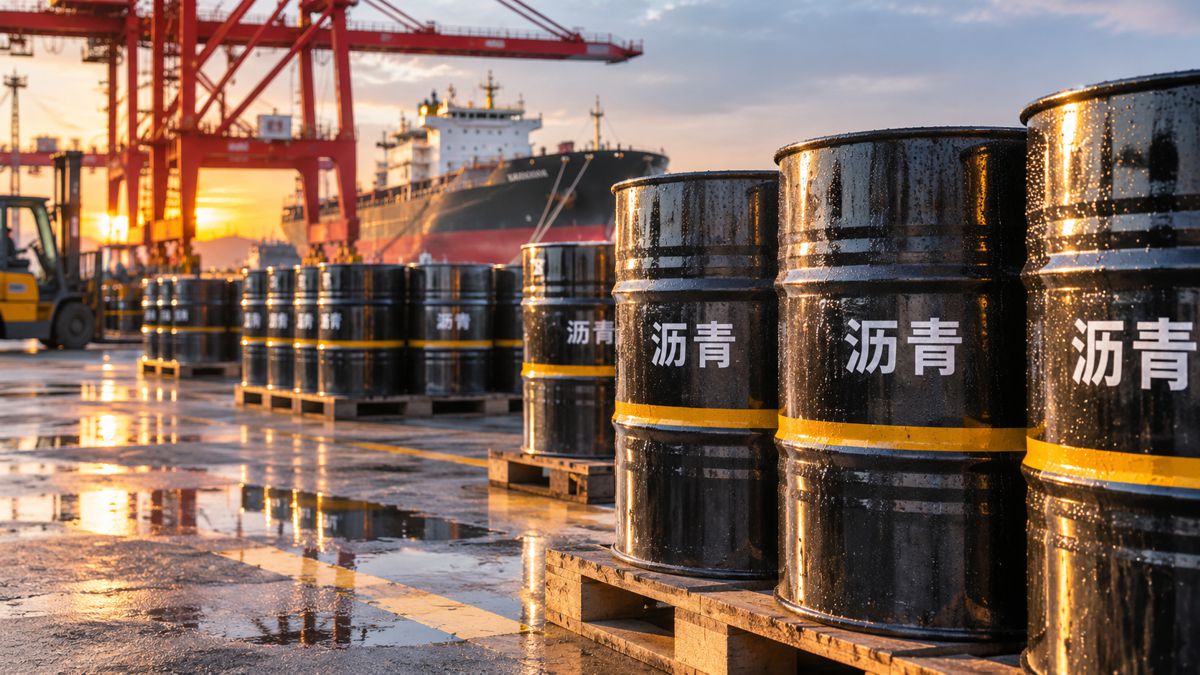
Rewriting Bitumen Emulsion Procurement with Bio-Based Enhancers
At the Bituroad Conference 2026 in Tbilisi, among keynotes on corridor economics and supply-chain resilience, a technical presentation from China’s XiYueFa Group set out a proposition with unusually broad commercial reach. The road industry is living with a widening mismatch, with the bitumen leaving refineries is becoming harder, more variable and more difficult to work with, while demand for high-performance bitumen emulsions used in maintenance keeps climbing.
XiYueFa’s response is a bio-based emulsification enhancer, presented by the group’s research and development director XU Quanxin, designed to loosen the link between the quality of the raw bitumen a producer can buy and the quality of the emulsion that producer can sell. If the results hold at production scale, the consequences run well beyond a single product line, reaching into procurement strategy, maintenance economics and the carbon arithmetic of road preservation.
Emulsions sit close to the centre of the sustainable-maintenance conversation because they enable cold and low-temperature application, cutting energy use and emissions relative to hot processes. The complication is that an emulsion is only as reliable as the chemistry holding it together, and that chemistry has become harder to control as feedstocks deteriorate. XiYueFa’s contribution is an attempt to address the problem at the additive level rather than by rebuilding production lines, and that framing is what makes it interesting to anyone who buys, blends or applies emulsion.
Briefing
- XiYueFa Group used Bituroad 2026 in Tbilisi to present a Bio-based Emulsification Enhancer (BEE), a 100 per cent bio-based additive that the company says improves emulsification efficiency and emulsion stability without changing an existing formulation, and works across cationic, nonionic, amphoteric and anionic systems.
- The commercial premise is a reduced dependence on base bitumen quality, which would widen the range of feedstocks and price points a producer can accept while still meeting specification.
- Reported laboratory results include sharp improvements in storage stability, finer and more uniform particle size distributions, and successful emulsification of hard, low-penetration straight-run bitumen and of polymer-modified binders carrying high SBS content.
- The authors include Bert Jan Lommerts, twice a past president of the International Bitumen Emulsion Federation and former chief executive of Netherlands binder specialist Latexfalt, whose earlier work centred on bio-based emulsion stabilisers.
- Field applications span non-sticky tack coats, stress-absorbing interlayers, ultra-fast-curing micro-surfacing in Seoul and cold-paved coloured surfacing, with an emulsion consignment shipped to the Netherlands for a motorway spraying trial after roughly three months at sea.
The Supply Squeeze Driving the Search
The problem XiYueFa is chasing is structural rather than local. Global crude is trending heavier, and refineries are increasingly configured to squeeze the maximum value from every barrel. The presentation cites analysis in Nature Climate Change indicating that more than 80 per cent of China’s refining capacity is built around deep conversion units such as coking and hydrocracking, which are optimised to turn heavy and residue fractions into high-value transport fuels. Bitumen is the material left behind at the bottom of that process, so as more residue is converted upstream, the remaining bitumen becomes harder to upgrade and its quality drifts downward. This is not a Chinese peculiarity. It is a direct consequence of refining economics and fuel demand that plays out wherever crude slates get heavier and margins push refiners toward maximum conversion.
At the same time, the pull on emulsion is strengthening. XiYueFa reports that China’s road network reached about 5.49 million kilometres by December 2025, with roughly 5.45 million kilometres, or 99.9 per cent of the total, under maintenance. Independent figures broadly corroborate the scale, with international datasets placing China’s network in the region of 5.2 to 5.8 million kilometres and rising.
The group puts China’s apparent bitumen consumption at around 40 million tonnes in 2025, more than three-quarters of it destined for roads, yet emulsion accounts for only about 4 per cent of that volume against a global average nearer 8 per cent. The International Bitumen Emulsion Federation independently estimates that more than 8 million tonnes of emulsion are used worldwide each year. That gap between Chinese and global penetration is the headroom XiYueFa is describing, and it exists precisely because emulsion has historically been fussy about the bitumen it is made from. A technology that reduces that fussiness, if it works, addresses the demand side and the supply side of the same equation.
Loosening Emulsion Quality From Feedstock Quality
The strategic heart of the presentation is decoupling, and it is the point most likely to matter to a commercial audience. For emulsion producers, base bitumen quality has always set a hard ceiling on what can be made and stored reliably. Harder, lower-penetration and higher-asphaltene binders resist emulsification, tend to produce coarser particles and separate more readily in the tank, which forces producers toward a narrower, more expensive band of feedstock.
XiYueFa’s claim is that its enhancer relaxes that constraint, allowing the emulsification of straight-run low-penetration or high-asphaltene bitumen without changing the type or dosage of the emulsifier, and letting producers tune emulsifier dosage to hit specific breaking and setting behaviour while holding emulsification quality constant.
The commercial translation is procurement freedom. If a plant can turn a wider range of bitumen grades into on-specification emulsion, its buyers gain leverage over price and availability rather than being locked into premium binder to guarantee a stable product. The company frames this as reduced dependence of emulsion production on bitumen quality, expanding both the quality and the price range of base bitumen a producer can source.
For maintenance-heavy road networks operating under budget pressure, that flexibility compounds. It touches material cost, sourcing risk and the ability to keep producing consistent emulsion when feedstock quality wobbles, which is exactly the condition the refining trend is making more common. The same logic underpins a second commercial argument the presentation makes, namely that better and more consistent stability reduces the losses caused by separation and sedimentation, from wasted product to the cleaning of blocked mills and fouled construction equipment, while extending how long an emulsion can be stored and how far it can be transported.
What the Enhancer Actually Does
Mechanically, the enhancer is straightforward to deploy, which is central to its appeal. It is added during preparation of the soap water, dissolving in the aqueous phase to work synergistically with conventional emulsifiers rather than replacing them. Because it slots into the existing water side of the process, the company stresses that no special equipment or processing changes are required and that production can run on existing emulsification systems. That matters for adoption. An additive that improves a difficult emulsion without a capital programme behind it is a far easier proposition for a plant manager than a process retrofit, and it lowers the barrier to trialling the technology on a live line.
The performance data presented is where the argument is won or lost. In cationic emulsions made with low-penetration bitumen, XiYueFa reports five-day storage stability improving from around 14 per cent to below 1 per cent with a small enhancer addition, alongside a finer particle size. In anionic systems made from low-quality bitumen, one-day stability is shown falling from close to 32 per cent to under 1 per cent.
The polymer-modified results are the more demanding test, because high-SBS binders are notoriously hard to emulsify. The presentation showed a 5 per cent SBS modified bitumen brought to a normal, stable emulsion with the enhancer where the untreated equivalent separated badly or blocked the mill, and it presents emulsions of 10 per cent SBS modified bitumen produced for both spraying and mixing, with zero sieve residue, five-day stability below half a per cent and recovered binder retaining high elasticity. The enhancer is also shown stabilising light oils such as bitumen rejuvenators, extending resistance to separation from a handful of days to more than seventy, which opens the door to rejuvenators being handled as room-temperature composite components rather than fragile, short-lived blends.
This lineage is worth understanding, because it is not the work of newcomers to emulsion chemistry. Bert Jan Lommerts, XiYueFa’s chief technology officer, spent more than two decades running Latexfalt in the Netherlands and was twice elected president of the International Bitumen Emulsion Federation, with an earlier career at Akzo Nobel in high-performance fibre science. His patent record includes bio-based emulsion stabilisers and biodegradable emulsifying agents for bituminous systems, and he has been involved in Dutch collaborative work on non-petroleum, bio-circular binders. None of that guarantees the new enhancer performs as claimed at scale, but it does place the technology within a long and credible thread of bio-based binder development rather than presenting it as an isolated assertion.
From Bench to Carriageway
The presentation did not stop at the laboratory, and the application catalogue is where the technology’s breadth becomes clear. Using the enhancer’s ability to emulsify very hard binder, XiYueFa has designed a non-sticky, shear-resistant tack coat from low-penetration bitumen below 20 decimillimetres, intended to break rapidly and resist pick-up by construction traffic so that layers can be placed in quick succession while improving interlayer shear strength. The group has also applied cold stress-absorbing membrane interlayers to alligator-cracked pavement, presenting a treated section still performing two years after repair. Both cases speak to a maintenance crew’s practical priorities, namely fast turnaround, tolerance of imperfect site conditions and durability that justifies the intervention.
The showcase applications are the surface treatments. An ultra-fast-curing micro-surfacing system has been used on night works in Seoul, including the Yeouido central business district and a double-layer application on the Yeonseong No. 2 Bridge, with reported mixing times of thirty to seventy seconds and curing in five to fifteen minutes, the kind of window that makes overnight closures on busy urban arterials feasible.
A cold-paved coloured surface system built on a transparent emulsion and coloured mortar has been laid across a spread of sites from Beijing and Shanghai to Haikou, Taiyuan, a Seoul bridge deck and Manila, with mechanical laying rates quoted at up to 10,000 square metres a day. The group’s MicroSeal, a water-based, solvent-free multi-component emulsion combining polymer-modified bitumen, latex and a bio-based rejuvenator, is positioned as a preservation and thin-maintenance layer that restores skid resistance while retaining flexibility. Perhaps the most telling proof point for the storage claims is logistical rather than technical.
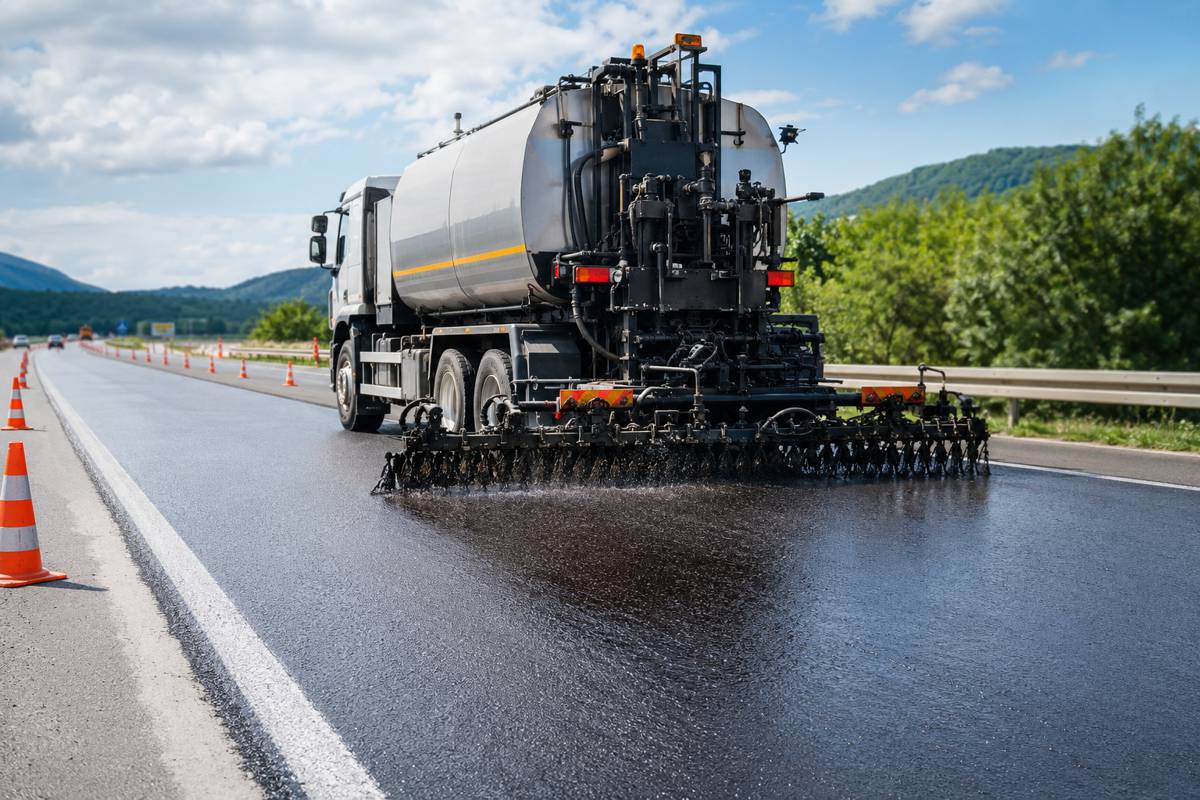
XiYueFa reports shipping emulsion to the Netherlands, roughly three months by sea, and running a spraying trial on the A27 motorway using computer-controlled equipment on porous asphalt. An emulsion that survives that journey and still sprays cleanly is making a stability argument that a data table alone cannot.
The Carbon and Cost Case
The environmental logic sits underneath everything else and gives the commercial case a second dimension. Cold and low-temperature application is inherently less energy-intensive than hot methods, and the presentation draws on published life-cycle work to sharpen the contrast, citing figures in which hot cutback bitumen carries roughly double the greenhouse-gas burden of an emulsified equivalent across the chip-sealing life cycle.
Cutback binders also rely on solvents that flash off during construction, whereas a stable, high-performance emulsion allows the same job to be done cold with lower emissions and less construction-site pollution. Set against a national backdrop in which China has committed to peaking carbon emissions before 2030 and reaching neutrality by 2060, and against a road sector that is itself a significant consumer of energy, the emissions angle is not decoration. It is part of why emulsion demand is forecast to keep rising and why enabling technologies attract attention.
The authors push the point one step further, and it is a point worth quoting directly, since it captures the strategic thesis of the whole presentation. Reflecting on where the largest carbon savings actually come from, they write that “Extending the service life of roads in our opinion is the most effective strategies for reducing carbon emissions.” That reframes the enhancer from a niche chemical into part of a preservation-led maintenance philosophy, in which better emulsions enable more frequent, lower-impact interventions that keep pavements in good condition for longer and defer the far more carbon-intensive work of reconstruction.
Combined with the cost argument, that no new equipment is required and that a wider bitumen procurement range lowers input cost, the case being made is that performance, economics and emissions can move in the same direction rather than being traded off against one another.
Where This Leaves Emulsion Producers
The measured way to read the XiYueFa presentation is as a signal about the direction of emulsion chemistry rather than as a settled outcome. The performance claims are the company’s own, drawn from its laboratories and field projects, and independent verification at production scale across different feedstocks and climates will be the real test of how far the decoupling promise extends.
What is not in doubt is the shape of the problem it targets. Feedstock quality is under structural pressure, maintenance demand is rising, and any technology that widens the window of usable bitumen while improving stability speaks directly to the commercial anxieties of producers, contractors and the authorities who pay for road upkeep. The involvement of a former IBEF president with a bio-based stabiliser track record, presenting at an IBEF-supported gathering, suggests the wider emulsion community is at least paying attention to this line of work.
For the industry, the useful takeaway is conceptual as much as chemical. If additives can be tuned to control breaking time, particle size and storage stability largely independently of the base binder, then emulsion formulation gains degrees of freedom it has not traditionally had, and the design space for high-value products such as coloured, fast-curing and high-polymer emulsions widens accordingly.
Whether XiYueFa’s specific enhancer becomes a standard tool or one option among several, the more durable message is that bio-based chemistry is being positioned as a practical answer to a refining trend the sector cannot control, and that preservation, not reconstruction, is increasingly where the environmental and economic arguments converge. That is a genuinely optimistic frame for an industry that spends much of its time managing decline, and it deserves to be tested rather than dismissed.
Key Industry Questions
- What is a bio-based emulsification enhancer, and how does it differ from a normal emulsifier? An emulsifier is the surfactant that lets bitumen droplets disperse and stay suspended in water. XiYueFa’s enhancer is not a replacement for that emulsifier but an additive that works alongside it, dissolved in the water phase during soap-water preparation. Derived from bio-based materials, it is intended to raise emulsification efficiency and, in particular, storage stability without changing the existing formulation or dosage of the primary emulsifier. In practice it functions as a stabiliser and performance aid, aimed at the two hardest cases in emulsion production, namely difficult binders and demanding stability requirements, rather than as the core emulsifying agent itself.
- Can it really let producers use harder or lower-quality bitumen without losing performance? That is the central claim, and the presented data supports it for the specific binders tested, including straight-run low-penetration and high-asphaltene bitumen that resists conventional emulsification. The commercial value is that it would widen the acceptable feedstock range and reduce dependence on premium binder to guarantee a stable product. The important caveat is that these are the developer’s own laboratory and field results. Producers considering adoption should validate performance on their own bitumen sources, emulsifier systems and storage conditions, since feedstock chemistry varies significantly by refinery and crude slate, and stability behaviour is sensitive to those variables.
- Does adopting it require new plant or equipment? According to XiYueFa, no. The enhancer is introduced during preparation of the soap water and dissolves into the aqueous phase, so it is designed to work on existing emulsification lines without process modifications or capital investment. This low barrier to trial is a meaningful part of its commercial appeal, because it allows a plant to test the additive on a live process rather than committing to a retrofit. As with any additive change, producers would still need to confirm dosing, compatibility with their emulsifier package and the effect on breaking and setting times before moving from trial to routine production.
- Why does storage stability matter so much commercially? Instability is expensive in ways that extend beyond wasted product. Emulsions that separate or sediment create losses in the tank, block mills, foul spraying and mixing equipment and shorten the practical shelf life and transport range of a product. Improved stability therefore reduces cleaning, downtime and rejected batches, and it widens the geographic market a producer can serve. XiYueFa’s most striking demonstration of this is logistical, shipping emulsion to the Netherlands over roughly three months at sea and then spraying it successfully on a motorway trial. An emulsion that survives that supply chain turns a laboratory metric into a genuine commercial capability.
- Can it emulsify highly polymer-modified bitumen, and why is that difficult? High-SBS polymer-modified binders are hard to emulsify because the polymer raises viscosity and elasticity, resisting the shear that breaks bitumen into fine, stable droplets, which tends to produce coarse emulsions, mill blockages and rapid separation. The presentation explored emulsions of binders carrying up to 10 per cent SBS produced for both spraying and mixing, with zero sieve residue and low five-day separation, and recovered binder retaining high elasticity and ring-and-ball softening points above 100 degrees Celsius. If reproducible at scale, that capability matters because high-polymer emulsions underpin premium applications such as durable surface treatments, coloured systems and high-performance tack coats.
- How does cold, emulsion-based maintenance compare with hot methods on carbon? Cold and low-temperature application avoids much of the energy used to heat binder and aggregate, and it removes the solvents that cutback binders release during construction. The presentation cites life-cycle figures in which hot cutback bitumen carries roughly twice the greenhouse-gas burden of an emulsified equivalent over the chip-sealing life cycle. The larger point the authors make is that the biggest carbon savings come from extending pavement service life through timely preservation, because keeping a road in good condition defers the far more emissions-intensive work of reconstruction. Emulsion enabling technologies feed directly into that preservation-led approach.
- Is the technology proven in the field, including outside China? There is a spread of field evidence, most of it in China, covering fast-curing micro-surfacing, cold coloured surfacing, stress-absorbing interlayers and expressway preservation, some with multi-year follow-up. International application is more limited but notable, including micro-surfacing works in Seoul and a spraying trial on the Netherlands A27 motorway using emulsion shipped from China. This is meaningful demonstration rather than independent, peer-reviewed validation across many climates and specifications. For risk-averse buyers, the sensible position is that the technology has moved well beyond the bench, while wider third-party trials would strengthen confidence for large-scale procurement.
- What does this mean for bitumen procurement strategy? If emulsion quality can be held steady across a broader range of base bitumen, procurement gains flexibility on price, grade and supplier, which is valuable when refining trends are pushing bitumen quality downward and making premium grades scarcer or dearer. Buyers could, in principle, accept feedstock they would previously have rejected, provided the enhancer delivers the claimed stability on that material. The practical approach is to treat the additive as a way to widen sourcing options rather than as a licence to buy the cheapest binder available, and to build feedstock validation into procurement so that stability performance is confirmed before volume commitments are made.
Strategic Takeaways
- The structural decline in refinery-grade bitumen quality is a durable, global trend, and technologies that widen the usable feedstock window will increasingly be evaluated on procurement and risk grounds, not only on chemistry.
- Storage stability is a commercial asset, not just a technical metric, because it governs shelf life, transport range and the losses tied to separation, cleaning and downtime that quietly erode emulsion margins.
- Additives that improve difficult emulsions without new plant lower the barrier to adoption dramatically, making live trials feasible and shifting the decision from capital planning to operational testing.
- The ability to emulsify high-polymer and hard binders expands the design space for premium products such as coloured, fast-curing and high-performance emulsion systems, which is where value and differentiation increasingly sit.
- Preservation-led maintenance, in which better emulsions enable frequent low-impact interventions, is emerging as a coherent strategy for aligning cost control, network condition and carbon reduction rather than treating them as competing objectives.