Between Fleets and Cities: Arrive’s Eugene Tsyrklevich on the Kerbside’s Next Decade
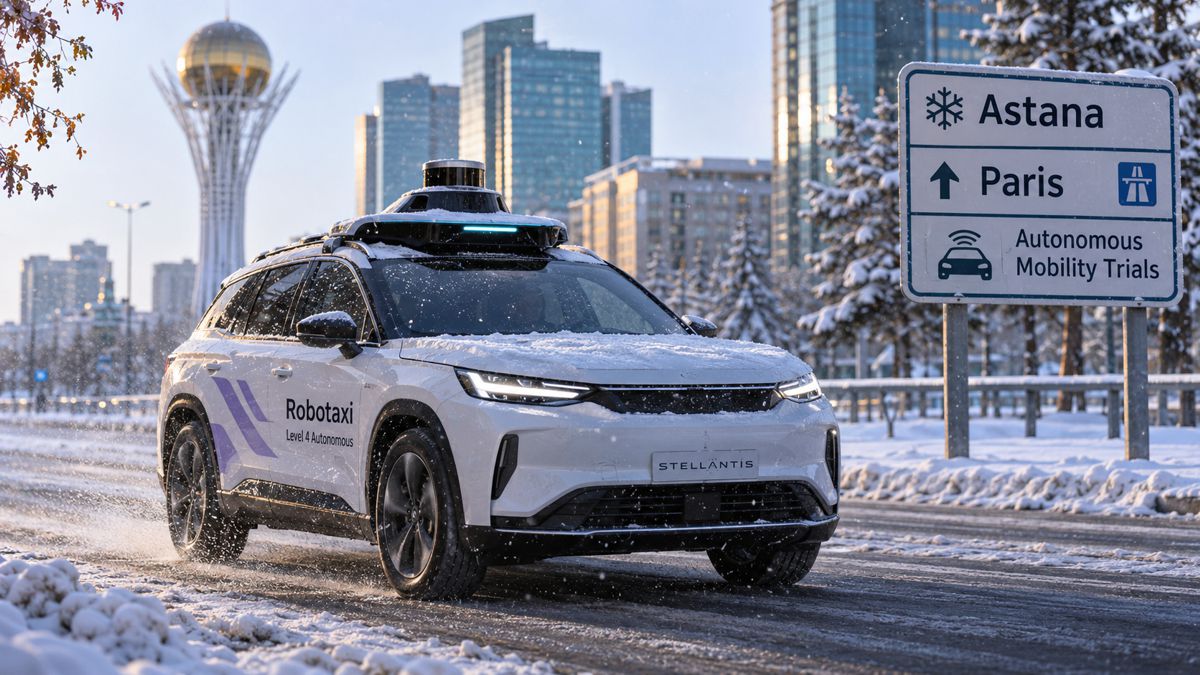
The United Kingdom opened its self-driving vehicle pilot scheme in 2026, with applications inviting operators to run taxi and bus-style automated services and the first paying journeys expected later in the year. Wayve, Uber and Waymo have all publicly committed to take part, with London expected to be among the first cities to host passenger-carrying services.
Most of the attention around that milestone has fixed on the vehicles and the software driving them. Far less has been paid to a quieter but equally consequential question, which is where all of those vehicles stop, wait, charge and turn over between rides. That gap between trips is precisely where the parking industry now finds its future, and it is where Arrive has chosen to plant its flag.
Arrive is the global mobility platform that sits behind EasyPark, Flowbird, RingGo, ParkMobile and Parkopedia, and it is present in more than 20,000 cities across 90 countries. Earlier this year the company named Parkopedia founder Eugene Tsyrklevich as its Chief AI Officer, part of a declared shift from tracking mobility to predicting it. The strategic logic is visible in its corporate moves as well as its language, with Arrive setting out its intention to acquire Passport and unify enforcement technology, paid parking and payment infrastructure into a single autonomous-ready platform.
Tsyrklevich’s central argument runs against the easy assumption that autonomy will make parking obsolete. In his reading, parking does not disappear so much as change character, becoming managed kerbside space, and the sharpest near-term risk is not too few vehicles but too many empty ones circling while they wait for the next fare.
For construction professionals, infrastructure owners and investors, the implications reach well beyond the parking sector. Multi-storey car parks, surface lots and the kerb itself start to behave like live, data-led infrastructure that can be reconfigured for charging, staging and light servicing, which changes how such assets are designed, powered, connected and financed.
The market context sharpens the point, with the SMMT valuing the UK automated passenger services market at around £3.7 billion a year by 2040. Handled well, the transition promises better accessibility, reduced dependency on private car ownership and shorter journeys. Handled poorly, it risks adding thousands of empty vehicle movements to already pressured streets.
In the conversation that follows, Tsyrklevich sets out how he expects the balance to be struck.
Briefing
- Arrive, the global mobility platform behind EasyPark, RingGo, Flowbird, ParkMobile and Parkopedia, has appointed Parkopedia founder Eugene Tsyrklevich as Chief AI Officer as it moves from tracking mobility to predicting it.
- Tsyrklevich argues parking will not disappear as autonomous fleets scale but will be redefined as managed kerbside space, with pressure points shifting to pick-up, drop-off, waiting, charging, cleaning and fleet balancing between trips.
- The most immediate risk he identifies is empty autonomous vehicles circling while waiting for the next fare, adding congestion and friction at the kerb for buses, deliveries and emergency services unless cities provide clear, paid places to stop.
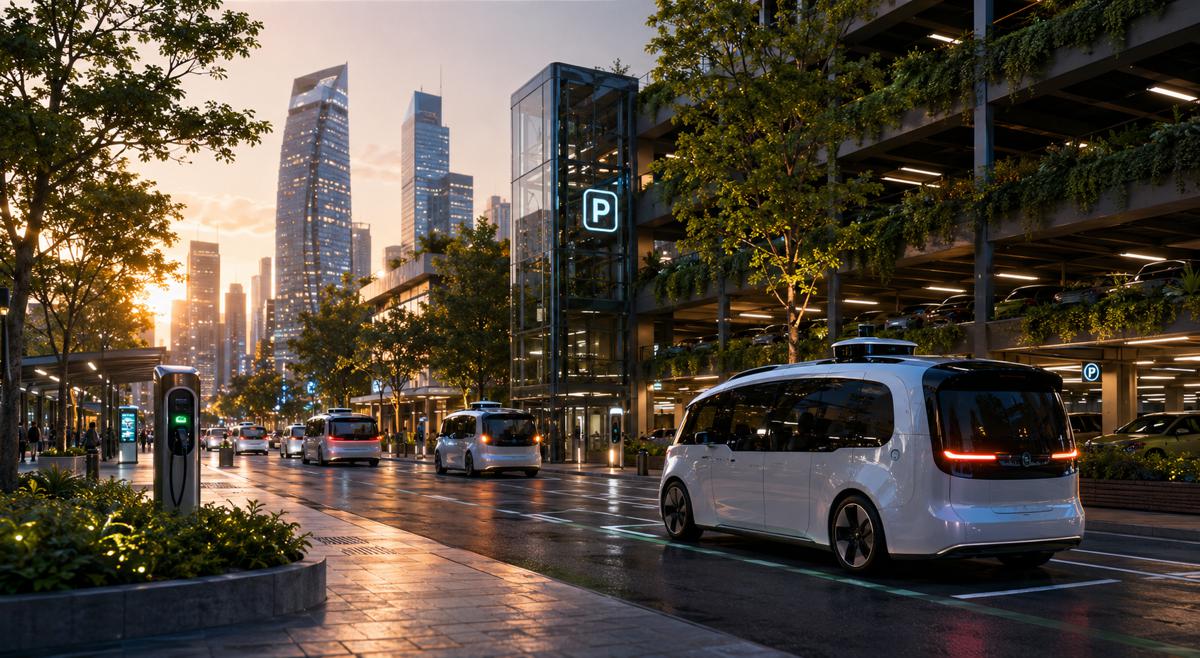
- Multi-storey car parks and surface lots are cast as flexible, reconfigurable capacity that can be turned over to EV charging, robotaxi staging and servicing, evolving into mobility hubs rather than fixed infrastructure.
- The interview lands as the UK opens its self-driving vehicle pilot scheme, with Wayve, Uber and Waymo committed, London expected among the first host cities, and full implementation of the Automated Vehicles Act anticipated by late 2027.
The Shifting Role Of Parking
How do you define the future of parking in a world increasingly shaped by autonomous vehicles, connected mobility and robotaxi fleets?
“It is notoriously difficult to predict the future, but even as autonomous vehicles and robotaxi fleets become more prevalent, the need for vehicles to stop, for a variety of reasons, won’t disappear, nor will the desire for people to own their own vehicles.
“Parking won’t disappear, but it will need to change to reflect new usage patterns.
“As autonomous fleets scale, the pressure points shift to what happens in the gaps between trips, such as picking up, dropping off, waiting briefly, charging, cleaning and balancing fleets to meet demand.
“There is a need for a company like Arrive to sit in between autonomous vehicle service operators and cities, as these two parties’ needs don’t always align, even if their goals to improve urban mobility are the same.
“If the integration isn’t organised, there is a risk of fleets keeping vehicles rolling, even if they are empty until the next fare. This may be seen as positive for utilisation, but adding thousands of additional empty vehicles to today’s roads would have a direct, negative impact on congestion and for everyone else trying to move around the city.
“There is a huge amount of opportunity with the introduction of Autonomous Vehicles to improve transport accessibility, reduce car ownership dependency and reduce journey times, but it must be carefully managed. The future of the parking industry will be in managing the kerbside. That means clear rules, the right places to wait, and simple, automated payments so autonomous vehicles can access space and stop and smoothly integrate into today’s urban landscape.”
Do you believe parking will remain a core urban need in 20 years’ time, or will it become a transitional asset class?
“This will depend on who you are asking as the advent of AVs will not be consistent across the UK, or indeed across the globe. Even in areas where we expect to see greater and faster adoption of shared and autonomous travel, cities will still need places for vehicles to stop safely and legally, for residents and visitors or for deliveries and trades. There may be less emphasis on privately owned vehicles stopping for long periods of time in key locations, and more emphasis on higher-turnover use, charging, and managed space that supports the wider network.
“Parking will remain a key part of urban mobility, but it will become more discussed as part of managing the kerbside as cities adopt a more data-driven approach to fairly managing demand and keeping journeys reliable.”
What signals are you seeing today that suggest the parking sector is already changing faster than many people realise?
“The integration into the broader approach to urban mobility is starting to take shape. The way councils are thinking about parking is starting to be part of a live part of the transport system. You can see it in three very practical ways.
“Firstly, the industry is moving from requiring the driver to find a space to planning the stop. Drivers increasingly expect to reserve, pay and navigate in one flow, just like they do with tickets and travel.
“Secondly, decisions are becoming data-led. Rather than fixed tariffs and best guesses, operators and cities are using real-time occupancy, traffic and event information to manage demand, in turn reducing the stop-start circling that clogs streets.
“Thirdly, parking is becoming a tool for wider mobility goals. It supports EV charging, manages kerbside space for deliveries and pick-ups, and feeds into the dashboards cities use to keep networks moving.”
Car Ownership And The Rise Of Shared Autonomy
As robotaxis and autonomous ride-hailing scale, do you expect private car ownership to decline significantly in cities?
“It is difficult to predict how robotaxis and autonomous vehicles will affect private car ownership. It is well documented that fewer young people in urban areas are learning to drive, and access to affordable robotaxi services would accelerate that trend. Equally there are many scenarios for which a car is still the preferred mode for many people. Moving a family around a city is still more easily achieved with a car than relying on taxis and public transport, supporting clubs or after school activities or getting out of the city for leisure.
“At Arrive we are broadly agnostic to the mode of transport people want to use. We will be there to support their journeys no matter how they take it.”
Will younger generations increasingly choose access over ownership when transport becomes cheaper and more convenient on demand?
“If robotaxis offer a good enough user experience, and are affordable enough then we would definitely expect that to support a decline in younger drivers to continue. However, if young people are able to buy autonomous vehicles for themselves that could just as equally increase vehicle ownership, so it is difficult to predict, especially as we don’t have a live robotaxi service in the UK yet.”
Could private car ownership eventually become a premium lifestyle choice rather than the default mode of mobility?
“In London today 30 million journeys are made by public transport each day, compared to 6 million by car. Taxis and private hire vehicles make 300,000 journeys. If you were to replace all taxis and private hire vehicles with robotaxis tomorrow it would still ‘only’ be a 1% change in the total number of journeys in the capital of the UK. For many people in urban areas a private car is already a premium lifestyle choice compared to the default. It will depend on cost. If using autonomous vehicles becomes comparable in cost to private vehicle ownership, people will make that choice depending on their circumstances, but that change will take time and is not imminent.”
Do you foresee a two-tier future where cities rely on shared autonomous fleets while rural areas remain ownership-driven?
“Not necessarily. The attraction of autonomous vehicle services make sense in less built up areas just as much as urban areas. There are many possible future fleet set ups in a mixed fleet environment. Could bus services in rural areas be improved with autonomous buses increasing the frequency of bus routes alongside existing human driven buses for example? Taxis exist in rural areas and are a vital part of getting around, if the economies of scale work there is no reason autonomous vehicles couldn’t also be used in rural environments. However it develops, there will be a need to manage autonomous vehicles and ensure they are properly integrated into the existing mobility paradigm, and that is what Arrive can help with.”
Regulation, Access And Urban Restrictions
Do you believe consumers will be freely allowed to own fully autonomous vehicles, or will regulation favour licensed fleet operators?
“The specifics of each market will dictate how autonomous vehicles will roll out onto our streets. As we are already seeing, fleets are the first movers. Once the technology is proven there will be a push to deliver consumer vehicles with ever more powerful autonomous features.
“What we must be vigilant to avoid is the addition of thousands of extra vehicle journeys, especially those of empty vehicles, adding to congestion and putting pressure on existing kerbside space. There is a huge risk of both fleet and consumer AVs having a negative impact on congestion, and that must not be allowed to happen.”
Could there come a point where manually driven vehicles are restricted from certain urban zones?
“It is very difficult to say from where we stand today. Given the relative number of car journeys made compared to taxi journeys in a city like London (roughly 20:1), a really big and dramatic shift would have to take place for autonomous vehicles to become the primary mode of vehicular transport. If autonomous vehicle adoption takes off quickly and people prefer robotaxi services to driving their own cars then it would seem that the need for restrictions wouldn’t arrive, the same way horses are not restricted from being ridden on the road, but it is seldom seen. It would also be a very emotive issue so it is difficult to see who would benefit from such restrictions.”
Rethinking Parking: From Demand To Mobility Hubs
If robotaxis remain in near-constant motion, what happens to traditional parking demand in city centres?
“We’ll likely be in a mixed-fleet world for a long time. People will still drive in, trades will still need vans, deliveries will still need space, and not every trip will be taken by a robotaxi. So, there will still be a role for both on-street and off-street parking. As referenced before, only 1% of journeys made in London are by taxi or private hire vehicle.
“At the same time, some of what we currently call parking demand will turn into managed dwell demand. Robotaxis still need places to wait between rides, to charge, to be cleaned and serviced, and to stage near high-demand areas. If cities don’t provide clear, paid options for that, fleets will default to circling nearby, adding to congestion on already pressurised roads.
“That’s why cities will need to actively manage supply and demand, using tools like dynamic pricing. The question becomes less ‘will we need parking?’, and more ‘where do we want vehicles to be when they’re not carrying passengers, and how do we manage that fairly?’”
How should parking operators rethink multi-storey car parks, surface lots and kerbside space today to remain relevant tomorrow?
“Operators should start treating multi-storeys and kerbside space as flexible, data-led capacity rather than fixed infrastructure.
“That means using connectivity and analytics to understand how space is actually being used and making availability visible. When you can see what’s happening in real time, you can run a site more efficiently, whether that’s guiding people (and eventually vehicles) to free capacity, reducing internal queuing, and making better use of underused areas.
“The next step is designing for reconfiguration. The most future-ready sites will be able to cordon off bays for EV charging, create a staging area for robotaxi fleets, or set aside space for light maintenance and cleaning.
“And on kerbside, space needs clearer digital definition so pick-up, drop-off and loading can be managed safely and consistently. The goal is to make the right behaviour the easiest behaviour for everyone.”
Could parking facilities evolve into mobility hubs combining EV charging, logistics, servicing and autonomous fleet staging?
“Yes, and in many places they almost have to.
“As fleets electrify and cities get stricter on congestion and air quality, the more valuable model is a mobility hub.
“That means sites that can cope with faster turnover and different users without creating queues or confusion. We need to see operators making facilities smarter and more responsive, using real-time data to understand demand and keep the experience simple and predictable.
“Done well, hubs also give cities a practical place to direct activity away from the most pressured streets, rather than fighting a constant battle at the kerb. And for fleets, they create certainty. Guaranteed access, clear rules and friction-free payment are what turn a car park into infrastructure a city can rely on.”
Risks And The Technology Already Bridging The Gap
What risks concern you most — congestion from empty vehicles circulating, monopolised fleets, cyber threats, or reduced consumer freedom?
“All of those risks matter, but the one that hits cities first will be more vehicles moving with less purpose.
“Empty AVs circulating while they wait for the next job can lead to more congestion, more friction at the kerb, and slower journeys for buses, deliveries and emergency services. The early priority has to be clear rules for stopping and waiting, and ways to make compliance easy.
“Alongside that, if a small number of fleets end up setting the terms of access, cities could lose control over price and curb space.”
Which technologies available today are already helping bridge traditional parking into the autonomous future?
“One problem AVs expose is that the journey is connected and intelligent right up until the moment a vehicle enters a car park. Then that visibility disappears. There are, however, technologies that already exist today that are solving this problem.
“The biggest bridge is the digital layer that makes off-street parking understandable to the vehicle. Indoor mapping, paired with real-time availability, means parking doesn’t have to be a space where drivers just circle and guess. Spaces, EV chargers and reserved inventory become visible and usable, so navigation can continue inside the facility rather than stopping at the entrance.
“The second bridge is frictionless transactions. These are reservations and payments that can be triggered automatically, without a human needing to stop, read signage or download something new. This will really matter in an AV world, because it’s the vehicle itself that will need to reserve, authenticate and pay as part of the trip.
“Lastly, cities need to bring together paid parking, enforcement and payment infrastructure into one connected system. This is what will, in turn, help policy be applied consistently as fleets scale.”
Misconceptions And Parking’s Future
What misconceptions do policymakers and the public still have about autonomy and parking?
“Perhaps the first misconception to address is that autonomy doesn’t make streets truly self-managing. In practice, autonomy can make the network more crowded unless cities set clear expectations for where vehicles can stop, wait and turn over. Without modern rules and pricing, you’ll get the wrong kind of efficiency.
“Second is that the only answer is big infrastructure change. It’s important to remember that a lot of progress can come from fixing the basics. That includes making parking and kerbside rules digitally clear and creating interoperability so the same approach works across operators and borders. If a driver can travel seamlessly between countries, but compliance and payment cannot, we’re left with uneven enforcement.”
Will parking disappear, or simply become something entirely different?
“It will become a managed space that keeps cities moving, and it’s important it’s treated that way so demand is organised rather than pushed onto already crowded streets.”
The Kerbside As Living Infrastructure
Read as a whole, Tsyrklevich’s answers describe a sector whose value is migrating from static storage to dynamic access. The old model measured success by how many vehicles a site could hold overnight, while the emerging one measures how intelligently space can be turned over across a day, sorting passenger pick-ups from deliveries, charging sessions from short waits, and staged fleets from human drivers who still want somewhere to leave a car.
That reframing carries real weight for the built environment, because it turns the multi-storey and the kerb into programmable assets whose worth depends on connectivity, power capacity and the quality of the data layer sitting on top. It also reframes the central risk of the autonomous transition, which in his telling is not the technology itself but the prospect of vehicles moving with less purpose, an outcome that clear rules, defined dwell space and automated payment are designed to prevent.
The timing gives the argument its urgency. With the UK pilot regime now live and full implementation of the Automated Vehicles Act 2024 expected in the second half of 2027, there is a defined window in which policy, procurement and design decisions will set the pattern for years. Government has framed the prize in terms of safety and growth, pointing to the roughly 88 per cent of road collisions attributed to human error and to tens of thousands of jobs, while Arrive positions itself as the connective layer between operators chasing utilisation and cities protecting the flow of their streets.
For infrastructure owners and investors, the practical takeaway is that the interoperable, digitally defined kerbside Tsyrklevich describes is closer than the more dramatic visions of driverless cities, and that the businesses treating car parks as reconfigurable mobility hubs rather than fixed concrete are the ones most likely to remain relevant as fleets scale. The question he leaves the industry with is not whether parking survives, but where cities want vehicles to be when they are not carrying passengers, and how that space is managed fairly.
Strategic Takeaways
- The commercial centre of gravity in parking is shifting from static storage to managed kerbside access, and operators who treat multi-storeys and kerb space as reconfigurable, data-led capacity will hold the stronger position as fleets scale.
- The clearest near-term threat to urban networks is not autonomous vehicles themselves but empty vehicles circling for want of somewhere to wait, making paid, well-defined dwell space both a congestion-management priority for cities and a revenue opportunity for asset owners.
- Car parks are on a credible path to becoming mobility hubs that combine charging, staging, servicing and logistics, with direct consequences for how new and refurbished sites are designed, powered and connected.
- Interoperability and digitally defined kerbside rules, rather than large capital schemes, offer the fastest route to consistent enforcement and payment as fleets cross operator and national borders, favouring standards and software over concrete in the first phase.
- With the UK pilot regime live and full implementation of the Automated Vehicles Act expected by late 2027, infrastructure owners, investors and policymakers have a defined window to shape kerbside policy, procurement and hub design before robotaxi volumes build.