Britain’s First Liebherr 620 HC-L Goes to Work Inside York’s City Walls
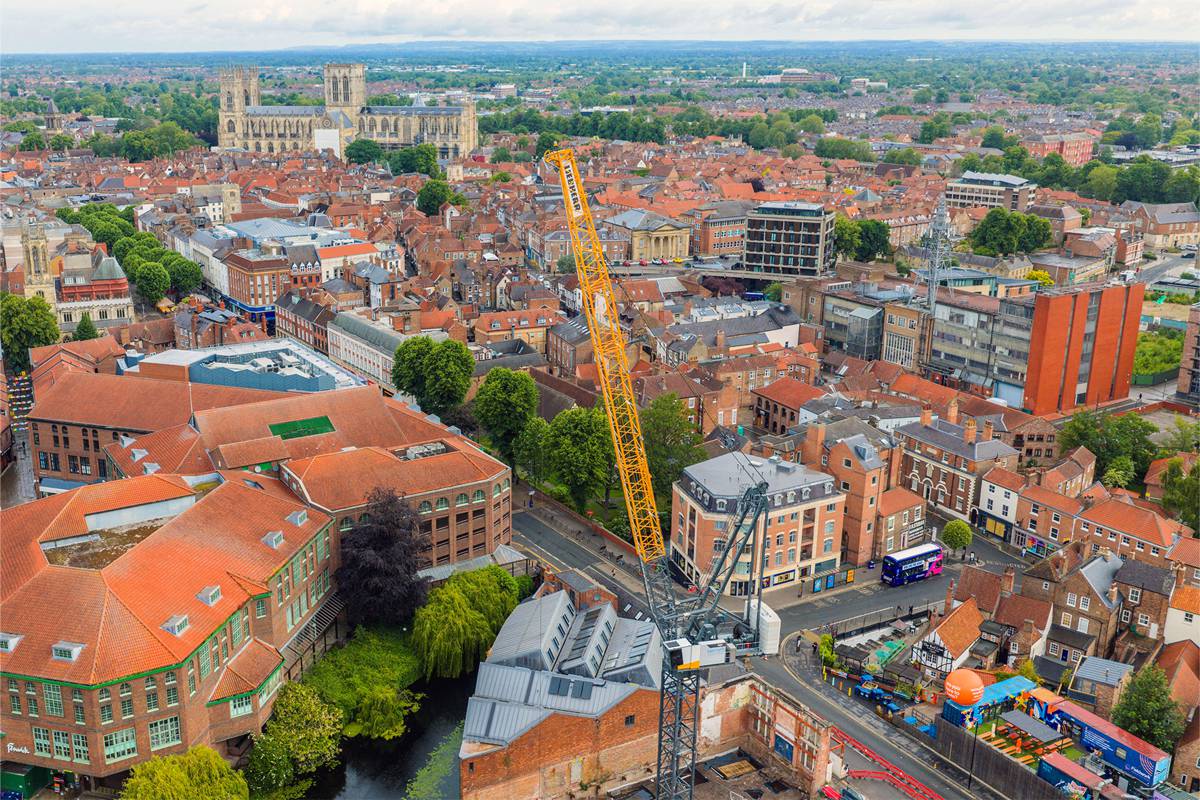
The arrival of the UK’s first Liebherr 620 HC-L luffing jib tower crane matters less for the machine itself than for the type of project it has been bought to serve. Bennetts Cranes has raised the crane on a tightly bounded plot inside York’s medieval walls, where a new hotel is being built on ground that ruled out most conventional lifting options.
The site cannot oversail its neighbours, the crane sits barely four metres from the building it is helping to construct, and the heaviest components are prefabricated panels weighing up to fourteen tonnes. That combination of heavy lifting inside a confined, heritage-bound footprint is becoming a defining challenge for British urban delivery, and it is precisely the problem the 620 HC-L was engineered to solve.
For the wider industry, the installation is a useful signal about where high-capacity tower crane demand is heading. Regeneration is increasingly concentrated on awkward city-centre infill sites hemmed in by existing buildings, conservation rules and restricted access, rather than on open greenfield plots where a saddle-jib crane can slew freely. Contractors working those sites need cranes that pair serious lifting power with a small out-of-service and working radius, so that airspace over adjacent properties is never crossed. Bennetts, one of the UK’s specialist tower crane hirers, has read that trend and moved early, and the York job is the first practical demonstration of the bet.
Briefing
- Bennetts Cranes has erected the UK’s first Liebherr 620 HC-L on a constrained development inside York’s historic city walls, the first of three units the firm ordered at Bauma 2025.
- Bennetts is the world’s first owner of the 620 HC-L series, positioning its high-capacity fleet for dense urban and regeneration work where oversailing neighbours is prohibited.
- The crane offers up to 36 tonnes of lifting capacity in two-fall operation alongside a minimum working radius of 4.1 metres, an unusual pairing of strength and compactness in the 600 metre-tonne class.
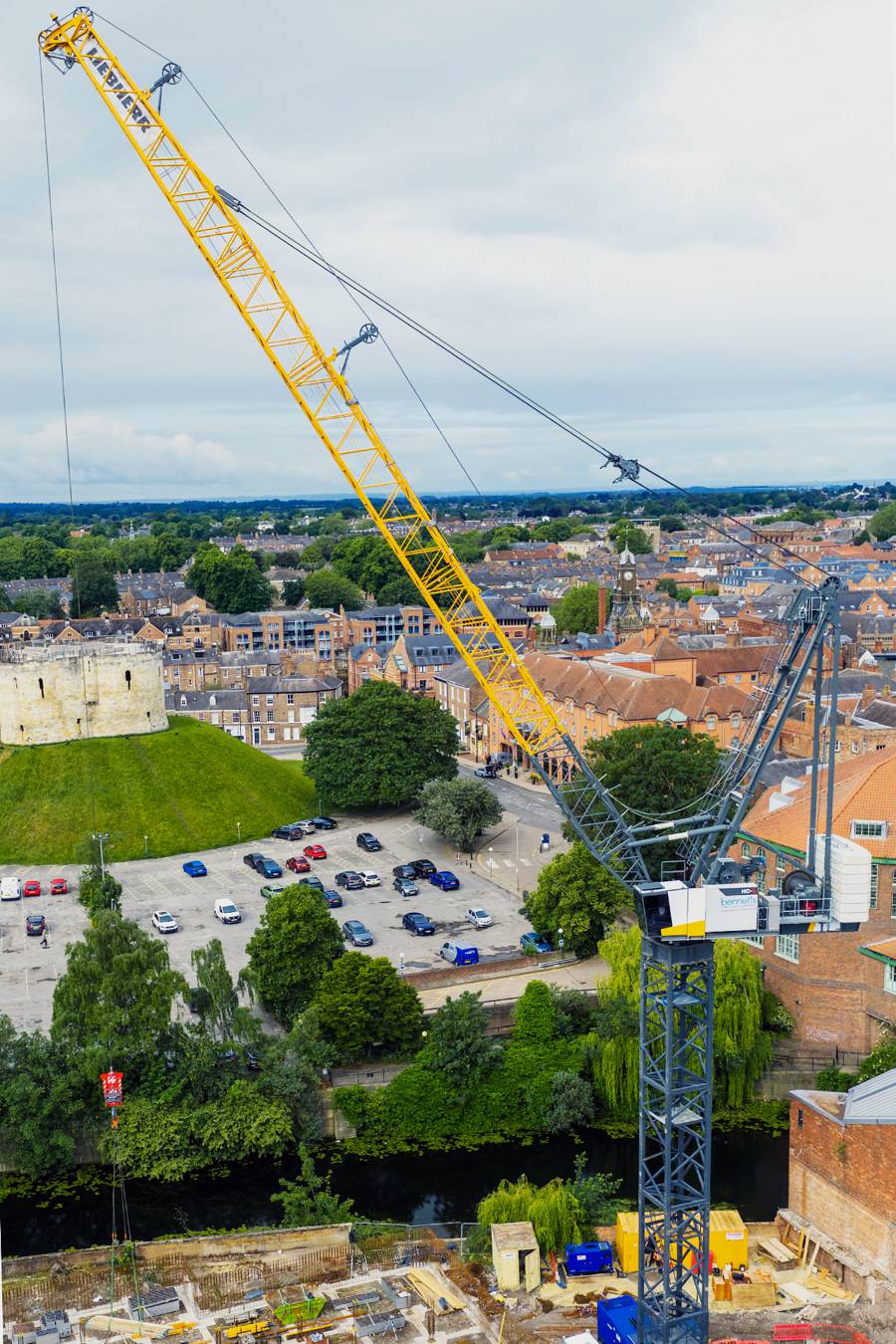
- At York it is configured with a 45-metre jib in single fall, parking at an out-of-service radius of 12.9 metres and handling panel lifts of up to 14 tonnes within a footprint only four metres from the structure.
- Intelligent power management lets the crane run on mains electricity where comparable models might require a diesel generator, a growing commercial and regulatory advantage on UK sites.
A Fleet Bet on Britain’s Most Difficult Sites
Bennetts confirmed the purchase of three 620 HC-L cranes at Bauma 2025 in Munich, becoming the first customer anywhere to take the model into service. That is a notable commercial position for a specialist hirer to occupy, because being first in the market with a new class of machine carries both risk and advantage. The risk is obvious in any early adoption of unproven equipment; the advantage is that Bennetts can now offer contractors a lifting solution that few competitors can match on the toughest inner-city plots, and can build operational familiarity ahead of the rest of the field.
Tracey Pockett, Director at Bennetts Cranes, framed the decision in fleet-strategy terms, noting that “Our investment in the Liebherr 620 HC-L reflects our commitment to expanding Bennetts’ high-capacity tower crane fleet with equipment that meets the demands of modern construction sites. The 620 HC-L gives customers the lifting power needed for complex projects, while helping them work safely and efficiently on sites where space is limited and oversailing must be carefully managed. It also supports more efficient installation and operation, making it a strong addition to our fleet.”
The commercial logic sits within a broader repositioning of the tower crane hire market. Gloucestershire-based Bennetts runs a multi-brand fleet and acts as the UK distributor for Raimondi, so the addition of a flagship Liebherr luffer at the top of its capacity range widens the spread of jobs it can quote for. High-capacity, compact cranes are difficult to source and command premium hire rates precisely because they unlock sites that would otherwise stall at the procurement stage.
By committing to three units rather than a single trial machine, Bennetts is signalling that it expects sustained demand from regeneration schemes, hotel and residential developers, and contractors working within conservation areas. The York project is the proof of concept, and the two further cranes give the firm the capacity to chase similar work without holding up its own pipeline.
Engineering Heavy Lifts Into a Tight Footprint
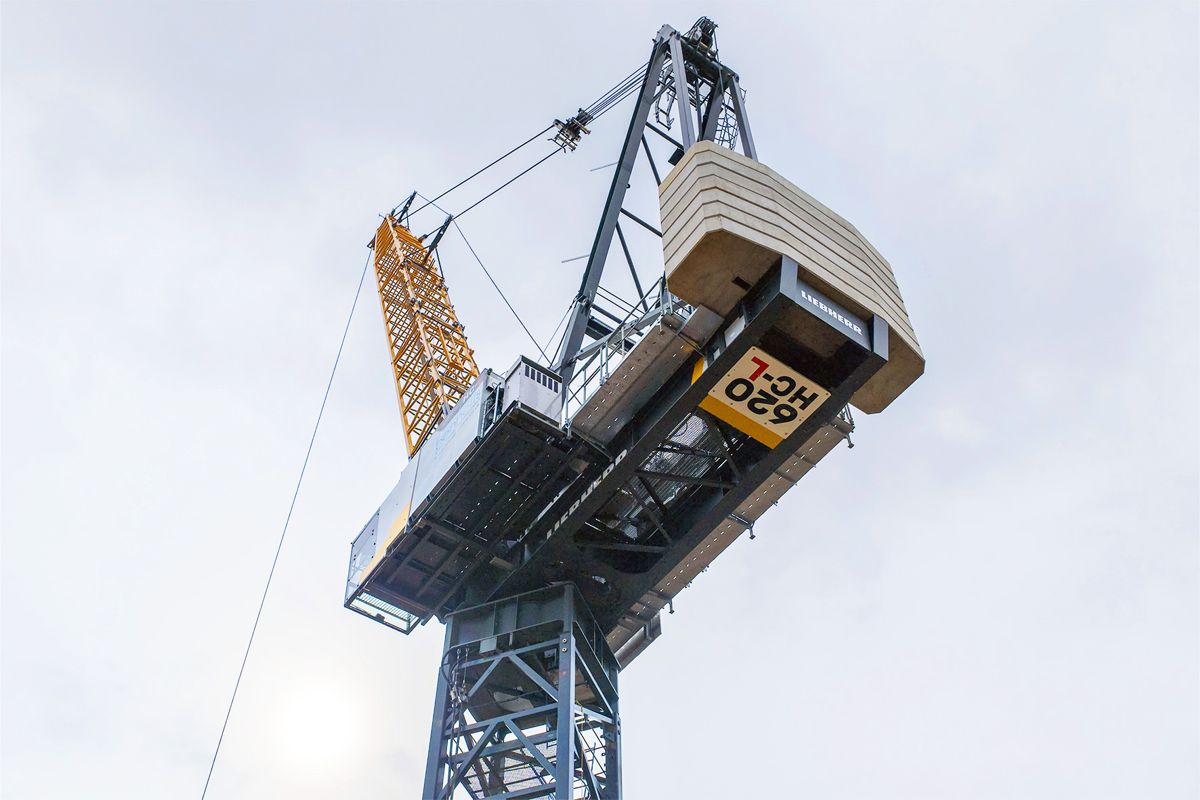
The technical appeal of the 620 HC-L lies in resolving a trade-off that has long constrained urban lifting. Cranes that lift heavy loads have traditionally needed room to work and to weathervane out of service, while cranes compact enough for tight sites have tended to sacrifice capacity. The 620 HC-L closes that gap by combining a maximum lifting capacity of up to 36 tonnes in two-fall operation with a minimum working radius of just 4.1 metres when rigged with its full 65-metre jib.
Liebherr’s Load-Plus function can lift capacity by as much as 76 per cent on specific load charts, which materially widens the range of components the crane can place without reconfiguration. For a site handling 14-tonne panels within a footprint four metres from the building edge, those figures translate directly into whether the job is buildable at all.
Equally important is what the crane does when it is not lifting. A luffing jib can raise its boom to shrink its radius, and the 620 HC-L is designed for an out-of-service position of around twelve metres, allowing it to sit close to a structure without slewing across neighbouring airspace. At York, Bennetts rigged the machine with a 45-metre jib in single fall, giving an out-of-service radius of 12.9 metres suited to the plot’s constraints.
The series is also the first Liebherr luffer to use aramid fibre guying, and it carries the manufacturer’s EMS-4 control system with the TC-OS operating platform, level-luffing for a horizontal load path, and the Micromove function for fine positioning. Those refinements are not cosmetic on a job of this kind, because placing heavy prefabricated units accurately in a confined space depends on smooth, controllable movement rather than raw power alone.
The York Plot and Why It Demanded This Crane
The development sits on the former Banana Warehouse furniture store, a long-vacant plot inside York’s historic walls that is being turned into a 168-room hotel, reported by Bennetts as a Marriott. Building within a walled cathedral city brings a stack of constraints that rarely appear together on open sites, from conservation controls and archaeological sensitivity to narrow access and the strict prohibition on oversailing adjacent flats and commercial buildings.
Working closely with Liebherr, Bennetts identified the 620 HC-L as the model best able to deliver the required capacity while keeping every part of its arc within the site boundary. The crane’s compact working and out-of-service radii were decisive, because they let contractors maximise the usable ground while respecting the airspace of everyone next door.
Access shaped the erection as much as the operation. The plot could only accommodate a mobile crane for the assembly, so lorries carrying the tower crane components were unloaded in a closed traffic lane directly outside the site rather than within it. Fast, predictable assembly therefore carried real value, and the 620 HC-L is built for it, with a pin-tower system and pre-installed rope reeving that cut on-site rigging time.
Pockett was clear that the manufacturer’s involvement extended beyond supply, observing that “Liebherr’s support throughout the process has been very good, from enquiry through to build, with their technicians on site during erection to provide familiarisation training to the Bennetts team.” On a job where the erection window and the surrounding street closures were both tightly managed, that hands-on support reduces the risk of delay at the most sensitive stage.
Mains Power and the Changing Economics of City Sites
One of the less visible features of the crane may prove among the most commercially significant. The 620 HC-L’s intelligent control system monitors available power and adjusts performance accordingly, which allows it to operate on mains electricity in situations where comparable cranes might need a diesel generator. That capability lands squarely in the middle of a shift in UK site economics.
Since April 2022, the construction sector has no longer been entitled to use rebated red diesel in non-road mobile machinery and mobile generators, removing a duty saving of 46.81 pence per litre and pushing operators onto standard-rate white diesel or cleaner alternatives. Running a crane from the grid rather than an on-site generator therefore cuts fuel cost, emissions and noise at the same time.
For city-centre and regeneration work the calculation is sharper still. Urban plots are the sites most exposed to air quality scrutiny, low-emission zone requirements and neighbours sensitive to generator noise, so a crane that can draw mains power removes a recurring source of cost and complaint across a build that may run for many months.
The wider policy backdrop reinforces the direction of travel, with red diesel identified by government as a substantial contributor to construction-sector carbon and nitrogen oxide emissions. Equipment that lowers operational carbon without sacrificing capability is increasingly a procurement criterion rather than a nice-to-have, and cranes are among the most visible and energy-hungry items on any site. On that measure the 620 HC-L is positioned to appeal well beyond York.
What the York Debut Signals for Urban Delivery
The first outing of a new crane is rarely a story in isolation, and this one reads best as an indicator of where investment and procurement are heading. British regeneration is moving deeper into constrained, heritage-sensitive infill, and the machines that unlock those plots command a premium precisely because they are scarce.
Bennetts’ decision to be first into the 620 HC-L, backed by an order for three units, is a calculated read of that demand curve, and the York installation shows the strategy working in practice on one of the hardest kinds of site a UK contractor can face. Owners and developers weighing similar schemes now have concrete evidence that heavy lifting and tight footprints need not be mutually exclusive.
The lesson for the wider ecosystem is that crane selection is becoming a project-enabling decision made far earlier in the programme. When a plot forbids oversailing and restricts access, the choice of lifting equipment can determine whether a scheme is viable, how its logistics are sequenced, and what it costs to run for the duration of the build.
Compact high-capacity luffers with mains-power capability answer several of those questions at once, which is why demand for them is likely to firm up as regeneration pipelines mature and decarbonisation pressure intensifies. For contractors, hirers and investors alike, the York job is a small installation carrying an outsized message about the direction of urban construction.
Key Industry Questions
- Why choose a luffing jib crane rather than a saddle or flat-top crane for a site like this? Luffing jib cranes can raise their boom to reduce their working and out-of-service radius, which is essential where oversailing neighbouring buildings is prohibited. Saddle and flat-top cranes keep a horizontal jib that sweeps a fixed arc, so on tightly bounded urban plots they would cross adjacent airspace when slewing or parked. On the York site, where the crane sits four metres from the structure and cannot oversail nearby flats and commercial buildings, a luffer is often the only compliant option. The trade-off historically was reduced capacity, but the 620 HC-L pairs that compact geometry with up to 36 tonnes of lift, which is why it suited a job handling 14-tonne panels in a confined footprint.
- What makes the 620 HC-L different from Liebherr’s existing luffing jib cranes? The 620 HC-L extends Liebherr’s luffing range into the 600 metre-tonne segment and sits above the 440 HC-L as its larger sibling, sharing the same tower system so contractors can reuse tower sections and avoid complex building tie-ins. It offers up to 36 tonnes in two-fall operation, a 65-metre jib, and a minimum working radius of 4.1 metres, along with the new Load-Plus function that raises capacity by up to 76 per cent on specific load charts. It is also the first Liebherr luffer to use aramid fibre guying and carries the EMS-4 control system with the TC-OS platform. The design emphasis is on combining higher capacity with faster assembly and a smaller footprint.
- How significant is Bennetts being the world’s first owner of the series? Being the first operator worldwide gives Bennetts an early foothold in a capability that is scarce in the UK market, letting it quote for constrained high-capacity jobs that many competitors cannot service. It also builds operational and maintenance familiarity ahead of the field, which matters when a hirer is renting out a premium machine on complex sites. Ordering three units rather than a single trial crane indicates genuine confidence in sustained demand rather than a one-off experiment. The commercial risk of early adoption is real, but the reward is a differentiated position in a segment where regeneration and infill work is growing.
- Why does the crane’s ability to run on mains power matter commercially? Since April 2022, UK construction has been unable to use rebated red diesel in non-road mobile machinery or mobile generators, which removed a duty saving of 46.81 pence per litre and raised the running cost of generator-powered equipment. A crane that can draw mains electricity avoids much of that cost while cutting emissions and noise over a build that may last months. On urban sites subject to air quality scrutiny and low-emission zone rules, grid power also reduces the risk of complaints and restrictions. As operational carbon becomes a procurement criterion, mains capability shifts from a convenience to a measurable financial and reputational advantage.
- What does the York configuration tell contractors about deploying the crane elsewhere? At York the crane runs a 45-metre jib in single fall, giving an out-of-service radius of 12.9 metres tuned to the plot, rather than its full 65-metre reach. That illustrates how the 620 HC-L can be rigged to match a site’s specific constraints instead of forcing the site to accommodate the crane. Contractors planning similar schemes can therefore treat jib length, fall configuration and parking radius as variables to optimise around access, oversailing limits and lift weights. The practical takeaway is that crane selection and configuration should be settled early, because they shape logistics, ground use and neighbour management across the whole programme.
- How does faster assembly translate into value on constrained sites? On plots with restricted access, erection time carries a premium because it often depends on temporary street closures, a single mobile crane and tightly booked delivery windows. The 620 HC-L’s pin-tower system and pre-installed rope reeving reduce the hours needed for on-site rigging, and Liebherr transports the crane in a limited number of units. At York, components were unloaded in a closed lane outside the boundary, so any reduction in assembly time lowers disruption to surrounding streets and shortens the most sensitive phase of the job. Faster, more predictable erection also reduces exposure to weather delays and the cost of holding a mobile crane and traffic management in place.
- What kinds of projects are most likely to require this class of crane in future? Regeneration and infill schemes within city centres, conservation areas and walled or heritage settings are the strongest candidates, particularly where heavy prefabricated or modular components must be placed with precision. Hotel, student accommodation and residential developments on brownfield plots frequently combine tight boundaries with substantial lift weights, which is the exact profile the 620 HC-L addresses. Sites bound by strict oversailing prohibitions and limited access will increasingly favour compact high-capacity luffers over conventional alternatives. As modern construction leans further into offsite manufacture and dense urban delivery, demand for cranes that reconcile power, compactness and low operational emissions is likely to grow.
Strategic Takeaways
- High-capacity, compact luffing jib cranes are becoming project-enabling assets for constrained urban and heritage sites, and early ownership of scarce models offers specialist hirers a defensible commercial edge.
- Crane selection and configuration should be treated as an early-stage procurement decision, because on oversailing-restricted plots they can determine whether a scheme is buildable and how its logistics and costs are shaped.
- Mains-power capability is shifting from convenience to competitive advantage as the loss of the red diesel rebate and tightening urban air quality rules raise the cost and reputational risk of generator-powered equipment.
- Faster, more predictable assembly has direct commercial value on access-restricted sites, where erection time is tied to street closures, single-crane logistics and narrow delivery windows.
- Bennetts’ three-unit commitment signals expected sustained demand from regeneration, hotel and residential developers working awkward infill plots, a useful demand indicator for equipment investors and manufacturers.