Real-Time Concrete Data is Rewriting the Economics of the Pour
The most expensive risk in concrete construction is rarely the one that makes headlines. Blow-outs, hidden voids and structural defects are real, yet they remain comparatively uncommon on well-run sites. The cost that quietly accumulates on almost every pour is the cost of not knowing. A wall is placed more slowly than the formwork could safely allow because lateral pressure cannot be seen.
Striking is delayed because strength cannot yet be confirmed. A crane waits, follow-on trades are pushed back, and plant and temporary works stay on hire for another shift. None of those decisions is wrong. Each is a rational response to working with a material that gains strength out of sight. Taken together across a full programme, they add up to a conservatism tax that the industry has long treated as the unavoidable price of building safely.
Formwork manufacturer PERI and its concrete-monitoring business VEMAVENTURI are making the case that this tax is now largely optional. The commercial proposition on offer is not really about instrumenting concrete for its own sake. It is about converting conservative margins into recovered programme time, released plant and freed capital, while generating a defensible record of exactly what happened inside the formwork.
That reframing is the point worth watching. It moves sensing out of the quality department and into the part of the business where contractors actually make or lose money, and it arrives just as the concrete itself is changing in ways that make the old rules of thumb harder to trust.
Briefing
- The dominant cost of uncertainty in concreting is not catastrophic failure but lost productivity, expressed through slower pours, delayed striking, idle cranes and extended equipment hire.
- VEMAVENTURI, a Swedish-founded business now part of the PERI Group, supplies sensors that measure fresh concrete quality, lateral formwork pressure, filling and compaction, and real-time strength development on a single digital platform.
- On the HS2 A46 Kenilworth Bypass box slide, Balfour Beatty VINCI used 24 PHONO sensors to verify placement of more than 800 cubic metres of self-compacting concrete in enclosed voids with no line of sight.
- Real-time strength monitoring based on the maturity method is becoming more valuable as lower-carbon mixes with high GGBS or fly ash content gain early strength more slowly and less predictably than traditional Portland cement.
- The same monitoring data doubles as a permanent audit trail, giving project teams objective evidence of pour conditions long after the concrete has cured and documentation requirements have tightened.

The Economics of Certainty Rather Than the Fear of Failure
The strongest way to read this development is through the balance sheet rather than the risk register. Contractors already know how to pour concrete safely, and the overwhelming majority of pours go well precisely because experienced teams build in generous margins. The difficulty is that those margins are invisible and uncosted. When a pour proceeds at half the rate the formwork could withstand, the lost hours never appear as a line item. When formwork stays in place a day longer than the structure required, the extended crane hire, the delayed trades and the slower cycle time are absorbed into the general friction of a project. Multiply that across a high-rise core climbing floor by floor, or across the repetitive pours of a major civils programme, and the cumulative drag on productivity becomes substantial even though no single decision looks costly in isolation.
VEMAVENTURI positions its sensing portfolio as the instrument that makes those hidden margins visible and therefore recoverable. Fresh concrete quality can be checked before placement, lateral pressure can be read during the pour so it can proceed at the optimal rate, and strength can be tracked as it develops so formwork is struck when the structure is genuinely ready rather than when the clock says it should be.
Aaron Lucid, global partnership and channel manager at VEMAVENTURI, frames the commercial logic directly. “Contractors naturally build in extra time and capacity to protect safety and quality,” he explained. “However, real-time concrete data eliminates the need for overly conservative margins. It allows them to fully leverage the engineering built into their formwork investment, unlocking major time and cost savings without ever compromising structural integrity.” The reference to formwork investment is the commercially telling part. Engineered formwork is a capital asset designed to specific pressure and cycling tolerances, and padding the safety margins means paying for engineering that is never fully used.
Why Decarbonisation Raises the Stakes for Striking Times
The timing of this push is not incidental. British concrete specification is shifting steadily away from neat Portland cement, classified as CEM I, towards the blended CEM II and CEM III cements that carry ground granulated blast-furnace slag or fly ash and cut embodied carbon significantly. Those replacements are the single most practical lever the sector has for decarbonising structural concrete, and GGBS in particular can displace a large share of Portland cement while reducing the global warming potential of a cubic metre of concrete by well over half.
The engineering trade-off is that these mixes tend to gain early strength more slowly and less predictably, especially in thinner sections, at lower cement contents and in colder weather. The Cementitious Slag Makers Association notes that concretes with GGBS levels above roughly half the binder will not always reach sufficient strength within a day to allow vertical formwork to be struck, which is precisely the point at which a decarbonisation decision starts to collide with the construction programme.
This is where evidence-based monitoring stops being a convenience and starts becoming an enabler of the low-carbon transition itself. Time-based striking rules were calibrated on a diet of CEM I concrete, and peer-reviewed work has flagged that established maturity functions can struggle to estimate the strength of high-slag mixes accurately. Real-time strength tracking answers that problem head on.
Sensors using the maturity method, codified in ASTM C1074 and its Nurse-Saul and Arrhenius models, calculate in-situ strength from the concrete’s actual temperature history rather than from a laboratory cube or an assumed curing curve. For a contractor being asked to hit both a carbon target and a cycle time, that capability resolves an otherwise awkward tension. It allows greener mixes to be adopted without automatically paying a programme penalty, because striking is governed by measured strength rather than by a cautious estimate padded to cover an unfamiliar material. Sustainability, productivity and the commercial case for sensing therefore converge on the same instrument.
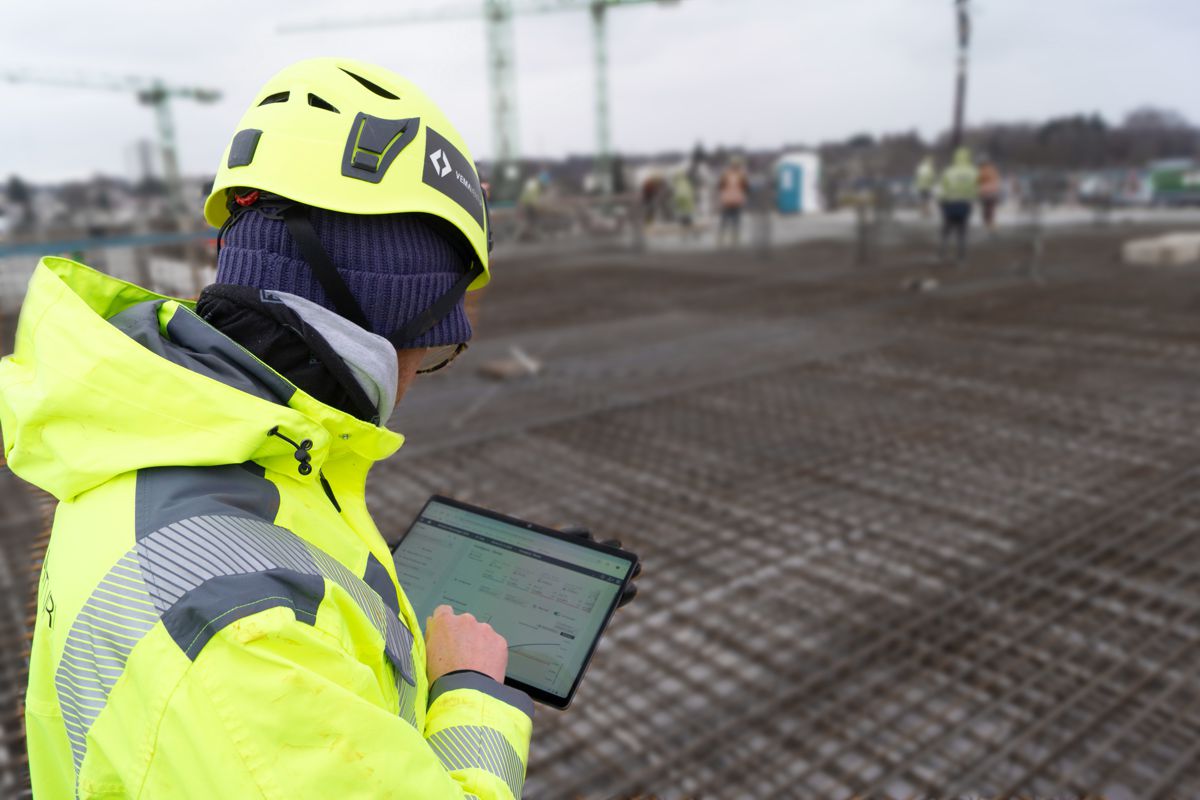
Proven on a Critical HS2 Operation
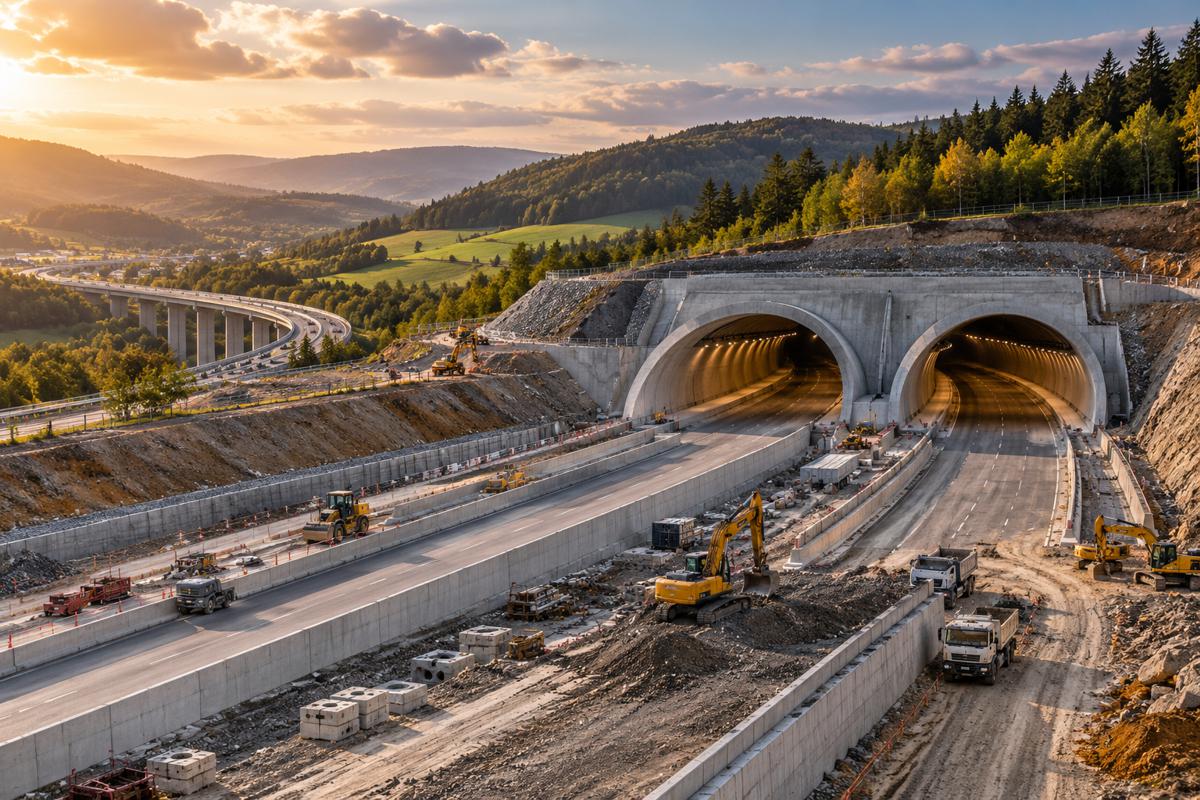
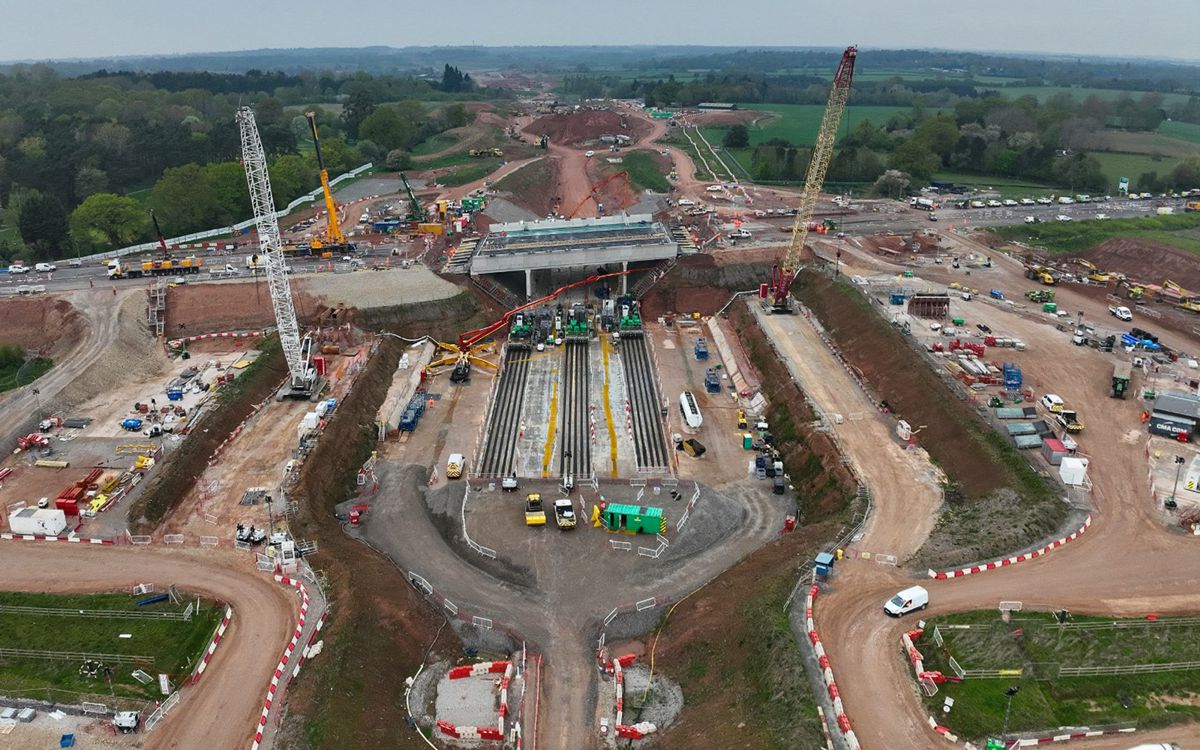
The clearest domestic demonstration comes from one of the country’s most scrutinised civils programmes. On HS2, Balfour Beatty VINCI installed the A46 Kenilworth Bypass box structure using a bridge slide that moved the 14,500-tonne concrete box, the heaviest of its kind in Europe, into position beneath the dual carriageway during an 18-day closure. The method allowed the box to be built off-line and jacked into place, sparing the route an estimated two years of lane closures and speed restrictions, and the road reopened around 30 hours ahead of schedule.
Once the box was seated, concrete infill was required on either side, and the design left tall enclosed voids with no direct line of sight, making it impossible to confirm visually whether every area had filled. The project team worked with PERI UK and VEMAVENTURI to deploy 24 PHONO sensors linked wirelessly to a cloud platform, giving live visibility of concrete movement through a three-day operation that placed more than 800 cubic metres of self-compacting concrete.
What that instrumentation delivered was less about speed and more about control of a condition the team could not otherwise observe. Live data let the crew confirm coverage, switch pump lines when needed and maintain the required rate of rise, while building a digital record to support quality assurance and compliance.
Maurice Dowling, works manager at Balfour Beatty VINCI, described the value in operational terms. “The PERI/VEMAVENTURI void sensors proved to be an invaluable addition to our quality assurance and control processes during the A46 bridge slide and associated pours,” he said. “They gave us the confidence, control, and traceability needed for a critical and complex operation.” On a programme where a hidden void discovered after curing would be enormously expensive to investigate and remediate, verified evidence of full filling during the pour is worth considerably more than the hardware that produced it.
When the Audit Trail Becomes a Balance-Sheet Asset
The second commercial thread running through this technology is documentation, and it is arguably the one with the longest tail. Construction is becoming more accountable at the same time as it becomes more complex, and information that once vanished the moment concrete was placed is increasingly expected to survive as part of the permanent project record.
Monitoring turns a pour into a dated, auditable data set that shows the conditions on site, explains why particular engineering decisions were taken, and preserves evidence that stands up long after the structure is in service. In a post-Grenfell environment where the golden thread of building information carries statutory weight, and where liability for workmanship can surface years into an asset’s life, that record has a value that is easy to underestimate at the point of pour and difficult to recreate afterwards.
International demand illustrates how quickly documentation can move from optional to expected. The companies point to strong uptake of VEMAVENTURI’s SONO Hub water-content system in South Korea, where a series of high-profile structural failures prompted tighter requirements around testing of fresh concrete and pushed contractors towards rapid digital measurement in place of slower manual sampling.
The PHONO system extends the same principle to the parts of a structure inspectors and engineers cannot see, confirming that concrete has reached difficult areas while monitoring vibration to reduce the risk of hidden voids and honeycombing. The commercial reading is that regulation tends to follow failure, and markets that have absorbed a costly lesson are already treating this class of data as a baseline requirement rather than a premium extra. Contractors operating internationally, or bidding for the most demanding domestic infrastructure, have an incentive to build the capability before a specification forces it on them.
Rethinking the Cost Question and the Procurement Model
A persistent objection is that monitoring is an expensive add-on, particularly in a market such as the United Kingdom where it is not yet mandated. That framing tends to compare the hardware cost against a baseline of zero rather than against the cost of the uncertainty it removes. Several of VEMAVENTURI’s solutions are designed to be reused across multiple pours and projects, so the sensing hardware is amortised over repeated cycles rather than consumed on a single job, which changes the economics materially for a contractor with a steady pipeline of repetitive structures.
Set against that modest, spreadable cost is the recurring expense of uncertainty itself, measured in programme time lost waiting for the confidence to proceed, plant and temporary works held on site because waiting is the safest option, and the far larger cost of discovering a quality defect only once the concrete has hardened.
The more strategic shift is in how the capability is procured. PERI’s argument is that sensing delivers most value when it is designed into the formwork solution from the start rather than retrofitted when a specific problem appears on site.
Matthew Binder, national product manager at PERI UK, is explicit about the difference. “Certainly, we can add VEMAVENTURI sensors into formwork at any time,” he said. “But the biggest benefits come when it’s considered alongside the formwork design from the outset. By combining engineered formwork with live monitoring data, we’re able to help contractors optimise the whole concreting operation, rather than just patching an individual problem. Ultimately, it’s about giving engineers greater confidence in the decisions they’re already making.”
For a formwork supplier, bundling engineered systems with the data that proves those systems are being used to their full capacity is a logical commercial move, and it points towards temporary works being sold increasingly as an integrated performance package rather than as hire equipment alone.
Where This Leaves Contractors and Asset Owners
The direction of travel is towards a more measurable construction site, and concrete is one of the last major processes to be brought fully into that world. These systems are not yet widely specified in the United Kingdom, but demand is building on exactly the projects where the economics are most compelling, namely major infrastructure and high-rise developments with repetitive pours, tight programmes, complex geometries and demanding documentation requirements.
On those jobs the case is straightforward. The technology replaces cautious assumptions with measured evidence, and it does so without displacing the judgement of the engineers and site teams who remain firmly in control of the process. It gives them a sharper instrument, not a substitute for expertise.
For contractors and asset owners weighing where to invest, the sensible posture is to treat real-time concrete data as an operational capability rather than a novelty, and to consider it early enough to influence formwork design and mix selection rather than late enough to be a patch. The convergence of three pressures, the drive to decarbonise mixes, the demand for auditable quality records, and the perennial hunt for faster cycle times and better plant utilisation, points in the same direction.
As concrete construction becomes steadily more measurable, the ability to replace assumption with evidence is shaping up to be one of the more valuable and quietly commercial advances available to the sector, and the contractors who internalise it first are likely to carry a durable advantage into their next generation of projects.
Key Industry Questions
- What is the real cost of uncertainty in concrete construction if it rarely causes failures? The cost mostly shows up as lost productivity rather than defects. Pours proceed more slowly than the formwork can safely allow because pressure is unseen, formwork is struck later than necessary because strength is unconfirmed, and cranes, labour and temporary works stay on site or on hire while teams wait for the confidence to move on. Individually these delays look minor, but across a repetitive high-rise core or a large civils programme they compound into significant schedule drag and higher equipment costs. Because none of it appears as a discrete line item, it is routinely absorbed as ordinary project friction, which is exactly why real-time monitoring can recover value that contractors did not realise they were spending.
- How does real-time monitoring let formwork be struck earlier without adding risk? Traditional striking decisions often rely on elapsed time and conservative assumptions about strength gain. Maturity-based sensors instead calculate in-situ concrete strength continuously from the pour’s actual temperature history, using validated models set out in ASTM C1074. That means formwork is released when measured strength confirms the structure is ready, rather than when a cautious time buffer expires. The result is earlier, evidence-based striking that shortens cycle times while keeping the safety decision anchored to real conditions rather than a rule of thumb. Because the strength data is site-specific and continuous, it also removes the lag and logistics of casting and breaking field-cured cubes.
- Why does low-carbon concrete make monitoring more important? Lower-carbon mixes replace much of the Portland cement with GGBS or fly ash, which cuts embodied carbon substantially but slows early strength development and makes it less predictable, particularly in thin sections and cold weather. Established time-based striking rules were calibrated on traditional CEM I concrete and can misjudge how these blended mixes behave. Real-time strength monitoring resolves that tension by governing striking with measured data, allowing contractors to adopt greener concrete without automatically accepting a programme penalty. As decarbonisation targets tighten and blended cements become the norm, this shifts monitoring from a convenience to a practical enabler of low-carbon delivery.
- What did the sensors actually achieve on the HS2 A46 project? On the A46 Kenilworth Bypass box slide, Balfour Beatty VINCI faced tall enclosed voids requiring concrete infill where no visual inspection was possible. Twenty-four PHONO sensors linked to a cloud platform gave live visibility of concrete movement as more than 800 cubic metres of self-compacting concrete were placed over three days. The team could confirm full coverage, switch pump lines when needed and maintain the required rate of rise. Beyond a smoother pour, the exercise produced verified evidence that the concrete had fully filled the required areas during a critical phase, plus a digital record supporting quality assurance and compliance on one of the country’s most scrutinised programmes.
- Is concrete monitoring too expensive for projects where it is not mandated? The perception of high cost usually compares the hardware against a baseline of zero rather than against the cost of the uncertainty it removes. Several VEMAVENTURI systems are designed to be reused across multiple pours and projects, so the hardware is amortised over many cycles rather than consumed on a single job, which is attractive for contractors with a steady pipeline of repetitive structures. Weighed against that spreadable cost is the recurring expense of uncertainty, including idle plant, delayed striking and the far larger cost of finding a defect after curing. On complex or repetitive work the value case often holds even without a regulatory mandate.
- How does monitoring data support quality assurance and liability protection? Every monitored pour becomes a dated, auditable record of the conditions inside the formwork, capturing filling, pressure, temperature and strength development. That evidence lets teams demonstrate why engineering decisions were made and prove that a structure was placed correctly, long after the concrete has cured. In jurisdictions where the golden thread of building information carries statutory weight, and where liability for workmanship can emerge years later, this record can prove as valuable as the operational benefit at the time of pour. It converts information that once disappeared with the concrete into a durable asset for compliance, dispute resolution and long-term asset management.
- Should sensors be retrofitted or designed into the formwork from the start? Sensors can be added to formwork at any point, and many contractors first engage when a specific site problem arises. The greater benefit comes from integrating monitoring with the formwork design from the outset, so the engineered system and the live data work together to optimise the whole concreting operation rather than patching an isolated issue. Designing sensing in early allows pressure, filling and strength data to inform pour rates, striking sequences and cycle planning across a project. It also points towards temporary works being procured as an integrated performance package rather than as hire equipment considered in isolation from the data that proves its capability.
- Will real-time concrete monitoring become standard practice in the UK? It is not yet widely specified domestically, but demand is growing fastest where the economics are strongest, on major infrastructure and high-rise developments with tight programmes, complex geometries and heavy documentation requirements. International experience suggests regulation often follows costly failures, and markets that have absorbed such lessons already treat this data as a baseline expectation. Combined with decarbonisation pressures and the drive for faster cycles and better plant utilisation, the trajectory points towards broader adoption over time. Contractors bidding for demanding infrastructure have an incentive to build the capability before a specification requires it, positioning monitoring as an emerging norm rather than a permanent niche.
Strategic Takeaways
- The commercial value of concrete sensing lies less in preventing rare failures and more in eliminating the invisible conservatism tax of slow pours, late striking and idle plant, which makes it a productivity and capital-efficiency tool rather than a pure quality measure.
- Decarbonisation and monitoring are becoming linked decisions, because higher-GGBS and fly-ash mixes gain early strength more slowly and less predictably, and real-time maturity data allows contractors to hit carbon targets without surrendering programme certainty.
- Monitoring data is emerging as a durable balance-sheet asset in its own right, providing an auditable quality record that protects against liability and satisfies tightening documentation requirements long after a structure enters service.
- The strongest returns come from designing sensing into formwork from the outset rather than retrofitting it to solve isolated problems, signalling a broader shift towards temporary works sold as integrated engineered-and-data packages.
- Adoption will concentrate first on complex, repetitive and heavily scrutinised infrastructure and high-rise projects, and international precedent suggests regulation tends to follow failure, giving early adopters a defensible advantage before wider specification catches up.