NEURA Robotics Brings Touch, Sound and Memory to Physical AI
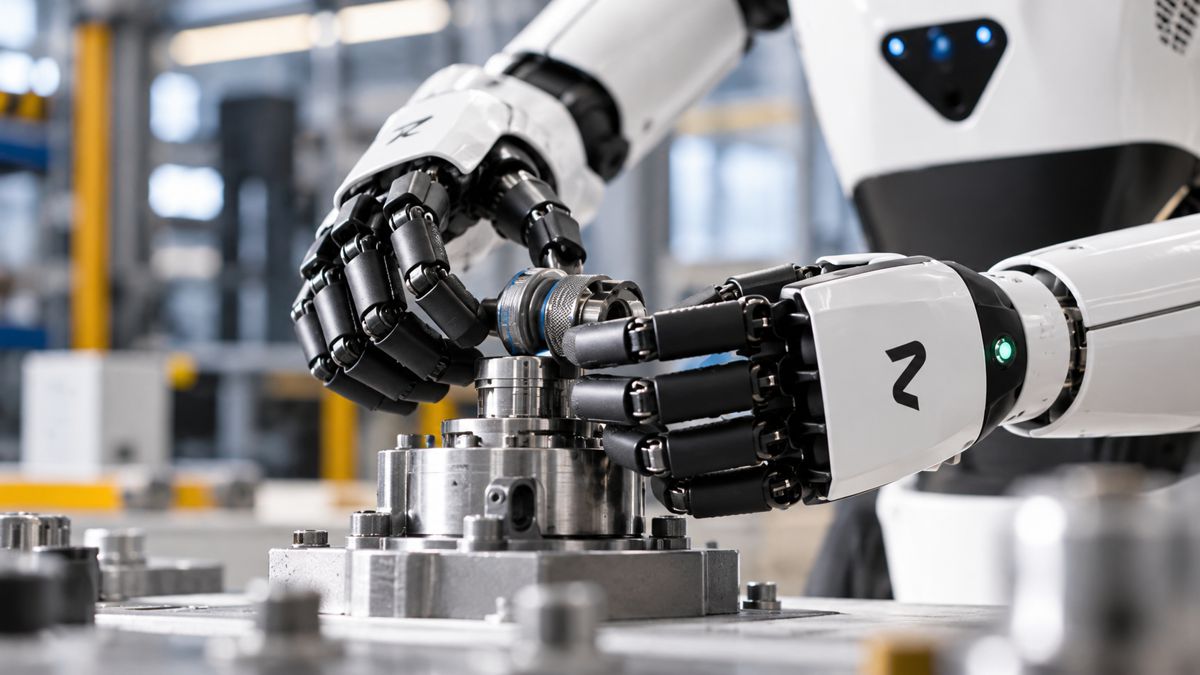
A robot can see a connector entering a socket without knowing whether it has locked into place. It can recognise an object but lose sight of it while carrying out an operation. These limitations are among the problems German developer NEURA Robotics is addressing with Neuron AI, a foundation model that combines vision, touch, sound, movement information and memory within a single robotic control system.
Developed at the company’s headquarters in Metzingen, Neuron AI uses what NEURA describes as a Perception-Language-Action (PLA) architecture. The model processes multiple forms of sensory information alongside the robot’s operating state and task instructions, allowing physical actions to be informed by both current conditions and previous interactions.
Industrial robots already combine cameras, force sensors and programmed control systems to perform demanding operations. The more ambitious proposition behind Neuron AI is to bring these capabilities into a shared learning architecture that can acquire skills through physical experience and potentially transfer them between different robotic platforms.
NEURA is developing the technology alongside its own robots, training facilities and fleet software, with the aim of reducing the engineering effort required to introduce new automated operations.
Briefing
- NEURA Robotics has introduced Neuron AI, a multimodal foundation model for physical robotics.
- Its PLA architecture combines 3D vision, touch, force, audio, robot state, language and memory.
- Training draws on real robot operations, simulated environments and human demonstrations.
- The model is intended to support five NEURA robot embodiments, with deployment and updates managed through Neuraverse.
- An eleven-minute autonomous laundry-handling demonstration is planned for NVIDIA GTC Berlin in October 2026.
Giving Robots More Than Vision
Machine vision has considerably extended the capabilities of industrial robots, enabling them to identify components, locate objects and respond to variations in positioning. Yet visual information alone cannot establish everything happening during a physical interaction.
A camera may show a robotic gripper closing around a component without confirming whether sufficient force has been applied. It may identify a connector entering a socket without establishing whether the locking mechanism has engaged. During assembly, an object can disappear behind another component while remaining essential to the next operation.
Neuron AI is designed to process these different forms of information together rather than treating each sensor as an isolated source. Its architecture combines three-dimensional visual information with tactile feedback, force measurements, audio, language instructions and data describing the robot’s own movement and configuration.
Tactile sensing provides information about contact, while force measurements help establish the loads being applied during an operation. Together, they can provide feedback that is difficult or impossible to obtain through vision alone.
The company gives the example of opening a lock, where sound and touch can help confirm that the mechanism has operated. Similar principles apply to grasping objects outside a camera’s field of view or monitoring a welding operation through acoustic information, although assessing weld quality requires more than sound alone.
In mechanical assembly, the resistance encountered while inserting a component may be as informative as its visible position. During fastening, contact and torque information can help determine whether a connection has been completed correctly.
“An intelligent robot needs a brain that brings its senses together and remembers what happened,” said David Reger, founder and CEO of NEURA Robotics. “With Neuron AI, we are building the brain of the physical world: Physical AI that turns human expertise and physical experience into capabilities robots can learn and apply. Developed in Germany, built for the world.”
Memory and Physical Interaction
One of Neuron AI’s central features is its ability to retain information about previous actions and objects that are no longer visible.
This becomes particularly important during operations involving several connected movements. A robot handling components must maintain an understanding of their locations and the consequences of earlier actions, even when its view changes or an object becomes obscured.
Consider a robot placing an item inside a container. Once the item disappears from view, the machine must retain information about its existence and location. If the next operation involves closing the container, moving it or retrieving the contents, the robot needs to act on that retained context.
Remembering where an object was last observed is only part of the problem. The robot must also account for what happened during the interaction. An item may have slipped, shifted position or failed to enter the container as intended. New sensory information needs to be reconciled with the system’s previous understanding of the task.
NEURA says it has adapted the model architecture to incorporate memory and is training it with dedicated datasets intended to develop this capability. The objective is to associate sensory observations with earlier interactions and subsequent physical actions, allowing the model to maintain context across a sequence of operations.
Physical environments introduce uncertainties that are less common in tightly controlled digital processes. Objects move unexpectedly, contact conditions vary and an apparently successful movement may produce a different result from the one intended. A robotic system operating across multiple stages must be able to respond to those differences without losing track of the wider operation.
Training Across Different Robot Platforms
Neuron AI draws on three complementary sources of training data: real-world robotic operations, simulation and human demonstrations.
The physical training takes place in NEURA Gyms and other operating environments, where robots generate synchronised visual, tactile, force, audio and movement data. These recordings provide information about how the machines interact with objects and respond to different physical conditions.
NEURA’s Data Amplifier and simulation tools extend that material by generating variations of tasks and environments. Simulation allows developers to explore conditions that would be expensive or time-consuming to reproduce physically, although differences between simulated and real-world behaviour remain an important consideration when transferring learned capabilities to actual machines.
The third source is human experience. People wearing sensor-equipped suits demonstrate physical tasks, allowing movement information and practical knowledge to be captured for use in the training process.
NEURA is combining these datasets to develop a shared foundation model across five robot embodiments, including configurations with different hands and grippers.
Training across different physical configurations is more complicated than teaching identical robots to repeat the same movement. A humanoid hand, a mechanical gripper and another manipulation system may all be capable of handling an object, but their joint arrangements, contact surfaces and movement constraints differ.
A common model must accommodate those mechanical differences while retaining useful knowledge about the underlying task. A grasping strategy, for example, may need to be expressed differently depending on the available end effector, even when the object and intended result remain unchanged.
The potential advantage is reduced duplication of training effort between robotic platforms. How effectively Neuron AI transfers skills between embodiments, and how much additional training each configuration requires, has not yet been established through published comparative performance data.
From Training Facilities to Industrial Fleets
NEURA is developing an infrastructure around its foundation model rather than treating the software as a standalone product.
Its NEURA Gyms provide controlled environments for collecting data, training robotic skills and benchmarking performance before deployment. Experience gathered through these facilities is intended to inform subsequent versions of the model.
The company’s Neuraverse platform provides the corresponding deployment environment, allowing capabilities to be distributed and updated across robotic fleets. Customers are also expected to be able to fine-tune the model for their own applications.
Under the proposed arrangement, an industrial customer could develop a specialised robotic skill based on its manufacturing processes and retain that capability privately. Alternatively, customers choosing to share skills or deployment information could contribute to future model development.
Neuron AI is also designed to perform inference locally on the robot, without requiring a continuous cloud connection. Local processing can reduce dependence on network availability and avoid the communication delays associated with sending sensor information to remote servers for interpretation. The actual responsiveness of the system will depend on its computing hardware, model implementation and operating conditions.
For industrial facilities, local inference also offers potential advantages in controlling where operational data is processed. It does not remove the need for cybersecurity, software management or appropriate safeguards when robotic capabilities are updated.
NEURA identifies Time-to-Skill as a central performance measure: the period required for a robot to learn a new operation and execute it reliably.
In conventional industrial automation, introducing a new operation can involve mechanical integration, programming, tooling, safety validation and commissioning. The programming component is only one part of the process, but reducing the effort needed to teach a robot a new task could make automation economically viable for a wider range of lower-volume operations.
The distinction between learning a task in a controlled training facility and performing it consistently in production remains substantial. Industrial deployment requires predictable cycle times, repeatability, recovery from faults and compatibility with established safety systems.
NEURA has not disclosed comparative Time-to-Skill figures or independently verified productivity improvements for Neuron AI. These measurements will be central to assessing whether its learning architecture can deliver practical advantages over established automation methods.
German Industrial Development
Neuron AI was developed and trained in-house in Metzingen, Germany, where NEURA combines robotic hardware, sensing technology, artificial intelligence and data infrastructure.
Founded in 2019, the company is pursuing an integrated approach in which robot design and software development inform one another. Its hardware platforms provide the physical environments in which the model can collect experience, while the model’s requirements influence the sensing and control systems incorporated into the machines.
NEURA also identifies industrial data partnerships involving Schaeffler and Bosch as part of its development environment.
Access to manufacturing expertise can be valuable when training robots for operations involving specialised components, tooling and established production processes. The quality and relevance of the resulting datasets are likely to influence how successfully the model can perform tasks beyond its original training environment.
The relationship between general-purpose robotic intelligence and application-specific engineering remains an important consideration. A broadly capable foundation model may reduce some programming requirements, but integration with machinery, production controls, safety equipment and site procedures will still require engineering work.
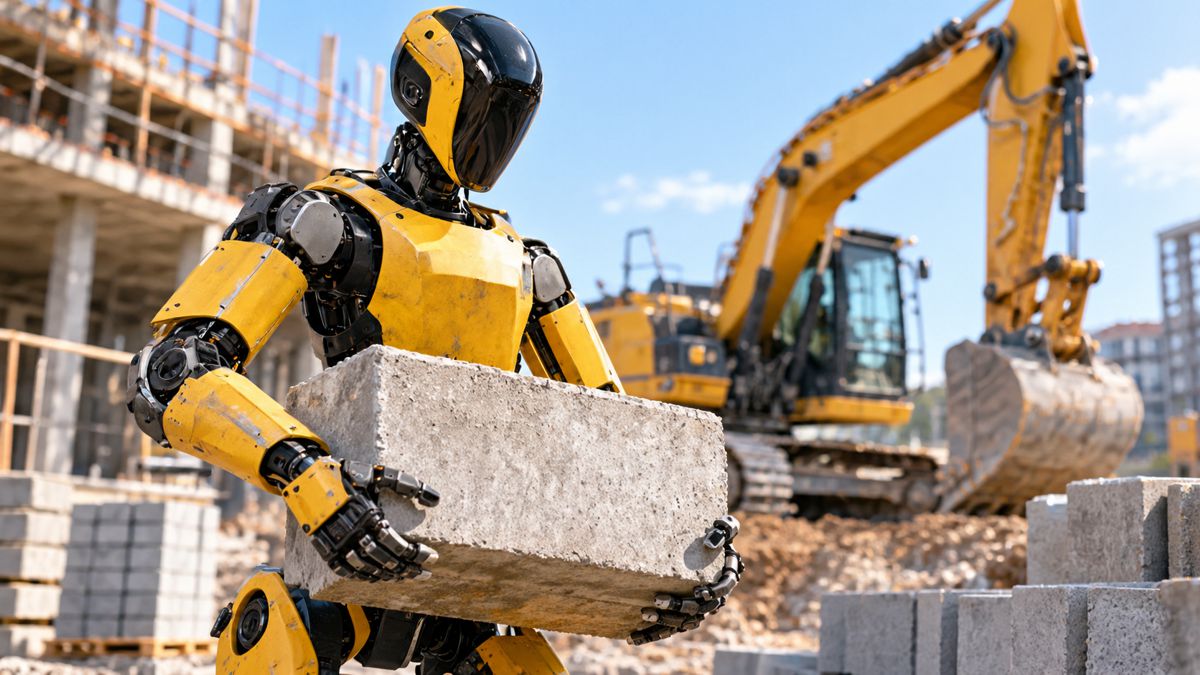
Construction presents an especially demanding environment for adaptable robotics. Materials are frequently irregular, operating conditions change and physical tasks may involve uncertain contact, limited visibility or variable positioning. Multisensory perception and persistent memory could support future applications in tool manipulation, mechanical assembly, maintenance and material handling, although NEURA has not announced a construction-specific deployment of Neuron AI.
Humanoid Demonstration at NVIDIA GTC Berlin
NEURA plans to demonstrate Neuron AI at NVIDIA GTC Berlin 2026, taking place at Station-Berlin from 20 to 22 October.
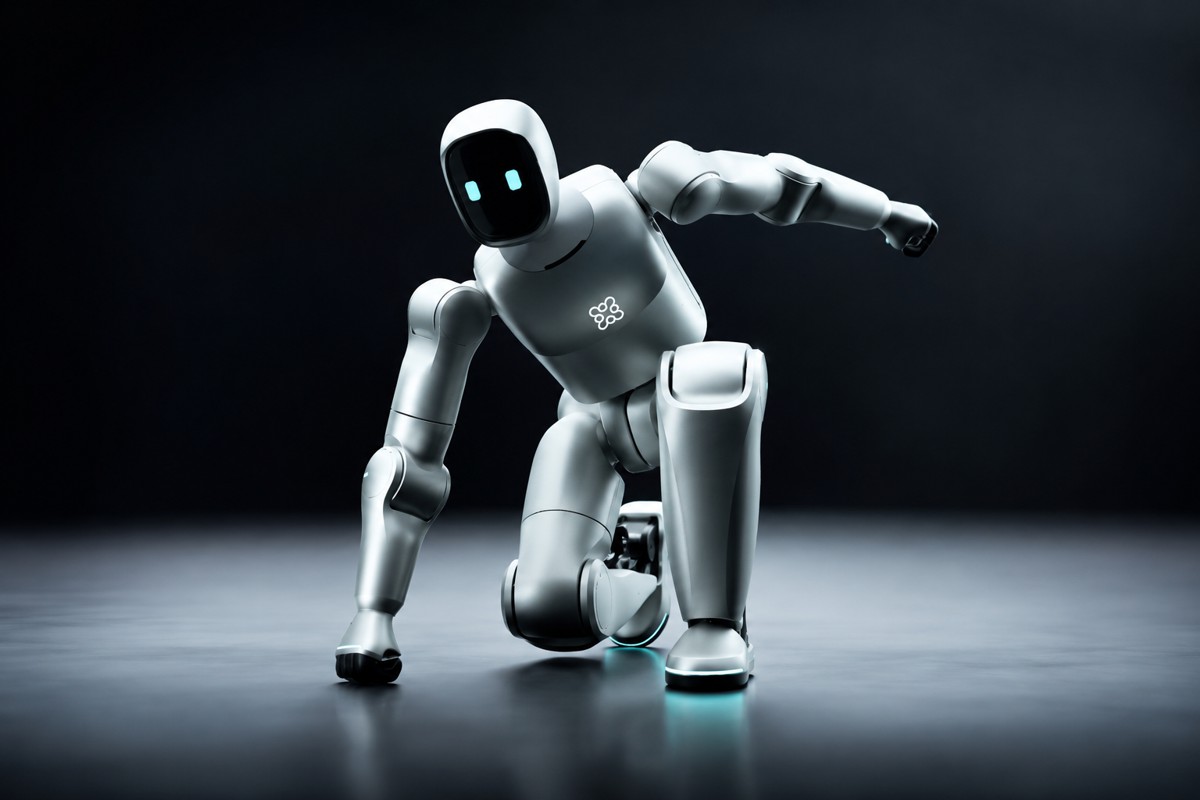
The demonstration will feature the company’s 4NE1 humanoid robot performing an eleven-minute laundry-handling sequence without human intervention. According to NEURA, the planned operation involves sorting laundry, loading a washing machine, closing and reopening it, unloading the contents and transferring them to a dryer.
Although domestic laundry is removed from most industrial applications, the sequence provides a useful demonstration environment for manipulating flexible materials and coordinating multiple physical operations.
Fabric changes shape during handling, may fold unpredictably and can obscure the position of individual items. Opening and closing machine doors also requires the robot to interact with mechanical components while maintaining an understanding of the wider task.
The demonstration is intended to show how the model combines perception, memory, planning and physical action across successive stages of an operation. Each movement must be coordinated with the next, while the robot retains information about objects and earlier interactions.
As of 15 October, the demonstration remains a scheduled event rather than an independently observed result. Its performance under the exhibition conditions will provide an opportunity to assess the technology, although sustained industrial reliability requires testing beyond a controlled demonstration.
NEURA identifies Hall 3, Booth 3031 at Station-Berlin as the demonstration location. Visitors should confirm exhibition access and demonstration times with the organiser.
The Economics of Adaptable Robotics
Traditional automation is highly effective where large production volumes justify specialised equipment and programming. More variable processes can be harder to automate economically, particularly when components, product configurations or operating conditions change frequently.
A robotic foundation model capable of retaining skills, incorporating new demonstrations and adapting to different hardware configurations could reduce some of the engineering effort involved in changing tasks. The commercial benefit would depend on training costs, hardware requirements, operating reliability and the extent to which capabilities can be reused.
NEURA’s combination of physical training facilities and fleet software also creates the possibility of improving deployed systems as additional operating experience becomes available. Such arrangements introduce practical questions around data ownership, software validation and the management of updates to machinery operating alongside people.
For manufacturers, the attraction is the prospect of using robotic systems across a wider range of processes without treating every new operation as an entirely separate automation project. The strongest applications may be those where tasks share underlying physical skills but differ sufficiently to make conventional programming expensive.
Teaching a robot to perform a movement is one problem. Teaching it to recognise whether that movement worked, remember the result and apply the experience to another task is considerably more demanding. Neuron AI brings those capabilities into a common architecture, with NEURA now facing the challenge of making them dependable across different machines and operating environments.
Key Industry Questions
- What is Neuron AI? Neuron AI is a multimodal foundation model developed by NEURA Robotics to combine sensory information, memory, language and physical actions in robotic systems.
- How does Neuron AI differ from conventional robotic control? It uses a shared learning architecture to combine multiple sensory inputs, previous interactions and task instructions. Conventional industrial robots can also use multiple sensors and retain task information, but often rely on more application-specific programming and control methods.
- What is Perception-Language-Action architecture? PLA is NEURA’s architecture for connecting sensory observations, language instructions and physical actions within a model that also incorporates previous interactions.
- Why does robotic memory matter? Memory allows a robot to retain information about objects and earlier actions when they are no longer directly observable, supporting multi-stage physical operations.
- How is Neuron AI trained? NEURA describes three training sources: real-world robotic operations, simulation-amplified data and human demonstrations captured using sensor-equipped suits.
- Can Neuron AI work with different robot designs? NEURA intends the model to support five robotic embodiments with different hands and grippers. Quantitative evidence of cross-platform skill transfer has not been provided in the announcement.
- Does Neuron AI require cloud connectivity? NEURA describes the model as capable of running inference locally on the robot, without requiring a continuous cloud connection for that processing.
- What is the Neuraverse platform? Neuraverse is NEURA’s software ecosystem for deploying, updating and fine-tuning robotic capabilities across fleets, with options for customers to retain or share developed skills.
- What is Time-to-Skill in robotics? Time-to-Skill describes how long a robot takes to acquire a new task and perform it reliably. NEURA identifies it as a measure of progress towards more adaptable automation.
- Is Neuron AI being used on construction sites? The announcement does not identify a construction-site deployment. The technology has potential relevance to robotic manipulation, material handling and other variable physical operations.
Strategic Takeaways
- Combining visual, tactile, force and acoustic information within a shared model could improve robotic performance in operations where individual sensors provide incomplete information.
- Persistent memory may help robots manage multi-stage tasks involving concealed objects, changing positions and uncertain physical interactions.
- Training across different robot embodiments could reduce duplicated development effort, although the effectiveness of skill transfer remains to be quantified.
- Local inference reduces dependence on cloud connectivity for robotic decision-making, while placing computing and software-management requirements on the deployed machine.
- Commercial adoption will depend on measurable improvements in task-learning time, operating reliability and integration costs rather than demonstration capability alone.