Reinforcement Learning Gains Stability Guarantees for Real-World Robotics
A robot can learn to follow a route remarkably well in simulation, yet struggle when the physical machine behaves differently from its digital model. Researchers at the University of Illinois Urbana-Champaign have developed a control method designed to address that uncertainty, combining reinforcement learning with mathematical stability guarantees.
The approach, known as Contraction-Aware Reinforcement Learning (CARL), was tested on wheeled, flying and six-legged robots. The researchers report improvements in tracking performance of up to 15% compared with existing methods, alongside mathematical bounds on tracking errors.
For construction and infrastructure robotics, the research is particularly interesting because machines must operate in environments where physical conditions rarely match the assumptions used during simulation. Uneven terrain, changing payloads, variable traction and mechanical uncertainty all complicate the transition from a trained controller to a working machine.
Briefing
- Researchers at the University of Illinois Urbana-Champaign developed Contraction-Aware Reinforcement Learning (CARL).
- The method combines reinforcement learning with contraction theory to establish mathematical stability guarantees.
- Experimental validation involved a wheeled TurboBot 3 Burger, a flapping aerial drone and a six-legged Jethexa robot.
- Tracking performance improved by up to 15% against comparison methods, according to the researchers.
- The research was published in IEEE Transactions on Robotics, with publicly available code.
Combining Learning with Control Theory
Reinforcement learning allows robotic systems to develop control strategies through experience, using feedback to improve their decisions. Rather than relying entirely on predefined instructions, a controller can learn how to achieve a desired objective through repeated interaction with a simulated or physical environment.
The difficulty is that successful learning does not automatically produce predictable behaviour. A controller may perform well during training but respond poorly when confronted with unfamiliar conditions, modelling errors or disturbances. In physical robotics, an unstable response can damage equipment or compromise the task being performed.
Minjae Cho, a doctoral researcher working with Huy Tran and Hiroyasu Tsukamoto in the university’s Department of Aerospace Engineering, set out to address this limitation.
“Reinforcement learning offers a promising way for robots to learn effective behavior, but it often lacks stability guarantees,” Cho explained. “Without confidence that a robot will remain stable, deploying it in practice is difficult. In a worst-case scenario, it could break and require costly repairs. So, guaranteeing stability of the robot as well as ensuring it can learn effective behavior is the key idea of this project.”
CARL incorporates principles from contraction theory, a mathematical framework used to analyse how the behaviour of a dynamic system evolves over time. In control applications, contraction-based methods can establish conditions under which differences between system trajectories diminish, helping provide assurances about stability and tracking behaviour.
By incorporating these principles into reinforcement learning, the researchers can establish mathematical bounds on tracking behaviour under defined conditions while allowing the learned controller to remain responsible for directing the robot.
These guarantees are mathematical properties established under the method’s stated assumptions. They should not be confused with a guarantee that a physical robot will remain safe under every possible operating condition.
Testing Across Three Robot Platforms
The researchers initially evaluated CARL in simulation before progressing to experiments at the university’s aerospace engineering flight laboratory.
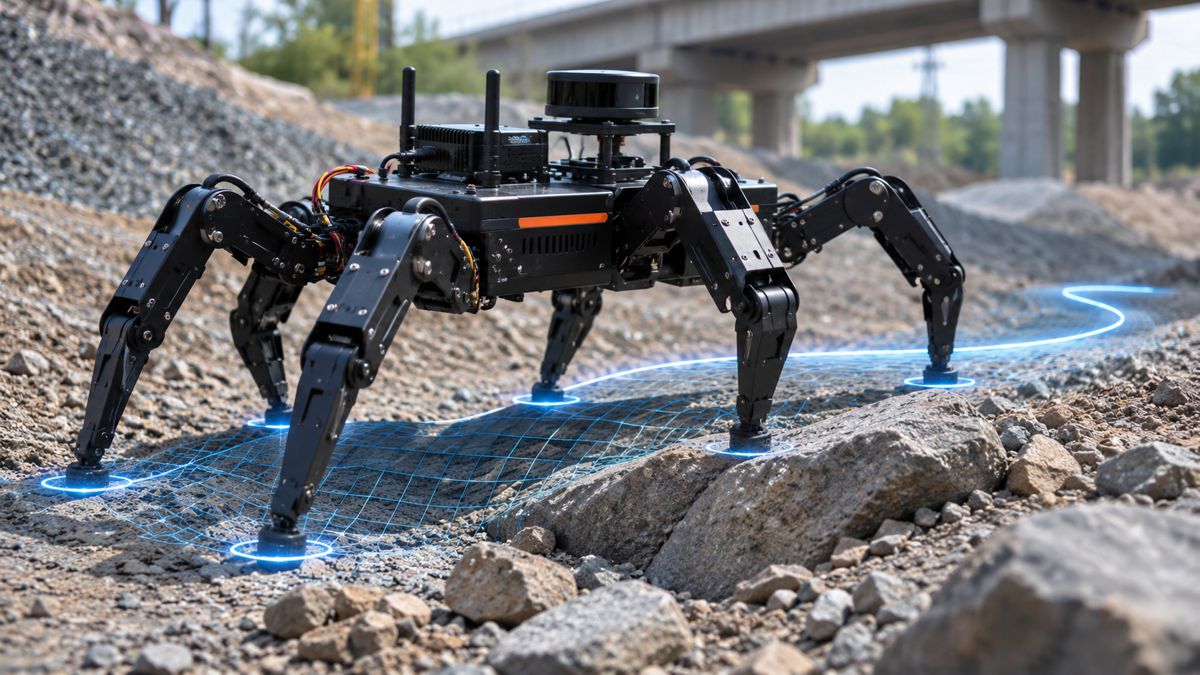
Testing involved three different robotic configurations: a wheeled TurboBot 3 Burger, a flapping aerial drone and a six-legged Jethexa robot. Each presents different control challenges, from maintaining a desired ground trajectory to managing aerial movement or coordinating multiple articulated legs.
Using different platforms allowed the researchers to examine whether the approach could operate across systems with substantially different dynamics rather than being optimised for a single robot.
One of the principal challenges was the difference between simulated models and physical machines. Known as the simulation-to-reality gap, this discrepancy arises because computer models cannot perfectly represent every mechanical characteristic or environmental influence.
“There is a difference between the model we train in the computer world to the physical robot in the real world. For example, a model in the simulator has a mass of 1 kilogram. In the real world, it may be 1.2 kilograms. This is called the sim-to-real gap, but our algorithm was shown to be better at handling those uncertainties.”
The researchers reported that CARL maintained its performance advantages when transferred to physical robots, achieving improvements of up to 15% in tracking performance against the methods used for comparison. This represents the upper end of the reported improvement, rather than a universal gain across every robot, task or operating condition.
Potential Applications in Construction and Infrastructure
Although the experimental programme did not involve construction machinery, the control problem addressed by CARL is relevant to autonomous equipment operating in changing physical environments.
An autonomous excavator, for example, must respond to changes in hydraulic loading as its bucket encounters different materials. A controller trained under idealised conditions may experience substantially different resistance when working through compacted soil, loose aggregate or rock. Similar uncertainties affect robotic inspection platforms travelling over uneven surfaces and aerial systems operating in changing wind conditions.
Learning-based controllers offer potential advantages in these applications because they can develop strategies for complicated systems without requiring every behaviour to be explicitly programmed. Industrial deployment, however, also requires predictable responses, appropriate safety mechanisms and confidence that a controller will remain within acceptable operating limits.
A method that combines learned control with mathematical bounds on tracking errors could contribute to that development. The Illinois experiments establish a research foundation, although further validation would be required before applying the method to heavy machinery or safety-critical infrastructure operations.
The research team has also identified wildfire management as a potential application. Robots could assist emergency responders by locating hotspots or transporting supplies into areas where human access is difficult, although these remain prospective uses rather than demonstrated CARL deployments.
From Laboratory Control to Industrial Deployment
Autonomous construction equipment already relies on combinations of sensors, positioning systems, machine-control algorithms and operational safeguards. Introducing reinforcement learning into these systems creates additional questions about verification, reliability and the conditions under which learned behaviour can be trusted.
CARL addresses part of that challenge by integrating stability analysis into the learning process itself. The reinforcement-learning controller remains responsible for controlling the robot, while the mathematical framework establishes bounds on its tracking behaviour under specified conditions.
Further testing on larger machines and under more demanding operating conditions will be needed before the approach can be considered for industrial equipment. For now, the researchers have demonstrated CARL on three distinct robotic platforms and made their implementation publicly available for further investigation.
The study, Contraction-Aware Reinforcement Learning for Nonlinear Control with Statistical Robustness, by Minjae Cho, Hiroyasu Tsukamoto and Huy T. Tran, was published in IEEE Transactions on Robotics. The researchers have also made the CARL source code publicly available on GitHub.
Key Industry Questions
- What is Contraction-Aware Reinforcement Learning? CARL is a robot-control method combining reinforcement learning with contraction theory to provide mathematical stability guarantees for tracking performance under specified assumptions.
- How does CARL differ from conventional reinforcement learning? Conventional reinforcement learning optimises behaviour through feedback but does not inherently guarantee stability. CARL incorporates principles from contraction theory to establish bounds on tracking behaviour.
- What performance improvement did researchers report? The University of Illinois researchers reported improvements of up to 15% in tracking performance compared with the methods used in their experiments.
- Which robots were used to test CARL? Experiments involved a wheeled TurboBot 3 Burger, a flapping aerial drone and a six-legged Jethexa robot.
- Could CARL be used in autonomous construction equipment? Potentially. Its approach to tracking control and uncertainty could be relevant to autonomous machinery, but the published experimental programme did not demonstrate operation on construction equipment.
- What is the simulation-to-reality gap? It describes differences between simulated systems and physical equipment, including variations in mass, mechanical behaviour, environmental conditions and other parameters that can affect controller performance.
- Does mathematical stability guarantee operational safety? No. Stability guarantees apply under defined mathematical assumptions. Industrial safety additionally requires consideration of equipment failures, environmental hazards, operating limits and independent protective systems.
- Is CARL publicly available? Yes. The researchers have published code on GitHub, allowing other researchers to examine and experiment with the method.
Strategic Takeaways
- Stability guarantees could help address a fundamental limitation of reinforcement learning in physical robotics.
- Testing across three different robot configurations provides evidence of applicability beyond a single machine architecture.
- Improved tolerance of modelling uncertainty could reduce some difficulties associated with transferring trained controllers from simulation to physical equipment.
- Industrial adoption would require additional testing under realistic operating conditions, particularly for heavy machinery and safety-critical applications.
- Open-source availability provides a route for independent evaluation, replication and further development.